ESP BMW X5 4.4I 2000 Owner's Guide
[x] Cancel search | Manufacturer: BMW, Model Year: 2000, Model line: X5 4.4I, Model: BMW X5 4.4I 2000Pages: 201, PDF Size: 1.93 MB
Page 137 of 201
IndexDataTechnologyRepairsCar careControlsOverview
137n
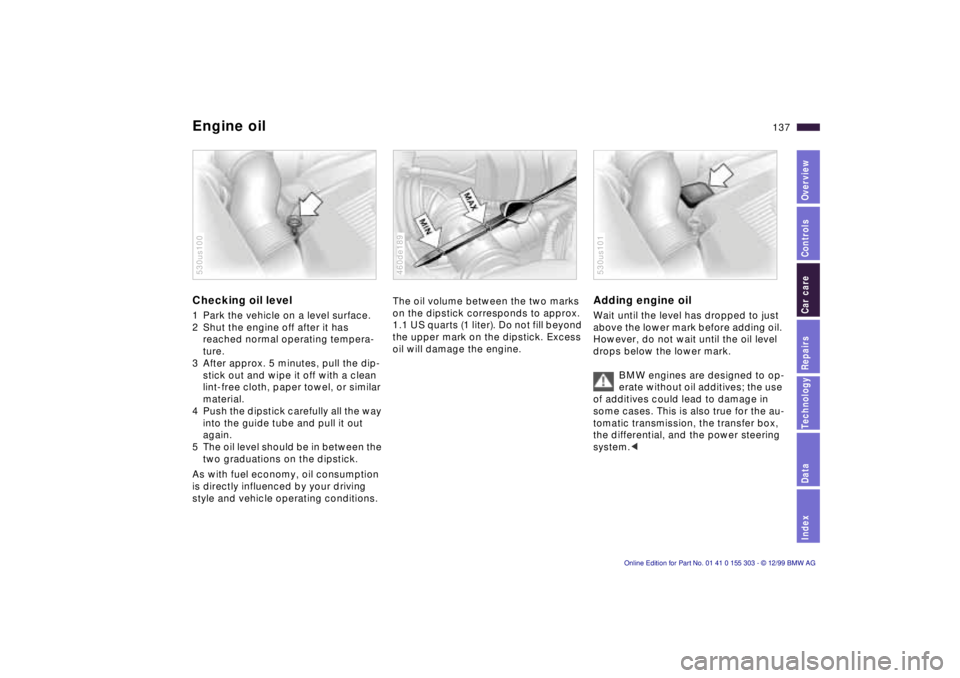
Engine oil Checking oil level 1 Park the vehicle on a level surface.
2 Shut the engine off after it has
reached normal operating tempera-
ture.
3 After approx. 5 minutes, pull the dip-
stick out and wipe it off with a clean
lint-free cloth, paper towel, or similar
material.
4 Push the dipstick carefully all the way
into the guide tube and pull it out
again.
5 The oil level should be in between the
two graduations on the dipstick.
As with fuel economy, oil consumption
is directly influenced by your driving
style and vehicle operating conditions. 530us100
The oil volume between the two marks
on the dipstick corresponds to approx.
1.1 US quarts (1 liter). Do not fill beyond
the upper mark on the dipstick. Excess
oil will damage the engine. 460de189
Adding engine oil Wait until the level has dropped to just
above the lower mark before adding oil.
However, do not wait until the oil level
drops below the lower mark.
BMW engines are designed to op-
erate without oil additives; the use
of additives could lead to damage in
some cases. This is also true for the au-
tomatic transmission, the transfer box,
the differential, and the power steering
system.< 530us101
Page 143 of 201

IndexDataTechnologyRepairsCar careControlsOverview
143n
Caring for your vehicle Washing your vehicle You can have your new BMW washed
in an automatic car wash. Car wash
systems that do not employ brushes
are preferable.
Wipe away tough dirt and loosen and
remove dead insects before washing
the vehicle.
To prevent spots, avoid washing when
the hood is still warm, or immediately
after and during exposure to strong
sunlight.
When using an automatic car wash, be
sure that:
>The car wash system is suited for the
dimensions of your vehicle.
Before washing the vehicle in a
car wash, fold in the exterior mir-
rors manually, otherwise they may be
damaged on account of the width of the
vehicle.<
>No damage will occur on vehicles
with attached body accessories (such
as spoilers or antennas). If you are
uncertain, consult the manager of the
car wash.
>The wheels and tires of your vehicle
cannot be damaged by the convey-
ance devices of the car wash system.
>The vehicle is cleaned with minimum
brush pressure, and that ample water
is available for washing and rinsing.
Vehicles with rain sensor
*:
Clean the windshield regularly. Wax
from automatic car washes or insects,
for example, can cause malfunctions in
the function of the rain sensor.
Turn the rain sensor off in auto-
matic car washes. If you do not,
damage may occur if the wipers switch
on unintentionally.<
Parts of the vehicle that are inaccessi-
ble to the automatic washer Ñ such as
door sills, door and hood edges, etc. Ñ
should be cleaned by hand.
In the winter months, it is especially
important to ensure that the vehicle is
washed on a regular basis. Large quan-
tities of dirt and road salt are difficult to
remove, and they also cause damage to
the vehicle.
If spray wands or high-pressure
washers are used, be sure to
maintain an adequate distance between
the spray source and the vehicle's sur-
face. Inadequate distance and exces-
sive pressure can damage or weaken
the finish, making it more susceptible to
subsequent attack. In addition, mois-
ture could penetrate to vehicle compo-
nents, leading to long-term damage.<
When cleaning the headlamps,
please observe the following:
>Do not clean by wiping with a dry
cloth. Never use abrasives or strong
solvents to clean the covers.
>Remove dirt and contamination (such
as insects) by soaking with BMW Car
Shampoo and then rinsing with plenty
of water.
>Always use a deicer spray to remove
accumulated ice and snow Ð never
use a scraper.<
After washing the vehicle, apply
the brakes briefly to dry them.
Braking efficiency might otherwise be
reduced by the moisture and the brake
rotors could also be corroded.<
Page 144 of 201

144n
Caring for your vehicle Exterior finish To provide effective corrosion protec-
tion, multilayer paintwork is applied at
the factory. Cataphoretic immersion
priming techniques are supplemented
using special body-cavity protectants,
with the application of specially-devel-
oped and extensively tested materials.
A layer of flexible PVC is first applied to
the undercarriage. Following this, a
comprehensive undercoating treat-
ment with a wax-based protectant is
applied.
Regular maintenance makes an impor-
tant contribution to maintaining the
safety and value of your vehicle.
Increasing awareness of the effects of
harmful environmental factors on vehi-
cle finishes have led paint and vehicle
manufacturers to initiate ongoing pro-
grams designed to further improve the
durability of their finishes. Despite this,
environmental factors that occur locally
or regionally can have negative effects
on the finish of your vehicle. These
should guide you in determining the fre-
quency and extent of your efforts to
maintain the vehicle finish. Depending upon material and type
of impact (perforation of paint layer),
physical stresses from sand, road salt,
gravel, etc., can cause corrosion to
start extending beneath the finish, start-
ing at the point of impact.
Road dirt, tar spots, dead insects, ani-
mal droppings (strong alkali effect) and
tree excretions (resins and pollen) all
contain substances capable of causing
damage when allowed to remain on the
finish of your vehicle for any period of
time (spots, etching, flaking, separation
in the top coat).
In industrial areas, deposits from fly
ash, lime, oil deposits, sulfur-dioxide in
precipitation (acid rain) and other envi-
ronmental pollutants will all damage the
surface of the vehicle unless adequate
protection is provided. In coastal regions, high levels of atmo-
spheric salt and humidity promote cor-
rosion.
In tropical zones, temperatures of over
105 7 (40 6) in the shade prevail, in
addition to heavy ultraviolet radiation
and high humidity. Under those condi-
tions, light paints can reach tempera-
tures up to 175 7 (80 6) and dark
paints up to 250 7 (120 6).
Page 145 of 201

IndexDataTechnologyRepairsCar careControlsOverview
145n
Caring for your vehicle Caring for the vehicle finish Regular washing is a preventive mea-
sure against long-term effects from
substances that are harmful to the vehi-
cle's finish, especially if you drive your
vehicle in areas with high levels of air
pollution or aggressive natural sub-
stances (tree resins, pollen).
Nevertheless, you should immediately
remove especially aggressive sub-
stances. Failure to do so can lead to
changes in the paint's chemical struc-
ture or to discoloration. Gasoline spilled
during refueling, oil, grease and brake
fluid should always be cleaned away
immediately, as should bird droppings
(finish damage).
Any contamination remaining on the
surface of the vehicle will be especially
conspicuous after washing. Use clean-
ing fluid or alcohol with a clean cloth or
cotton pad to remove these stains. Re-
move tar spots with tar remover. After
cleaning, the affected areas should be
waxed to ensure continued protection.
Waxing your vehicle Protect the finish using carnauba or
synthetic-based waxes only.
The best way to determine when the
finish needs to be waxed is by noting
when water stops beading on the sur-
face.
You can use a glass cleaner to remove
any wax or silicone that may have been
left on the windows during waxing.
Paint damageYou can touch up small areas of dam-
age with BMW spray paint or a BMW
touchup stick.
The color code of your vehicle is pro-
vided on a tag on the right-hand panel
under the hood and on the first page of
the Service and Warranty Information
Booklet.
Damage caused by flying stones,
scratches, etc., must be touched up
without delay to prevent rust from
forming.
If corrosion has started to form in an
area with paint damage, remove all rust
and clean the area. Then prime the area
with a BMW Primer Stick. Finally, apply
the finish coat. After a few days, polish
and protect the touched-in areas.
More extensive paint damage should
be professionally repaired in accor-
dance with the manufacturer's instruc-
tions. Your BMW center uses original
BMW finish materials in accordance
with factory repair procedures.
A full range of car-care products is
available from your BMW center.<
Page 146 of 201

146n
Caring for your vehicle Window care You can use window and glass cleaner
to clean inside window surfaces and
mirrors without smearing and streaking.
Never use polishing pastes or abrasive
(quartz) cleansers on mirror lenses.
Clean the wiper blades with soapy wa-
ter. The wiper blades should be re-
placed twice a year, before and after
the cold season.
Use only wiper blades that have
been approved by BMW.<
Caring for other vehicle
components and materials Light-alloy wheels should be treated
with alloy wheel cleaner, especially dur-
ing the winter months. However, do not
use aggressive products containing
acids, strong alkalis or abrasives. Do
not use steam cleaners operating at
temperatures above 140 7 (60 6).
Follow the manufacturer's instructions.
If your vehicle has chrome parts
* such
as window moldings, door handles or
other items, clean these parts carefully
with ample clean water, especially if
they have an accumulation of road salt.
Use chrome polish as an additional
treatment.
Plastic components, vinyl upholstery,
headliners, lamp lenses, the clear cover
of the instrument panel and compo-
nents with a sprayed dull black surface
can be cleaned with water (add plastic
cleaner as required). Do not allow mois-
ture to soak through the seats or head-
liner. Never use solvents such as lac-
quer thinner, heavy-duty grease
remover, fuels, etc. Rubber components should be cleaned
with water only; a rubber treatment or
silicone spray may also be applied.
The safety belts should be cleaned with
a mild soap and water solution without
being removed from the vehicle. Never
attempt chemical or dry cleaning, as
damage to the belt fabric could result.
After cleaning, never allow the inertia
reel to retract the belts until they are
completely dry. Dirty safety belts pre-
vent the inertia reel mechanism from re-
tracting the strap properly, and thus
constitute a safety hazard.
Heavily soiled floor carpets and mats
*
can be cleaned with an interior cleaner.
The floor mats can be removed from
the vehicle for cleaning.
Please use only a damp cloth to clean
wooden fascia panels and components.
Follow up by drying with a soft cloth.
A full range of car-care products is
available from your BMW center.<
Page 148 of 201
148n
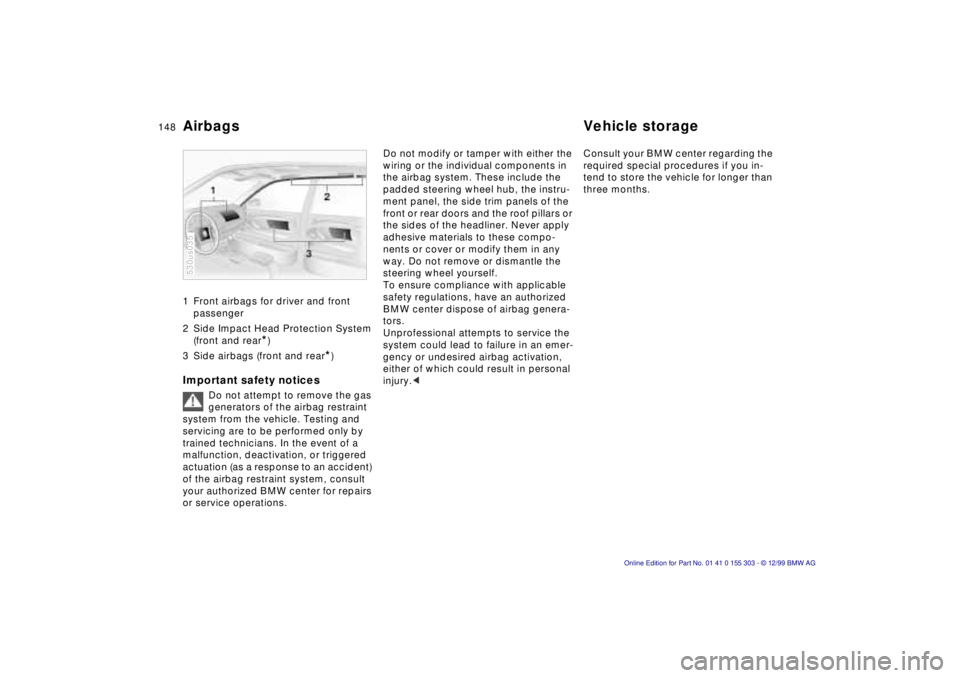
Airbags Vehicle storage 1 Front airbags for driver and front
passenger
2 Side Impact Head Protection System
(front and rear
*)
3 Side airbags (front and rear
*)
Important safety notices
Do not attempt to remove the gas
generators of the airbag restraint
system from the vehicle. Testing and
servicing are to be performed only by
trained technicians. In the event of a
malfunction, deactivation, or triggered
actuation (as a response to an accident)
of the airbag restraint system, consult
your authorized BMW center for repairs
or service operations.
530us035
Do not modify or tamper with either the
wiring or the individual components in
the airbag system. These include the
padded steering wheel hub, the instru-
ment panel, the side trim panels of the
front or rear doors and the roof pillars or
the sides of the headliner. Never apply
adhesive materials to these compo-
nents or cover or modify them in any
way. Do not remove or dismantle the
steering wheel yourself.
To ensure compliance with applicable
safety regulations, have an authorized
BMW center dispose of airbag genera-
tors.
Unprofessional attempts to service the
system could lead to failure in an emer-
gency or undesired airbag activation,
either of which could result in personal
injury.< Consult your BMW center regarding the
required special procedures if you in-
tend to store the vehicle for longer than
three months.
Page 150 of 201
150n
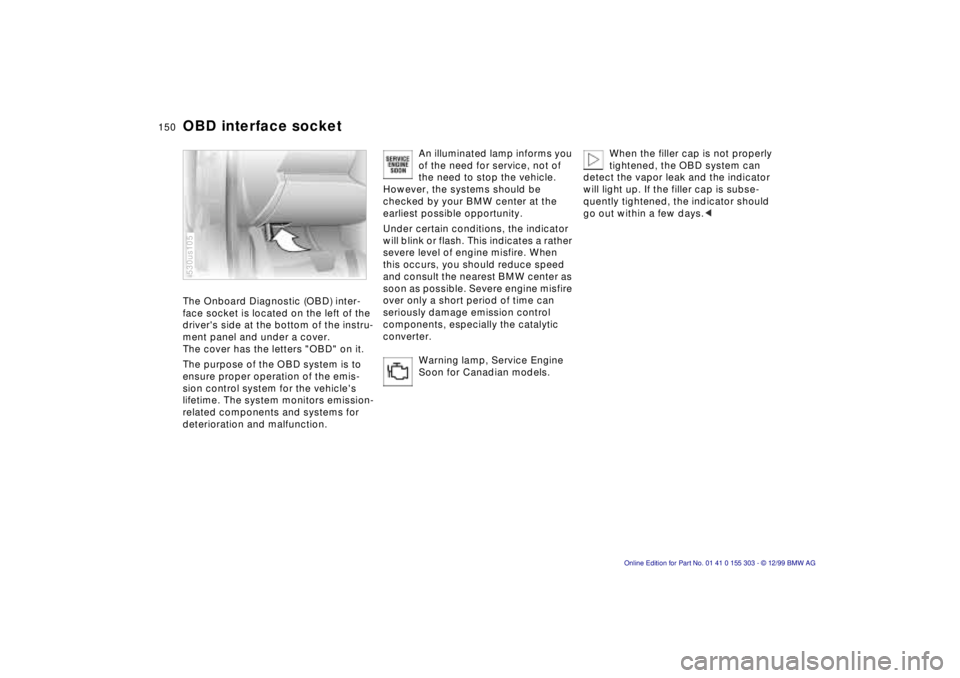
OBD interface socket The Onboard Diagnostic (OBD) inter-
face socket is located on the left of the
driver's side at the bottom of the instru-
ment panel and under a cover.
The cover has the letters "OBD" on it.
The purpose of the OBD system is to
ensure proper operation of the emis-
sion control system for the vehicle's
lifetime. The system monitors emission-
related components and systems for
deterioration and malfunction. 530us105
An illuminated lamp informs you
of the need for service, not of
the need to stop the vehicle.
However, the systems should be
checked by your BMW center at the
earliest possible opportunity.
Under certain conditions, the indicator
will blink or flash. This indicates a rather
severe level of engine misfire. When
this occurs, you should reduce speed
and consult the nearest BMW center as
soon as possible. Severe engine misfire
over only a short period of time can
seriously damage emission control
components, especially the catalytic
converter.
Warning lamp, Service Engine
Soon for Canadian models.
When the filler cap is not properly
tightened, the OBD system can
detect the vapor leak and the indicator
will light up. If the filler cap is subse-
quently tightened, the indicator should
go out within a few days.<
Page 165 of 201

IndexDataTechnologyRepairsCar careControlsOverview
165n
Battery Battery location The battery is located in the floor of the
vehicle below the spare wheel. Battery care The battery is maintenance-free, that is,
the original electrolyte will normally last
for the service life of the battery under
moderate climatic conditions.
For all questions that regard the
battery, please consult your BMW
center. Since the battery is mainte-
nance-free, the following is for your in-
formation only.<
Symbols You will find the following symbols on
your vehicle battery. To avoid injury,
please comply with the corresponding
precautions whenever you work with or
near the battery.
Before handling the battery,
please read the following infor-
mation:
Wear eye protection. Do not al-
low particles containing battery
acid or lead to come into con-
tact with your eyes, your skin, or your
clothing.
Battery acid is extremely corro-
sive. Wear eye protection and
protective gloves. Do not tip the
battery. Battery acid can leak from the
ventilation openings.
Do not allow children to have
access to batteries and battery
acid.
Never allow sparks or open
flame near the battery. Do not
smoke in the vicinity of the bat-
tery. Avoid sparks from electrical cables
or electrical equipment. Turn the key to
position 0 in the steering lock when you
are disconnecting or connecting the
battery. Never short-circuit the battery
terminals. This creates a risk of injury
from high-energy sparks.
A highly-explosive gas is
generated when the battery is
charged.
If you happen to get acid in your
eyes, rinse thoroughly for
15 minutes with clear water.
Following that, consult a physician im-
mediately. If you get acid spray on your
skin or clothing, rinse with plenty of wa-
ter. If electrolyte is accidentally swal-
lowed, consult a physician immediately.
In order to protect the battery
case from ultraviolet radiation,
do not place it in direct sunlight.
A discharged battery can freeze. Store
the battery in areas where temperature
remains above freezing.
Page 166 of 201

166n
Battery Charging the battery Charge the battery in the vehicle only
when the engine is not running. Use the
connections provided in the engine
compartment (for correct connections,
refer to "Jump-starting" on page 170).
The service life specified for the
battery can be achieved only if it
is always kept adequately charged.
Have the charge condition of the bat-
tery checked frequently if the vehicle
is used primarily for driving short
distances.<
Before performing any work on
the electrical system, disconnect
the cable from the negative terminal. If
you do not, short circuits can create the
risk of fire or personal injury.<
If you plan to park the vehicle longer
than 4 weeks, have the battery discon-
nected from the vehicle's electrical
system by disconnecting the cable from
the negative terminal. Then have the
battery charged with an appropriate
battery charger.
If the vehicle will not be driven for a
period longer than 12 weeks, have the
battery removed, charged and store it
in a clean and cool (frost-free) area.
Recharge the battery at least every
three months during storage. Also,
recharge the battery before it is in-
stalled. If you fail to do so, it will not be
serviceable. Every time the battery is
discharged, especially over extended
periods, its service life is reduced. Do not disconnect the battery
when the engine is running. If
you do so, the ensuing voltage surge
will damage the vehicle's onboard elec-
tronics.
Do not make any modifications in the
wires to the positive terminal. If you do
so, the protective function of the safety
battery terminal is no longer ensured.
Repair and disposal must be performed
by trained technicians only.<
Return used batteries to a recy-
cling point or your authorized
BMW center. Maintain the battery in an
upright position for transport and stor-
age. Secure the battery against tilting in
transit.<
Page 167 of 201
IndexDataTechnologyRepairsCar careControlsOverview
167n
Fuses When an electrical accessory fails to
operate, switch it off and inspect the
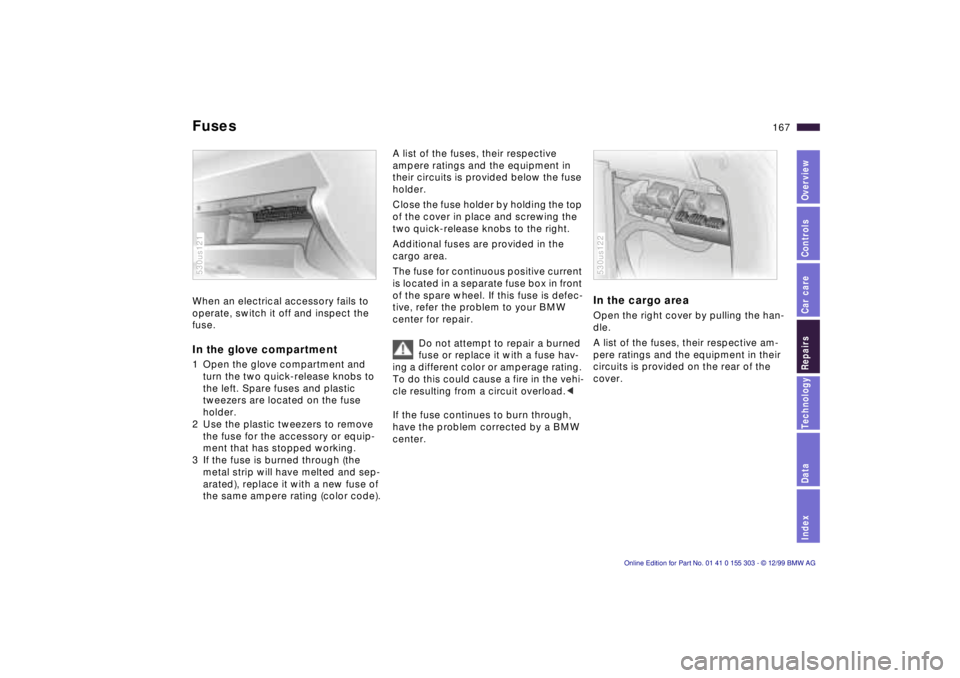
fuse. In the glove compartment 1 Open the glove compartment and
turn the two quick-release knobs to
the left. Spare fuses and plastic
tweezers are located on the fuse
holder.
2 Use the plastic tweezers to remove
the fuse for the accessory or equip-
ment that has stopped working.
3 If the fuse is burned through (the
metal strip will have melted and sep-
arated), replace it with a new fuse of
the same ampere rating (color code). 530us121
A list of the fuses, their respective
ampere ratings and the equipment in
their circuits is provided below the fuse
holder.
Close the fuse holder by holding the top
of the cover in place and screwing the
two quick-release knobs to the right.
Additional fuses are provided in the
cargo area.
The fuse for continuous positive current
is located in a separate fuse box in front
of the spare wheel. If this fuse is defec-
tive, refer the problem to your BMW
center for repair.
Do not attempt to repair a burned
fuse or replace it with a fuse hav-
ing a different color or amperage rating.
To do this could cause a fire in the vehi-
cle resulting from a circuit overload.<
If the fuse continues to burn through,
have the problem corrected by a BMW
center.
In the cargo area Open the right cover by pulling the han-
dle.
A list of the fuses, their respective am-
pere ratings and the equipment in their
circuits is provided on the rear of the
cover. 530us122