wheel BMW X5 4.4I 2000 Service Manual
[x] Cancel search | Manufacturer: BMW, Model Year: 2000, Model line: X5 4.4I, Model: BMW X5 4.4I 2000Pages: 201, PDF Size: 1.93 MB
Page 143 of 201

IndexDataTechnologyRepairsCar careControlsOverview
143n
Caring for your vehicle Washing your vehicle You can have your new BMW washed
in an automatic car wash. Car wash
systems that do not employ brushes
are preferable.
Wipe away tough dirt and loosen and
remove dead insects before washing
the vehicle.
To prevent spots, avoid washing when
the hood is still warm, or immediately
after and during exposure to strong
sunlight.
When using an automatic car wash, be
sure that:
>The car wash system is suited for the
dimensions of your vehicle.
Before washing the vehicle in a
car wash, fold in the exterior mir-
rors manually, otherwise they may be
damaged on account of the width of the
vehicle.<
>No damage will occur on vehicles
with attached body accessories (such
as spoilers or antennas). If you are
uncertain, consult the manager of the
car wash.
>The wheels and tires of your vehicle
cannot be damaged by the convey-
ance devices of the car wash system.
>The vehicle is cleaned with minimum
brush pressure, and that ample water
is available for washing and rinsing.
Vehicles with rain sensor
*:
Clean the windshield regularly. Wax
from automatic car washes or insects,
for example, can cause malfunctions in
the function of the rain sensor.
Turn the rain sensor off in auto-
matic car washes. If you do not,
damage may occur if the wipers switch
on unintentionally.<
Parts of the vehicle that are inaccessi-
ble to the automatic washer Ñ such as
door sills, door and hood edges, etc. Ñ
should be cleaned by hand.
In the winter months, it is especially
important to ensure that the vehicle is
washed on a regular basis. Large quan-
tities of dirt and road salt are difficult to
remove, and they also cause damage to
the vehicle.
If spray wands or high-pressure
washers are used, be sure to
maintain an adequate distance between
the spray source and the vehicle's sur-
face. Inadequate distance and exces-
sive pressure can damage or weaken
the finish, making it more susceptible to
subsequent attack. In addition, mois-
ture could penetrate to vehicle compo-
nents, leading to long-term damage.<
When cleaning the headlamps,
please observe the following:
>Do not clean by wiping with a dry
cloth. Never use abrasives or strong
solvents to clean the covers.
>Remove dirt and contamination (such
as insects) by soaking with BMW Car
Shampoo and then rinsing with plenty
of water.
>Always use a deicer spray to remove
accumulated ice and snow Ð never
use a scraper.<
After washing the vehicle, apply
the brakes briefly to dry them.
Braking efficiency might otherwise be
reduced by the moisture and the brake
rotors could also be corroded.<
Page 146 of 201

146n
Caring for your vehicle Window care You can use window and glass cleaner
to clean inside window surfaces and
mirrors without smearing and streaking.
Never use polishing pastes or abrasive
(quartz) cleansers on mirror lenses.
Clean the wiper blades with soapy wa-
ter. The wiper blades should be re-
placed twice a year, before and after
the cold season.
Use only wiper blades that have
been approved by BMW.<
Caring for other vehicle
components and materials Light-alloy wheels should be treated
with alloy wheel cleaner, especially dur-
ing the winter months. However, do not
use aggressive products containing
acids, strong alkalis or abrasives. Do
not use steam cleaners operating at
temperatures above 140 7 (60 6).
Follow the manufacturer's instructions.
If your vehicle has chrome parts
* such
as window moldings, door handles or
other items, clean these parts carefully
with ample clean water, especially if
they have an accumulation of road salt.
Use chrome polish as an additional
treatment.
Plastic components, vinyl upholstery,
headliners, lamp lenses, the clear cover
of the instrument panel and compo-
nents with a sprayed dull black surface
can be cleaned with water (add plastic
cleaner as required). Do not allow mois-
ture to soak through the seats or head-
liner. Never use solvents such as lac-
quer thinner, heavy-duty grease
remover, fuels, etc. Rubber components should be cleaned
with water only; a rubber treatment or
silicone spray may also be applied.
The safety belts should be cleaned with
a mild soap and water solution without
being removed from the vehicle. Never
attempt chemical or dry cleaning, as
damage to the belt fabric could result.
After cleaning, never allow the inertia
reel to retract the belts until they are
completely dry. Dirty safety belts pre-
vent the inertia reel mechanism from re-
tracting the strap properly, and thus
constitute a safety hazard.
Heavily soiled floor carpets and mats
*
can be cleaned with an interior cleaner.
The floor mats can be removed from
the vehicle for cleaning.
Please use only a damp cloth to clean
wooden fascia panels and components.
Follow up by drying with a soft cloth.
A full range of car-care products is
available from your BMW center.<
Page 148 of 201
148n
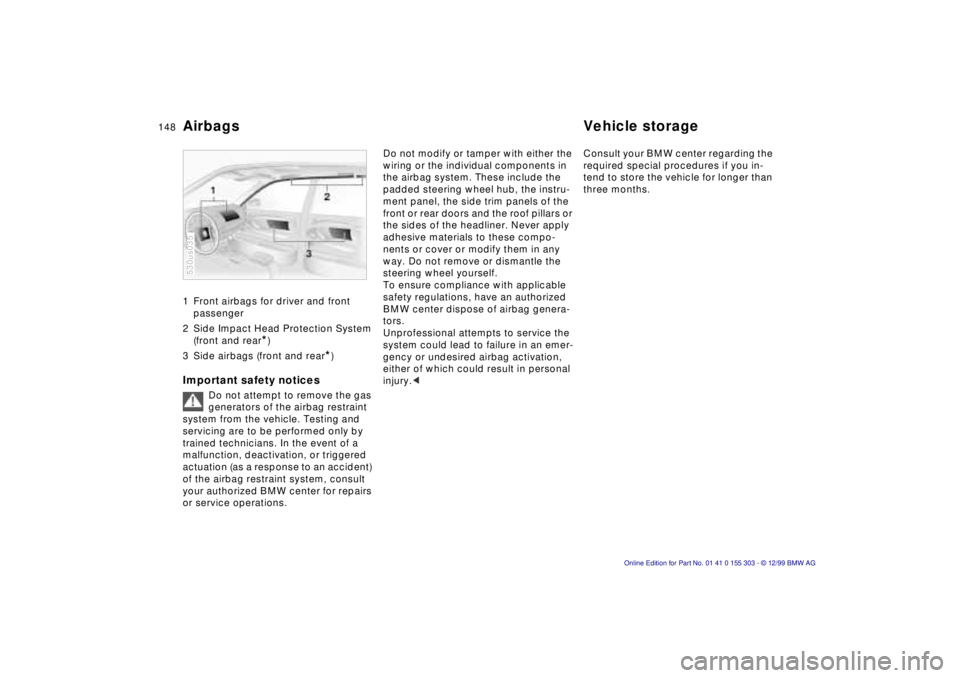
Airbags Vehicle storage 1 Front airbags for driver and front
passenger
2 Side Impact Head Protection System
(front and rear
*)
3 Side airbags (front and rear
*)
Important safety notices
Do not attempt to remove the gas
generators of the airbag restraint
system from the vehicle. Testing and
servicing are to be performed only by
trained technicians. In the event of a
malfunction, deactivation, or triggered
actuation (as a response to an accident)
of the airbag restraint system, consult
your authorized BMW center for repairs
or service operations.
530us035
Do not modify or tamper with either the
wiring or the individual components in
the airbag system. These include the
padded steering wheel hub, the instru-
ment panel, the side trim panels of the
front or rear doors and the roof pillars or
the sides of the headliner. Never apply
adhesive materials to these compo-
nents or cover or modify them in any
way. Do not remove or dismantle the
steering wheel yourself.
To ensure compliance with applicable
safety regulations, have an authorized
BMW center dispose of airbag genera-
tors.
Unprofessional attempts to service the
system could lead to failure in an emer-
gency or undesired airbag activation,
either of which could result in personal
injury.< Consult your BMW center regarding the
required special procedures if you in-
tend to store the vehicle for longer than
three months.
Page 153 of 201
IndexDataTechnologyRepairsCar careControlsOverview
Overview
Controls and features
Operation, care
and maintenance
Owner service procedures
Technical data
Index Advanced technology
153n
Replacement procedures:
Onboard tool kit154
Wiper blades154
Lamps and bulbs155
Changing a wheel161
Battery165
Fuses167
In case of electrical
malfunction:
Fuel filler door168
Sliding/Tilt sunroof168
Liftgate168
Tailgate169
Assistance, giving and
receiving:
Jump-starting170
Towing the vehicle171
Repairs
Page 160 of 201
160n
Changing a wheel
Safety measures in the event of a
ßat tire or wheel change:
Stop the vehicle as far as possible from
passing trafÞc. Park on a Þrm, ßat, sur-
face. Switch on the hazard ßashers.
Turn the steering wheel to the straight-
ahead position, remove the key and en-
gage the steering lock. Select ÒParkÒ po-
sition and engage the parking brake. All
passengers should be outside the vehi-
cle and well away from your immediate
working area (behind a guardrail, for in-
stance). If a warning triangle or portable
hazard warning lamp is available, set it
up on the roadside at an appropriate
distance from the rear of the vehicle.
Comply with all safety guidelines and
regulations. Change the wheel only on a
level, Þrm surface which is not slippery.
Avoid jacking the vehicle up on a soft or
slippery surface (snow, ice, very smooth
surfaces, etc.), since it could slide side-
ways. Position the jack on a Þrm support
surface. Do not place wooden blocks or
similar objects under the jack. If this is
done, the jack might not be able to
reach its full support capacity because
of the limited height. Do not lie under
the vehicle or start the engine when the
vehicle is supported by the jack. Failure
to comply with this creates a risk of fatal
injury.<
What you will need In order to avoid rattling noises later,
note the position of the tools when you
remove them and return them to their
original position when you are through
using them.
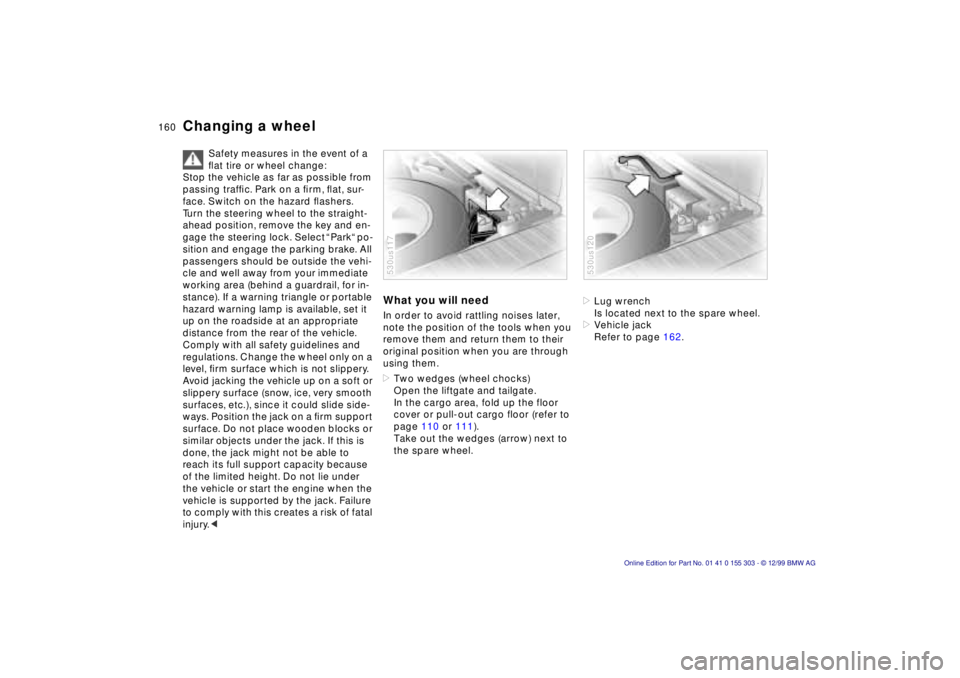
>Two wedges (wheel chocks)
Open the liftgate and tailgate.
In the cargo area, fold up the floor
cover or pull-out cargo floor (refer to
page 110 or 111).
Take out the wedges (arrow) next to
the spare wheel. 530us117
>Lug wrench
Is located next to the spare wheel.
>Vehicle jack
Refer to page 162.530us120
Page 161 of 201
IndexDataTechnologyRepairsCar careControlsOverview
161n
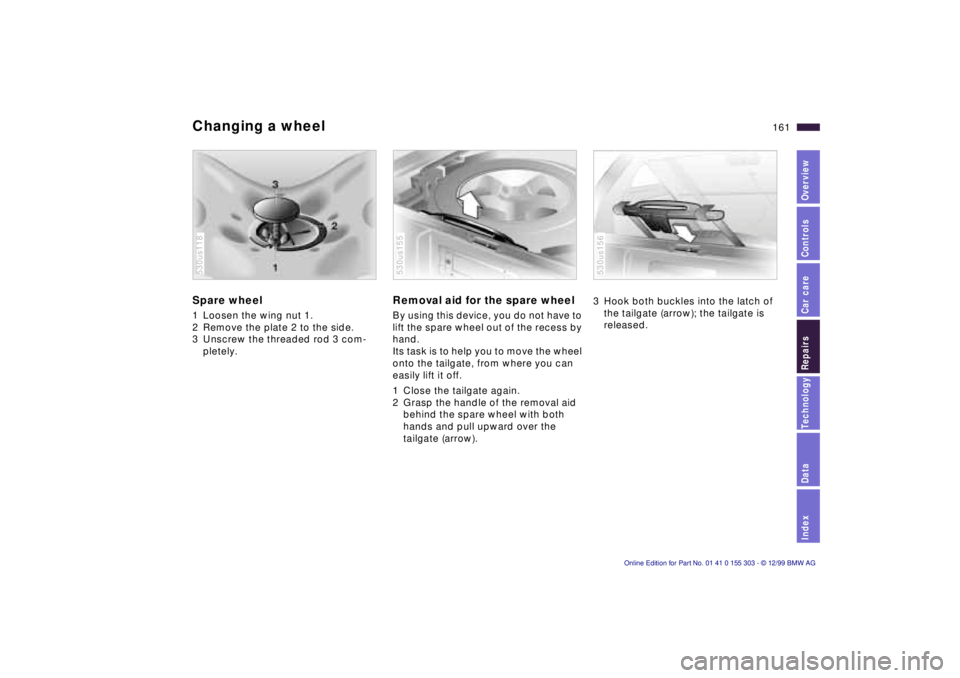
Changing a wheel Spare wheel 1 Loosen the wing nut 1.
2 Remove the plate 2 to the side.
3 Unscrew the threaded rod 3 com-
pletely. 530us118
Removal aid for the spare wheel By using this device, you do not have to
lift the spare wheel out of the recess by
hand.
Its task is to help you to move the wheel
onto the tailgate, from where you can
easily lift it off.
1 Close the tailgate again.
2 Grasp the handle of the removal aid
behind the spare wheel with both
hands and pull upward over the
tailgate (arrow).530us155
3 Hook both buckles into the latch of
the tailgate (arrow); the tailgate is
released.530us156
Page 162 of 201
162n
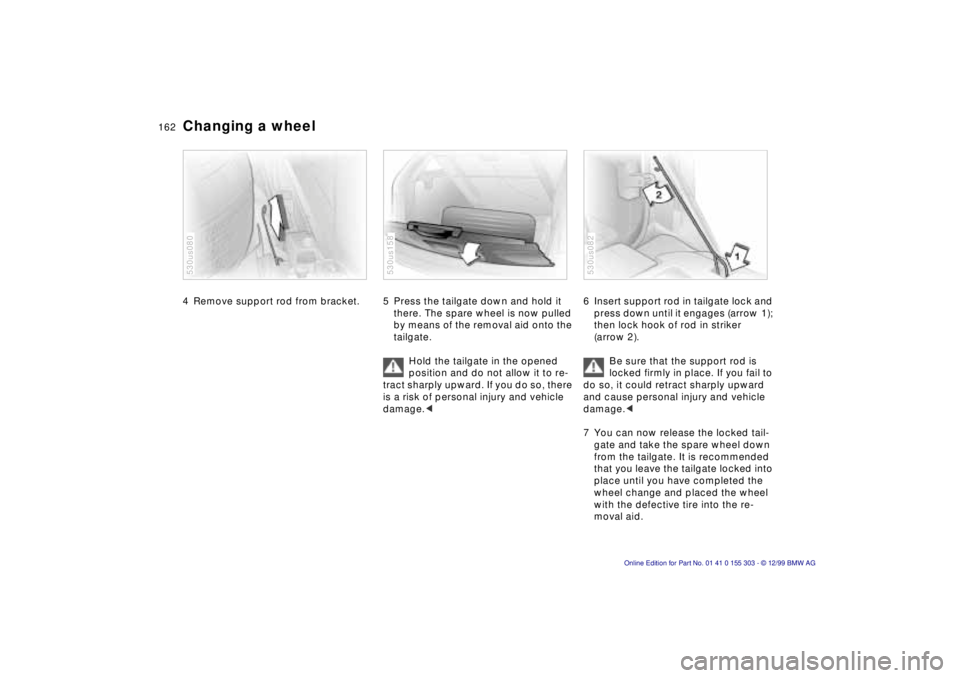
Changing a wheel 4 Remove support rod from bracket. 530us080
5 Press the tailgate down and hold it
there. The spare wheel is now pulled
by means of the removal aid onto the
tailgate.
Hold the tailgate in the opened
position and do not allow it to re-
tract sharply upward. If you do so, there
is a risk of personal injury and vehicle
damage.< 530us158
6 Insert support rod in tailgate lock and
press down until it engages (arrow 1);
then lock hook of rod in striker
(arrow 2).
Be sure that the support rod is
locked firmly in place. If you fail to
do so, it could retract sharply upward
and cause personal injury and vehicle
damage.<
7 You can now release the locked tail-
gate and take the spare wheel down
from the tailgate. It is recommended
that you leave the tailgate locked into
place until you have completed the
wheel change and placed the wheel
with the defective tire into the re-
moval aid. 530us082
Page 163 of 201
IndexDataTechnologyRepairsCar careControlsOverview
163n
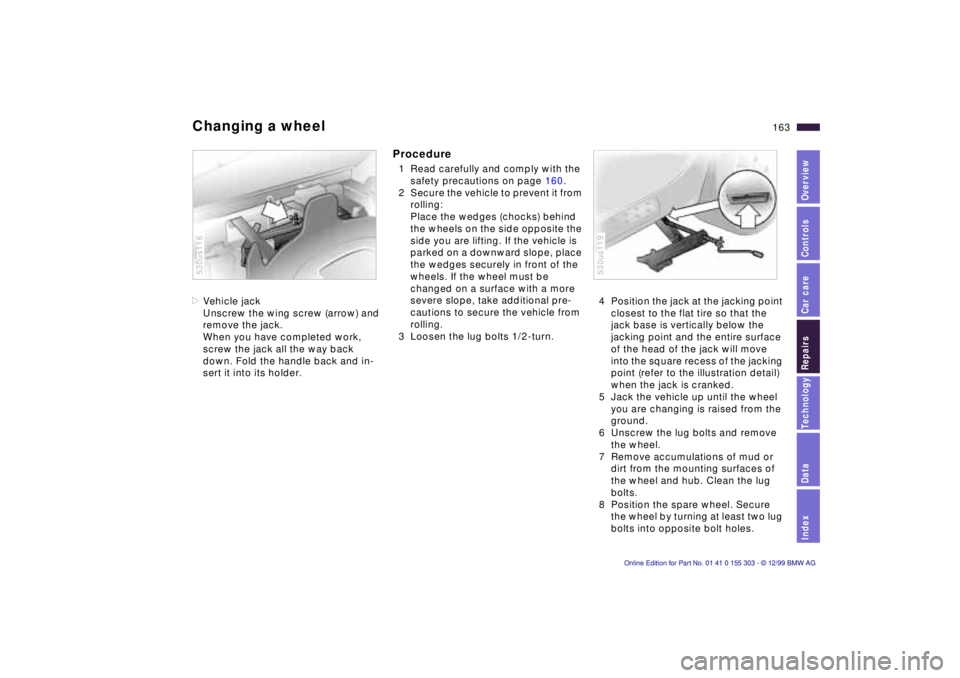
Changing a wheel >Vehicle jack
Unscrew the wing screw (arrow) and
remove the jack.
When you have completed work,
screw the jack all the way back
down. Fold the handle back and in-
sert it into its holder. 530us116
Procedure 1 Read carefully and comply with the
safety precautions on page 160.
2 Secure the vehicle to prevent it from
rolling:
Place the wedges (chocks) behind
the wheels on the side opposite the
side you are lifting. If the vehicle is
parked on a downward slope, place
the wedges securely in front of the
wheels. If the wheel must be
changed on a surface with a more
severe slope, take additional pre-
cautions to secure the vehicle from
rolling.
3 Loosen the lug bolts 1/2-turn. 4 Position the jack at the jacking point
closest to the flat tire so that the
jack base is vertically below the
jacking point and the entire surface
of the head of the jack will move
into the square recess of the jacking
point (refer to the illustration detail)
when the jack is cranked.
5 Jack the vehicle up until the wheel
you are changing is raised from the
ground.
6 Unscrew the lug bolts and remove
the wheel.
7 Remove accumulations of mud or
dirt from the mounting surfaces of
the wheel and hub. Clean the lug
bolts.
8 Position the spare wheel. Secure
the wheel by turning at least two lug
bolts into opposite bolt holes.
530us119
Page 164 of 201

164n
Changing a wheel 9 Screw in the remaining lug bolts.
Tighten all the bolts securely.
10 Lower the jack and remove it from
beneath the vehicle.
11 Tighten the lug bolts in a diagonal
pattern.
12 Check and correct the tire inflation
pressure at the earliest opportunity.
The vehicle jack is designed for
changing wheels only. Do not at-
tempt to raise another vehicle model
with it or to raise any load of any kind.
To do so could cause accidents and
personal injury.
To ensure continued safety, have the
tightness of the lug bolts checked with
a calibrated lug wrench [torque specifi-
cation: 94 ft-lb (130 Nm)] at the earliest
opportunity.<
Store the wheel and the tools in the or-
der opposite that for removal. Be sure
that the jack is first placed back into its
original position.
Before removing the support rod,
be sure that the tailgate is held
down firmly. If you fail to do so, it could
retract sharply upward and cause per-
sonal injury and vehicle damage.
After you remove the rod, close the tail-
gate carefully. Continue to hold it firmly
until it is completely closed.<
If light-alloy wheels other than original
BMW light-alloy wheels have been
mounted, it may be necessary to use
different lug bolts for those wheels.
Replace the defective tire as soon as
possible and have the new wheel/tire
balanced.
The spare wheel has a size
235/65 R 17 tire. If you have
mounted tires on your vehicle with a
different size, have wheels and tires of
the same size and specification rein-
stalled as soon as possible.
When the spare wheel is mounted, the
maximum speed rating is 130 mph
(210 km/h).<
Page 165 of 201
IndexDataTechnologyRepairsCar careControlsOverview
165n
Battery Battery location The battery is located in the floor of the
vehicle below the spare wheel. Battery care The battery is maintenance-free, that is,
the original electrolyte will normally last
for the service life of the battery under
moderate climatic conditions.
For all questions that regard the
battery, please consult your BMW
center. Since the battery is mainte-
nance-free, the following is for your in-
formation only.<
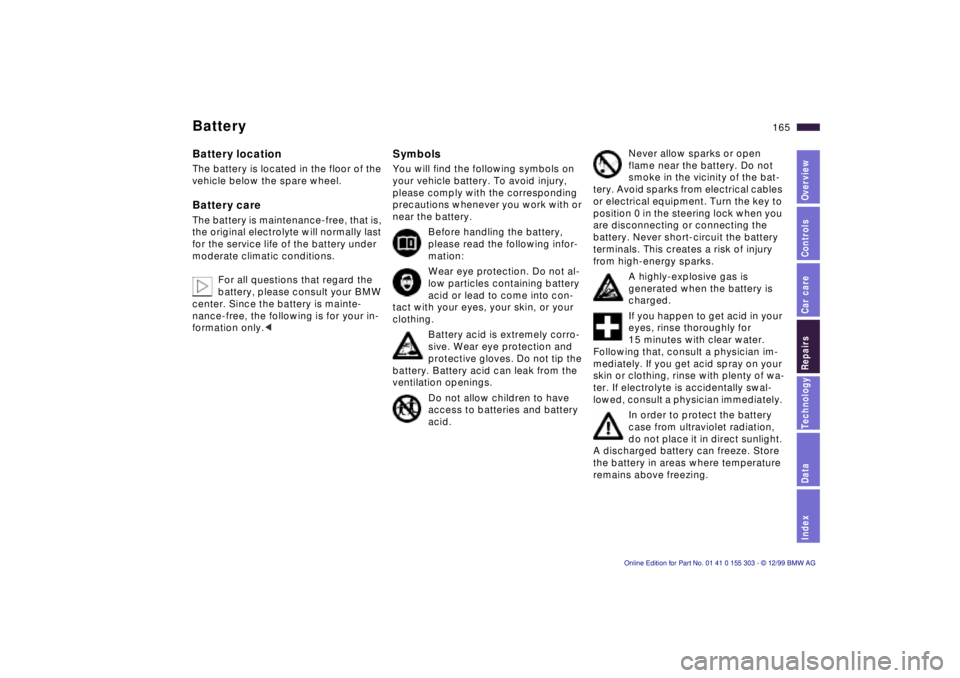
Symbols You will find the following symbols on
your vehicle battery. To avoid injury,
please comply with the corresponding
precautions whenever you work with or
near the battery.
Before handling the battery,
please read the following infor-
mation:
Wear eye protection. Do not al-
low particles containing battery
acid or lead to come into con-
tact with your eyes, your skin, or your
clothing.
Battery acid is extremely corro-
sive. Wear eye protection and
protective gloves. Do not tip the
battery. Battery acid can leak from the
ventilation openings.
Do not allow children to have
access to batteries and battery
acid.
Never allow sparks or open
flame near the battery. Do not
smoke in the vicinity of the bat-
tery. Avoid sparks from electrical cables
or electrical equipment. Turn the key to
position 0 in the steering lock when you
are disconnecting or connecting the
battery. Never short-circuit the battery
terminals. This creates a risk of injury
from high-energy sparks.
A highly-explosive gas is
generated when the battery is
charged.
If you happen to get acid in your
eyes, rinse thoroughly for
15 minutes with clear water.
Following that, consult a physician im-
mediately. If you get acid spray on your
skin or clothing, rinse with plenty of wa-
ter. If electrolyte is accidentally swal-
lowed, consult a physician immediately.
In order to protect the battery
case from ultraviolet radiation,
do not place it in direct sunlight.
A discharged battery can freeze. Store
the battery in areas where temperature
remains above freezing.