wheel BMW X5 4.4I 2000 Owner's Guide
[x] Cancel search | Manufacturer: BMW, Model Year: 2000, Model line: X5 4.4I, Model: BMW X5 4.4I 2000Pages: 201, PDF Size: 1.93 MB
Page 120 of 201

120n
Antilock Brake System (ABS) should adapt road speed to the road
conditions.
On road surfaces that have a loose sur-
face layer on a firm base with good
traction (on gravel, deep sand or snow,
for example), braking distances may be
longer than with locked wheels.This is
also true if snow chains are mounted.
However, ABS continues to provide en-
hanced vehicle stability and steering re-
sponse under these conditions. Information for your safety Not even ABS can suspend the laws of
physics. ABS alone cannot prevent
accidents when the brakes are applied
without an adequate safety distance
between vehicles, if the vehicle is
driven with excessive speed, or if aqua-
planing occurs. Responsibility for these
types of situations remains in the hands
(and at the feet) of the driver. You
should never allow the added safety of
ABS to lull you into a false sense of
security, or mislead you into taking
increased risks that could affect your
own safety and that of others.
Do not make any modifications to
the ABS system.
Service procedures on ABS are to be
performed by authorized technicians
only.<
Cornering Brake Control (CBC) CBC is an advanced engineering de-
sign of the ABS. When braking during
cornering with high lateral accelera-
tion, or when braking during a lane
change, vehicle stability is further im-
proved and the steering response is
enhanced. Electronic Brake Force Distribu-
tion (EBV) EBV governs brake application pres-
sure at the rear wheels to achieve sta-
ble brake response.
If the EBV fails (refer to the next
page), avoid full or "panic" brake
applications. Full or panic brake appli-
cations can result in overbraking at the
rear axle, and braking stability is no
longer ensured.<
Dynamic Brake Control (DBC)
If you apply the brakes rapidly, this sys-
tem automatically produces the maxi-
mum braking force boost and thus
helps to achieve the shortest possible
braking distance during "panic stops."
All of the benefits of the ABS system
are exploited under these circum-
stances.
Do not reduce the pressure on the
brake pedal for the duration of the
brake application. When the brake
pedal is released, the DBC is deacti-
vated.
In the event of a malfunction,
the yellow warning lamp comes
on. Have the system checked
and repaired at your BMW cen-
ter as soon as possible.
Refer to the "Information for your
safety" covering the ABS system.
This information also applies in general
for DBC.<
Page 121 of 201

IndexDataTechnologyRepairsCar careControlsOverview
121n
Antilock Brake System (ABS) In the event of a fault
If the brake warning lamp
comes on red together with the
yellow indicator lamps for ABS
and DSC (refer to pages 22
and 24), ABS, CBC, DSC, DBC,
EBV and HDC have failed. You
may continue driving, but drive
defensively and with extra cau-
tion. Avoid full brake applications be-
cause the vehicle could become unsta-
ble and go out of control.
Have the system checked by the near-
est BMW center.
If all all three warning lamps come on
yellow:
ABS, CBC, DSC, DBC and HDC have
failed. The effect of the EBV Brake
Force Distribution at the rear wheels,
which achieves stable brake response,
is largely preserved. Optimum brake
force and braking stability are no longer
assured. Continue to drive; drive cau-
tiously and defensively and avoid full
brake applications.
Have the system checked by your
authorized BMW center as soon as
possible.
Following an interruption in bat-
tery power, the ABS, CBC, DSC,
DBC and HDC systems are no longer
available. After you drive for only a few
yards or meters or if you turn the steer-
ing wheel from stop to stop while the
vehicle is stationary and the engine is
running, the functions are activated
again and the three warning lamps will
go out.<
Warning lamps for Canadian
models.
Page 122 of 201

122n
Disc brakes Disc brakes furnish optimum decelera-
tion and braking control and greater
fade resistance under heavy use.
When the vehicle is driven only occa-
sionally, during extended periods when
the vehicle is not used at all, and in op-
erating conditions where brake applica-
tions are less frequent, there is an in-
creased tendency for corrosion of the
rotors and accumulation of contamina-
tion on the brake pads. This occurs be-
cause the minimal pressure which must
be exerted by the pads to clean the ro-
tors by brake applications is not
reached.
If the brake rotors are corroded, they
will tend to respond to braking with a
pulsating effect which even extended
application will fail to cure.
For your own safety: use only
brake pads that BMW has re-
leased for your particular vehicle
model. BMW cannot evaluate non-ap-
proved brake pads to determine if they
are suited for use, and therefore cannot
ensure the operating safety of the vehi-
cle if they are installed.<
Driving notes When driving in wet conditions and in
heavy rain, it is advisable to apply light
pressure to the brake pedal every few
miles (kilometers). Watch traffic condi-
tions to ensure that this maneuver does
not endanger other road users. The
heat which is generated by the brake
applications helps to dry the brake
pads and rotors.
Maximum braking force is obtained
while the wheels continue to rotate,
peaking when the wheels remain on the
verge of locking without actually doing
so. ABS maintains this state automati-
cally. If the ABS fails, you should revert
to the staggered braking technique
(refer to page 124).
Extended or steep mountain descents
do not necessarily have to lead to re-
duced braking efficiency. Move the se-
lector lever to the appropriate lower
range in which only minimal periodic
brake applications are required.
You can increase the engine's braking
effect by selecting progressively lower
gears, downshifting as far as 1st gear,
on steep descents. If engine braking should prove to be in-
adequate, you should still avoid ex-
tended, continuous braking. Instead of
maintaining low to moderate pressure
over an extended period of time, you
should decelerate by applying more
substantial pressure to the brake pedal
(watch for following traffic), then releas-
ing the pedal, then repeating the appli-
cation. This staggered braking tech-
nique allows the brakes to cool in the
intervals between active braking
phases, preventing overheating and en-
suring that full braking capacity remains
available at all times.
Do not coast with the selector le-
ver in ÒNeutralÒ. Do not drive with
the engine shut off. The engine pro-
vides no braking effect when the trans-
mission is in ÒNeutralÒ, and there is no
power-assist for braking or steering
when the engine is not running.
Have brake inspections performed at
an authorized BMW center only. If you
do not, parts of the four-wheel drive
system could be damaged.
Never allow floor mats, carpets or any
other objects to protrude into the area
around the accelerator and brake ped-
als and obstruct their movement.<
Page 124 of 201

124n
Winter operation Rubber seals and components In order to prevent the weather-strip-
ping from freezing, apply BMW rubber
treatment or silicone spray to the seals
on the doors, hood and tailgate.
A full range of car care products is
available from your BMW center.< Snow chains Mount BMW snow chains
* only on tire
size 235/65 R 17. Always mount chains
in pairs and on the rear wheels only.
Read and comply with the chain manu-
facturer's safety precautions. Do not
exceed a maximum speed of 30 mph
(50 km/h).
Starting offWhen starting in deep snow or "rock-
ing" the vehicle free, it may be advis-
able to deactivate the DSC system
briefly. Refer to page 83.
Driving on low-traction road
surfaces Use smooth, gentle pressure to control
the accelerator pedal and avoid exces-
sive engine speeds. Maintain an ade-
quate distance between yourself and
the car ahead. BrakingWinter road conditions substantially re-
duce the amount of traction available
between the tires and the road surface.
The resulting increases in braking dis-
tance are considerable and should be
kept in mind at all times.
ABS is intended to prevent the wheels
from locking during brake applications,
thus helping to maintain vehicle stability
and steering response. If the ABS does not respond in a critical
braking situation and the wheels lock:
Reduce the pressure on the brake
pedal until the wheels just start to roll
again while still maintaining enough
force to continue braking. Following
that, increase pedal pressure again.
Reduce the pressure as the wheels
lock, then reapply pressure. Repeat this
braking sequence.
This type of staggered braking will re-
duce the braking distance, and the ve-
hicle still remains responsive to steer-
ing.
You can then attempt to steer around
hazards after you have reduced pres-
sure on the brake pedal.
Do not shift down on slick road
surfaces if you want to decelerate.
Doing so could cause the wheels to
lose traction and skid, thus resulting in
the loss of vehicle control.<
Page 127 of 201
IndexDataTechnologyRepairsCar careControlsOverview
127n
Information for your safety The factory-approved radial tires are
matched to the vehicle and have been
selected to provide optimum safety and
driving comfort on your vehicle.
It is not merely the tire's service life, but
also driving comfort and Ð above all else
Ð driving safety which depend on the
condition of the tires and the mainte-
nance of the specified tire pressure.
Incorrect inflation pressure is a frequent
cause of tire damage. It also signifi-
cantly influences the roadholding ability
of your BMW.
Check tire inflation pressures Ð
including the spare wheel Ð regu-
larly, at least every two weeks and
before beginning a longer trip. If this is
not done, incorrect tire pressures can
cause driving instability and tire
damage, ultimately resulting in an
accident.<
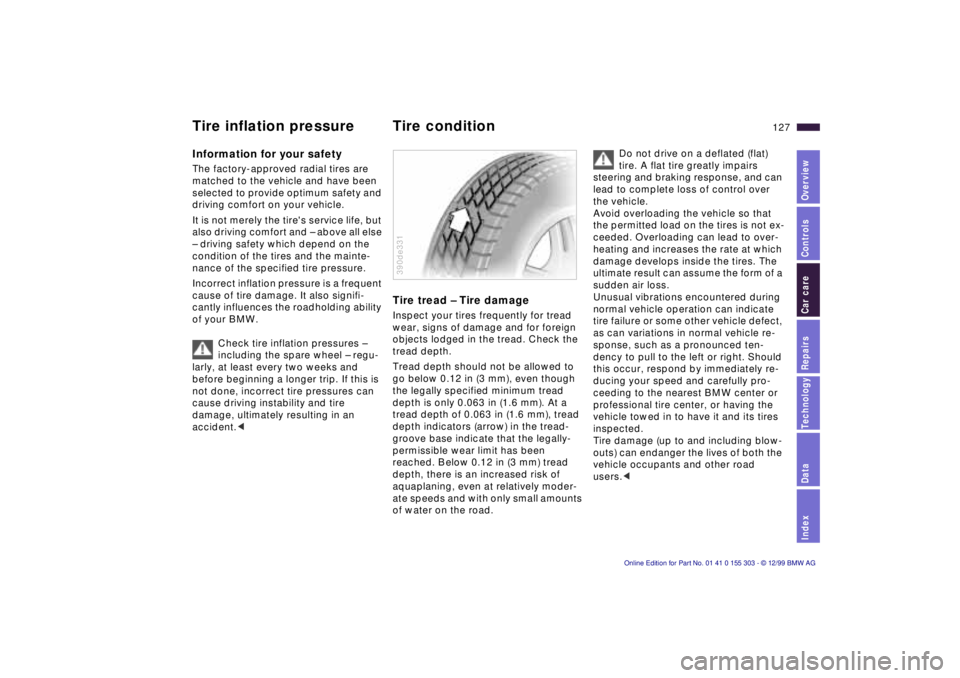
Tire tread Ð Tire damage Inspect your tires frequently for tread
wear, signs of damage and for foreign
objects lodged in the tread. Check the
tread depth.
Tread depth should not be allowed to
go below 0.12 in (3 mm), even though
the legally specified minimum tread
depth is only 0.063 in (1.6 mm). At a
tread depth of 0.063 in (1.6 mm), tread
depth indicators (arrow) in the tread-
groove base indicate that the legally-
permissible wear limit has been
reached. Below 0.12 in (3 mm) tread
depth, there is an increased risk of
aquaplaning, even at relatively moder-
ate speeds and with only small amounts
of water on the road. 390de331
Do not drive on a deflated (flat)
tire. A flat tire greatly impairs
steering and braking response, and can
lead to complete loss of control over
the vehicle.
Avoid overloading the vehicle so that
the permitted load on the tires is not ex-
ceeded. Overloading can lead to over-
heating and increases the rate at which
damage develops inside the tires. The
ultimate result can assume the form of a
sudden air loss.
Unusual vibrations encountered during
normal vehicle operation can indicate
tire failure or some other vehicle defect,
as can variations in normal vehicle re-
sponse, such as a pronounced ten-
dency to pull to the left or right. Should
this occur, respond by immediately re-
ducing your speed and carefully pro-
ceeding to the nearest BMW center or
professional tire center, or having the
vehicle towed in to have it and its tires
inspected.
Tire damage (up to and including blow-
outs) can endanger the lives of both the
vehicle occupants and other road
users.<
Tire inflation pressure Tire condition
Page 128 of 201

128n
Tire replacement To maintain good handling and vehicle
response, use only tires of a single
tread configuration from a single manu-
facturer. BMW tests and approves
wheel/tire combinations. Refer to
page 130. DOT Quality Grades Treadwear
Traction AA A B C
Temperature A B C
All passenger car tires must con-
form to Federal Safety Require-
ments in addition to these grades.< Treadwear The treadwear grade is a comparative
rating based on the wear rate of the tire
when tested under controlled condi-
tions on a specified government test
course.
For example, a tire graded 150 would
wear one and one-half (1 1/2) times as
well on the government course as a tire
graded 100. The relative performance
of tires depends upon the actual condi-
tions of their use, however, and may
depart significantly from the norm due
to variations in driving habits, service
practices and differences in road char-
acteristics and climate.
Traction The traction grades, from highest to
lowest, are AA, A, B, and C.
Those grades represent the tire's ability
to stop on wet pavement as measured
under controlled conditions on speci-
fied government test surfaces of as-
phalt and concrete. A tire marked C
may have poor traction performance.
The traction grade assigned to
this tire is based on straight-
ahead braking traction tests, and does
not include acceleration, cornering, hy-
droplaning, or peak traction character-
istics.< Temperature The temperature grades are A (the
highest), B, and C, representing the
tire's resistance to the generation of
heat and its ability to dissipate heat
when tested under controlled condi-
tions on a specified indoor laboratory
test wheel.
Sustained high temperature can cause
the material of the tire to degenerate
and reduce tire life, and excessive tem-
perature can lead to sudden tire failure.
The grade C corresponds to a level of
performance which all passenger car
tires must meet under the Federal Mo-
tor Vehicle Safety Standard No. 109.
Grades B and A represent higher levels
of performance on the laboratory test
wheel than the minimum required by
law.
The temperature grade for this tire
is established for a tire that is
properly inflated and not overloaded.
Excessive speed, underinflation, or ex-
cessive loading, either separately or in
combination, can cause heat buildup
and possible tire failure.< Uniform Tire Quality Grading Quality grades can be found where ap-
plicable on the tire sidewall between
tread shoulder and maximum section
width. For example:
Treadwear 200 Traction AA
Temperature A
Do not use retreaded tires, since
driving safety may be impaired by
their use. This is due to the possible
variations in casing structures and, in
some cases, to their extreme age,
which can lead to a decrease in their
durability.<
Page 129 of 201

IndexDataTechnologyRepairsCar careControlsOverview
129n
Tire replacement Tire rotation Tire age The date on which the tire was manu-
factured is indicated by the code on the
sidewall:
DOT ... 419 indicates that the tire was
manufactured in Week 41 of 1999.
BMW recommends the replacement of
all tires when the tires are no more than
6 years old, even if a tire life of 10 years
is possible.
Spare tires over 6 years old should be
used only in case of emergency. Such a
tire should be replaced by a new tire
immediately, and should not be
mounted together with new tires.
Between the axles The tread wear patterns at the front end
differ from those at the rear Ñ the actual
patterns will vary according to individ-
ual driving conditions. In the interests of
safety and maintaining optimal handling
characteristics, tire rotation is not rec-
ommended.
When considering the potential eco-
nomic benefits of interaxle tire rotation,
you must decide whether the expense
of having the tires rotated is likely to be
amortized during the anticipated exten-
sion in tire life. In principle, interaxle tire
rotation should be performed at short
intervals, with a maximum of
3,000 miles (5,000 km). Consult your
authorized BMW center for more infor-
mation.
Should you decide to rotate the tires, it
is essential that you comply with the
following:
Rotate tires on the same side only,
since braking characteristics and road
grip could otherwise be adversely af-
fected.
Following tire rotation, correct the tire
inflation pressure. If different tire sizes are mounted
on the front and rear axles (refer to
page 132), the wheels may not be ro-
tated from one axle to the other.<
Page 130 of 201

130n
Wheel and tire combinations The right choice Use only tires approved by BMW. Refer
to page 132.
Due to the high speeds this vehicle can
reach, the use of specific brands, spec-
ifications and sizes is mandatory. Con-
sult any BMW center for details.
Comply with all local/national regula-
tions.
The correct wheel-tire combina-
tion affects different systems such
as ABS, ATC and DSC. The function of
these systems is impaired if improper
wheel-tire combinations are used.
For this reason, use only tires of the
same brand and tread pattern. If you
have mounted winter tires and must use
the spare wheel following a flat tire, for
example, remount the approved wheel-
tire combination as soon as possible.<
Codes on the tires and wheels The tire codes will aid you in selecting
the correct tire.
Codes on radial tires:
The speed rating indicates the ap-
proved maximum speed for the tire.
Summer tires:
S = up to 112 mph (180 km/h)
T = up to 118 mph (190 km/h)
H = up to 130 mph (210 km/h)
V = up to 150 mph (240 km/h)
W = up to 167 mph (270 km/h)
Y = up to 186 mph (300 km/h)
ZR= over 150 mph (240 km/h) Example:
Nominal width
in mm
Aspect ratio in X
Belt rating code for
radial tires
Rim diameter in inches
Load rating
Speed rating
235/65 R 17 104 H
All-Season, All-Terrain and Winter tires:
Q M+S = up to 100 mph (160 km/h)
T M+S = up to 118 mph (190 km/h)
H M+S = up to 130 mph (210 km/h)
Codes stamped on light-alloy wheels:
Protect valve stems from dirt by using
screw-on valve stem caps. Dirt in the
valves frequently leads to slow leaks. Rim width
in inches
Code letter for
flange type
Symbol for full-drop
center rim
Rim diameter in inches
Special Extended Hump
on the 2 rim shoulders
7.5 x 17 SEH 2
J
Page 131 of 201

IndexDataTechnologyRepairsCar careControlsOverview
131n
Winter tires Snow chains
*
Choosing the right tire BMW recommends special winter tires
(M+S radial tires) for driving in adverse
winter road conditions. While the All-
Season tires with M+S designation that
are mounted as standard equipment
provide better winter traction than sum-
mer tires, they generally do not achieve
the performance of winter tires.
For safe tracking and steering re-
sponse, install winter tires made by the
same manufacturer having the same
tread configuration on all four wheels.
Mount only winter tires approved by
BMW. Any BMW center will be glad to
provide you with information for select-
ing the best winter tires for your partic-
ular driving conditions.
Do not exceed specified
maximum speeds
Never exceed the maximum
speed for which winter tires are
rated.
Unprofessional attempts by laymen to
service tires can lead to damage and
accidents.
Have this work performed by skilled
professionals only. Any BMW center
has the required technical knowledge
and the proper equipment and will be
happy to assist you.<
Tire condition, tire pressure Once winter tires wear to a tread depth
below 0.16 in (4 mm), their performance
under winter driving conditions deterio-
rates noticeably. Worn tires should
therefore be replaced for safety consid-
erations.
Comply with the specified tire inflation
pressures Ñ and be sure to have the
wheel and tire assemblies balanced
every time you change the tires. Storage Store tires in a cool, dry place, away
from light whenever possible. Protect
the tires against contact with oil, grease
and fuel.
The use of narrow-link BMW snow
chains is approved only in pairs on the
rear wheels and only with tire size
235/65 R 17. Comply with all manufac-
turer's safety precautions when mount-
ing the chains.
Page 132 of 201

132n
Approved wheel and tire specifications Observe the specifications for tires and
wheels in the vehicle's manuals. If sizes
not approved by the manufacturer are
mounted, an entry in the vehicle's doc-
uments may be necessary. Snow chains
*
It is only possible to mount snow chains
on the rear wheels with tire size
235/65 R 17. Tire specifications Light-alloy wheels
BMW X5 4.4i
All-Season/All-Terrain
235/65 R 17 104 H M+S 7.5J x 17 SEH2
255/55 R 18 105 H M+S 8.5J x 18 EH2
Summer
255/55 R 18 105 V 8.5J x 18 EH2
Front: 255/50 R 19 103 V
Rear: 285/45 R 19 107 V9J x 19 EH2
10J x 19 EH2
Winter
235/65 R 17 104 Q/T/H M+S 7.5J x 17 SEH2
The use of rims and lug bolts that
do not meet the specifications of
the original factory-installed equipment
will affect the safe operation of your ve-
hicle and may cause an accident and
personal injury.
Never mix tires of different design, such
as steel-belted radials with radial bias
belted or bias-ply tires, etc. Mixing tire
types will adversely affect roadholding
and can lead to loss of vehicle con-
trol.<