ignition BUICK ENCLAVE 2009 Owner's Guide
[x] Cancel search | Manufacturer: BUICK, Model Year: 2009, Model line: ENCLAVE, Model: BUICK ENCLAVE 2009Pages: 412
Page 93 of 412

Torque Lock
Torque lock is when the weight of
the vehicle puts too much force
on the parking pawl in the
transmission. This happens when
parking on a hill and shifting
the transmission into P (Park) is
not done properly and then it
is difficult to shift out of P (Park).
To prevent torque lock, set the
parking brake and then shift into
P (Park). To nd out how, see
“Shifting Into Park” listed previously.
If torque lock does occur, your
vehicle may need to be pushed
uphill by another vehicle to relieve
the parking pawl pressure, so
you can shift out of P (Park).
Shifting Out of Park
This vehicle is equipped with an
electronic shift lock release system.
The shift lock release is designed to:
Prevent ignition key removal
unless the shift lever is in P (Park)
with the shift lever button fully
released, and
Prevent movement of the shift
lever out of P (Park), unless
the ignition is in ON/RUN or
ACC/ACCESSORY and the
regular brake pedal is applied.
The shift lock release is always
functional except in the case of
an uncharged or low voltage
(less than 9 volt) battery.
If the vehicle has an uncharged
battery or a battery with low voltage,
try charging or jump starting the
battery. SeeJump Starting on
page 5-28for more information.To shift out of P (Park) use the
following:
1. Apply the brake pedal.
2. Press the shift lever button.
3. Move the shift lever to the
desired position.
If you still are unable to shift out
of P (Park):
1. Fully release the shift lever
button.
2. While holding down the brake
pedal, press the shift lever
button again.
3. Move the shift lever to the
desired position.
If you still cannot move the shift
lever from P (Park), consult
your dealer/retailer.
Features and Controls 2-29
Page 96 of 412

Automatic Dimming Mirror
Operation
Automatic dimming reduces the
glare from the headlamps of
the vehicle behind you. The dimming
feature comes on and the indicator
light illuminates each time the
ignition is turned to start.
Cleaning the Mirror
Do not spray glass cleaner directly
on the mirror. Use a soft towel
dampened with water.
Outside Power Mirrors
Controls for the outside power
mirrors are located on the driver’s
door armrest.
To adjust each mirror:
1. Press (A) or (B) to select the
driver’s or passenger side mirror.
2. Press one of the four arrows
located on the control pad to
adjust the mirror.3. Adjust each outside mirror to see
a little of your vehicle, and the
area behind your vehicle.
4. Press either (A) or (B) again to
deselect the mirror.
Manually fold the mirrors inward to
prevent damage when going
through an automatic car wash.
To fold, push the mirror toward the
vehicle. Push the mirror outward,
to return it to the original position.
Using hood-mounted air deectors
and add-on convex mirror
attachments could decrease mirror
performance.
Turn Signal Indicator
The vehicle may have a turn signal
indicator lamp that is built into
the mirror housing. The turn signal
lamp ashes with the use of the
vehicle’s turn signal and hazard
ashers.
2-32 Features and Controls
Page 98 of 412

Park Tilt Mirrors
If the vehicle has the memory
package, the outside mirrors have a
park tilt feature. This feature tilts the
outside mirrors to a preselected
position when the vehicle is in
R (Reverse). This allows the driver to
view the curb for parallel parking.
The passenger and/or driver’s mirror
returns to its original position
when the vehicle is shifted out of
R (Reverse), or the ignition is turned
off or to OFF/LOCK.
This feature can be turned on or off
through the Driver Information
Center (DIC). SeeDIC Vehicle
Customization on page 3-57
andMemory Seat and Mirrors on
page 1-5for more information.
Outside Convex Mirror
{CAUTION
A convex mirror can make things
(like other vehicles) look farther
away than they really are. If you
cut too sharply into the right lane,
you could hit a vehicle on the
right. Check the inside mirror or
glance over your shoulder before
changing lanes.
The passenger side mirror is convex
shaped. A convex mirror’s surface
is curved so more can be seen from
the driver’s seat.
Outside Heated Mirrors
<
(Rear Window Defogger):
Press to heat the mirrors.
See “Rear Window Defogger” under
Dual Automatic Climate Control
System on page 3-20for more
information.
Object Detection
Systems
Ultrasonic Rear Parking
Assist (URPA)
For vehicles with the Ultrasonic Rear
Parking Assist (URPA) system, it
operates at speeds less than 5 mph
(8 km/h), and assists the driver with
parking and avoiding objects while in
R (Reverse). The sensors on the
rear bumper are used to detect the
distance to an object up to 8 feet
(2.5 m) behind the vehicle, and at
least 10 inches (25.4 cm) off the
ground.
2-34 Features and Controls
Page 117 of 412

Sunroof
The vehicle may have a sunroof
over the front seats and a rear
sunroof over the second row seats.
The rear sunroof does not open.
The switches to operate the
front sunroof and rear sunshade are
located on the headliner above
the rearview mirror. The ignition
must be in ON or ACCESSORY to
operate the sunroof. SeeIgnition
Positions on page 2-21.
Vent:From the closed position,
press and hold the front of the driver
side switch to vent the sunroof.
Press and hold the rear of the driver
side switch to close the sunroof.
Express-open/Express-close:
From the closed position, press and
release the rear of the driver side
switch to express-open the sunroof.
Press and release the front of
the driver side switch to
express-close the sunroof.The front sunshade must be opened
and closed manually. Push up on
the sunshade handle to open
the sunshade.
Notice:The rear sunshade could
be damaged if you attempt to
open or close it manually. Do not
manually open or close the rear
sunshade.
To open the rear sunshade,
located over the second row seats,
press and release the rear of the
passenger side switch. Press and
release the front of the switch
to close the sunshade.
Features and Controls 2-53
Page 126 of 412
If the headlamps are on, they will
return to low-beam when the lever is
released.
For vehicles with High Intensity
Discharge (HID) headlamps,
the ash-to-pass feature does not
work while the Daytime Running
Lamps (DRL) are on.
Windshield Wipers
The windshield wiper/washer lever
is located on the right side of
the steering column.
Turn the band with the wiper symbol
to control the windshield wipers.
8(Mist):Turn the band to mist
for a single wiping cycle and
then release. The wipers stop after
one wipe. Hold the band on
8
longer, for more wipe cycles.
9(Off):Turns the wipers off.
6(Delay): Adjusts the delay time.
The delay between wiping
cycles becomes shorter as the band
is moved to the top of the lever.
1 (Low Speed):For steady wiping
at low speed.
2 (High Speed):For steady wiping
at high speed.
Clear ice and snow from the wiper
blades before using them. If the
blades are frozen to the windshield,
gently loosen or thaw them. If
they become damaged, install new
blades or blade inserts. See
Windshield Wiper Blade
Replacement on page 5-36.
Heavy snow or ice can overload the
wipers. A circuit breaker stops
them until the motor cools.Windshield Washer
J
(Washer Fluid):Press the
button located at the end of the turn
signal/multifunction lever, to spray
washer uid on the windshield.
The wipers clear the windshield and
either stop or return to the preset
speed. The ignition key must
be in ACC/ACCESSORY or
ON/RUN for this to work. See
Windshield Washer Fluid on
page 5-23Windshield Washer Fluid.
{CAUTION
In freezing weather, do not use
your washer until the windshield is
warmed. Otherwise the washer
uid can form ice on the
windshield, blocking your vision.
WASHER FLUID LOW ADD FLUID
is displayed on the Driver
Information Center (DIC) when the
washer uid is low. SeeDIC
Warnings and Messages on
page 3-48.
3-8 Instrument Panel
Page 130 of 412
Using Cruise Control on Hills
How well the cruise control will work
on hills depends upon the vehicle
speed, load, and the steepness
of the hills. When going up steep
hills, you might have to step on the
accelerator pedal to maintain the
vehicle speed. When going downhill,
you might have to brake or shift
to a lower gear to keep the vehicle
speed down. When the brakes
are applied the cruise control
is disengaged.
Ending Cruise Control
There are three ways to end cruise
control:
Step lightly on the brake pedal.
Press the[button.
Press theTbutton.
Erasing Speed Memory
The cruise control set speed memory
is erased when the cruise control or
the ignition is turned off.
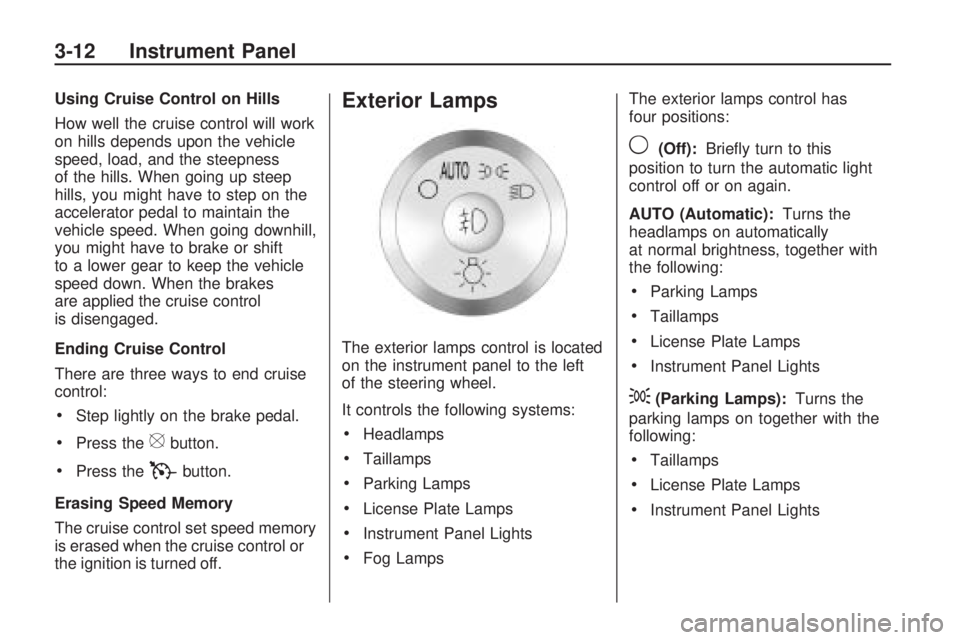
Exterior Lamps
The exterior lamps control is located
on the instrument panel to the left
of the steering wheel.
It controls the following systems:
Headlamps
Taillamps
Parking Lamps
License Plate Lamps
Instrument Panel Lights
Fog LampsThe exterior lamps control has
four positions:
9(Off):Briey turn to this
position to turn the automatic light
control off or on again.
AUTO (Automatic):Turns the
headlamps on automatically
at normal brightness, together with
the following:
Parking Lamps
Taillamps
License Plate Lamps
Instrument Panel Lights
;(Parking Lamps):Turns the
parking lamps on together with the
following:
Taillamps
License Plate Lamps
Instrument Panel Lights
3-12 Instrument Panel
Page 131 of 412

2(Headlamps):Turns the
headlamps on together with the
following lamps listed below.
A warning chime sounds if the
driver’s door is opened when the
ignition switch is off and the
headlamps are on.
Parking Lamps
Taillamps
License Plate Lamps
Instrument Panel Lights
#(Fog Lamps):Push the fog
lamps control in to turn on the
fog lamps.
SeeFog Lamps on page 3-14.
Delayed Headlamps
Delayed headlamps provide a period
of exterior lighting as you leave
the area around your vehicle. This
feature is activated when the
headlamps are on due to the
automatic headlamps control
feature, and when the ignition is
turned off. The headlamps remain
on until the exterior lamps control is
moved to the parking lamps
position or until the pre-selected
delayed headlamp lighting period
has ended.
If the ignition is turned off with the
headlamps switch in the parking
lamps or headlamps position,
the delayed headlamps cycle will
not occur.
To disable the delayed headlamps
feature or change the time of
delay, seeDIC Vehicle
Customization on page 3-57.
Daytime Running Lamps
(DRL)/Automatic
Headlamp System
Daytime Running Lamps (DRL) can
make it easier for others to see
the front of your vehicle during the
day. Fully functional daytime
running lamps are required on all
vehicles rst sold in Canada.
A light sensor on top of the
instrument panel makes the DRL
work, so do not cover the sensor.
The DRL system’s automatic control
makes the DRL lights come on when
the following conditions are met:
The ignition is in the ON/RUN
position.
The exterior lamps control is
in AUTO.
The engine is running.
Instrument Panel 3-13
Page 132 of 412

When the DRL are on, only the DRL
lights will be on. The headlamps,
taillamps, sidemarker, and other
lamps will not be on. The instrument
panel and cluster will also not be lit.
When it is dark enough outside, the
DRL lights will turn off and the
headlamps and parking lamps will
turn on. The other lamps that
come on with the headlamps will
also come on.
When it is bright enough outside,
the headlamps will go off and
the DRL will come on.
The regular headlamp system
should be turned on when it is
needed.Adaptive Forward
Lighting System
Vehicles with the Adaptive Forward
Lighting System (AFS) have
headlamps that swivel to the left or
right when making a turn to
provide better lighting. To enable
AFS, set the exterior lamp switch to
the AUTO position. Move the
switch out of the AUTO position to
turn off the system. SeeExterior
Lamps on page 3-12.
AFS operates when the vehicle
speed is greater than 2 mph
(3 km/h). AFS does not operate
when the transmission is in
R (Reverse). AFS is not immediately
operable after starting the vehicle;
driving a short distance is required
to calibrate the AFS.
Fog Lamps
Use the fog lamps for better vision
in foggy or misty conditions.
The fog lamps button is located on
the exterior lamps control to the
left of the steering column.
#(Fog Lamps):Press the exterior
lamps button to turn the fog lamps
on or off. A light comes on in
the instrument panel cluster when
the fog lamps are in use. The
ignition must be on for the fog lamps
to work.
When the headlamps are changed
to high-beam, the fog lamps will
turn off. The fog lamps come back
on again when the high-beam
headlamps are turned off.
Some localities have laws that
require the headlamps to be
on along with the fog lamps.
3-14 Instrument Panel
Page 133 of 412

Instrument Panel
Brightness
D
(Instrument Panel
Brightness):The knob with this
symbol on it is located next to
the exterior lamps control to the left
of the steering wheel. Push the
knob in all the way until it extends
out and then turn the knob clockwise
or counterclockwise to brighten or
dim the lights. Push the knob
back in when nished.
Dome Lamps
The dome lamps automatically
come on when a door is opened,
unless the dome lamp override
button is pressed in.
The lamps can also be turned on
and off by turning the instrument
panel brightness control clockwise to
the farthest position.
Dome Lamp Override
The dome lamp override button
is located next to the exterior lamps
control.
The dome lamp override sets the
dome lamps to remain off or
come on automatically when a door
is opened.
E(Dome Lamp Override):Press
the button in and the dome lamps
remain off when a door is opened.
Press the button again to return it to
the extended position so that the
dome lamps come on when a door
is opened.
Entry Lighting
For vehicles with courtesy lamps,
they come on and stay on for a set
time whenever the unlock symbol
is pressed on the Remote Keyless
Entry (RKE) Transmitter, if the
vehicle has one.If a door is opened, the lamps stay
on while it is open and then turn
off automatically about 25 seconds
after the door is closed. If the
unlock symbol is pressed and no
door is opened, the lamps turn
off after about 20 seconds.
Entry lighting includes a feature
called theater dimming. With theater
dimming, the lamps do not turn off at
the end of the delay time. Instead,
they slowly dim after the delay time
until they go out. The delay time is
canceled if the ignition key is turned
to ON/RUN or the power door lock
switch is pressed. The lamps will dim
right away.
When the ignition is on, illuminated
entry is inactive, which means
the courtesy lamps will not come on
unless a door is opened.
Instrument Panel 3-15
Page 134 of 412

Delayed Entry Lighting
Delayed entry lighting illuminates the
interior for a period of time after
all the doors have been closed.
The ignition must be off for delayed
entry lighting to work. Immediately
after all the doors have been closed,
the delayed entry lighting feature
will continue to work until one of the
following occurs:
The ignition is in ON/RUN.
The doors are locked.
An illumination period of
25 seconds has elapsed.
If during the illumination period a
door is opened, the timed
illumination period will be canceled
and the interior lamps will remain
on because a door is open.
Delayed Exit Lighting
This feature illuminates the interior
for a period of time after the key
is removed from the ignition.The ignition must be off for delayed
exit lighting to work. When the
key is removed, interior illumination
will activate and remain on until
one of the following occurs:
The ignition is in ON/RUN.
The power door locks are
activated.
An illumination period of
20 seconds has elapsed.
If during the illumination period a
door is opened, the timed
illumination period will be canceled
and the interior lamps will remain
on because a door is open.
Parade Dimming
Parade mode automatically prohibits
the dimming of the instrument panel
displays during the daylight while the
headlamps are on so that the
displays are still able to be seen.
Reading Lamps
The vehicle has reading lamps that
also act as the dome lamp. Press
the button to turn them on and off.
Electric Power
Management
The vehicle has Electric Power
Management (EPM) that estimates
the battery’s temperature and
state of charge. It then adjusts the
voltage for best performance
and extended life of the battery.
When the battery’s state of charge
is low, the voltage is raised
slightly to quickly bring the charge
back up. When the state of charge is
high, the voltage is lowered
slightly to prevent overcharging. If
the vehicle has a voltmeter gage or
a voltage display on the Driver
Information Center (DIC), you may
see the voltage move up or
down. This is normal. If there is a
problem, an alert will be displayed.
3-16 Instrument Panel