transmission BUICK LACROSSE 2008 Owner's Guide
[x] Cancel search | Manufacturer: BUICK, Model Year: 2008, Model line: LACROSSE, Model: BUICK LACROSSE 2008Pages: 440
Page 263 of 440
Trailering means changes in handling, acceleration,
braking, durability, and fuel economy. Successful, safe
trailering takes correct equipment, and it has to be
used properly.
That is the reason for this part. In it are many
time-tested, important trailering tips and safety rules.
Many of these are important for your safety and that of
your passengers. So please read this section carefully
before pulling a trailer.
Load-pulling components such as the engine,
transmission, wheel assembly, and tires are forced to
work harder against the drag of the added weight.
The engine is required to operate at relatively higher
speeds and under greater loads, generating extra heat.
What is more, the trailer adds considerably to wind
resistance, increasing the pulling requirements.
If You Do Decide To Pull A Trailer
Here are some important points:
There are many different laws, including speed limit
restrictions, having to do with trailering. Make sure
your rig will be legal, not only where you live
but also where you will be driving. A good source
for this information can be state or provincial police.
Consider using a sway control. Ask a hitch
dealer about sway controls.
Do not tow a trailer at all during the rst 1,000 miles
(1 600 km) the vehicle is driven. The engine, axle or
other parts could be damaged.
Then, during the rst 500 miles (800 km) that
the vehicle tows a trailer, do not drive over
50 mph (80 km/h) and do not make starts at full
throttle. This helps the engine and other parts of the
vehicle wear in at the heavier loads.
Obey speed limit restrictions when towing a trailer.
Do not drive faster than the maximum posted speed
for trailers, or no more than 55 mph (90 km/h), to
save wear on the vehicle’s parts.
There are three important considerations have to do
with weight:
The weight of the trailer
The weight of the trailer tongue
The total weight on the vehicle’s tires
4-29
Page 268 of 440
Driving On Grades
Reduce speed and shift to a lower gearbeforestarting
down a long hill or steep downgrade. If the vehicle is not
shifted down, the brakes might have to be used so much
that they would get hot and no longer work well.
On a long uphill grade, shift down and reduce the
vehicle’s speed to around 45 mph (70 km/h) to reduce
the possibility of engine and transmission overheating.
If towing a trailer, you may want to drive in THIRD (3)
instead of DRIVE (D). Shift to a lower gear as needed.
Parking on Hills
{CAUTION:
You really should not park your vehicle, with a
trailer attached, on a hill. If something goes
wrong, your rig could start to move. People
can be injured, and both your vehicle and the
trailer can be damaged.But if the rig ever has to be parked on a hill, here is
how to do it:
1. Apply the regular brakes, but do not shift into
PARK (P) yet.
2. Have someone place chocks under the trailer’s
wheels.
3. When the wheel chocks are in place, release the
regular brakes until the chocks absorb the load.
4. Reapply the regular brakes. Then apply the parking
brake, and shift to PARK (P).
5. Release the regular brakes.
4-34
Page 269 of 440
When You Are Ready to Leave After
Parking on a Hill
1. Apply the regular brakes and hold the pedal down
while you:
Start the engine.
Shift into a gear.
Release the parking brake.
2. Let up on the brake pedal.
3. Drive slowly until the trailer is clear of the chocks.
4. Stop and have someone pick up and store the
chocks.
Maintenance When Trailer Towing
The vehicle will need service more often when it pulls a
trailer. SeeScheduled Maintenance on page 6-4for
more information. Things that are especially important in
trailer operation are automatic transmission uid;
which should not be overlled; engine oil, drive belt(s),
and cooling and brake systems. Each of these is
covered in this manual, and the Index will help you nd
them quickly. If trailering, it is a good idea to review
this information before starting on a trip.
Check periodically to see that all hitch nuts and bolts
are tight.
Engine Cooling When Trailer Towing
The cooling system may temporarily overheat during
severe operating conditions. SeeEngine Overheating on
page 5-30.
4-35
Page 271 of 440
Service............................................................5-3
Accessories and Modications..........................5-3
California Proposition 65 Warning.....................5-3
California Perchlorate Materials Requirements.....5-4
Doing Your Own Service Work.........................5-4
Adding Equipment to the Outside of
Your Vehicle..............................................5-5
Fuel................................................................5-5
Gasoline Octane............................................5-5
Gasoline Specications....................................5-6
California Fuel...............................................5-6
Additives.......................................................5-7
Fuels in Foreign Countries...............................5-7
Filling the Tank..............................................5-8
Filling a Portable Fuel Container.....................5-10
Checking Things Under the Hood....................5-10
Hood Release..............................................5-11
Engine Compartment Overview.......................5-12
Engine Oil...................................................5-18
Engine Oil Life System..................................5-21
Engine Air Cleaner/Filter................................5-23
Automatic Transmission Fluid.........................5-25
Engine Coolant.............................................5-27
Radiator Pressure Cap..................................5-29
Pressure Cap...............................................5-30Engine Overheating.......................................5-30
Overheated Engine Protection
Operating Mode........................................5-32
Cooling System............................................5-33
Power Steering Fluid.....................................5-43
Windshield Washer Fluid................................5-44
Brakes........................................................5-46
Battery........................................................5-49
Jump Starting...............................................5-50
Headlamp Aiming...........................................5-56
Bulb Replacement..........................................5-58
Halogen Bulbs..............................................5-58
Taillamps, Turn Signal, Sidemarker, Stoplamps
and Back-up Lamps...................................5-59
License Plate Lamp......................................5-61
Replacement Bulbs.......................................5-61
Windshield Replacement.................................5-62
Windshield Wiper Blade Replacement..............5-62
Tires..............................................................5-63
Tire Sidewall Labeling...................................5-64
Tire Terminology and Denitions.....................5-67
Ination - Tire Pressure.................................5-70
Tire Pressure Monitor System.........................5-71
Tire Pressure Monitor Operation.....................5-73
Section 5 Service and Appearance Care
5-1
Page 283 of 440
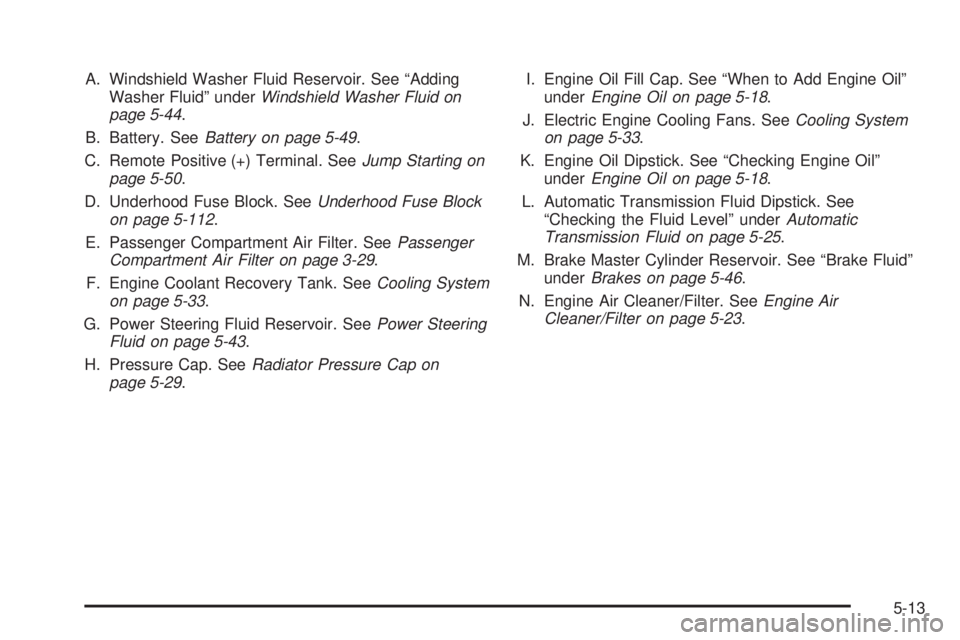
A. Windshield Washer Fluid Reservoir. See “Adding
Washer Fluid” underWindshield Washer Fluid on
page 5-44.
B. Battery. SeeBattery on page 5-49.
C. Remote Positive (+) Terminal. SeeJump Starting on
page 5-50.
D. Underhood Fuse Block. SeeUnderhood Fuse Block
on page 5-112.
E. Passenger Compartment Air Filter. SeePassenger
Compartment Air Filter on page 3-29.
F. Engine Coolant Recovery Tank. SeeCooling System
on page 5-33.
G. Power Steering Fluid Reservoir. SeePower Steering
Fluid on page 5-43.
H. Pressure Cap. SeeRadiator Pressure Cap on
page 5-29.I. Engine Oil Fill Cap. See “When to Add Engine Oil”
underEngine Oil on page 5-18.
J. Electric Engine Cooling Fans. SeeCooling System
on page 5-33.
K. Engine Oil Dipstick. See “Checking Engine Oil”
underEngine Oil on page 5-18.
L. Automatic Transmission Fluid Dipstick. See
“Checking the Fluid Level” underAutomatic
Transmission Fluid on page 5-25.
M. Brake Master Cylinder Reservoir. See “Brake Fluid”
underBrakes on page 5-46.
N. Engine Air Cleaner/Filter. SeeEngine Air
Cleaner/Filter on page 5-23.
5-13
Page 285 of 440
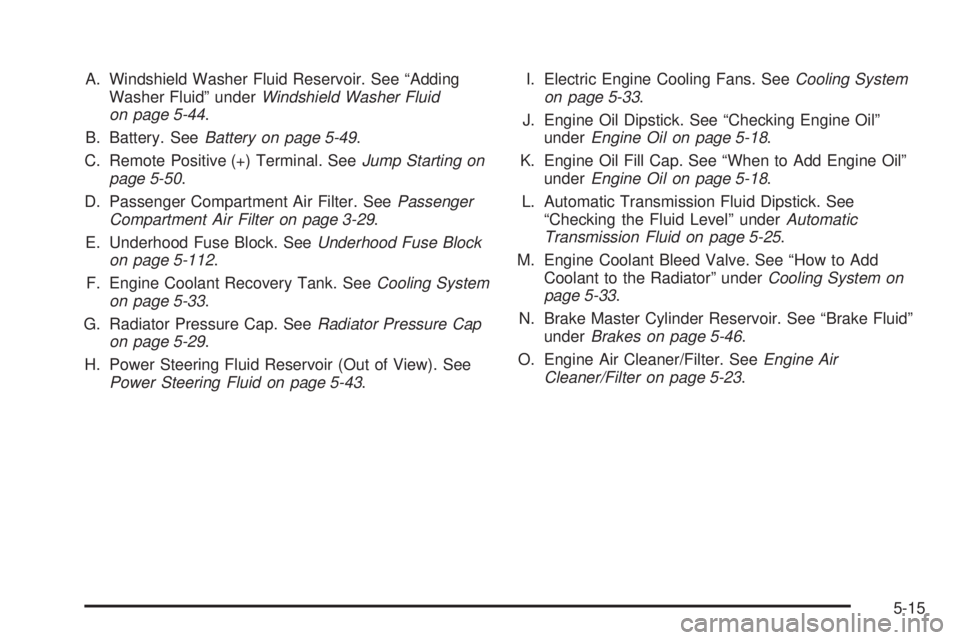
A. Windshield Washer Fluid Reservoir. See “Adding
Washer Fluid” underWindshield Washer Fluid
on page 5-44.
B. Battery. SeeBattery on page 5-49.
C. Remote Positive (+) Terminal. SeeJump Starting on
page 5-50.
D. Passenger Compartment Air Filter. SeePassenger
Compartment Air Filter on page 3-29.
E. Underhood Fuse Block. SeeUnderhood Fuse Block
on page 5-112.
F. Engine Coolant Recovery Tank. SeeCooling System
on page 5-33.
G. Radiator Pressure Cap. SeeRadiator Pressure Cap
on page 5-29.
H. Power Steering Fluid Reservoir (Out of View). See
Power Steering Fluid on page 5-43.I. Electric Engine Cooling Fans. SeeCooling System
on page 5-33.
J. Engine Oil Dipstick. See “Checking Engine Oil”
underEngine Oil on page 5-18.
K. Engine Oil Fill Cap. See “When to Add Engine Oil”
underEngine Oil on page 5-18.
L. Automatic Transmission Fluid Dipstick. See
“Checking the Fluid Level” underAutomatic
Transmission Fluid on page 5-25.
M. Engine Coolant Bleed Valve. See “How to Add
Coolant to the Radiator” underCooling System on
page 5-33.
N. Brake Master Cylinder Reservoir. See “Brake Fluid”
underBrakes on page 5-46.
O. Engine Air Cleaner/Filter. SeeEngine Air
Cleaner/Filter on page 5-23.
5-15
Page 287 of 440
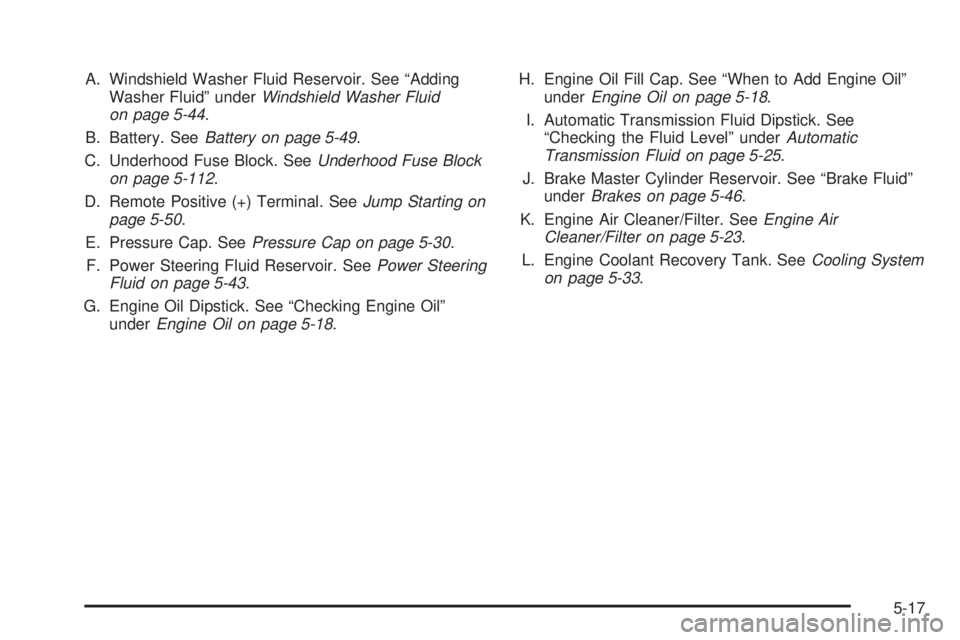
A. Windshield Washer Fluid Reservoir. See “Adding
Washer Fluid” underWindshield Washer Fluid
on page 5-44.
B. Battery. SeeBattery on page 5-49.
C. Underhood Fuse Block. SeeUnderhood Fuse Block
on page 5-112.
D. Remote Positive (+) Terminal. SeeJump Starting on
page 5-50.
E. Pressure Cap. SeePressure Cap on page 5-30.
F. Power Steering Fluid Reservoir. SeePower Steering
Fluid on page 5-43.
G. Engine Oil Dipstick. See “Checking Engine Oil”
underEngine Oil on page 5-18.H. Engine Oil Fill Cap. See “When to Add Engine Oil”
underEngine Oil on page 5-18.
I. Automatic Transmission Fluid Dipstick. See
“Checking the Fluid Level” underAutomatic
Transmission Fluid on page 5-25.
J. Brake Master Cylinder Reservoir. See “Brake Fluid”
underBrakes on page 5-46.
K. Engine Air Cleaner/Filter. SeeEngine Air
Cleaner/Filter on page 5-23.
L. Engine Coolant Recovery Tank. SeeCooling System
on page 5-33.
5-17
Page 295 of 440
Automatic Transmission Fluid
When to Check and Change Automatic
Transmission Fluid
A good time to check the automatic transmission uid
level is when the engine oil is changed.
Change the uid and lter at the intervals listed in
Additional Required Services on page 6-6, and be sure
to use the transmission uid listed inRecommended
Fluids and Lubricants on page 6-12.
How to Check Automatic Transmission
Fluid
Because this operation can be a little difficult, you may
choose to have this done at the dealer/retailer service
department.
If you do it yourself, be sure to follow all the instructions
here, or you could get a false reading on the dipstick.Notice:Too much or too little uid can damage
your transmission. Too much can mean that some
of the uid could come out and fall on hot engine
parts or exhaust system parts, starting a re.
Too little uid could cause the transmission to
overheat. Be sure to get an accurate reading if you
check your transmission uid.
Wait at least 30 minutes before checking the
transmission uid level if you have been driving:
When outside temperatures are above 90°F (32°C).
At high speed for quite a while.
In heavy traffic — especially in hot weather.
While pulling a trailer.
To get the right reading, the uid should be at normal
operating temperature, which is 180°F to 200°F
(82°C to 93°C).
Get the vehicle warmed up by driving about 15 miles
(24 km) when outside temperatures are above 50°F
(10°C). If it is colder than 50°F (10°C), you may have to
drive longer.
5-25
Page 296 of 440
Checking the Fluid Level
Prepare the vehicle as follows:
1. Park the vehicle on a level place. Keep the engine
running.
2. With the parking brake applied, place the shift lever
in PARK (P).
3. With your foot on the brake pedal, move the shift
lever through each gear, pausing for about
three seconds in each one. Then, position the shift
lever in PARK (P).
4. Let the engine run at idle for three to ve minutes.
Then, without shutting off the engine, follow these steps:
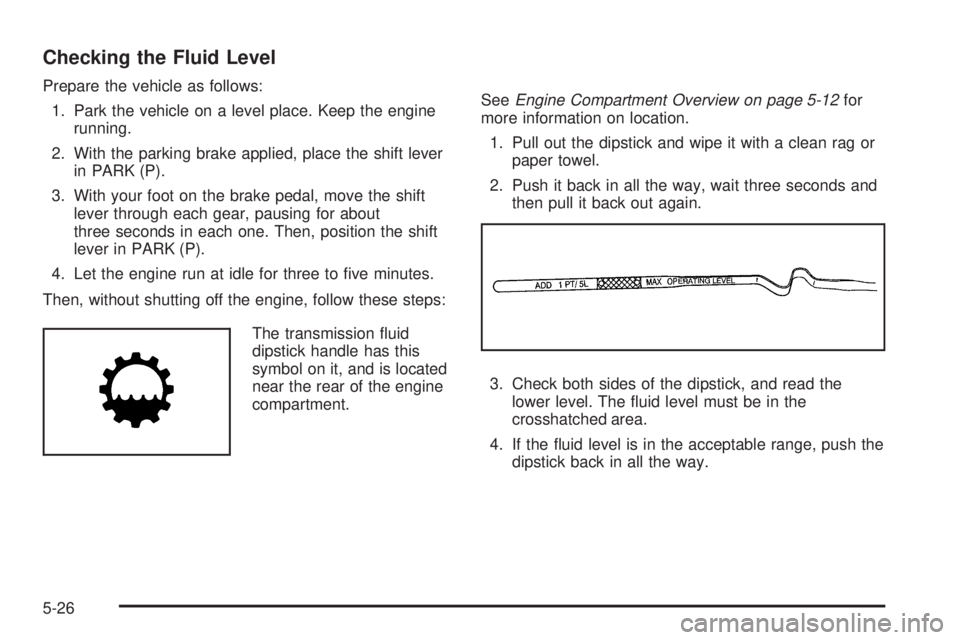
The transmission uid
dipstick handle has this
symbol on it, and is located
near the rear of the engine
compartment.SeeEngine Compartment Overview on page 5-12for
more information on location.
1. Pull out the dipstick and wipe it with a clean rag or
paper towel.
2. Push it back in all the way, wait three seconds and
then pull it back out again.
3. Check both sides of the dipstick, and read the
lower level. The uid level must be in the
crosshatched area.
4. If the uid level is in the acceptable range, push the
dipstick back in all the way.
5-26
Page 297 of 440
How to Add Automatic Transmission
Fluid
Refer to the Maintenance Schedule to determine what
kind of transmission uid to use. SeeRecommended
Fluids and Lubricants on page 6-12.
If the uid level is low, add only enough of the proper
uid to bring the level into the crosshatched area on the
dipstick.
1. Pull out the dipstick.
2. Using a long-neck funnel, add enough uid at the
dipstick hole to bring it to the proper level.
It does not take much uid, generally less than one
pint (0.5 L). Do not overll.
Notice:Use of the incorrect automatic transmission
uid may damage your vehicle, and the damages
may not be covered by your warranty. Always use
the automatic transmission uid listed in
Recommended Fluids and Lubricants on page 6-12.
3. After adding uid, recheck the uid level as
described under “How to Check Automatic
Transmission Fluid,” earlier in this section.
4. When the correct uid level is obtained, push the
dipstick back in all the way.
Engine Coolant
The cooling system in the vehicle is lled with
DEX-COOL®engine coolant. This coolant is designed to
remain in the vehicle for ve years or 150,000 miles
(240 000 km), whichever occurs rst, if only DEX-COOL
®
extended life coolant is added.
The following explains the cooling system and how to
add coolant when it is low. If there is a problem with
engine overheating or if coolant needs to be added to the
radiator, seeEngine Overheating on page 5-30.
A 50/50 mixture of clean, drinkable water and
DEX-COOL
®engine coolant will:
Give freezing protection down to−34°F (−37°C).
Give boiling protection up to 265°F (129°C).
Protect against rust and corrosion.
Help keep the proper engine temperature.
Let the warning lights and gages work as they
should.
Notice:Using coolant other than DEX-COOL
®may
cause premature engine, heater core, or radiator
corrosion. In addition, the engine coolant may
require changing sooner, at the rst maintenance
service after each 30,000 miles (50 000 km) or
24 months, whichever occurs rst. Any repairs would
not be covered by your warranty. Always use
DEX-COOL
®(silicate-free) coolant in your vehicle.
5-27