check BUICK LACROSSE 2009 Manual PDF
[x] Cancel search | Manufacturer: BUICK, Model Year: 2009, Model line: LACROSSE, Model: BUICK LACROSSE 2009Pages: 428
Page 338 of 428
Reset the Tire Pressure Monitor System. SeeTire
Pressure Monitor Operation on page 5-64.
Make certain that all wheel nuts are properly
tightened. See “Wheel Nut Torque” under
Capacities and Specifications on page 5-106.
{CAUTION:
Rust or dirt on a wheel, or on the parts to
which it is fastened, can make wheel nuts
become loose after time. The wheel could
come off and cause an accident. When you
change a wheel, remove any rust or dirt from
places where the wheel attaches to the
vehicle. In an emergency, you can use a cloth
or a paper towel to do this; but be sure to use a
scraper or wire brush later, if needed, to get all
the rust or dirt off. SeeChanging a Flat Tire on
page 5-76.
When It Is Time for New Tires
Various factors, such as maintenance, temperatures,
driving speeds, vehicle loading, and road conditions
inuence when you need new tires.
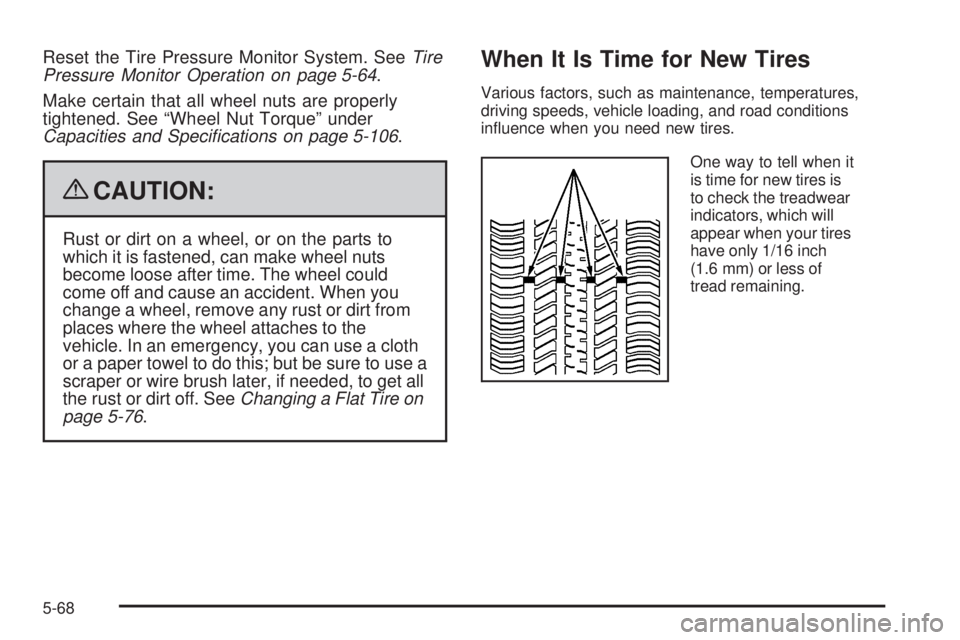
One way to tell when it
is time for new tires is
to check the treadwear
indicators, which will
appear when your tires
have only 1/16 inch
(1.6 mm) or less of
tread remaining.
5-68
Page 344 of 428
Wheel Alignment and Tire Balance
The tires and wheels on your vehicle were aligned and
balanced carefully at the factory to give you the longest
tire life and best overall performance. Adjustments to
wheel alignment and tire balancing will not be necessary
on a regular basis. However, if you notice unusual tire
wear or your vehicle pulling to one side or the other, the
alignment might need to be checked. If you notice your
vehicle vibrating when driving on a smooth road, the tires
and wheels might need to be rebalanced. See your
dealer/retailer for proper diagnosis.
Wheel Replacement
Replace any wheel that is bent, cracked, or badly rusted
or corroded. If wheel nuts keep coming loose, the wheel,
wheel bolts, and wheel nuts should be replaced. If the
wheel leaks air, replace it (except some aluminum
wheels, which can sometimes be repaired). See your
dealer/retailer if any of these conditions exist.
Your dealer/retailer will know the kind of wheel
you need.
Each new wheel should have the same load-carrying
capacity, diameter, width, offset, and be mounted
the same way as the one it replaces.If you need to replace any of your wheels, wheel bolts,
wheel nuts, or Tire Pressure Monitor System (TPMS)
sensors, replace them only with new GM original
equipment parts. This way, you will be sure to have
the right wheel, wheel bolts, wheel nuts, and TPMS
sensors for your vehicle.
{CAUTION:
Using the wrong replacement wheels, wheel bolts,
or wheel nuts on your vehicle can be dangerous.
It could affect the braking and handling of your
vehicle, make your tires lose air and make you
lose control. You could have a collision in which
you or others could be injured. Always use the
correct wheel, wheel bolts, and wheel nuts for
replacement.
Notice:The wrong wheel can also cause problems
with bearing life, brake cooling, speedometer or
odometer calibration, headlamp aim, bumper height,
vehicle ground clearance, and tire or tire chain
clearance to the body and chassis.
SeeChanging a Flat Tire on page 5-76for more
information.
5-74
Page 349 of 428
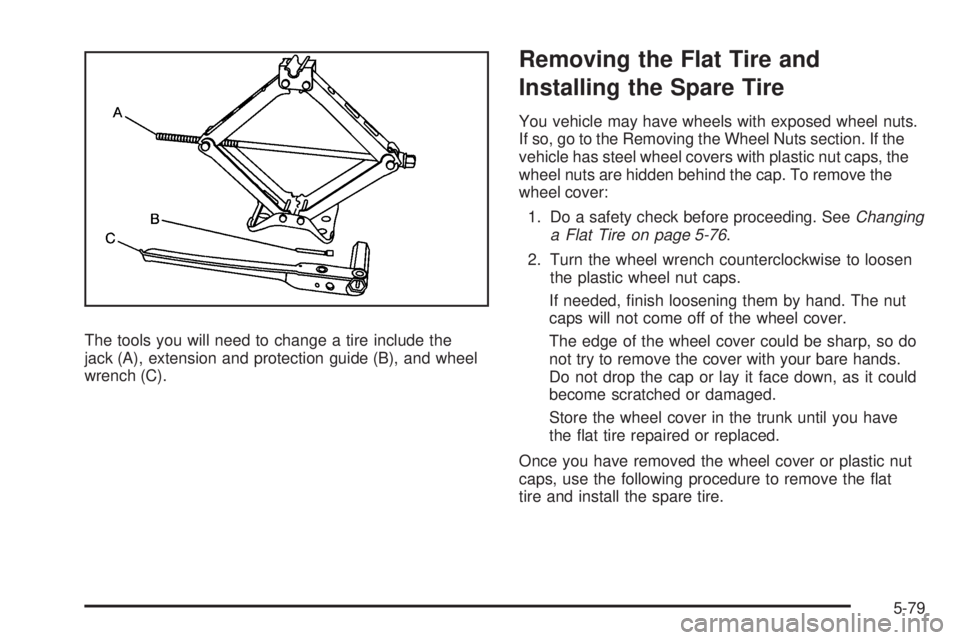
The tools you will need to change a tire include the
jack (A), extension and protection guide (B), and wheel
wrench (C).
Removing the Flat Tire and
Installing the Spare Tire
You vehicle may have wheels with exposed wheel nuts.
If so, go to the Removing the Wheel Nuts section. If the
vehicle has steel wheel covers with plastic nut caps, the
wheel nuts are hidden behind the cap. To remove the
wheel cover:
1. Do a safety check before proceeding. SeeChanging
a Flat Tire on page 5-76.
2. Turn the wheel wrench counterclockwise to loosen
the plastic wheel nut caps.
If needed, nish loosening them by hand. The nut
caps will not come off of the wheel cover.
The edge of the wheel cover could be sharp, so do
not try to remove the cover with your bare hands.
Do not drop the cap or lay it face down, as it could
become scratched or damaged.
Store the wheel cover in the trunk until you have
the at tire repaired or replaced.
Once you have removed the wheel cover or plastic nut
caps, use the following procedure to remove the at
tire and install the spare tire.
5-79
Page 359 of 428
Compact Spare Tire
Although the compact spare tire was fully inated
when the vehicle was new, it can lose air after a time.
Check the ination pressure regularly. It should be
60 psi (420 kPa).
After installing the compact spare on the vehicle,
stop as soon as possible and make sure the spare
tire is correctly inated. The compact spare is made
to perform well at speeds up to 65 mph (105 km/h)
for distances up to 3,000 miles (5 000 km), so you
can nish your trip and have the full-size tire repaired
or replaced at your convenience. Of course, it is best
to replace the spare with a full-size tire as soon as
possible. The spare tire will last longer and be in good
shape in case it is needed again.Notice:When the compact spare is installed,
do not take the vehicle through an automatic car
wash with guide rails. The compact spare can
get caught on the rails which can damage the tire,
wheel and other parts of the vehicle.
Do not use the compact spare on other vehicles.
And do not mix the compact spare tire or wheel with
other wheels or tires. They will not t. Keep the spare tire
and its wheel together.
Notice:Tire chains will not t the compact spare.
Using them can damage the vehicle and can damage
the chains too. Do not use tire chains on the
compact spare.
5-89
Page 363 of 428
Care of Safety Belts
Keep belts clean and dry.
{CAUTION:
Do not bleach or dye safety belts. It may severely
weaken them. In a crash, they might not be able
to provide adequate protection. Clean safety belts
only with mild soap and lukewarm water.
Weatherstrips
Silicone grease on weatherstrips will make them last
longer, seal better, and not stick or squeak. Apply
silicone grease with a clean cloth. During very cold,
damp weather frequent application may be required.
SeeRecommended Fluids and Lubricants on page 6-11.
Washing Your Vehicle
The best way to preserve the vehicle’s nish is to keep
it clean by washing it often.
Notice:Certain cleaners contain chemicals that can
damage the emblems or nameplates on the vehicle.
Check the cleaning product label. If it states that
it should not be used on plastic parts, do not use it
on the vehicle or damage may occur and it would
not be covered by the warranty.
Do not wash the vehicle in direct sunlight. Use a car
washing soap. Do not use cleaning agents that are
petroleum based or that contain acid or abrasives,
as they can damage the paint, metal or plastic on the
vehicle. Approved cleaning products can be obtained
from your dealer/retailer. Follow all manufacturers’
directions regarding correct product usage, necessary
safety precautions and appropriate disposal of any
vehicle care product.
5-93
Page 369 of 428
Electrical System
Add-On Electrical Equipment
Notice:Do not add anything electrical to the
vehicle unless you check with your dealer/retailer
rst. Some electrical equipment can damage
the vehicle and the damage would not be covered
by the vehicle’s warranty. Some add-on electrical
equipment can keep other components from
working as they should.
Add-on equipment can drain the vehicle battery, even if
the vehicle is not operating.
The vehicle has an airbag system. Before attempting to
add anything electrical to the vehicle, seeServicing
Your Airbag-Equipped Vehicle on page 1-66.
Headlamp Wiring
The headlamp wiring is protected by a circuit breaker.
An electrical overload will cause the lamps to go on
and off, or in some cases to remain off. If this happens,
have your headlamp wiring checked right away.
Windshield Wiper Fuses
The windshield wiper motor is protected by a circuit
breaker and a fuse. If the motor overheats due to heavy
snow, etc., the wiper will stop until the motor cools.
If the overload is caused by some electrical problem,
have it xed.
Power Windows and Other Power
Options
Circuit breakers in the fuse block protect the power
windows and other power accessories. When the current
load is too heavy, the circuit breaker opens and closes,
protecting the circuit until the problem is xed or
goes away.
Fuses and Circuit Breakers
The wiring circuits in the vehicle are protected from
short circuits by a combination of fuses, circuit breakers
and in the fuse block wiring itself. This greatly reduces
the chance of res caused by electrical problems.
Look at the silver-colored band inside the fuse. If the
band is broken or melted, replace the fuse. Make sure
a bad fuse is replaced with a new one of the identical
size and rating.
5-99
Page 379 of 428
Maintenance Schedule......................................6-2
Introduction...................................................6-2
Maintenance Requirements..............................6-2
Your Vehicle and the Environment....................6-2
Using the Maintenance Schedule......................6-3
Scheduled Maintenance...................................6-4
Additional Required Services............................6-6
Maintenance Footnotes...................................6-7Owner Checks and Services............................6-8
At Each Fuel Fill............................................6-8
At Least Once a Month...................................6-9
At Least Once a Year.....................................6-9
Recommended Fluids and Lubricants...............6-11
Maintenance Replacement Parts.....................6-13
Engine Drive Belt Routing..............................6-14
Maintenance Record.....................................6-15
Section 6 Maintenance Schedule
6-1
Page 380 of 428
Maintenance Schedule
Introduction
Important: Keep engine oil at the proper level and
change as recommended.
Have you purchased the GM Protection Plan? The Plan
supplements the vehicle warranties. See the Warranty
and Owner Assistance booklet or your dealer/retailer for
details.
Maintenance Requirements
Notice:Maintenance intervals, checks, inspections,
replacement parts, and recommended uids and
lubricants as prescribed in this manual are
necessary to keep this vehicle in good working
condition. Any damage caused by failure to follow
scheduled maintenance might not be covered by the
vehicle warranty.
Your Vehicle and the Environment
Proper vehicle maintenance not only helps to keep
the vehicle in good working condition, but also helps
the environment. All recommended maintenance
is important. Improper vehicle maintenance can even
affect the quality of the air we breathe. Improper
uid levels or the wrong tire ination can increase the
level of emissions from the vehicle. To help protect
the environment, and to keep the vehicle in good
condition, be sure to maintain the vehicle properly.
6-2
Page 381 of 428
Using the Maintenance Schedule
We want to help keep this vehicle in good working
condition. But we do not know exactly how you will drive
it. You might drive very short distances only a few
times a week. Or you might drive long distances all the
time in very hot, dusty weather. You might use the
vehicle in making deliveries. Or you might drive
it to work, to do errands, or in many other ways.
Because of all the different ways people use their
vehicles, maintenance needs vary. You might need more
frequent checks and replacements. So please read
the following and note how you drive. If you have any
questions on how to keep the vehicle in good condition,
see your dealer/retailer.
This schedule is for vehicles that:
carry passengers and cargo within recommended
limits on the Tire and Loading Information label.
SeeLoading the Vehicle on page 4-20.
are driven on reasonable road surfaces within legal
driving limits.
use the recommended fuel. SeeGasoline Octane
on page 5-6.
The services inScheduled Maintenance on page 6-4
should be performed when indicated. SeeAdditional
Required Services on page 6-6andMaintenance
Footnotes on page 6-7for further information.
{CAUTION:
Performing maintenance work on a vehicle can be
dangerous. In trying to do some jobs, you can be
seriously injured. Do your own maintenance work
only if you have the required know-how and the
proper tools and equipment for the job. If you have
any doubt, see your dealer/retailer to have a
qualied technician do the work. SeeDoing Your
Own Service Work on page 5-4.
Some maintenance services can be complex.
So, unless you are technically qualied and have the
necessary equipment, have your dealer/retailer do
these jobs.
When you go to your dealer/retailer for service, trained
and supported service technicians will perform the
work using genuine parts.
To purchase service information, seeService
Publications Ordering Information on page 7-16.
6-3
Page 382 of 428
Owner Checks and Services on page 6-8tells what
should be checked, when to check it, and what
can easily be done to help keep the vehicle in good
condition.
The proper replacement parts, uids, and lubricants to
use are listed inRecommended Fluids and Lubricants
on page 6-11andMaintenance Replacement Parts
on page 6-13. When the vehicle is serviced, make sure
these are used. All parts should be replaced and all
necessary repairs done before you or anyone else
drives the vehicle. We recommend the use of genuine
parts from your dealer/retailer.
Scheduled Maintenance
When the change engine oil light or CHANGE OIL
SOON DIC message displays, service is required for
the vehicle. Have the vehicle serviced as soon as
possible within the next 600 miles (1 000 km). It is
possible that, if driving under the best conditions, the
engine oil life system may not indicate that vehicle
service is necessary for over a year. However,
the engine oil and lter must be changed at least
once a year and at this time the system must be reset.
Your dealer/retailer has trained service technicians
who will perform this work using genuine parts and reset
the system.If the engine oil life system is ever reset accidentally,
service the vehicle within 3,000 miles (5 000 km)
since the last service. Remember to reset the oil life
system whenever the oil is changed. SeeEngine Oil Life
System on page 5-18for information on the Engine
Oil Life System and resetting the system.
When the light or message appears, certain services,
checks, and inspections are required. Required services
are described in the following for “MaintenanceI” and
“MaintenanceII.” Generally, it is recommended that the
rst service be MaintenanceI, the second service be
MaintenanceII, and then alternate MaintenanceI
and MaintenanceIIthereafter. However, in some cases,
MaintenanceIImay be required more often.
MaintenanceI— Use MaintenanceIif the light or
message displays within 10 months since the vehicle
was purchased or MaintenanceIIwas performed.
MaintenanceII— Use MaintenanceIIif the previous
service performed was MaintenanceI. Always use
MaintenanceIIwhenever the light or message displays
10 months or more since the last service or if the
light or message has not come on at all for one year.
6-4