center BUICK LACROSSE 2011 Service Manual
[x] Cancel search | Manufacturer: BUICK, Model Year: 2011, Model line: LACROSSE, Model: BUICK LACROSSE 2011Pages: 462, PDF Size: 5.73 MB
Page 259 of 462
Black plate (9,1)Buick LaCrosse Owner Manual - 2011
Driving and Operating 9-9
{WARNING
Coasting downhill in N (Neutral)
or with the ignition off is
dangerous. The brakes will
have to do all the work of slowing
down and they could get so hot
that they would not work well.
You would then have poor braking
or even none going down a hill.
You could crash. Always have the
engine running and the vehicle in
gear when going downhill.
.Stay in your own lane. Do not
swing wide or cut across the
center of the road. Drive at
speeds that let you stay in
your own lane.
.Top of hills: Be
alert—something could
be in your lane (stalled car,
accident).
.Pay attention to special road
signs (falling rocks area, winding
roads, long grades, passing or
no-passing zones) and take
appropriate action.
Winter Driving
Driving on Snow or Ice
Drive carefully when there is
snow or ice between the tires
and the road, creating less traction
or grip. Wet ice can occur at about
0°C (32°F) when freezing rain
begins to fall, resulting in even less
traction. Avoid driving on wet ice or
in freezing rain until roads can be
treated with salt or sand.
Drive with caution, whatever the
condition. Accelerate gently so
traction is not lost. Accelerating too
quickly causes the wheels to spin
and makes the surface under the
tires slick, so there is even less
traction. Try not to break the fragile traction.
If you accelerate too fast, the drive
wheels will spin and polish the
surface under the tires even more.
The
Antilock Brake System (ABS)
on page 9‑32 improves vehicle
stability during hard stops on
slippery roads, but apply the brakes
sooner than when on dry pavement.
Allow greater following distance
on any slippery road and watch
for slippery spots. Icy patches can
occur on otherwise clear roads in
shaded areas. The surface of a
curve or an overpass can remain
icy when the surrounding roads
are clear. Avoid sudden steering
maneuvers and braking while
on ice.
Turn off cruise control on slippery
surfaces.
Page 262 of 462
Black plate (12,1)Buick LaCrosse Owner Manual - 2011
9-12 Driving and Operating
Vehicle Load Limits
It is very important to know
how much weight the vehicle
can carry. This weight is called
the vehicle capacity weight
and includes the weight of
all occupants, cargo and all
nonfactory‐installed options.
Two labels on the vehicle
show how much weight it
may properly carry, the Tire
and Loading Information label
and the Certification label.{WARNING
Do not load the vehicle
any heavier than the
Gross Vehicle Weight
Rating (GVWR), or either the
maximum front or rear Gross
Axle Weight Rating (GAWR).
This can cause systems to
break and change the way the
vehicle handles. This could
cause loss of control and a
crash. Overloading can also
shorten the life of the vehicle. Tire and Loading Information
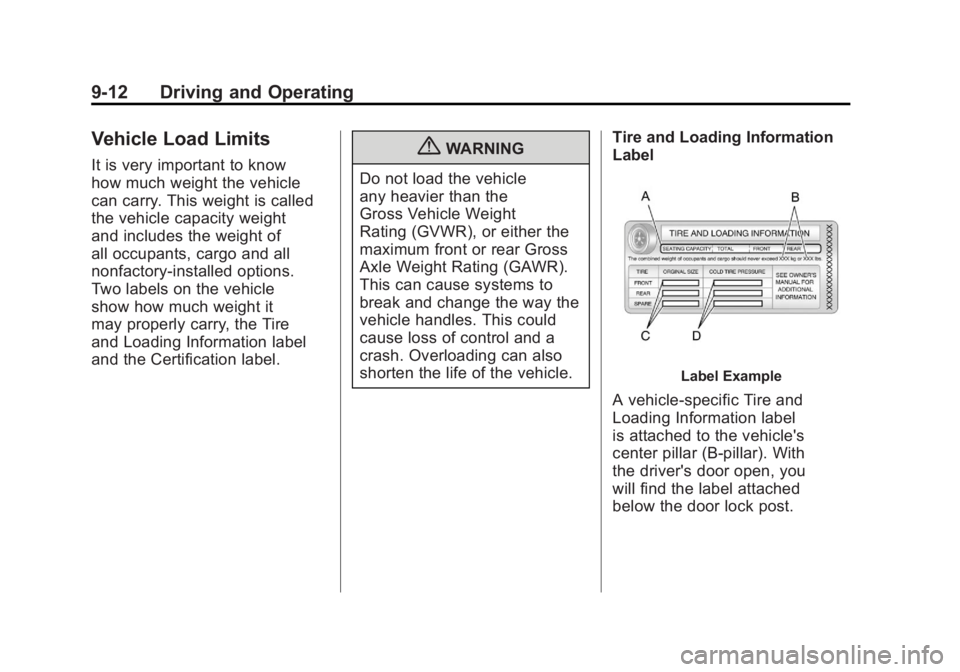
Label
Label Example
A vehicle-specific Tire and
Loading Information label
is attached to the vehicle's
center pillar (B-pillar). With
the driver's door open, you
will find the label attached
below the door lock post.
Page 265 of 462
Black plate (15,1)Buick LaCrosse Owner Manual - 2011
Driving and Operating 9-15
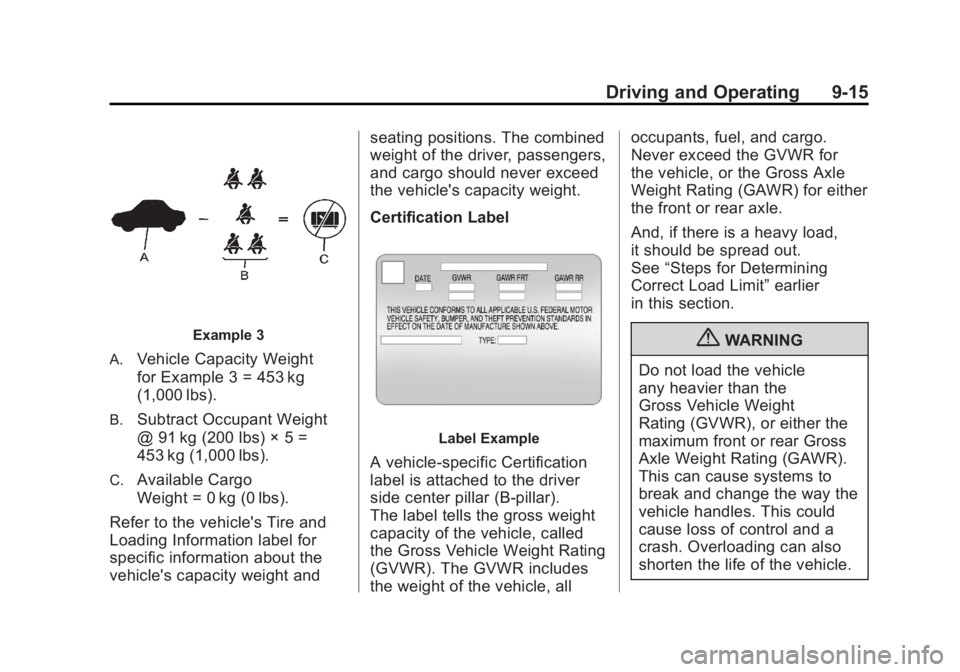
Example 3
A.
Vehicle Capacity Weight
for Example 3 = 453 kg
(1,000 lbs).
B.Subtract Occupant Weight
@ 91 kg (200 lbs) × 5 =
453 kg (1,000 lbs).
C.Available Cargo
Weight = 0 kg (0 lbs).
Refer to the vehicle's Tire and
Loading Information label for
specific information about the
vehicle's capacity weight and seating positions. The combined
weight of the driver, passengers,
and cargo should never exceed
the vehicle's capacity weight.
Certification Label
Label Example
A vehicle-specific Certification
label is attached to the driver
side center pillar (B-pillar).
The label tells the gross weight
capacity of the vehicle, called
the Gross Vehicle Weight Rating
(GVWR). The GVWR includes
the weight of the vehicle, alloccupants, fuel, and cargo.
Never exceed the GVWR for
the vehicle, or the Gross Axle
Weight Rating (GAWR) for either
the front or rear axle.
And, if there is a heavy load,
it should be spread out.
See
“Steps for Determining
Correct Load Limit” earlier
in this section.
{WARNING
Do not load the vehicle
any heavier than the
Gross Vehicle Weight
Rating (GVWR), or either the
maximum front or rear Gross
Axle Weight Rating (GAWR).
This can cause systems to
break and change the way the
vehicle handles. This could
cause loss of control and a
crash. Overloading can also
shorten the life of the vehicle.
Page 268 of 462
Black plate (18,1)Buick LaCrosse Owner Manual - 2011
9-18 Driving and Operating
In an emergency, if the vehicle must
be shut off while driving:
1. Brake using a firm and steadypressure. Do not pump the
brakes repeatedly. This may
deplete power assist, requiring
increased brake pedal force.
2. Shift the vehicle to N (Neutral). This can be done while the
vehicle is moving. After shifting
to N (Neutral), firmly apply the
brakes and steer the vehicle to
a safe location.
3. Come to a complete stop, shift to P (Park), and turn the ignition
to LOCK/OFF. On vehicles with
an automatic transmission, the
shift lever must be in P (Park)
to turn the ignition switch to
the LOCK/OFF position.
4. Set the parking brake. See Parking Brake on
page 9‑33.{WARNING
Turning off the vehicle while
moving may cause loss of power
assist in the brake and steering
systems and disable the airbags.
While driving, only shut the
vehicle off in an emergency.
5. If the vehicle must be shut off while driving, turn the ignition to
ACC/ACCESSORY.
The ignition switch can bind in the
LOCK/OFF position with the wheels
turned off center. If this happens,
move the steering wheel from
right to left while turning the key
to ACC/ACCESSORY. If this does
not work, then the vehicle needs
service.
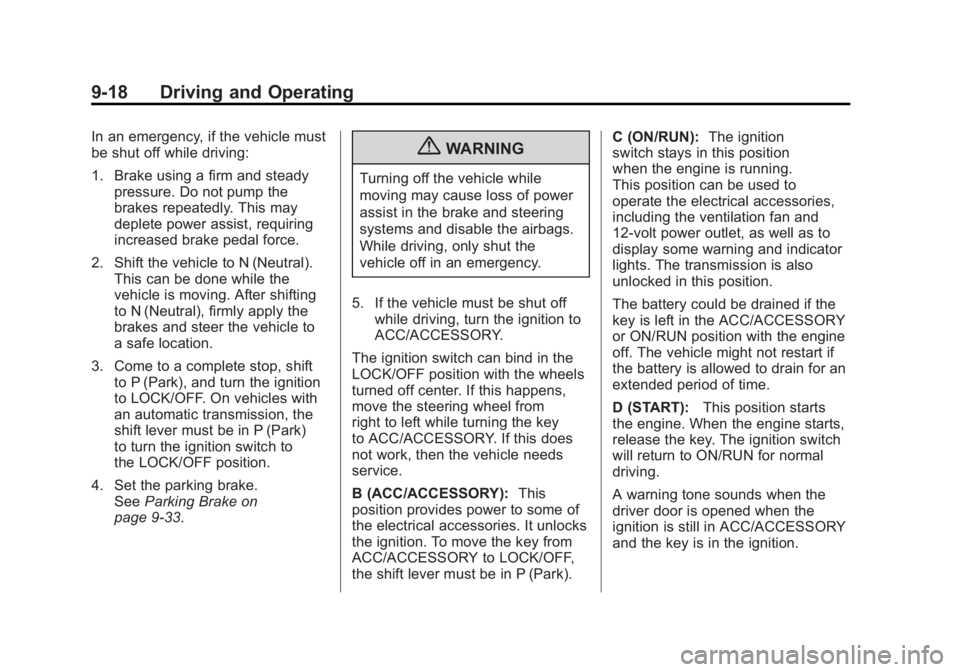
B (ACC/ACCESSORY): This
position provides power to some of
the electrical accessories. It unlocks
the ignition. To move the key from
ACC/ACCESSORY to LOCK/OFF,
the shift lever must be in P (Park). C (ON/RUN):
The ignition
switch stays in this position
when the engine is running.
This position can be used to
operate the electrical accessories,
including the ventilation fan and
12‐volt power outlet, as well as to
display some warning and indicator
lights. The transmission is also
unlocked in this position.
The battery could be drained if the
key is left in the ACC/ACCESSORY
or ON/RUN position with the engine
off. The vehicle might not restart if
the battery is allowed to drain for an
extended period of time.
D (START): This position starts
the engine. When the engine starts,
release the key. The ignition switch
will return to ON/RUN for normal
driving.
A warning tone sounds when the
driver door is opened when the
ignition is still in ACC/ACCESSORY
and the key is in the ignition.
Page 269 of 462
Black plate (19,1)Buick LaCrosse Owner Manual - 2011
Driving and Operating 9-19
Ignition Positions
(Keyless Access)
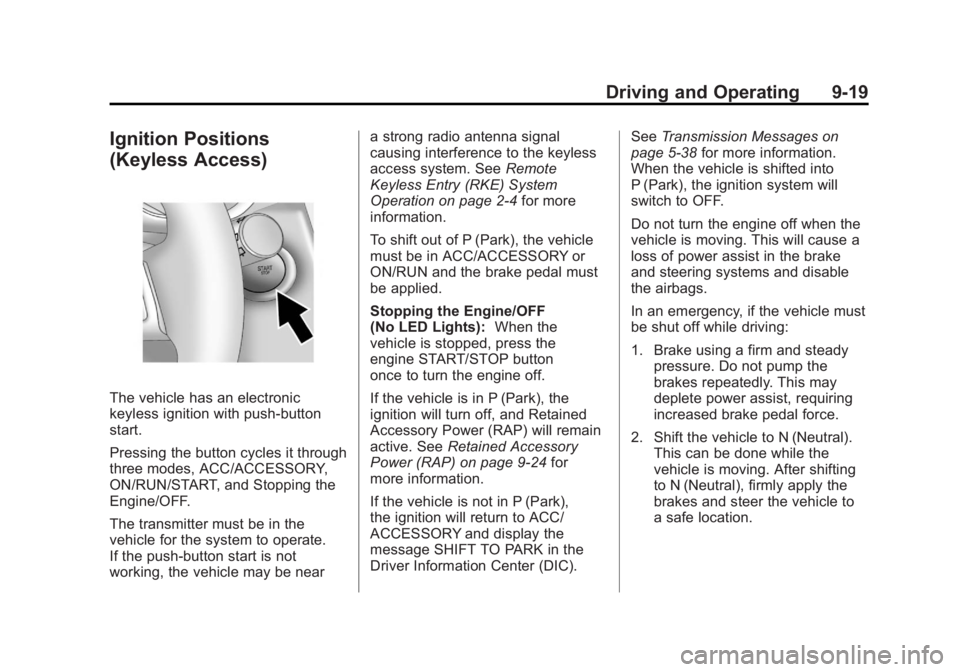
The vehicle has an electronic
keyless ignition with push‐button
start.
Pressing the button cycles it through
three modes, ACC/ACCESSORY,
ON/RUN/START, and Stopping the
Engine/OFF.
The transmitter must be in the
vehicle for the system to operate.
If the push-button start is not
working, the vehicle may be neara strong radio antenna signal
causing interference to the keyless
access system. See
Remote
Keyless Entry (RKE) System
Operation on page 2‑4 for more
information.
To shift out of P (Park), the vehicle
must be in ACC/ACCESSORY or
ON/RUN and the brake pedal must
be applied.
Stopping the Engine/OFF
(No LED Lights): When the
vehicle is stopped, press the
engine START/STOP button
once to turn the engine off.
If the vehicle is in P (Park), the
ignition will turn off, and Retained
Accessory Power (RAP) will remain
active. See Retained Accessory
Power (RAP) on page 9‑24 for
more information.
If the vehicle is not in P (Park),
the ignition will return to ACC/
ACCESSORY and display the
message SHIFT TO PARK in the
Driver Information Center (DIC). See
Transmission Messages on
page 5‑38 for more information.
When the vehicle is shifted into
P (Park), the ignition system will
switch to OFF.
Do not turn the engine off when the
vehicle is moving. This will cause a
loss of power assist in the brake
and steering systems and disable
the airbags.
In an emergency, if the vehicle must
be shut off while driving:
1. Brake using a firm and steady pressure. Do not pump the
brakes repeatedly. This may
deplete power assist, requiring
increased brake pedal force.
2. Shift the vehicle to N (Neutral). This can be done while the
vehicle is moving. After shifting
to N (Neutral), firmly apply the
brakes and steer the vehicle to
a safe location.
Page 272 of 462
Black plate (22,1)Buick LaCrosse Owner Manual - 2011
9-22 Driving and Operating
Starting Procedure
(Keyless Access)
1. If the vehicle has the keylessaccess system, the transmitter
must be in the vehicle. Put
your foot on the brake pedal
and push the START button.
When the engine begins
cranking, let go of the button.
The idle speed will go down
as your engine gets warm.
Do not race the engine
immediately after starting it.
Operate the engine and
transmission gently to allow
the oil to warm up and lubricate
all moving parts.
If the transmitter is not in
the vehicle or something is
interfering with the transmitter,
the Driver Information Center (DIC) will display NO REMOTE
DETECTED. See
Driver
Information Center (DIC) on
page 5‑25 for more information.
If the battery in the keyless
access transmitter needs
replacing, the DIC displays
REPLACE BATTERY IN
REMOTE KEY. The vehicle
can still be driven. See “Starting
the Vehicle with a Low
Transmitter Battery” inRemote
Keyless Entry (RKE) System
Operation on page 2‑4 for
more information.
The vehicle has a
Computer-Controlled Cranking
System. This feature assists
in starting the engine and
protects components. If the
START button is pressed, and
then released when the engine begins cranking, the engine
will continue cranking for a few
seconds or until the vehicle
starts. If the engine does not
start and the button is pressed
for many seconds, cranking will
be stopped after 15 seconds to
prevent cranking motor damage.
To prevent gear damage, this
system also prevents cranking
if the engine is already running.
Engine cranking can be stopped
by pressing the START button a
second time.
Notice: Cranking the engine for
long periods of time, by returning
the key to the START position
immediately after cranking has
ended, can overheat and damage
the cranking motor, and drain the
battery. Wait at least 15 seconds
between each try, to let the
cranking motor cool down.
Page 280 of 462
Black plate (30,1)Buick LaCrosse Owner Manual - 2011
9-30 Driving and Operating
D (Drive):This position is for
normal driving. It provides the
best fuel economy. If more power
is needed for passing, and the
vehicle is:
.Going less than 56 km/h
(35 mph), push the accelerator
pedal about halfway down.
.Going about 56 km/h (35 mph) or
more, push the accelerator all
the way down.
Notice: If the vehicle seems to
accelerate slowly or not shift
gears when you go faster, and
you continue to drive the vehicle
that way, you could damage the
transmission. Have the vehicle
serviced right away. You can
drive in L (Low) when you are
driving less than 56 km/h (35 mph)
and D (Drive) for higher speeds
until then.
Manual Mode: This position is
shown on the shifter as a +/−.
It allows the driver to select the
gears appropriate for current driving
conditions. See Manual Mode on
page 9‑30 for more information.
Manual Mode
Driver Shift Control (DSC)
Notice:If you drive the vehicle
at a high rpm without upshifting
while using Driver Shift Control
(DSC), you could damage the
vehicle. Always upshift when
necessary while using DSC.
Driver Shift Control (DSC)
allows you to shift an automatic
transmission similar to a manual
transmission. To use the DSC
feature:
With Selective Ride Control
1. Move the shift lever to the left from D (Drive).
The vehicle will be in Sport
Mode. The gear indicator in
the DIC will still display a D for
Drive, and the SPORT MODE
ON message will be displayed
momentarily. See Driver
Information Center (DIC) on
page 5‑25. When you are in
Sport Mode, the vehicle will still shift automatically, but
chassis tuning is modified.
See
Selective Ride Control on
page 9‑38. If you move the
shift lever forward or rearward,
the transmission will enter
Manual Mode, and the DIC
gear indicator will change to
an M followed by a number
representing the gear the
vehicle is currently in.
2. In Manual Mode, press the shift lever forward to upshift
or rearward to downshift.
Without Selective Ride Control
1. Move the shift lever to the left from D (Drive).
The transmission will enter
Manual Mode. The DIC gear
indicator will change to an
M followed by a number
representing the gear the
vehicle is currently in.
2. In Manual Mode, press the shift lever forward to upshift
or rearward to downshift.
Page 283 of 462
Black plate (33,1)Buick LaCrosse Owner Manual - 2011
Driving and Operating 9-33
Using ABS
Do not pump the brakes. Just hold
the brake pedal down firmly and let
ABS work. You might hear the ABS
pump or motor operating and feel
the brake pedal pulsate, but this is
normal.
Braking in Emergencies
ABS allows the driver to steer and
brake at the same time. In many
emergencies, steering can help
more than even the very best
braking.
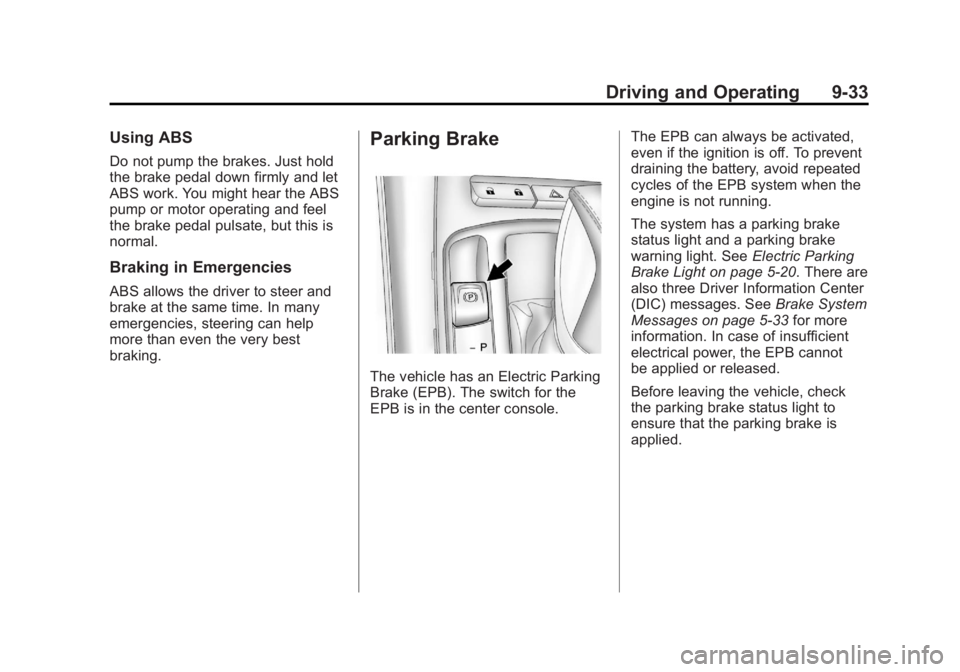
Parking Brake
The vehicle has an Electric Parking
Brake (EPB). The switch for the
EPB is in the center console.The EPB can always be activated,
even if the ignition is off. To prevent
draining the battery, avoid repeated
cycles of the EPB system when the
engine is not running.
The system has a parking brake
status light and a parking brake
warning light. See
Electric Parking
Brake Light on page 5‑20. There are
also three Driver Information Center
(DIC) messages. See Brake System
Messages on page 5‑33 for more
information. In case of insufficient
electrical power, the EPB cannot
be applied or released.
Before leaving the vehicle, check
the parking brake status light to
ensure that the parking brake is
applied.
Page 293 of 462
Black plate (43,1)Buick LaCrosse Owner Manual - 2011
Driving and Operating 9-43
PARK ASSIST OFF displays on
the Driver Information Center (DIC)
to indicate that URPA is off. The
message disappears after a short
period of time.
Turning the System On and Off
The URPA system can be turned on
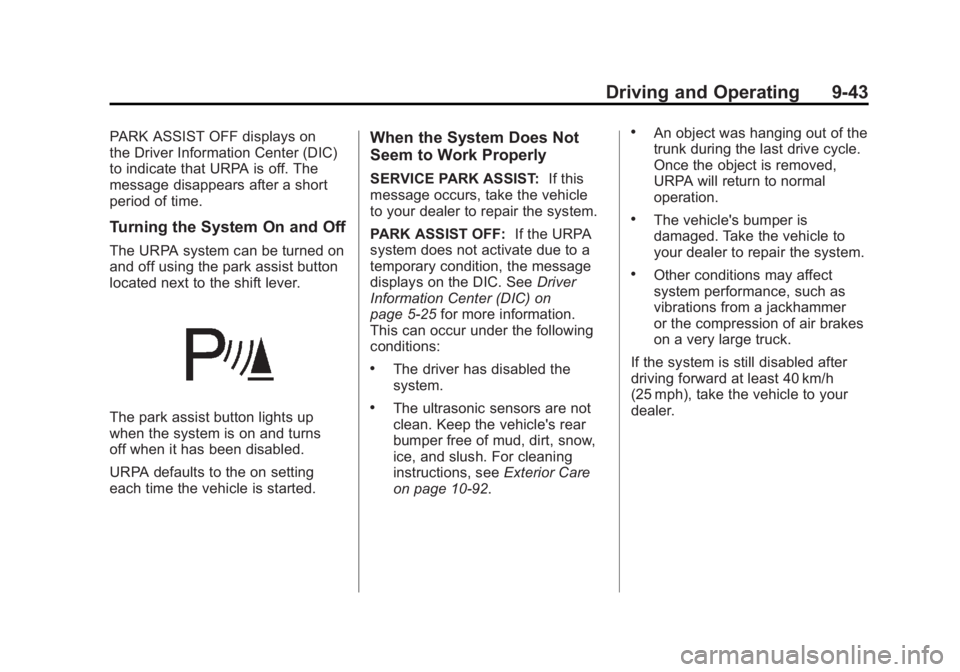
and off using the park assist button
located next to the shift lever.
The park assist button lights up
when the system is on and turns
off when it has been disabled.
URPA defaults to the on setting
each time the vehicle is started.
When the System Does Not
Seem to Work Properly
SERVICE PARK ASSIST:If this
message occurs, take the vehicle
to your dealer to repair the system.
PARK ASSIST OFF: If the URPA
system does not activate due to a
temporary condition, the message
displays on the DIC. See Driver
Information Center (DIC) on
page 5‑25 for more information.
This can occur under the following
conditions:
.The driver has disabled the
system.
.The ultrasonic sensors are not
clean. Keep the vehicle's rear
bumper free of mud, dirt, snow,
ice, and slush. For cleaning
instructions, see Exterior Care
on page 10‑92.
.An object was hanging out of the
trunk during the last drive cycle.
Once the object is removed,
URPA will return to normal
operation.
.The vehicle's bumper is
damaged. Take the vehicle to
your dealer to repair the system.
.Other conditions may affect
system performance, such as
vibrations from a jackhammer
or the compression of air brakes
on a very large truck.
If the system is still disabled after
driving forward at least 40 km/h
(25 mph), take the vehicle to your
dealer.
Page 317 of 462
Black plate (5,1)Buick LaCrosse Owner Manual - 2011
Vehicle Care 10-5
This vehicle has an airbag system.
Before attempting to do your own
service work, seeServicing the
Airbag-Equipped Vehicle on
page 3‑41.
Keep a record with all parts receipts
and list the mileage and the date
of any service work performed.
See Maintenance Records on
page 11‑10.Hood
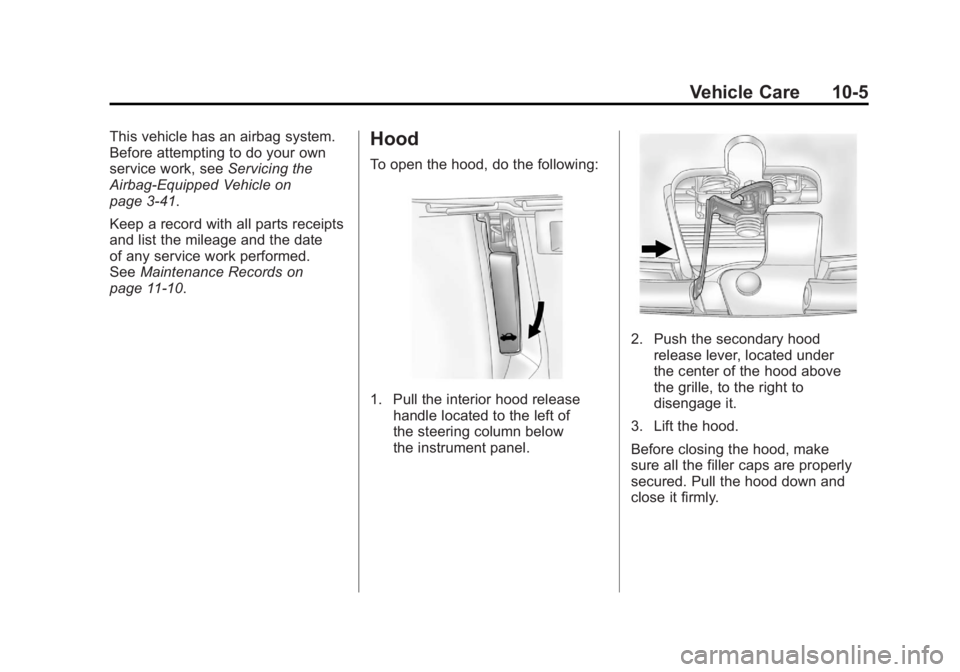
To open the hood, do the following:
1. Pull the interior hood release handle located to the left of
the steering column below
the instrument panel.
2. Push the secondary hoodrelease lever, located under
the center of the hood above
the grille, to the right to
disengage it.
3. Lift the hood.
Before closing the hood, make
sure all the filler caps are properly
secured. Pull the hood down and
close it firmly.