coolant BUICK LESABRE 1993 User Guide
[x] Cancel search | Manufacturer: BUICK, Model Year: 1993, Model line: LESABRE, Model: BUICK LESABRE 1993Pages: 324, PDF Size: 17.02 MB
Page 214 of 324
A CAUTION:
You can be burned if you spill coolant on hot
engine parts. Coolant contains ethylene
glycol
and it will burn if the engine parts are hot
enough. Don’t
spill coolant on a hot engine.
When the coolant in the coolant recovery tank is at or
above “FULL COLD,” start your vehicle.
If the overheat warning continues, there’s one more
thing you can try.
You can add the proper coolant mix
directly to the radiator, but be sure the cooling system
is
cool before you do it.
Steam and scalding -liquids from a hot cooling
system
can blow out and burn you badly. They
are under pressure,
and if you turn the radiator
pressure cap
- even a little -- they can come out
at high speed..Never turn the cap when the
cooling system, including the radiatorpressure
cap, is hot. Wait for the cooling system and
radiator pressure
cap to cool if you ever have40
turn the pressure cap.
212
Page 215 of 324
How to Add Coolant to the Radiator I
A@' #, I
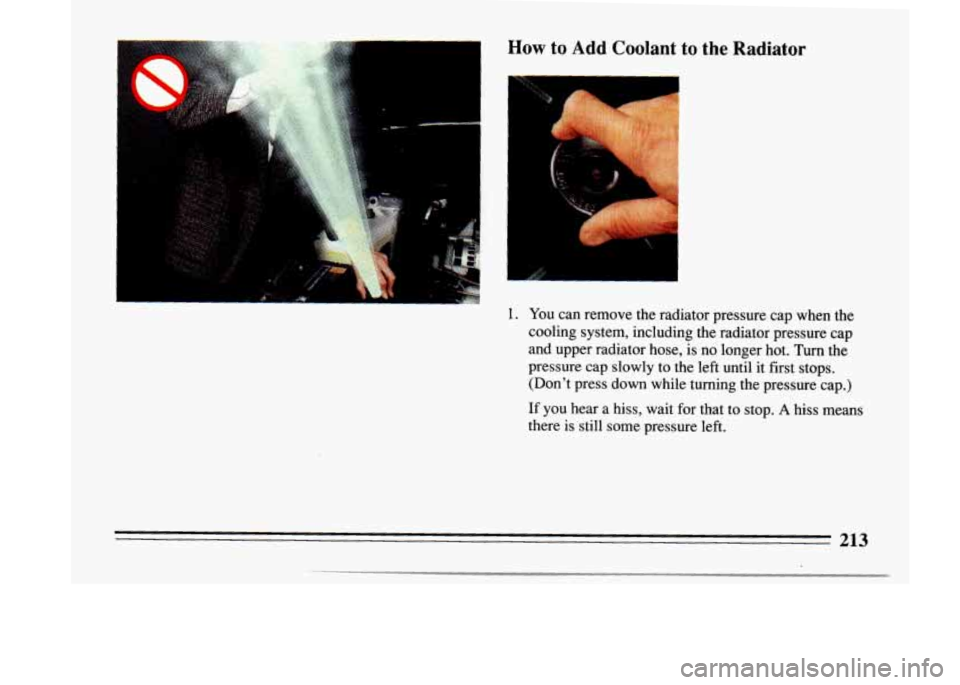
1. You can remove the radiator pressure cap when the
cooling system, including the radiator pressure cap
and upper radiator hose,
is no longer hot. Turn the
pressure cap slowly to the left until
it first stops.
(Don't press down while turning the pressure cap.)
If you hear a hiss, wait for that to stop. A hiss means
there is still
some pressure left.
213
Page 216 of 324
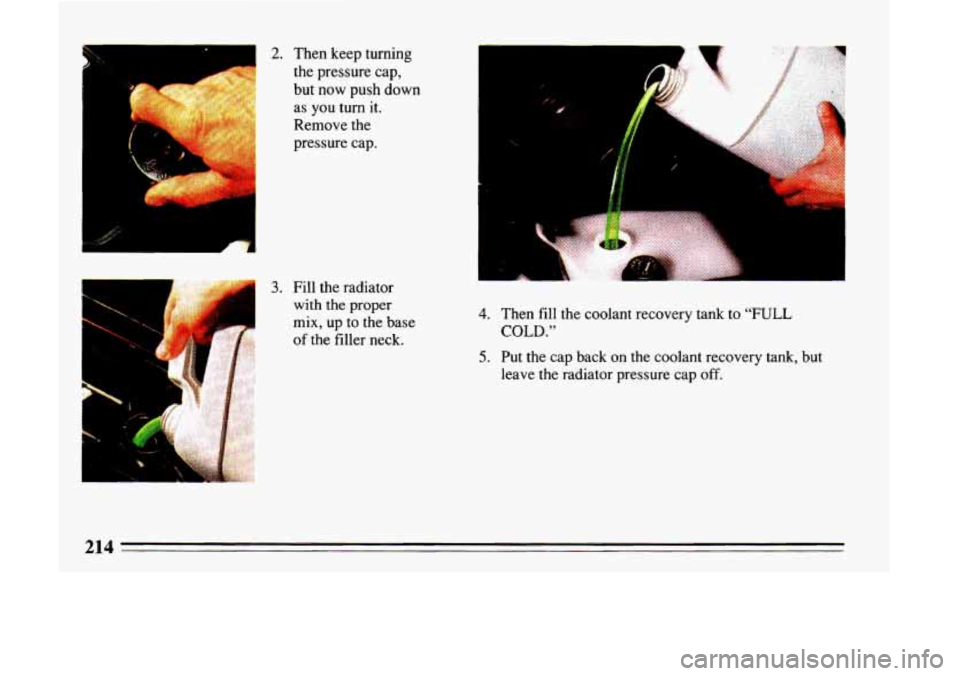
2. Then keep turning
the pressure cap,
but now push down
as you turn it.
Remove the
pressure cap.
I
3. Fill the radiator
with the proper
mix, up to the base
of the filler neck.
E
4. Then fill the coolant recovery tank to "FULL
COLD."
5. Put the cap back on the coolant recovery tank, but
leave the radiator pressure cap
off.
214
Page 217 of 324
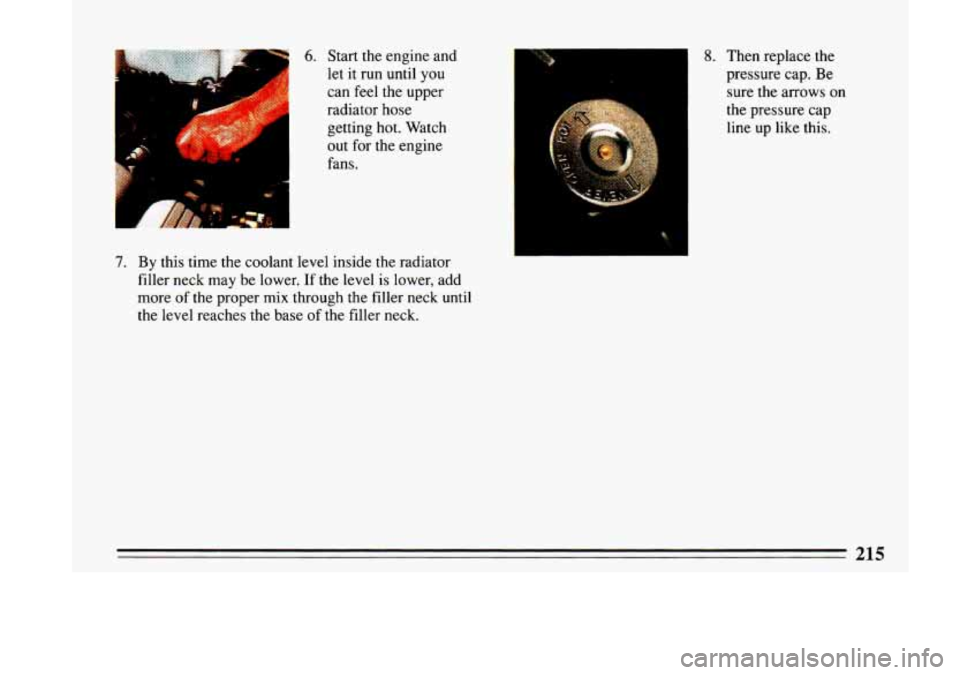
Bp. 6. Start the engine and
let
it run until you
can feel the upper
radiator hose
getting hot. Watch
out for the engine
fans.
7. By this time the coolant level inside the radiator
filler neck may be lower. If the level is lower, add
more of the proper mix through the filler neck until
the level reaches the base
of the filler neck.
:. . L *- 1 8. Then replace the
pressure cap. Be
sure the arrows on
the pressure cap
line up like this.
215
Page 231 of 324
@ Part 6 Service & Appearance Lare
Here you will find information about the care of your Buick . This part begins with service and fuel information. and
then it shows how to check important fluid and lubricant level\
s
. There is also technical information about your
vehicle. and a section devoted to its appearance care .
Part 6 includes:
ServiceTips
......................................................................
Fuel ........................................................................\
.....
HoodRelease .....................................................................
Engineoil ....................................................................... \
AirFilter ........................................................................\
.
Automatic Transaxle Fluid ............................................................
Enginecoolant ....................................................................
Power Steering Fluid ...............................................................
Windshield Washer Fluid ............................................................
Brakes ........................................................................\
...
Battery ........................................................................\
..
BulbReplacement .................................................................
Tires ........................................................................\
.....
Appearancecare ..................................................................
Vehicle Identification Number (VIN) ..................................................
FusesandCircuitBreake ............................................................
Capacities and Specifications .........................................................
LoadingYourVehicle ...............................................................
230
231
234
236
240
241
243
246 247
248
249
250
253
255
262
269
270
275
229
Page 238 of 324
A CAUTION:
Things that burn can get on hot engine parts and
start a fire. These include liquids like gasoline,
oil, coolant, brake fluid, windshield washer and
other fluids, and plastic
or rubber. You or others
could
be burned. Be careful not to drop or spill
things that
will burn onto a hot engine.
I
Before closing the hood, be sure all the filler caps are on
properly.
Then just pull the hood down and close it firmly.
Engine Oil
It’s a good idea to check your engine oil every time you
get fuel. In order to get an accurate reading, the oil must
be warm and the vehicle
must be on level ground.
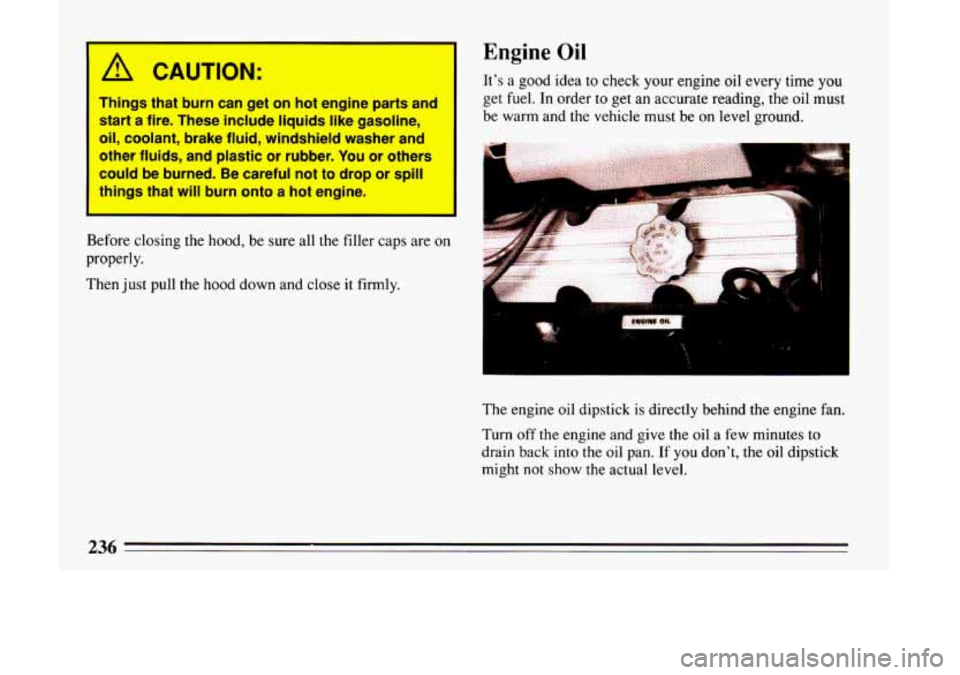
The engine oil dipstick is directly behind the engine fan.
Turn
off the engine and give the oil a few minutes to
drain back into the oil pan. If you don’t, the oil dipstick
might not show the actual level.
236
Page 245 of 324
3.
4.
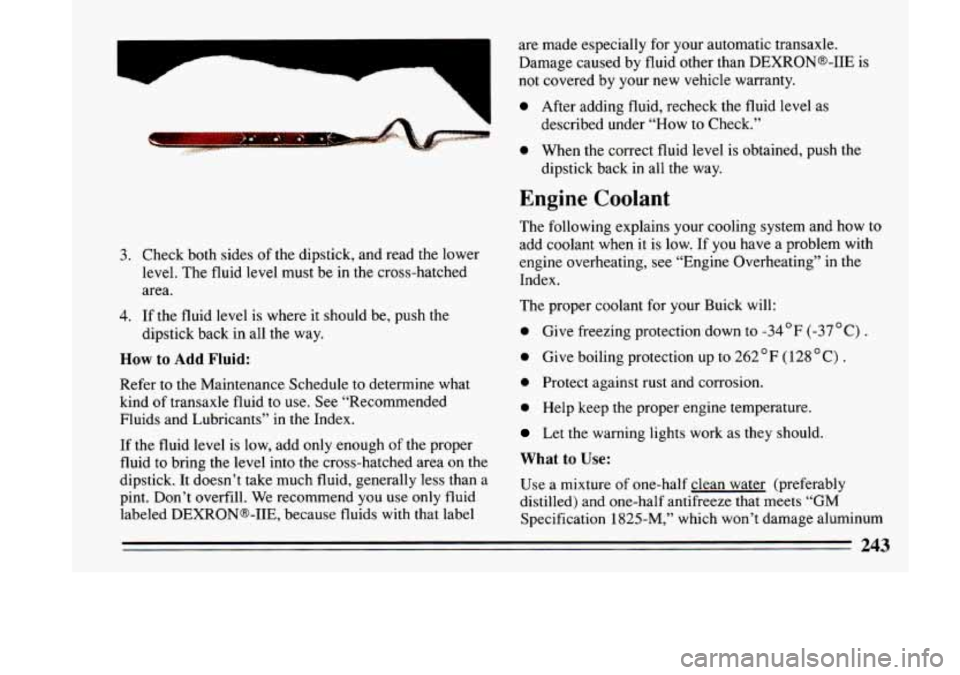
Check both sides of the dipstick, and read the lower
level. The fluid level must be in the cross-hatched
area.
If the fluid level is where it should be, push the
dipstick back in all the way.
How to Add Fluid:
Refer to the Maintenance Schedule to determine what
kind
of transaxle fluid to use. See “Recommended
Fluids and Lubricants” in the Index.
If the fluid level
is low, add only enough of the proper
fluid to bring the level into the cross-hatched area on the
dipstick. It doesn’t take much fluid, generally less than a
pint. Don’t overfill. We recommend you use only fluid
labeled DEXRONa-IIE, because fluids with that label are made especially for your automatic transaxle.
Damage caused by fluid other than DEXRONs-IIE
is
not covered by your new vehicle warranty.
0 After adding fluid, recheck the fluid level as
described under “How to Check.”
0 When the correct fluid level is obtained, push the
dipstick back in all the way.
Engine Coolant
The following explains your cooling system and how to
add coolant when it is low. If you have a problem with
engine overheating, see “Engine Overheating” in the
Index.
The proper coolant for your Buick will:
0 Give freezing protection down to -34OF (-37OC) .
0 Give boiling protection up to 262°F (128 “C) .
0 Protect against rust and corrosion.
0 Help keep the proper engine temperature.
Let the warning lights work as they should.
What to Use:
Use a mixture of one-half clean water (preferably
distilled) and one-half antifreeze that meets
“GM
Specification 1825-M,” which won’t damage aluminum
243
Page 246 of 324
parts. You can also use a recycled coolant conforming to
GM Specification 1825-M with a complete coolant flush
and refill. Use GM Engine Coolant Supplement (sealer)
with any complete coolant change.
If you use these, you
don’t need
to add anything else.
I k!, CAUTION:
Adding only plain water to your cooling system
can be dangerous. Plain water,
or some other
liquid like alcohol, can boil before the proper
coolant mix will. Your vehicle’s coolant warning
system
is set for the proper coolant mix. With
plain water or the wrong mix, your engine could
get too
hot but you wouldn’t get the overheat
warning. Your engine could catch fire
and you or
others could be burned.
Use a 5050 mix of clean
water and a proper antifreeze.
I
I NO IC i:
IT you use an Improper coolant mix, your engine
could overheat and be badly damaged. The
repair cost wouldn’t be covered
by your
warranty.
Too much water in the mix can treeze
and crack the engine, radiator, heater core and other
parts.
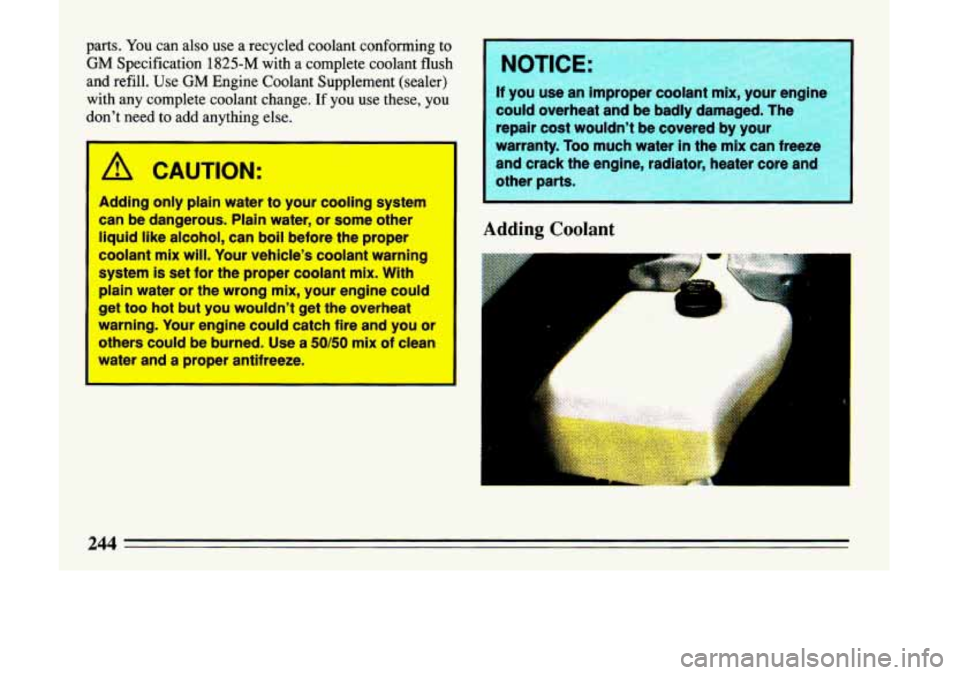
Adding Coolant
Page 247 of 324
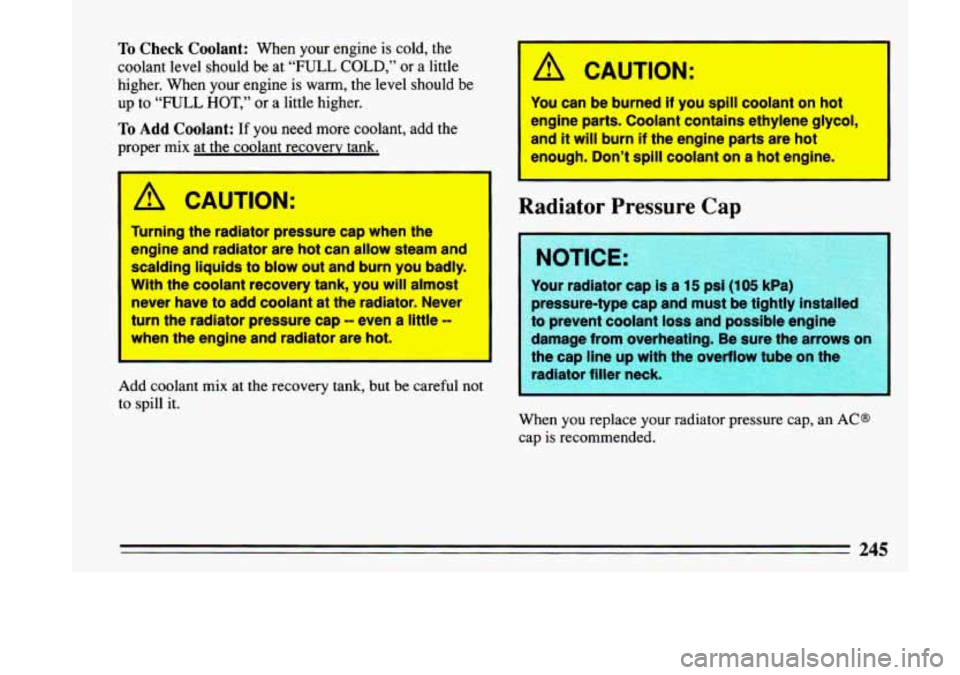
To Check Coolant: When your engine is cold, the
coolant level should
be at “FULL COLD,’’ or a little
higher. When your engine is
warm, the level should be
up to “FULL HOT,” or a little higher.
To Add Coolant: If you need more coolant, add the
proper mix at the coolant recovery tank.
I
I
A CAUTION:
Turning the radiator pressure cap when the
engine and radiator are hot can
allow steam and
scaldlng
liquids to blow out and burn you badly.
With the coolant recovery tank, you will almost
never have
to add coolant at the radiator. Never
turn the radiator pressure cap -- even a little -
when the engine and radiator are hot.
Add coolant mix at the recovery tank, but be careful not
to spill
it.
A CAUTION: I
You can be burned if you spill coolant on hot
engine parts. Coolant contains ethylene glycol,
-..d
it will burn if the engine parts are hot
enough. Don’t spill coolant on a hot engine.
Radiator Pressure Cap
I Tour rar
I I.
cap IS a 13 PSI (105 kPa1
pressure-rype cap and must be tightly Insrawe
to prevent coolant loss and possible engine
damage from overheating. Be sure the arrows
o
I
the cap line up with
radiator filler neck. I
When you replace your radiator pressure cap, an AC@
cap is recommended.
245
Page 248 of 324
Thermostat
Engine coolant temperature is controlled by a thermostat
in the engine coolant system. The thermostat stops the
flow of coolant through the radiator until the coolant
reaches a preset temperature.
When
you replace your thermostat, an ACS thermostat
is recommended.
Power Steering Fluid
:i
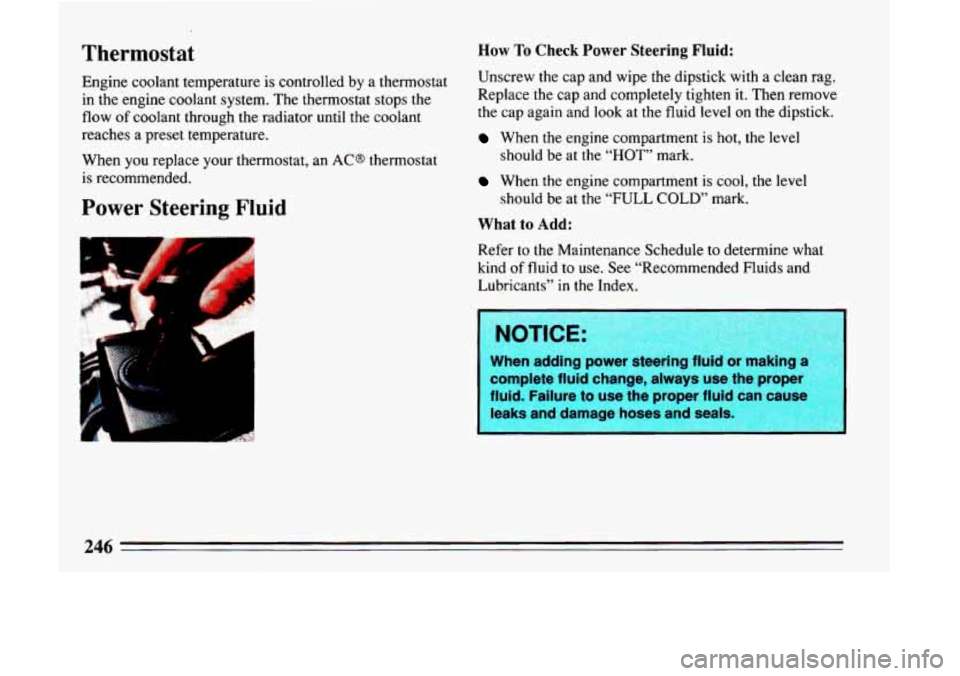
How To Check Power Steering Fluid:
Unscrew the cap and wipe the dipstick with a clean rag.
Replace the cap and completely tighten it. Then remove
the cap again and look at the fluid level on the dipstick.
When the engine compartment is hot, the level
When the engine compartment is cool, the level
What to Add:
Refer to the Maintenance Schedule to determine what
kind
of fluid to use. See “Recommended Fluids and
Lubricants” in the Index.
should be
at the
“HOT” mark.
should be at the
“FULL COLD” mark.
When adding power steering fli or making a
complete fluid change, always use the proper
fluid. Failure
to use the proper fluid can cause
leaks and damage hoses and seals.