engine compartment overview BUICK LUCERNE 2007 User Guide
[x] Cancel search | Manufacturer: BUICK, Model Year: 2007, Model line: LUCERNE, Model: BUICK LUCERNE 2007Pages: 496, PDF Size: 2.77 MB
Page 350 of 496

Checking Coolant (4.6L V8 Engine)
The engine coolant
surge tank is located
toward the rear of
the engine compartment
on the passenger’s
side of the vehicle.
For more information on location, seeEngine
Compartment Overview on page 334.{CAUTION:
Turning the surge tank pressure cap when
the engine and radiator are hot can allow
steam and scalding liquids to blow out
and burn you badly. Never turn the surge
tank pressure cap — even a little — when
the engine and radiator are hot.
The vehicle must be on a level surface. When
your engine is cold, the coolant level should be at
the FULL COLD mark, located on the side of
the surge tank that faces the engine.
350
Page 351 of 496
Adding Coolant
If you need more coolant, add the proper
DEX-COOL®coolant mixture at the coolant surge
tank, but only when the engine is cool.
{CAUTION:
You can be burned if you spill coolant on
hot engine parts. Coolant contains
ethylene glycol, and it will burn if the
engine parts are hot enough. Do not spill
coolant on a hot engine.
Occasionally check the coolant level in the
radiator. For information on how to add coolant to
the radiator, see Index. When replacing the
pressure cap, make sure to turn cap until it clicks.
Radiator Pressure Cap
Notice:The radiator cap on your vehicle is a
pressure-type cap and must be tightly
installed to prevent coolant loss and possible
engine damage from overheating. Be sure
the arrows on the cap line up with the overow
tube on the radiator ller neck.
SeeEngine Compartment Overview on page 334
for more information on location.
Engine Overheating
You will nd a warning light about a hot engine as
well as an engine coolant temperature gage on
your vehicle’s instrument panel cluster.
351
Page 364 of 496
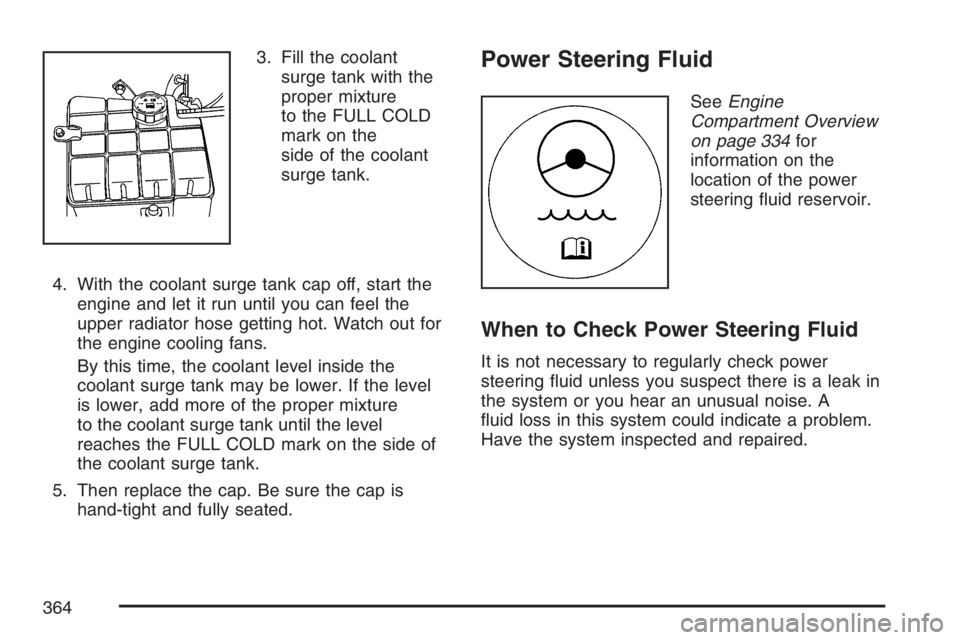
3. Fill the coolant
surge tank with the
proper mixture
to the FULL COLD
mark on the
side of the coolant
surge tank.
4. With the coolant surge tank cap off, start the
engine and let it run until you can feel the
upper radiator hose getting hot. Watch out for
the engine cooling fans.
By this time, the coolant level inside the
coolant surge tank may be lower. If the level
is lower, add more of the proper mixture
to the coolant surge tank until the level
reaches the FULL COLD mark on the side of
the coolant surge tank.
5. Then replace the cap. Be sure the cap is
hand-tight and fully seated.Power Steering Fluid
SeeEngine
Compartment Overview
on page 334for
information on the
location of the power
steering uid reservoir.
When to Check Power Steering Fluid
It is not necessary to regularly check power
steering uid unless you suspect there is a leak in
the system or you hear an unusual noise. A
uid loss in this system could indicate a problem.
Have the system inspected and repaired.
364
Page 366 of 496
Adding Washer Fluid
Open the cap with the
washer symbol on it.
Add washer uid
until the tank is full. See
Engine Compartment
Overview on page 334
for reservoir location.Notice:When using concentrated washer uid,
follow the manufacturer’s instructions
for adding water.
Do not mix water with ready-to-use washer
uid. Water can cause the solution to
freeze and damage your washer uid tank
and other parts of the washer system.
Also, water does not clean as well
as washer uid.
Fill your washer uid tank only
three-quarters full when it is very cold.
This allows for expansion if freezing
occurs, which could damage the tank if it
is completely full.
Do not use engine coolant (antifreeze) in
your windshield washer. It can damage
your washer system and paint.
366
Page 367 of 496
Brakes
Brake Fluid
Your brake master
cylinder reservoir is
lled with DOT-3 brake
uid. SeeEngine
Compartment Overview
on page 334for the
location of the reservoir.
There are only two reasons why the brake uid
level in the reservoir might go down. The rst
is that the brake uid goes down to an acceptable
level during normal brake lining wear. When
new linings are put in, the uid level goes back
up. The other reason is that uid is leaking out of
the brake system. If it is, you should have your
brake system xed, since a leak means that
sooner or later your brakes will not work well, or
will not work at all.So, it is not a good idea to top off your brake uid.
Adding brake uid will not correct a leak. If you
add uid when your linings are worn, then you will
have too much uid when you get new brake
linings. You should add or remove brake uid, as
necessary, only when work is done on the
brake hydraulic system.
{CAUTION:
If your vehicle has too much brake uid, it
can spill on the engine. The uid will burn
if the engine is hot enough. You or others
could be burned, and your vehicle could
be damaged. Add brake uid only when
work is done on the brake hydraulic
system.
When your brake uid falls to a low level, your
brake warning light will come on. SeeBrake
System Warning Light on page 201.
367
Page 374 of 496

4. Open the hood on the other vehicle and
locate the positive (+) and negative (−)
terminal locations on that vehicle.
You will not see the battery of your vehicle
under the hood. It is located under the
rear passenger’s seat. You will not need to
access the battery for jump starting. The
remote positive (+) terminal is for that purpose.
SeeEngine Compartment Overview on
page 334for location.
Access the remote positive (+) terminal by
removing the cover.
{CAUTION:
An electric fan can start up even when the
engine is not running and can injure you.
Keep hands, clothing and tools away from
any underhood electric fan.
{CAUTION:
Using a match near a battery can cause
battery gas to explode. People have been
hurt doing this, and some have been
blinded. Use a ashlight if you need
more light.
Be sure the battery has enough water.
You do not need to add water to the
battery installed in your new vehicle.
CAUTION: (Continued)
374
Page 485 of 496
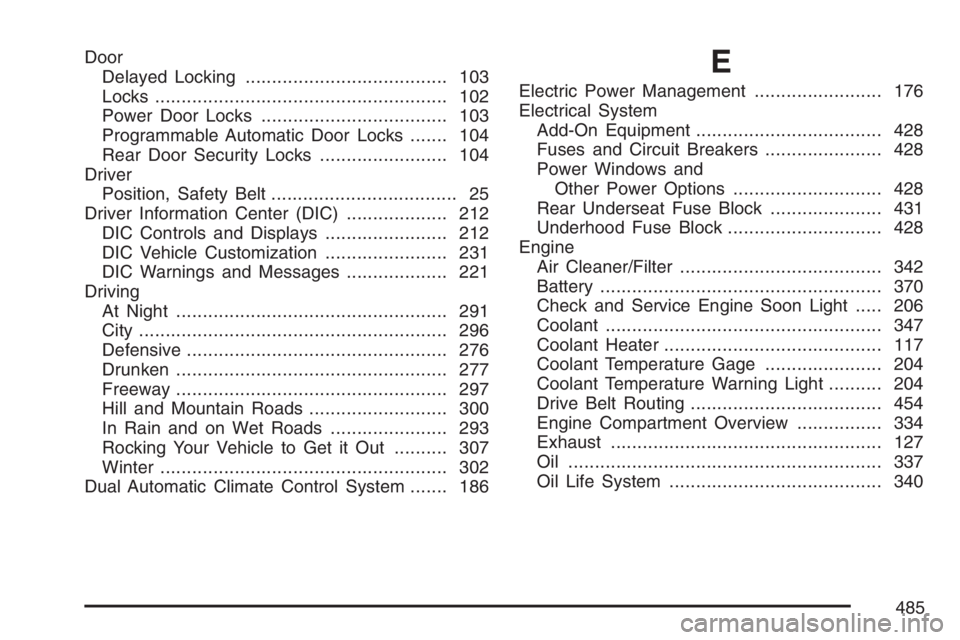
Door
Delayed Locking...................................... 103
Locks....................................................... 102
Power Door Locks................................... 103
Programmable Automatic Door Locks....... 104
Rear Door Security Locks........................ 104
Driver
Position, Safety Belt................................... 25
Driver Information Center (DIC)................... 212
DIC Controls and Displays....................... 212
DIC Vehicle Customization....................... 231
DIC Warnings and Messages................... 221
Driving
At Night................................................... 291
City.......................................................... 296
Defensive................................................. 276
Drunken................................................... 277
Freeway................................................... 297
Hill and Mountain Roads.......................... 300
In Rain and on Wet Roads...................... 293
Rocking Your Vehicle to Get it Out.......... 307
Winter...................................................... 302
Dual Automatic Climate Control System....... 186E
Electric Power Management........................ 176
Electrical System
Add-On Equipment................................... 428
Fuses and Circuit Breakers...................... 428
Power Windows and
Other Power Options............................ 428
Rear Underseat Fuse Block..................... 431
Underhood Fuse Block............................. 428
Engine
Air Cleaner/Filter...................................... 342
Battery..................................................... 370
Check and Service Engine Soon Light..... 206
Coolant.................................................... 347
Coolant Heater......................................... 117
Coolant Temperature Gage...................... 204
Coolant Temperature Warning Light.......... 204
Drive Belt Routing.................................... 454
Engine Compartment Overview ................ 334
Exhaust................................................... 127
Oil ........................................................... 337
Oil Life System........................................ 340
485