key BUICK PARK AVENUE 1994 Owner's Manual
[x] Cancel search | Manufacturer: BUICK, Model Year: 1994, Model line: PARK AVENUE, Model: BUICK PARK AVENUE 1994Pages: 324, PDF Size: 17.01 MB
Page 91 of 324
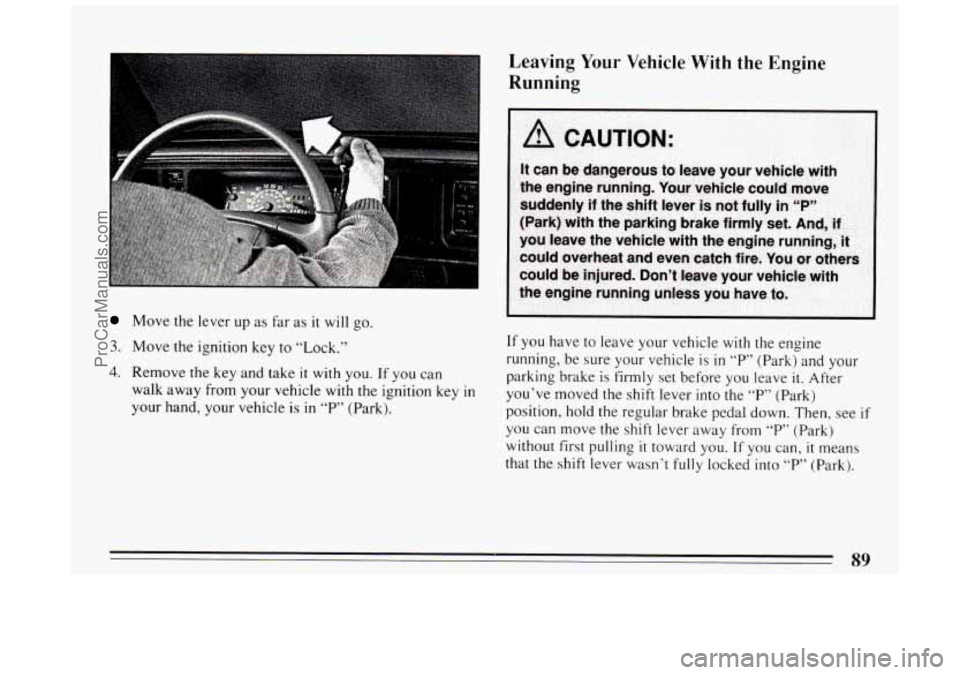
Move the lever up as far as it will go.
3. Move the ignition key to “Lock.”
4. Remove the key and take it with you. If you can
walk away from
your vehicle with the ignition key in
your hand, your vehicle is in “P” (Park).
Leaving Your Vehicle With the Engine
Running
If you have to leave your vehicle with the engine
running, be sure your vehicle
is in “P” (Park) and your
parking brake
is firmly set before you leave it. After
you’ve moved the shift lever into the
“P” (Park)
position, hold the regular brake pedal down. Then, see
if
you can move the shift lever away from “P” (Park)
without first pulling
it toward you. If you can, it means
that the
shift lever wasn’t fully locked into “P” (Park).
89
ProCarManuals.com
Page 92 of 324
Torque Lock
If you are parking on a hill and you don’t shift your
transaxle into
“P’ (Park) properly, the weight of the
vehicle may put too much force on the parking pawl
in
the transaxle. You may find it difficult to pull the shift
lever out of
“P’ (Park). This is called “torque lock.” To
prevent torque lock, set the parking brake and then shift
into “P” (Park) properly before you leave the driver’s
seat.
To find out how, see “Shifting Into ‘P’ (Park)” in
the Index.
When
you are ready to drive, move the shift lever out of
“P” (Park) BEFORE you release the parking brake.
If “torque lock” does occur, you may need
to have
another vehicle push yours
a little uphill to take some of
the pressure from the transaxle,
so you can pull the shift
lever out of “P’ (Park).
Shifting Out of P (Park) 66 99
Your hick has a brake-transaxle shift interlock. You
have
to fully apply your regular brake before you can
shift from
“P’ (Park) when the ignition is in the “Run”
position. See “Automatic Transaxle”
in the Index.
If you cannot shift
out of T“ (Park), ease pressure on
the shift lever
-- push the shift lever all the way into “P”
(Park) as you maintain brake application.
Then move the
shift lever into the gear you want. If
you ever hold the
brake pedal down but still can’t shift out of
“P” (Park),
try this:
1, Turn the key to “Off.” Open and close the driver’s
door
to turn off the Retained Accessory Power
feature,
if you have it.
2. Apply and hold the brake until the end of Step 4.
3. Shift to “N” (Neutral).
4. Start the vehicle and then shift to the drive gear you
5. Have the vehicle fixed as soon as you can.
want.
ProCarManuals.com
Page 122 of 324
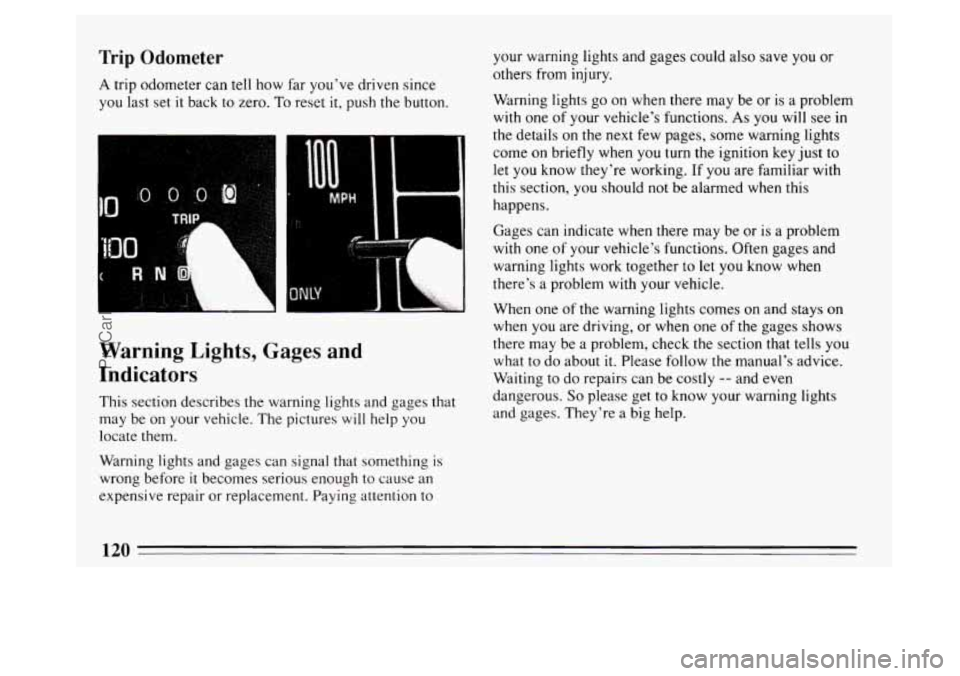
Trip Odometer
A trip odometer can tell how far you've driven since
you last set
it back to zero. To reset it, push the button.
R N ''. 7
I I ......A# L
Warning Lights, Gages and
Indicators
This section describes the warning lights and gages that
may be on your vehicle. The pictures
will help you
locate them.
Warning lights and gages can signal that something is
wrong before
it becomes serious enough to cause an
expensive repair or replacement. Paying attention to your warning lights and gages could
also save you
or
others from injury.
Warning lights
go on when there may be or is a problem
with one of your vehicle's functions. As you will see in
the details on
the next few pages, some warning lights
come on briefly when you
turn the ignition key just to
let you know they're working. If you are familiar with
this section, you
should not be alarmed when this
happens.
Gages can indicate when there may be or is a problem
with one
of your vehicle's functions. Often gages and
warning lights work together to let you know when
there's a problem
with your vehicle.
When one
of the warning lights comes on and stays on
when you are driving, or when one of the gages shows
there may be a problem, check the section that tells
you
what to do about it. Please follow the manual's advice.
Waiting to do repairs can be costly
-- and even
dangerous.
So please get to know your warning lights
and gages. They're a big help.
120
ProCarManuals.com
Page 127 of 324
Low Coolant Warning Light Engine
Oil Pressure Light and Gage
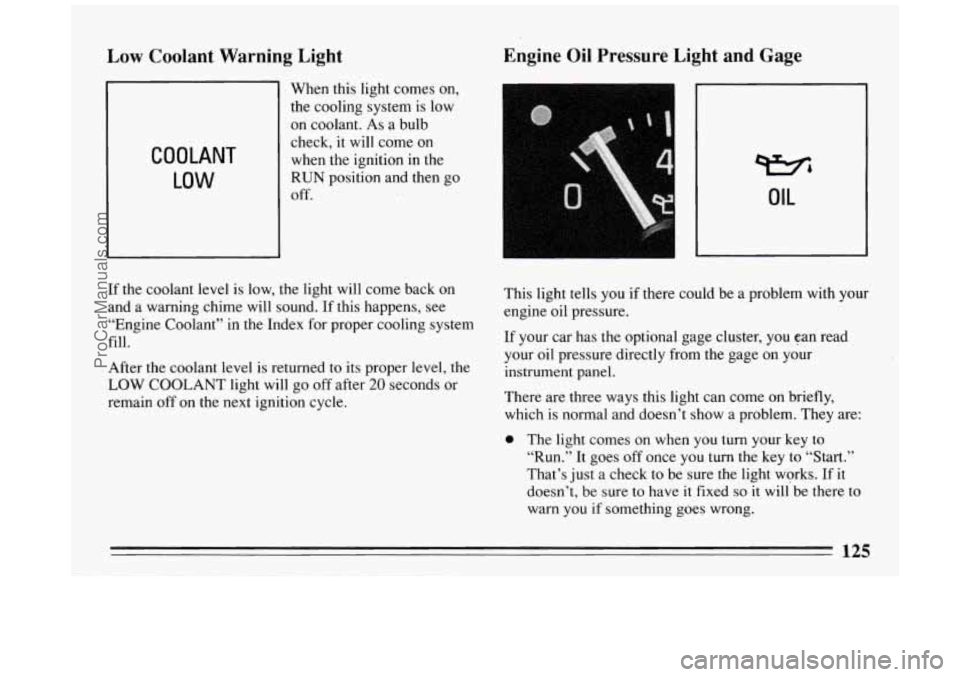
COOLANT
LOW
When this light comes on,
the cooling system is low
on coolant. As a bulb
check, it will come on
when the ignition in the
RUN position and then go
Off.
Wb
OIL
If the coolant level is low, the light will come back on
and
a warning chime will sound. If this happens, see
“Engine Coolant’’ in the Index for proper cooling system
fill.
After the coolant level is returned to its proper level, the
LOW COOLANT light will go off after 20 seconds or
remain off
on the next ignition cycle. This
light
tells you if there could be a problem with your
engine oil pressure.
If your car has the optional gage cluster, you can read
your oil pressure directly from the gage on your
instrument panel.
There are three ways this light can come on briefly,
which
is normal and doesn’t show a problem. They are:
0 The light comes on when you turn your key to
“Run.”
It goes off once you turn the key to “Start.”
That’s just a check
to be sure the light works. If it
doesn’t, be sure
to have it fixed so it willbe there to
warn you if something goes wrong.
125
ProCarManuals.com
Page 128 of 324
If you’re “idling” at a stop sign, the light may blink
on and then off.
If you make a hard stop, the light may come on for a
moment.
When this light
comes on and stays on, it means oil isn’t
going through your engine properly,
You could be low
on oil,
or you might have some other oil problem.
NOTICE:
Damage to your engine from neglected oil
problems can be costly and is not covered by
your warranty.
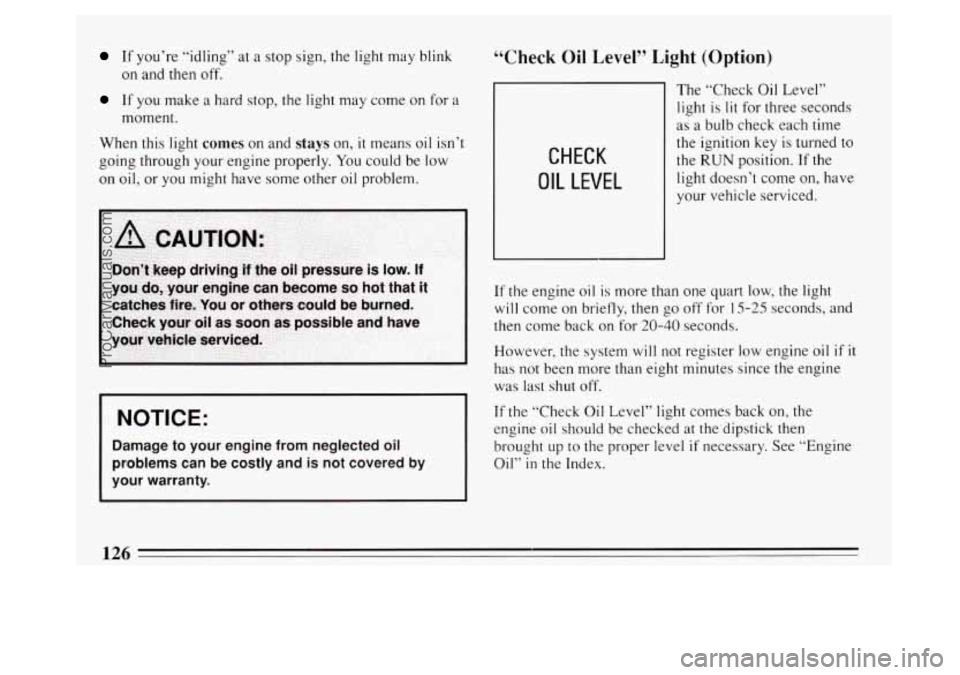
“Check Oil Level” Light (Option)
CHECK
OIL LEVEL
The “Check Oil Level”
light is
lit for three seconds
as
a bulb check each time
the ignition key
is turned to
the
RUN position. If the
light doesn’t come on, have
your vehicle serviced.
If the engine oil is more than one quart low, the light
will come on briefly, then go off for 15-25 seconds, and
then come back on for
20-40 seconds.
However, the system
will not register low engine oil if it
has not been more than eight minutes since the engine
was last shut off.
If the “Check Oil Level” light comes back on, the
engine oil should be checked at the.dipstick then
brought
up to the proper level if necessary. See “Engine
Oil”
in the Index.
ProCarManuals.com
Page 129 of 324
“Change Oil Soon” Light (Option)
CHANGE
OIL SOON
This light is activated by
the engine oil life monitor
system. The system
determines the condition
o
the engine oil and lets you
know when the oil should
be changed. (See “Engine
Oil” in the Index).
It does this using information about engine speed (revolutions per minute), coolant temperature and
vehicle speed. The system uses this data to determine
how much oil has degraded. of
the oil life has been used and each time the engine is
started after that.
If the “Change Oil Soon” light is on
continuously, there is a problem with the Oil Life
Monitor System and service is required.
After changing the engine oil, the system should be
reset.
This will cause the “Change Oil Soon” light to be
lit again for#the bulb check period
of three seconds.
When to change your oil depends on driving habits and
conditions because these directly affect engine speed,
coolant temperature and vehicle speed. Because of this,
the “Change Oil Soon” light may come on as early as
2,000 miles or less for harsh conditions.
The “Change Oil
Soon” light is lit for five seconds as a
bulb check each time the ignition key is turned to the
RUN position. It will stay on for 60 seconds once 90%
f
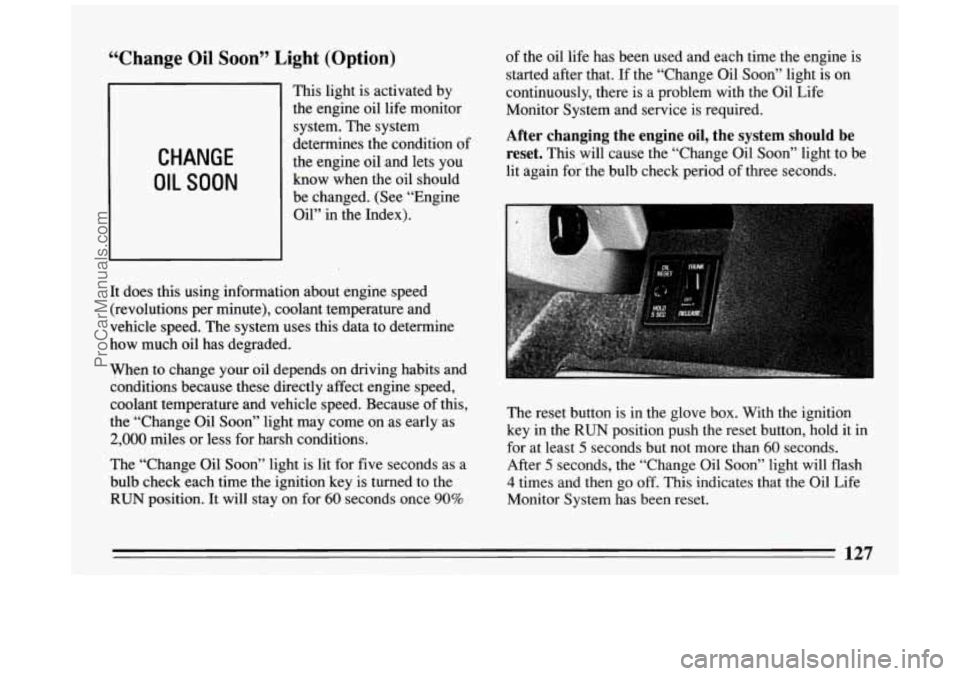
The reset button is in the glove box. With the ignition
key in the
RUN position push the reset button, hold it in
for at least
5 seconds but not more than 60 seconds.
After
5 seconds, the “Change Oil Soon” light will flash
4 times and then go off. This indicates that the Oil Life
Monitor System has been reset.
127
ProCarManuals.com
Page 130 of 324
Malfunction Indicator Lamp (Service
Engine Soon Light)
SERVICE
ENGINE SOON
NOTICE:
If you keep driving your vehicle with this light on,
after a while the emission controls won’t work as
well, your fuel economy won’t be as good and your engine may not run
as smoothly. This could
lead to costly repairs not covered by your
warranty.
SERVICE
ENGINE
SOON
Battery Light
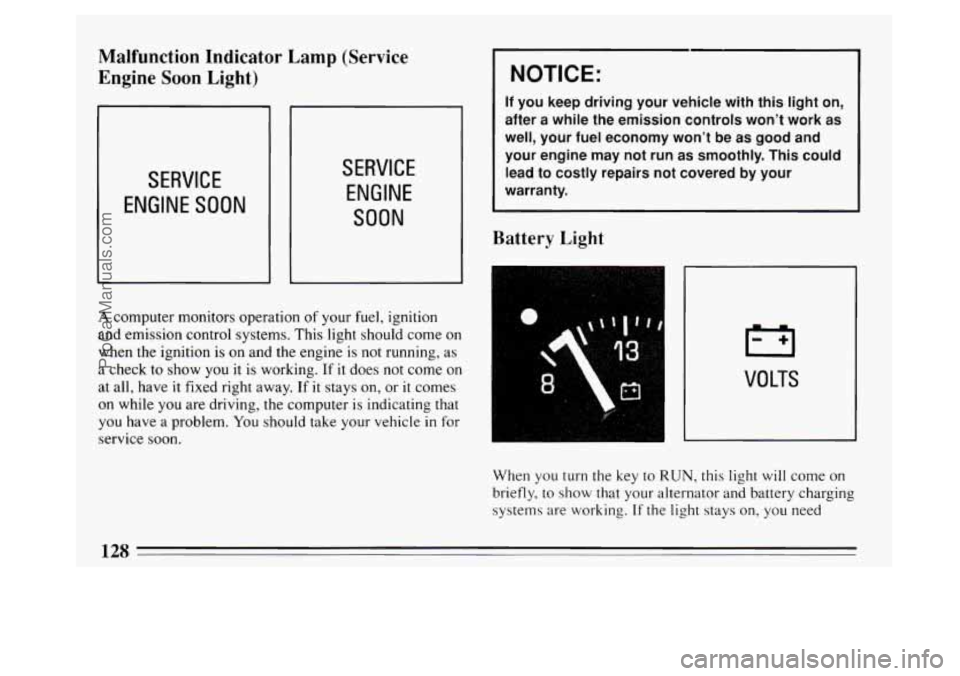
A computer monitors operation of your fuel, ignition
and emission control systems. This light should come on
when the ignition is on and the engine is not running, as
a check to show you it is working.
If it does not come on
at all, have it fixed right away. If it stays
on, or it comes
on while you are driving, the computer
is indicating that
you have
a problem. You should take your vehicle in for
service soon.
n
VOLTS
When you turn the key to RUN, this light will come on
briefly,
to show that your alternator and battery charging
systems are working. If the light stays on, you need
ProCarManuals.com
Page 156 of 324
Reverse
Press and hold REV to return rapidly to a favorite
passage
in a track. Release it to play the passage. Note
the seconds counter reading in the display.
Forward
Press and hold FWD to advance quickly within a track.
Release it to resume playing. Watch the display to stop
at a specific passage.
Previous
Press PREV to hear the previous track. If you hold this
button or press
it more than once, the disc will retreat to
previous tracks.
Next
Press NEXT to hear the next track now (instead of
waiting until the present track is finished.) If you hold
this button, or press
it more than once, the disc will
advance further.
Stop/Play
Press ST/PL the disc will stop and the radio will play.
Press ST/PL again to restart
the disc at the point where it
stopped.
Press the PWR button or turn the ignition key off to stop
the disc player. The disc stays in the player and will
resume playing at the point where it stopped.
Eject
Press EJCT and the disc will eject and the radio will
play. The disc
will start at track 1 when you reinsert it.
As a feature to protect the disc, if you turn off the
ignition with the disc partway out of the slot (after
eject), it will be drawn back into the player
in about 30
seconds. The disc will play at track 1 when the radio is
turned on again.
154
ProCarManuals.com
Page 165 of 324
Police records show that almost half of all motor
vehicle-related deaths involve alcohol
- a driver, a
passenger or someone else, such as
a pedestrian, had
been drinking. In most cases, these deaths are the result
of someone who was drinking and driving. About
20,000 motor vehicle-related deaths occur each year
because
of alcohol, and thousands of people are injured.
Just how much alcohol is too much if a person plans
to
drive? Ideally, no one should drink alcohol and then
drive. But if one does, then what’s “too much”? It can be
a lot less than many might think. Although it depends on
each person and situation, here is some general
information on the problem.
The Blood Alcohol Content (BAC)
of someone who is
drinking depends upon four things:
0
0
0
0
How much alcohol is in the drink.
The drinker’s body weight.
The amount of food that is consumed before and
during drinking.
The length of time it has taken the drinker to
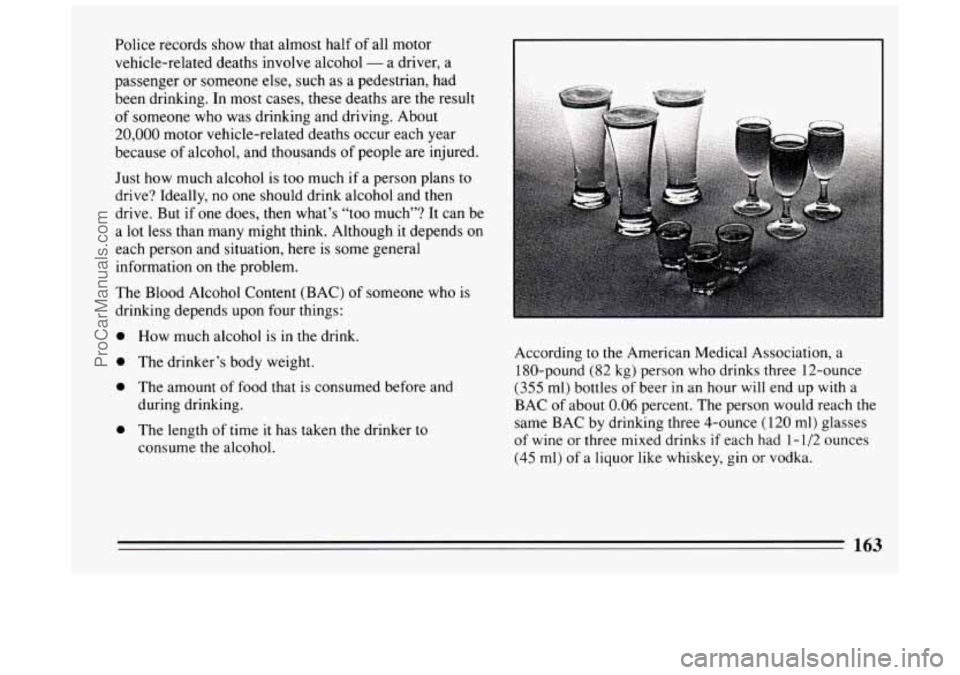
consume the alcohol. According
to the American Medical Association, a
180-pound
(82 kg) person who drinks three 12-ounce
(355 ml) bottles of beer in an hour will end up with a
BAC of about
0.06 percent. The person would reach the
same BAC by drinking three 4-ounce (120 ml) glasses
of wine or three mixed drinks if each had 1 - 1/2 ounces
(45 ml) of a liquor like whiskey, gin or vodka.
163
ProCarManuals.com
Page 199 of 324
e I
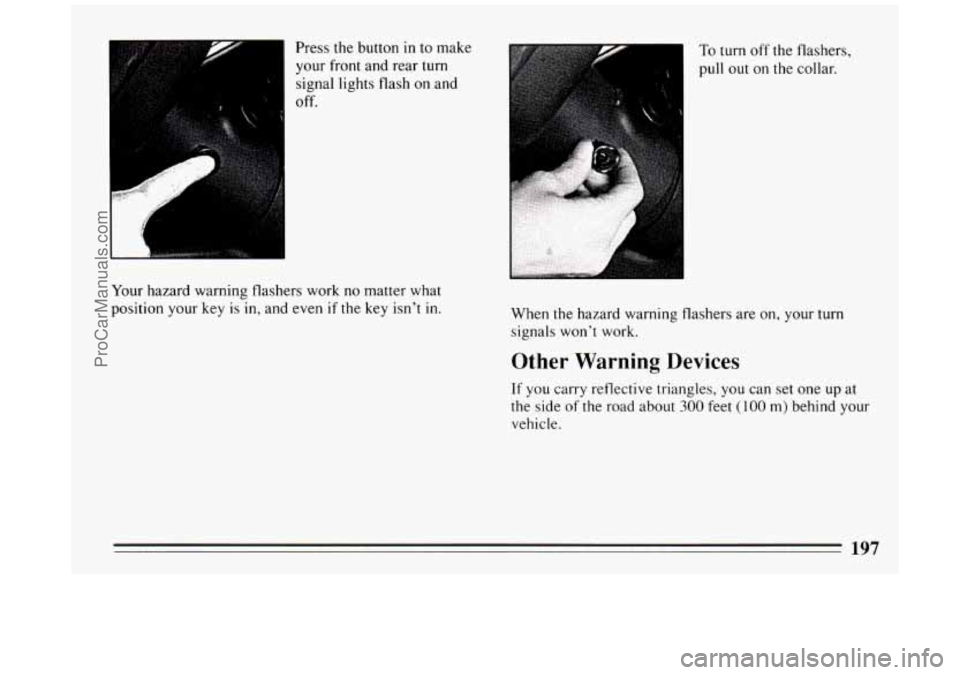
Press the button in to make
your front and rear turn
signal lights flash
on and
off.
I
Your hazard warning flashers work no matter what
position your key is in, and even
if the key isn’t in.
To turn off the flashers,
pull
out on the collar.
When
the hazard warning flashers are on, your turn
signals won’t work.
Other Warning Devices
If you carry reflective triangles, you can set one up at
the side of the road about
300 feet (100 m) behind your
vehicle.
197
ProCarManuals.com