tow BUICK PARK AVENUE 1994 Owner's Guide
[x] Cancel search | Manufacturer: BUICK, Model Year: 1994, Model line: PARK AVENUE, Model: BUICK PARK AVENUE 1994Pages: 324, PDF Size: 17.01 MB
Page 216 of 324

8. Then replace the
pressure cap. At
any time during this
procedure
if coolant
begins to
flow out
of the filler neck,
reinstall the
pressure cap. Be
sure the arrows on
pressure cap line up
like this.
If a Tire Goes Flat
It’s unusual for a tire to “blow out” while you’re driving,
especially
if you maintain your tires properly. If air goes
out of
a tire, it’s much more likely to leak out slowly.
But
if you should ever have a “blowout,” here are a few
tips about what to expect and what to do:
If a front tire fails, the flat tire will create
a drag that
pulls the vehicle toward that side. Take your foot
off the
accelerator pedal and grip the steering wheel firmly.
Steer to maintain lane position, then gently brake to a
stop well out of the traffic lane.
A rear blowout, particularly on a curve, acts much like a
skid and may require the same correction you’d use in a
skid. In any rear blowout, remove your foot from the
accelerator pedal. Get the vehicle under control by
steering the way you want the vehicle to
go. It may be
very bumpy and noisy, but you can still steer. Gently
brake to a stop, well
off the road if possible.
If a tire goes flat, the next section shows how to use
your jacking equipment to change
a flat tire safely.
214
ProCarManuals.com
Page 224 of 324
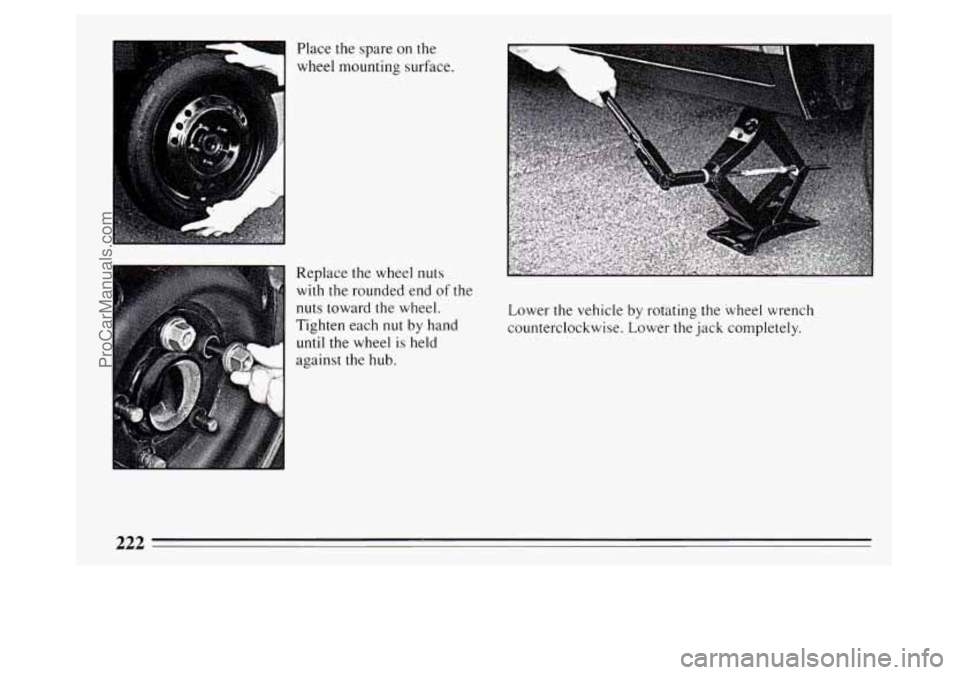
Place the spare on the
wheel mounting surface.
Replace the wheel nuts
with the rounded end
of the
nuts toward the wheel.
Tighten each
nut by hand
until the wheel is held
against the hub. Lower
the vehicle by rotating the wheel wrench
counterclockwise. Lower the jack completely.
222
ProCarManuals.com
Page 228 of 324
NOTICE:
Spinning your wheels can destroy parts of your
vehicle as well as the tires.
If you spin the wheels
too fast while shifting your transaxle back and
forth, you can destroy your transaxle.
Rocking your vehicle to get it out:
First, turn your steering wheel left and right. That will
clear the area around your front wheels. You should turn
your traction control system off. (See “Traction Control
System” in
the Index.) Then shift back and forth
between
“R” (Reverse) and a forward gear, spinning the
wheels as little as possible. Release the accelerator pedal
while you shift, and press lightly on the accelerator
pedal when the transaxle is in gear. If that doesn’t get
you out after a few tries,
you may need to be towed out.
If
you do need to be towed out, see “Towing Your Car”
in the Index.
226
ProCarManuals.com
Page 241 of 324
It’s a good idea to check your engine oil every time you
get fuel. In order to get an accurate reading, the oil must
be warm and the vehicle must be on level ground.
To Check Engine Oil
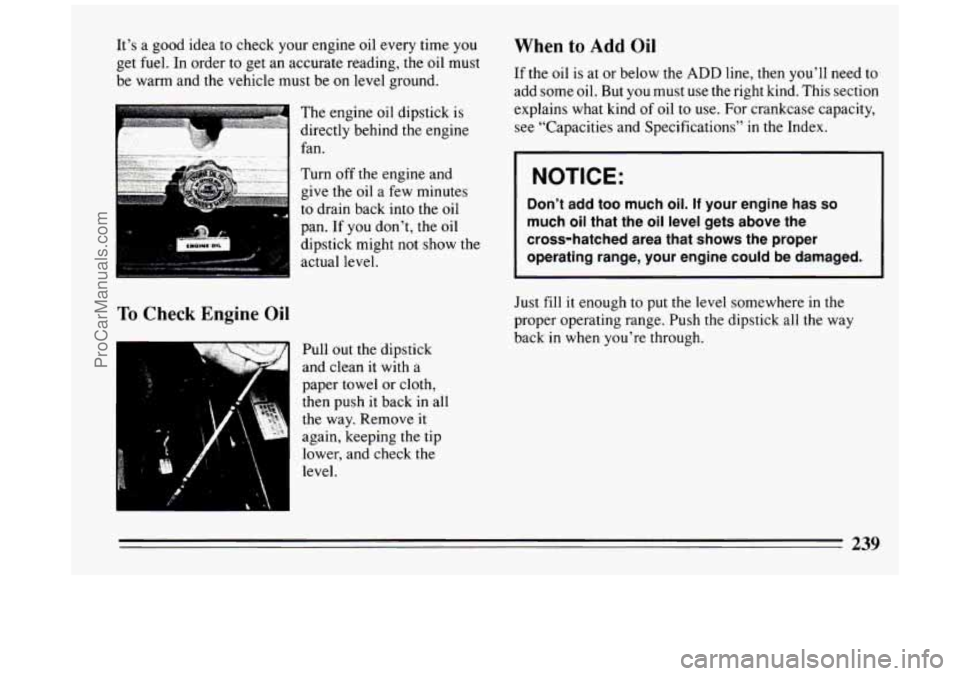
The engine oil dipstick is
directly behind the engine
fan.
Turn off the engine and
give the oil a few minutes
to drain back into
the oil
pan. If you don’t, the oil
dipstick might not show the
actual level.
When to Add Oil
If the oil is at or below the ADD line, then you’ll need to
add some oil. But you must use the right kind. This section
explains what kind
of oil to use. For crankcase capacity,
see “Capacities and Specifications” in the Index.
NOTICE:
Don’t add too much oil. If your engine has so
much oil that the oil level gets above the
cross-hatched area that shows the proper
operating range, your engine could be damaged.
Pull out the dipstick
and clean it with a
paper towel or cloth,
then push it back
in all
the way. Remove
it
again, keeping the tip
lower, and check the
level. Just
fill it enough to put the level somewhere in
the
proper operating range. Push the dipstick all the way
back
in when you’re through.
239
ProCarManuals.com
Page 244 of 324

Engine Oil Additives
Don’t add anything to your oil. Your Buick dealer is
ready to advise if you think something should be added.
When to Change Engine Oil
See if any one of these is true for you:
Most trips are less than 4 miles (6 km).
It’s below freezing outside and most trips are less
than
10 miles (16 km).
The engine is at low speed most of the time (as in
door-to-door delivery, or in stop-and-go traffic).
0 You tow a trailer often.
Most trips are through dusty places.
If any one of these is true for your vehicle, then you
need to change your oil and filter every
3,000 miles
(5 000 km) or 3 months -- whichever comes first. (See
“Change Oil Soon” in the Index.) If
none of
them is true, change the oil every 7,500 miles
(12 500 km) or 12 months -- whichever comes first.
Change the filter at the first oil change and at every
other oil change after that.
If the optional “Change Oil Soon” light comes on you
will need to change your oil sooner than either mileage
specified. Depending upon driving habits, the “Change
Oil Soon’’ light may come on
as early as 2,000 miles or
less from the last time the oil life monitor was reset (See
“Oil Life Monitor” in the Index.)
Always reset the oil
life monitor after every oil change.
Engine Coolant Heater (Engine Block
Heater)
An engine coolant heater can be a big help if you have
to park outside in very cold weather,
0°F (- 18 “C) or
colder. If your vehicle has this option, see “Engine
Coolant Heater” in the Index.
242
ProCarManuals.com
Page 247 of 324
Wait at least 30 minutes before checking the transaxle
fluid level
if you have been driving:
0 When outside temperatures are above 90°F (32°C).
0 At high speed for quite a while.
0 In heavy traffic -- especially in hot weather.
0 While pulling a trailer.
To get the right reading, the fluid should be at normal
operating temperature, which is 180°F to 200°F (82°C
to 93°C).
Get the vehicle warmed up by driving about 15 miles
(24 km) when outside temperatures are above 50°F
(10°C). If it's colder than 50°F (lO"C), you may have
to drive longer.
To check the fluid level
Park your vehicle on a level place. Keep the engine
running.
0 With the parking brake applied, place the shift lever
in "P" (Park).
With your foot on the brake pedal, move the shift
lever through each gear range, pausing for about
three seconds
in each range. Then, position the shift
lever in "P" (Park).
0 Let the engine run at idle for three to five minutes.
Then, without shutting
off the engine. follow these
steps:
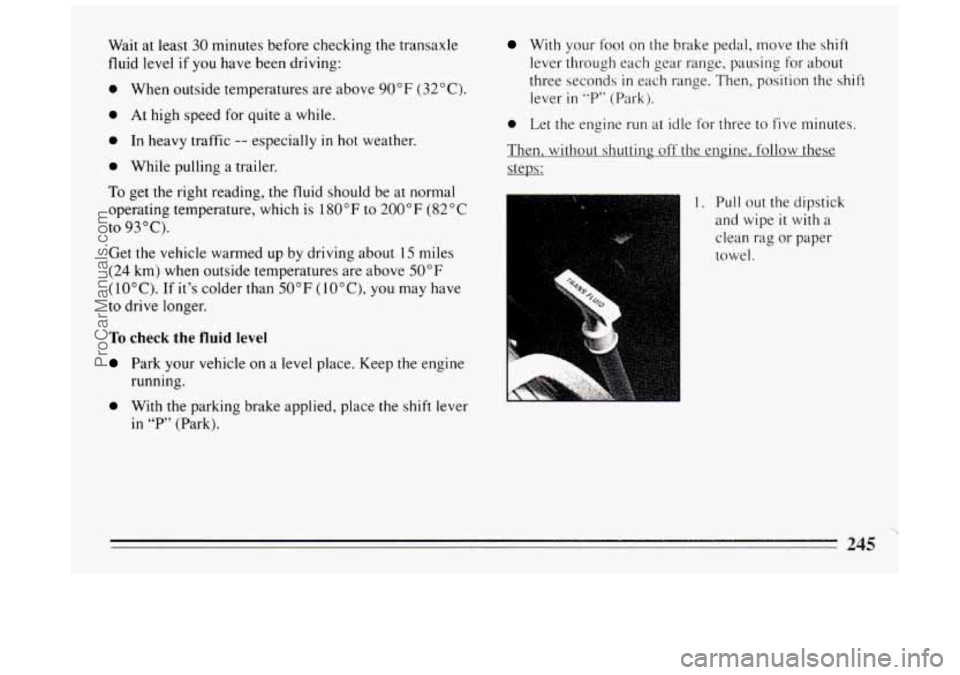
I. Pull out the dipstick
and wipe
it with a
clean rag or paper
towel.
ProCarManuals.com
Page 271 of 324
Use solvent-type cleaners in a well-ventilated area
only. If
you use them, don’t saturate the stained area.
0 If a ring forms after spot cleaning, clean the entire
area immediately or
it will set.
Using Foam-Type Cleaner on Fabric
0 Vacuum and brush the area to remove any loose dirt.
0 Always clean a whole trim panel or section. Mask
surrounding trim along stitch or welt lines.
0 Mix Multi-Purpose Powdered Cleaner following the
directions on the container label.
0 Use suds only and apply with a clean sponge.
0 Don’t saturate the material.
0 Don’t rub it roughly.
0 As soon as you’ve cleaned the section, use a sponge
to remove the suds.
0 Rinse the section with a clean, wet sponge.
0 Wipe off what’s left with a slightly damp paper towel
or cloth.
0 Then dry it immediately with a blow dryer or a heat
lamp.
I NOTICE:
I
Be careful with a hair dryer or heat lamp. You
could scorch the fabric.
Wipe with a clean cloth.
Using Solvent-Type Cleaner on Fabric
First, see if you have to use solvent-type cleaner at all.
Some spots and stains will clean off better
with just
water and mild soap.
If you need to use a solvent:
0 Gently scrape excess soil from the trim material with
a clean, dull knife or scraper. Use very little cleaner,
light pressure and clean cloths (preferably
cheesecloth). Cleaning should start at the outside of
the stain, “feathering” toward
the center. Keep
changing to a clean section of the cloth.
When you clean a stain from fabric, immediately dry
the area with an air hose, hair dryer, or heat lamp to
help prevent a cleaning ring. (See the previous
NOTICE.)
269
ProCarManuals.com
Page 274 of 324
Cleaning the Outside of the
Windshield and Wiper Blades
If the windshield is not clear after using the windshield
washer, or
if the wiper blade chatters when running, wax
or other material may be on the blade or windshield.
Clean
the outside of the windshield with GM
Windshield Cleaner, Bon-Ami Powder@ (GM Part No.
10500 1 I ). The windshield is clean if beads do not form
when you rinse
it with water.
Clean the blade by wiping vigorously with a cloth
soaked
in full strength windshield washer solvent. Then
rinse the blade with water.
Wiper blades should be checked
on a regular basis and
replaced when worn.
Cleaning the Outside of Your Buick
The paint finish on your vehicle provides beauty, depth
of color, gloss retention and durability.
Washing Your Vehicle
The best way to preserve your vehicle’s finish is to keep
it clean by washing it often with lukewarm or cold
water.
Don’t
wash your vehicle in the direct rays of the sun.
Don‘t use strong soaps or chemical detergents. Use
liquid hand, dish or car washing (mild detergent) soaps.
Don’t use cleaning agents that contain acid or abrasives.
All cleaning agents should be flushed promptly and not
allowed to dry on the surface, or they could stain. Dry
the finish
with a soft, clean chamois or a 100% cotton
towel to avoid surface scratches and water spotting,
High pressure car washes may cause water to enter your
vehicle.
Finish Care
Occasional waxing or mild polishing of your Buick may
be necessary to remove residue from the paint finish.
You can get GM approved cleaning products from your
dealer. (See “Appearance Care and Materials’’
in the
Index.)
ProCarManuals.com
Page 289 of 324
Section A: Scheduled Maintenance
Services
Using Your Maintenance Schedules
This section tells you the maintenance services you
should have done and when you should schedule them.
Your Buick dealer knows your vehicle best and wants
you
to be happy with it. If you go to your dealer for your
service needs, you’ll know that GM-trained and
supported service people
will perform the work using
genuine GM parts.
These schedules are for vehicles that:
0
0
0
carry passengers and cargo within recommended
limits.
You will find these limits on your vehicle’s
Tire-Loading Information label. See “Loading Your
Vehicle”
in the Index.
are driven on reasonable road surfaces
within legal
driving limits.
use the recommended unleaded fuel. See “Fuel”
in
the Index.
Selecting the Right Schedule
First you’ll need to decide which of the two schedules is
right for your vehicle. Here’s how to decide which
schedule to follow:
Schedule I
Is any one of these true for your vehicle?
Most trips are less than 4 miles (6 km).
0 Most trips are less than 10 miles ( 16 km) when
outside temperatures are below freezing.
door-to-door delivery, or
in stop-and-go traffic).
0 The engine is at low speed most of the time (as in
You operate your vehicle in dusty areas.
You tow a trailer. (With some models, you should
never tow a trailer. See “Towing
a Trailer” in the
Index.)
If any one (or more) of these is true for your driving,
follow Schedule
I.
Schedule I1
Follow Schedule I1 only if none of the above conditions
is true.
287
ProCarManuals.com
Page 290 of 324
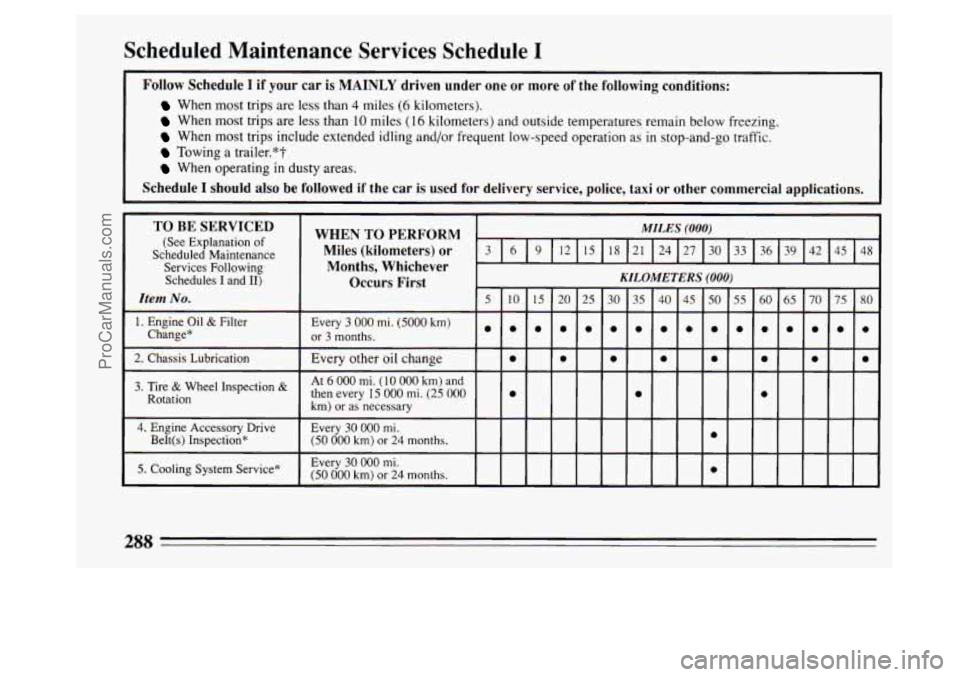
Scheduled Maintenance Services Schedule I - - ~~~~
Follow Schedule I if your car is MAINLY driven under one or more of the following conditions:
When most trips are less than 4 miles (6 kilometers).
When most trips are less than 10 miles (16 kilometers) and outside temperatures remain below freezing.
When most trips include extended idling and/or frequent low-speed operation as in stop-and-go traffic.
Towing a trailer.*?
When operating in dusty areas.
Schedule I should also be followed if the car is used for delivery service, police, taxi or other commercial applications.
288
ProCarManuals.com