tow BUICK PARK AVENUE 1994 User Guide
[x] Cancel search | Manufacturer: BUICK, Model Year: 1994, Model line: PARK AVENUE, Model: BUICK PARK AVENUE 1994Pages: 324, PDF Size: 17.01 MB
Page 95 of 324
Power Windows
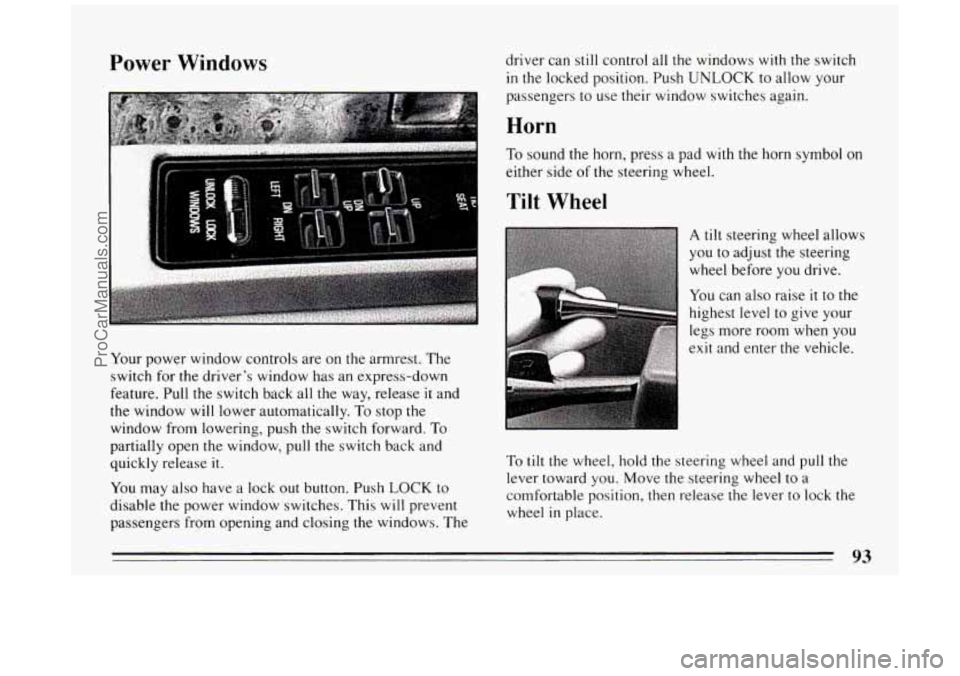
Your power window controls are on the armrest. The
switch for the driver’s window has an express-down
feature. Pull
the switch back all the way, release it and
the window will lower automatically.
To stop the
window from lowering, push the switch forward.
To
partially open the window, pull the switch back and
quickly release it.
You may also have a lock out button. Push
LOCK to
disable the power window switches. This
will prevent
passengers from opening and closing the windows. The driver
can still control all the windows
with the switch
in
the locked position. Push UNLOCK to allow your
passengers to use their window switches again.
Horn
To sound the horn, press a pad with the horn symbol on
either side of the steering wheel.
Tilt Wheel
A tilt steering wheel allows
you to adjust the steering
wheel before you drive.
You can also raise
it to the
highest level to give your
legs more room
when you
exit and enter
the vehicle.
To tilt the wheel, hold the steering wheel and pull the
lever toward
you. Move the steering wheel to a
comfortable position, then release the lever to lock the
wheel
in place.
93
ProCarManuals.com
Page 97 of 324
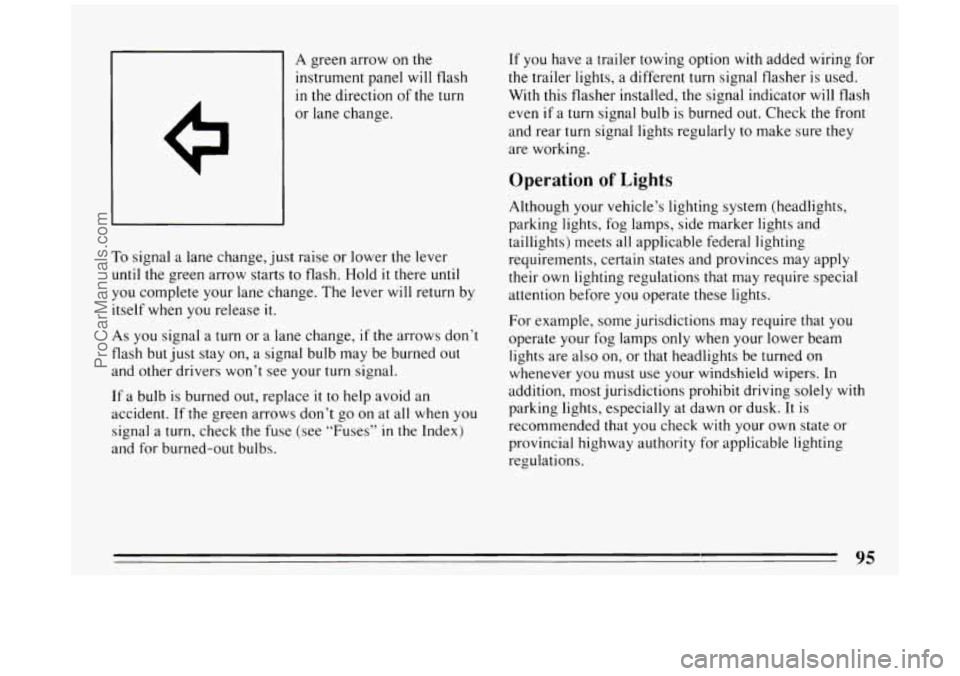
A green arrow on the
instrument panel will flash
in the direction of the turn
To signal a lane change, just raise or lower the lever
until the green arrow starts to flash. Hold it there until
you complete your lane change. The lever will return by
itself when you release
it.
As you signal a turn or a lane change, if the arrows don’t
flash but just stay on, a signal bulb may be burned out
and other drivers won’t see your turn signal.
If a bulb is burned out, replace it to help avoid an
accident. If the green arrows don’t go on at all when you
signal a
turn, check the fuse (see “Fuses” in the Index)
and for burned-out bulbs. If you
have a trailer towing option
with added wiring for
the trailer lights, a different turn signal flasher is used.
With this flasher installed, the signal indicator
will flash
even
if a turn signal bulb is burned out. Check the front
and rear turn signal lights regularly to make sure they
are working.
Operation of Lights
Although your vehicle’s lighting system (headlights,
parking lights, fog lamps, side marker lights and
taillights) meets all applicable federal lighting
requirements, certain states and provinces may apply
their own lighting regulations that may require special
attention before you operate these lights.
For example, some jurisdictions may require that you
operate your fog lamps only when your lower beam
lights are also on, or that headlights be turned on
whenever you must
use your windshield wipers. In
addition, most jurisdictions prohibit driving solely
with
parking lights, especially at dawn or dusk. It is
recommended that you check with your own state or
provincial highway authority for applicable lighting
regulations.
95
ProCarManuals.com
Page 98 of 324
Headlight High-Low Beam
BRIGHT
Windshield Wipers
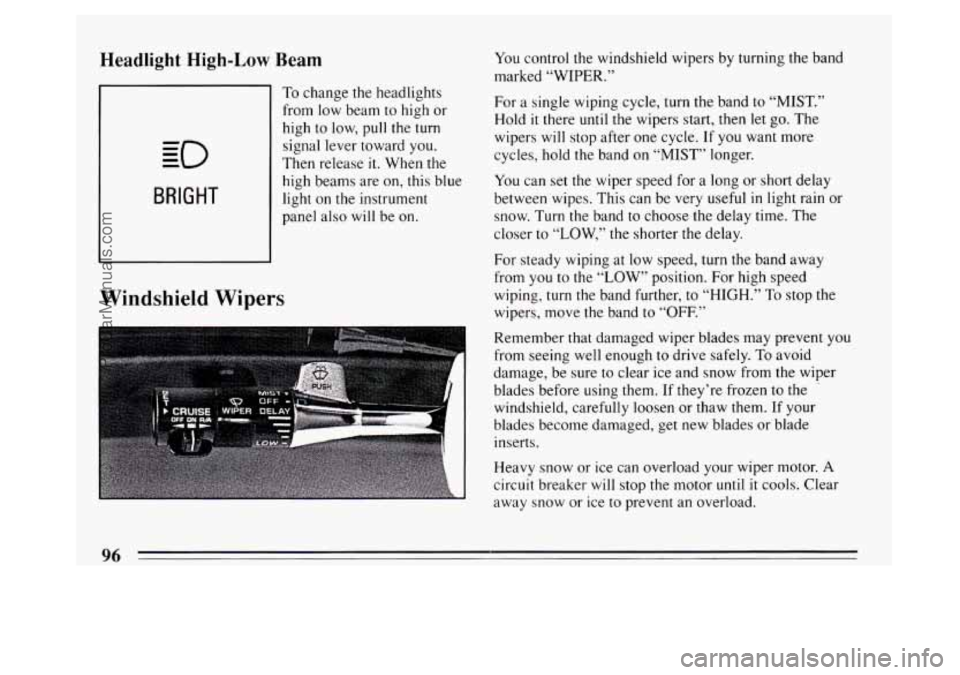
To change the headlights
from low beam to high or
high to low,
pull the turn
signal lever toward you.
Then release
it. When the
high beams are on, this blue
light on the instrument
panel also will be on. You
control the windshield wipers by turning the band
marked
“WIPER.”
For a single wiping cycle, turn the band to “MIST.”
Hold
it there until the wipers start, then let go. The
wipers will stop after one cycle. If you want more
cycles, hold the band on “MIST” longer.
You can set the wiper speed for a long or short delay
between wipes. This can be very useful
in light rain or
snow. Turn the band to choose the delay time. The
closer to
“LOW,” the shorter the delay.
For steady wiping at low speed, turn the band away
from you to the
“LOW” position. For high speed
wiping, turn the band further,
to “HIGH.” To stop the
wipers, move the band to “OFF.”
Remember that damaged wiper blades may prevent you
from seeing well enough to drive safely.
To avoid
damage, be sure to clear ice and snow from the wiper
blades before using them. If they’re frozen to
the .
windshield, carefully loosen or thaw them. If your
blades become damaged, get new blades or blade
inserts.
Heavy snow or ice can overload your wiper motor.
A
circuit breaker will stop the motor until it cools. Clear
away snow or ice to prevent an overload.
96
ProCarManuals.com
Page 124 of 324
Brake System Warning Light
BRAKE
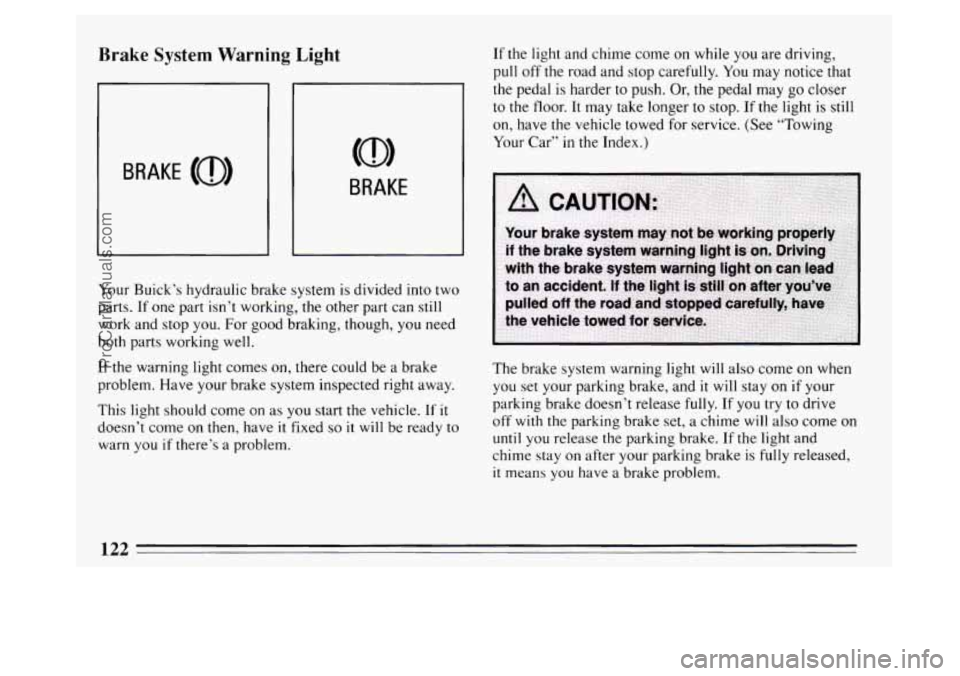
Your Buick’s hydraulic brake system is divided into two
parts. If one part isn’t working, the other part can still
work and stop you. For good braking, though,
you need
both parts working well.
If the warning light comes on, there could be
a brake
problem. Have your brake system inspected right away.
This light should come on as you start the vehicle. If
it
doesn’t come on then, have it fixed so it will be ready to
warn you if there’s
a problem. If
the light and chime come on while you are driving,
pull off the road and stop carefully. You may notice that
the pedal
is harder to push. Or, the pedal may go closer
to
the floor. It may take longer to stop. If the light is still
on, have the vehicle towed for service. (See “Towing
Your Car”
in the Index.)
The brake system warning light will also come on when
you set your parking brake, and
it will stay on if your
parking brake doesn’t release
fully. If you try to drive
off
with the parking brake set, a chime will also come on
until you release the parking brake. If the light and
chime stay on after your parking brake is
fully released.
it means you have a brake problem.
122
ProCarManuals.com
Page 135 of 324
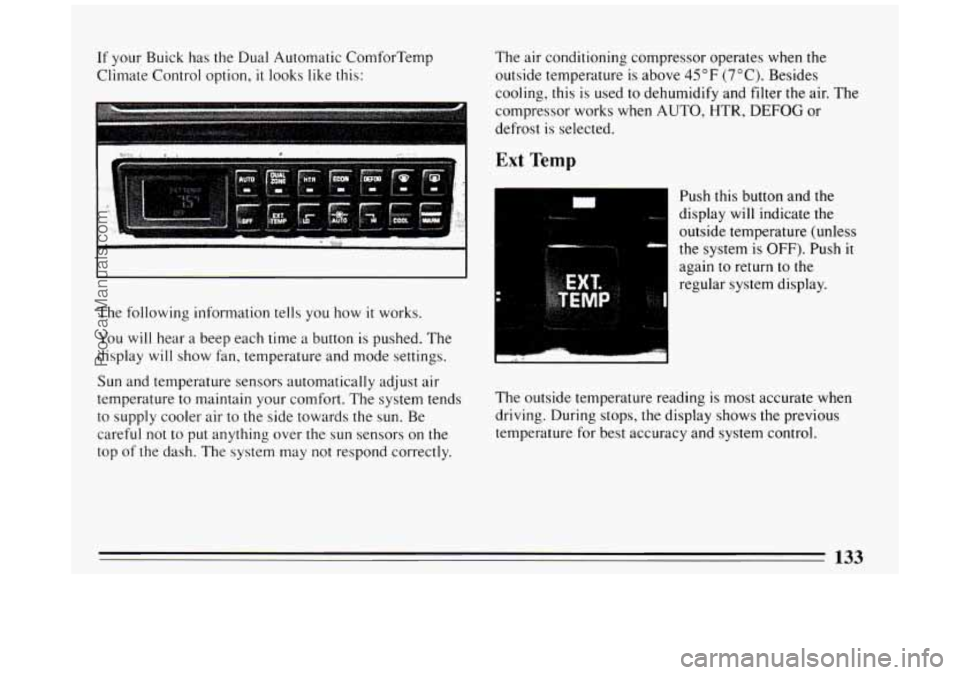
If your Buick has the Dual Automatic ComforTemp
Climate Control option,
it looks like this: The air conditioning compressor operates
when
the
outside temperature is above 45°F (7°C). Besides
cooling, this is used to dehumidify and filter
the air. The
compressor works when AUTO, HTR, DEFOG or
defrost is selected.
The following information
tells you how it works.
You
will hear a beep each time a button is pushed. The
display
will show fan, temperature and mode settings.
Sun and temperature sensors automatically adjust air
temperature to maintain your comfort. The system tends
to supply cooler air to the side towards the sun. Be
careful not to put anything over the sun sensors on the
top
of the dash. The system may not respond correctly.
Ext Temp
Push this button and the
display will indicate the
outside temperature (unless
the system
is OFF). Push it
again to return to the
regular system display.
.. * '' I
The outside temperature reading is most accurate when
driving. During stops, the display shows
the previous
temperature for best accuracy and system control.
133
ProCarManuals.com
Page 140 of 324
Defog Defrost
When the outside
temperature is mild, use
DEFOG to keep fog off the
I windshield.
Air entering the vehicle will be evenly split between the
floor outlets and the outlets near the windshield.
The blower speed will be controlled automatically, or
you can choose another fan speed by pushing the HI or
LO buttons. This
setting directs most
of
the air flow toward the
windshield. Use DEFROST
when there is fog or ice on
the windshield.
Defrost will work better
if any ice and snow is cleared
from the hood and the air inlet area between the hood
and the windshield.
Blower speed
will be controlled automatically, but you
can choose another speed by pushing the
HI or LO
buttons.
138
ProCarManuals.com
Page 143 of 324
Max Vent
This setting provides maximum cooling with the least
amount
of work. MAX recirculates much of the air
inside
your vehicle so it maximizes your air
conditioner’s performance and fuel economy. Air is
directed through
the instrument panel outlets.
Norm
Use NORM for normal cooling on hot days. This setting
cools outside air and directs
it through the instrument
panel outlets.
Bi-Level
This setting is designed for use on sunny days when the
air is only moderately warm or cool. On days like these,
the sun may adequately warm your upper body, but your
lower body may not be warm enough.
The Bi-level setting directs vehicle air
in two ways.
Cool air
is directed toward your upper body through
instrument panel outlets, while slightly warmed air is
directed through the heater outlet at your feet. For
mild outside temperatures when little heating or
cooling is needed, use the VENT setting. Air
will flow
through the instrument panel outlets. ,Use the air outlets
to turn
on, adjust and turn off the air flow. Adjust the
temperature lever to the desired temperature.
Heater
When outside temperatures are cold, pressing the HTR
setting and adjusting the temperature lever
will send
warm air through
the floor outlets and some through the
defroster vents.
Defrost
The DEFROST setting directs most of the air flow
toward the windshield. Use defrost when you want
to
remove fog or ice from the windshield. When it’s 42°F
(6°C) or warmer, you’ll get cooled air.
ProCarManuals.com
Page 163 of 324
@ Part 4 Your Driving and the Road
Here you’ll find information about driving on different kinds of roads and in varying weather conditions . We’ve also
included many other useful tips on driving
.
Part 4 includes:
DefensiveDriving .................................................................
DrunkenDriving ..................................................................
ControlofaVehicle ................................................................
Braking .....................................................................
Steering .....................................................................
Passing .....................................................................
LossofControl .....................................................................
DrivingatNight ...................................................................
DrivingintheRain .................................................................
CityDriving ......................................................................
FreewayDriving ...................................................................
HillandMountainRoads ............................................................
WinterDriving ....................................................................
TowingaTrailer ...................................................................
162
162
165
166
170 172
173
175 176
179 180
182
184
184
161
ProCarManuals.com
Page 190 of 324
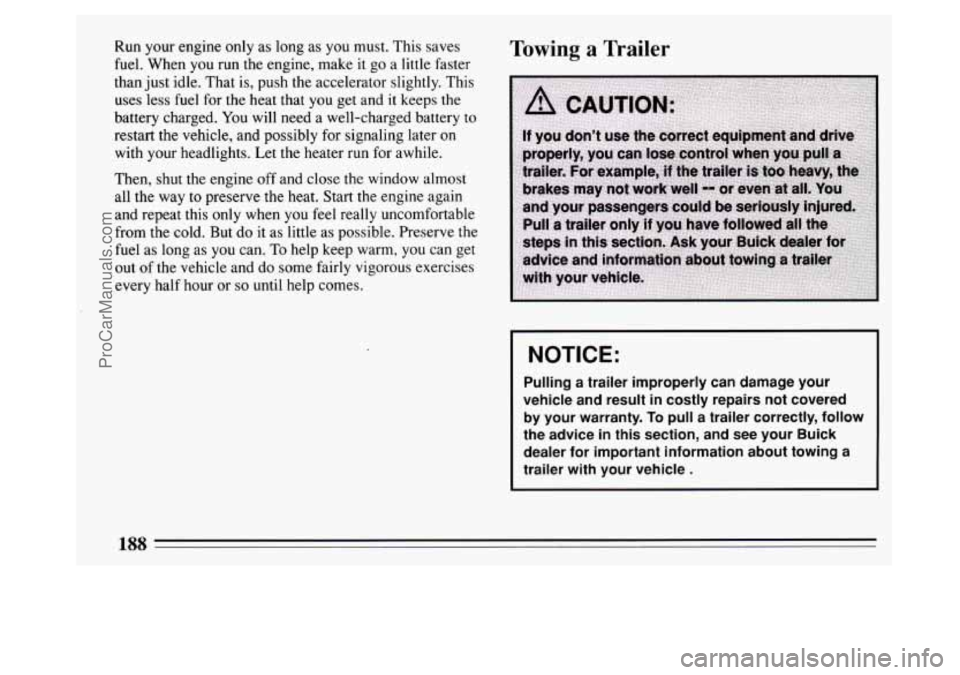
Run your engine only as long as you must. This saves
fuel. When you run the engine, make it go a little faster
than just idle. That is, push the accelerator slightly. This
uses less fuel
for the heat that you get and it keeps the
battery charged.
You will need a well-charged battery to
restart the vehicle, and possibly for signaling later
on
with your headlights. Let the heater run for awhile.
Then, shut the engine off and close the window almost
all the way to preserve the heat. Start the engine again
and repeat this only when
you feel really uncomfortable
from the cold. But
do it as little as possible. Preserve the
fuel as long as you can. To help keep warm, you can get
out of the vehicle and do some fairly vigorous exercises
every half hour or
so until help comes.
Towing a Trailer
NOTICE:
Pulling a trailer improperly can damage your
vehicle and result in costly repairs not covered
by your warranty.
To pull a trailer correctly, follow
the advice in this section, and see your Buick
dealer for important information about towing
a
trailer with your vehicle .
188
ProCarManuals.com
Page 191 of 324
Your car can tow a trailer if it is equipped with the 3800
(L27) engine or (L67) Supercharged engine and proper
trailer towing equipment. To identify what the vehicle
trailering capacity is for your vehicle, you should read
the information in “Weight
of the Trailer” that appears
later in this section. But trailering
is different than just
driving your vehicle by itself. Trailering means changes
in handling, durability, and fuel economy. Successful,
safe trailering takes correct equipment, and it has
to be
used properly.
That’s the reason for this section. In
it are many
time-tested, important trailering tips and safety rules.
Many
of these are important for your safety and that of
your passengers. So please read this section carefully
before
you pull a trailer.
Load-pulling components such as the engine, transaxle,
wheel assemblies, and tires are forced
to work harder
against the drag of the added weight.
The engine is
required to operate at relatively higher speeds and under
greater loads, generating extra heat. What’s more, the
trailer adds considerably to wind resistance, increasing
the pulling requirements. If You
Do Decide To Pull
A Trailer
If you do, here are some important points.
There are many different laws having to do with
trailering. Make sure your rig will be legal, not only
where you live but also where you’ll be driving.
A
good source for this information can be state or
provincial police.
Consider using a sway control if your trailer will
weigh
2,000 pounds (900 kg) or less. You should
always use a sway control if your trailer will weigh
more than
2,000 pounds (900 kg).
You can ask a hitch dealer about sway controls.
Don’t tow a trailer at all during the first 500 miles
(800 km) your new vehicle is driven. Your engine,
axle or other parts could be damaged.
0 Then, during the first 500 miles (800 km) that you
tow
a trailer, don’t drive over 50 mph (80 km/h) and
don’t make starts at full throttle. This helps your
engine and other parts of
your vehicle wear in at the
heavier loads.
Three important considerations have to do with weight:
189
ProCarManuals.com