steering BUICK PARK AVENUE 1996 User Guide
[x] Cancel search | Manufacturer: BUICK, Model Year: 1996, Model line: PARK AVENUE, Model: BUICK PARK AVENUE 1996Pages: 388, PDF Size: 20.04 MB
Page 90 of 388
ion ever
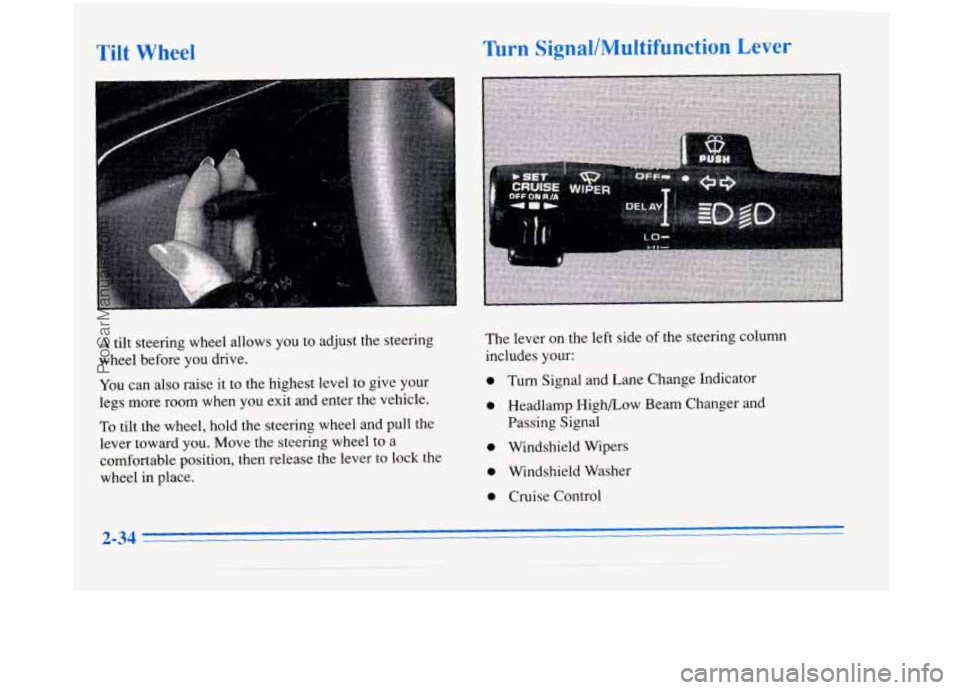
The lever on the left side of the steering column
includes your:
a Turn Signal and Lane Change Indicator
a Headlamp High/Low Beam Changer and
Passing Signal
a Windshield Wipers
a Windshield Washer
0 Cruise Control
ProCarManuals.com
Page 121 of 388
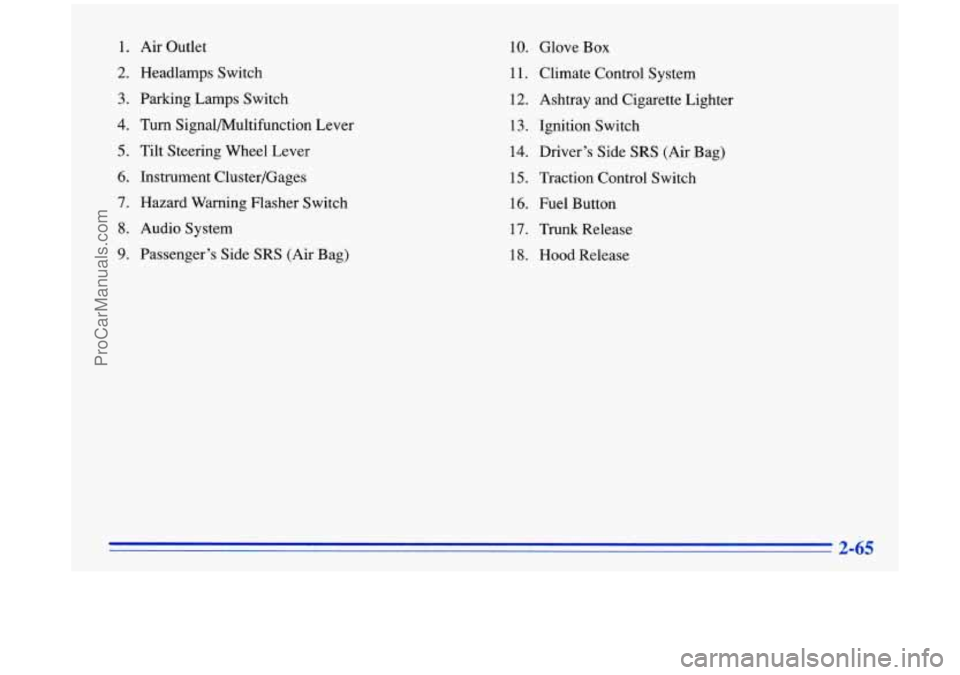
1. Air Outlet
2. Headlamps Switch
3. Parking Lamps Switch
4. Turn Signal/Multifunction Lever
5. Tilt Steering Wheel Lever
6. Instrument Cluster/Gages
7. Hazard Warning Flasher Switch
8. Audio System
9. Passenger’s Side SRS (Air Bag)
10. Glove Box
11. Climate Control System
12. Ashtray and Cigarette Lighter
13. Ignition Switch
14. Driver’s Side
SRS (Air Bag)
15. Traction Control Switch
16. Fuel Button
17.
Trunk Release
18. Hood Release
ProCarManuals.com
Page 129 of 388
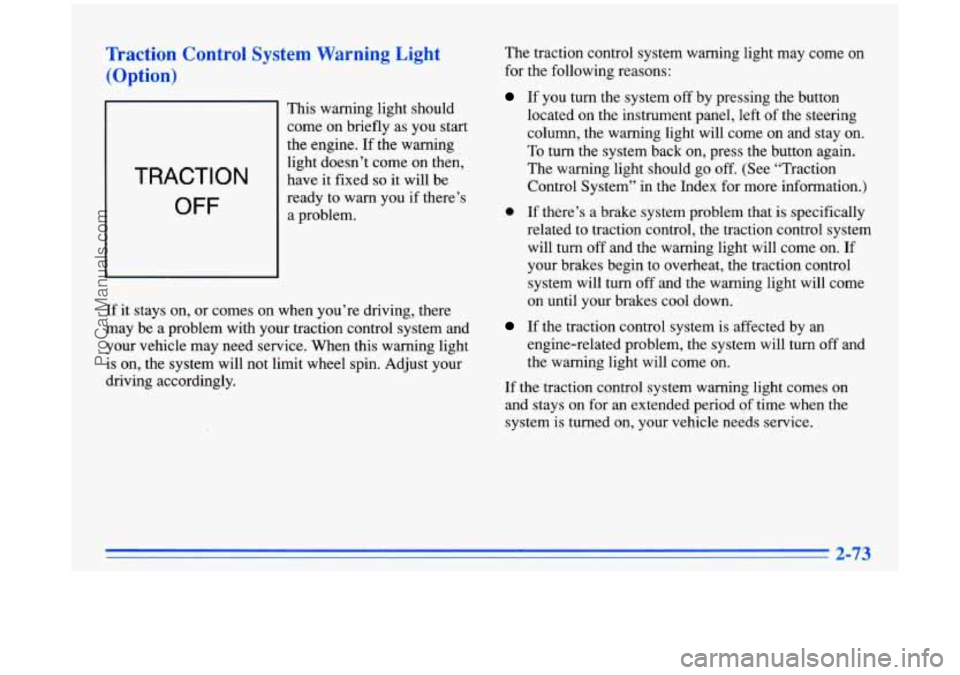
Traction Control System Warning Light
(Option)
TRACTION
OFF
This warning light should
come on briefly as you start
the engine. If the warning
light doesn’t come on then,
have
it fixed so it will be
ready to warn you if there’s
a problem.
If it stays on, or comes on when you’re driving, there
may be a problem with your traction control system and
your vehicle may need service. When this warning light
is on, the system will not limit wheel
spin. Adjust your
driving accordingly. The
traction control system warning light may come on
for the following reasons:
If you turn the system off by pressing the button
located on the instrument panel, left of the steering
column, the warning light will come on and stay on.
To turn the system back on, press the button again.
The warning light should go off. (See “Traction
Control System” in the Index for more information.)
0 If there’s a brake system problem that is specifically
related to traction control, the traction control system will turn off and the warning light will come on. If
your brakes begin to overheat, the traction control
system will turn off and the warning light will come
on until your brakes cool down.
If the traction control system is affected by an
engine-related problem, the system will turn
off and
the warning light will come on.
If the traction control system warning light comes on
and stays on for an extended period of time when the
system is turned on, your vehicle needs service.
2-73
ProCarManuals.com
Page 151 of 388
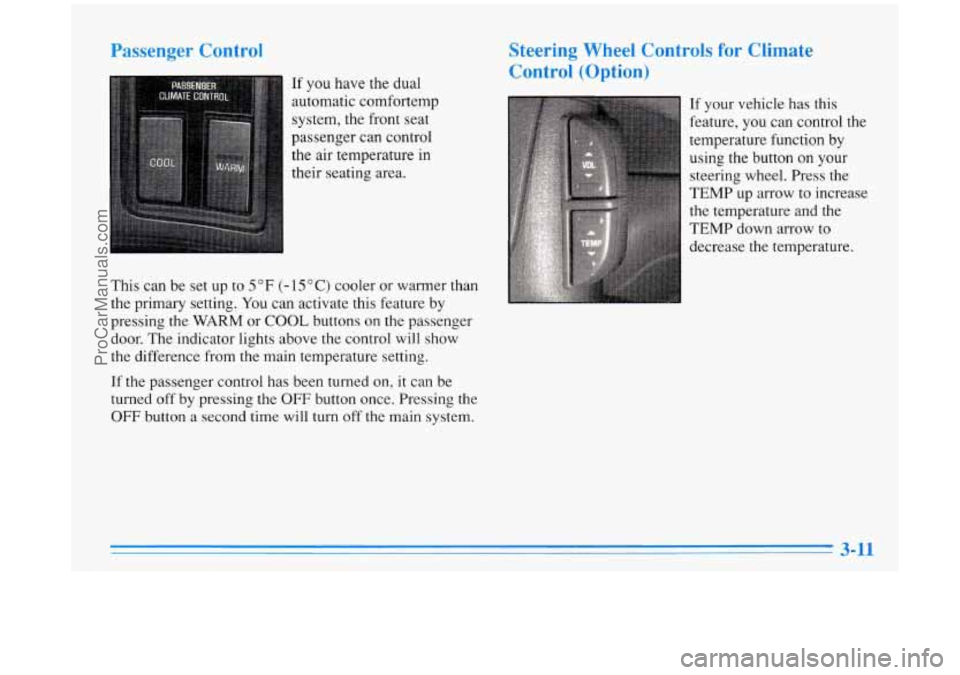
Passenger Control
If you have the dual
automatic cornfortemp
system, the front seat
passenger can control
the
air temperature in
their seating area.
This can be set up to
5 OF (- 15 O C) cooler or warmer than
the primary setting.
You can activate this feature by
pressing the
WARM or COOL buttons on the passenger
door. The indicator lights above the control will show
the difference from
the main temperature setting.
If the passenger control has been turned on,
it can be
turned
off by pressing the OFF button once. Pressing the
OFF button a second time will turn off the main system.
Steering Wheel Controls for Climate
Control (Option)
If your vehicle has this
feature, you can control the
temperature function by
using the button
on your
steering wheel. Press the
TEMP up
arrow to increase
the temperature and the
TEMP down arrow to
decrease the temperature.
ProCarManuals.com
Page 169 of 388
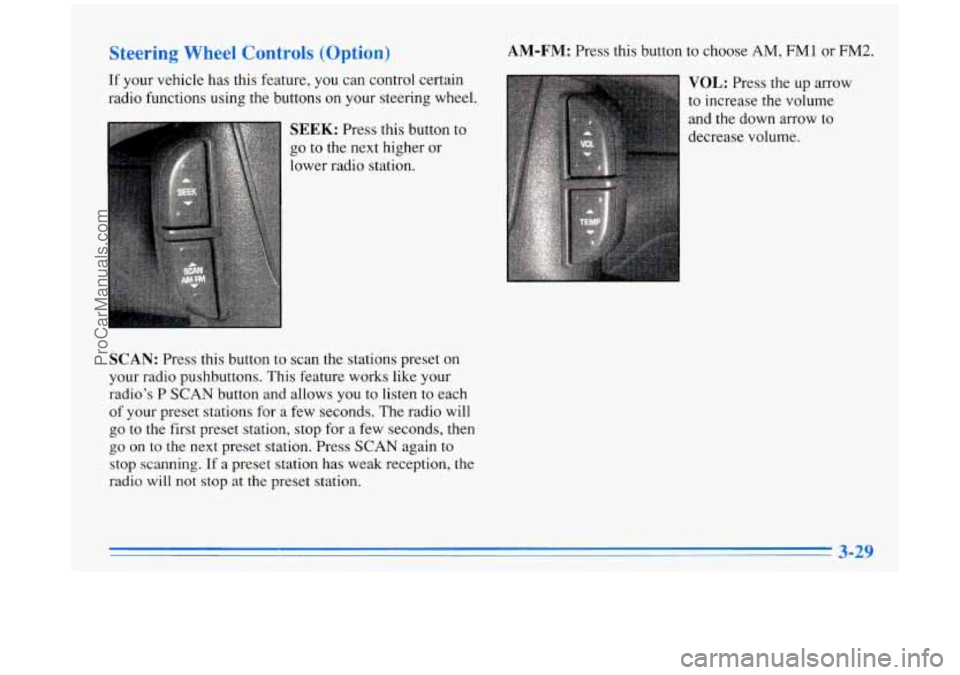
Steering Wheel Controls (Option)
If your vehicle has this feature, you can control certain
radio functions using the buttons on your steering wheel.
SEEK: Press this button to
go to the next higher or
lower radio station.
SCAN: Press this button to scan the stations preset on
your radio pushbuttons. This feature works like your
radio’s
P SCAN button and allows you to listen to each
of your preset stations for a few seconds. The radio will
go
to the first preset station, stop for a few seconds, then
go on to the next preset station. Press SCAN again to
stop scanning.
If a preset station has weak reception, the
radio
will not stop at the preset station.
AM-FM: Press this button to choose AM, FMl or FM2.
VOL: Press the up arrow
to increase the volume
and the down arrow
to
decrease volume.
ProCarManuals.com
Page 179 of 388
Control of a Vehicle
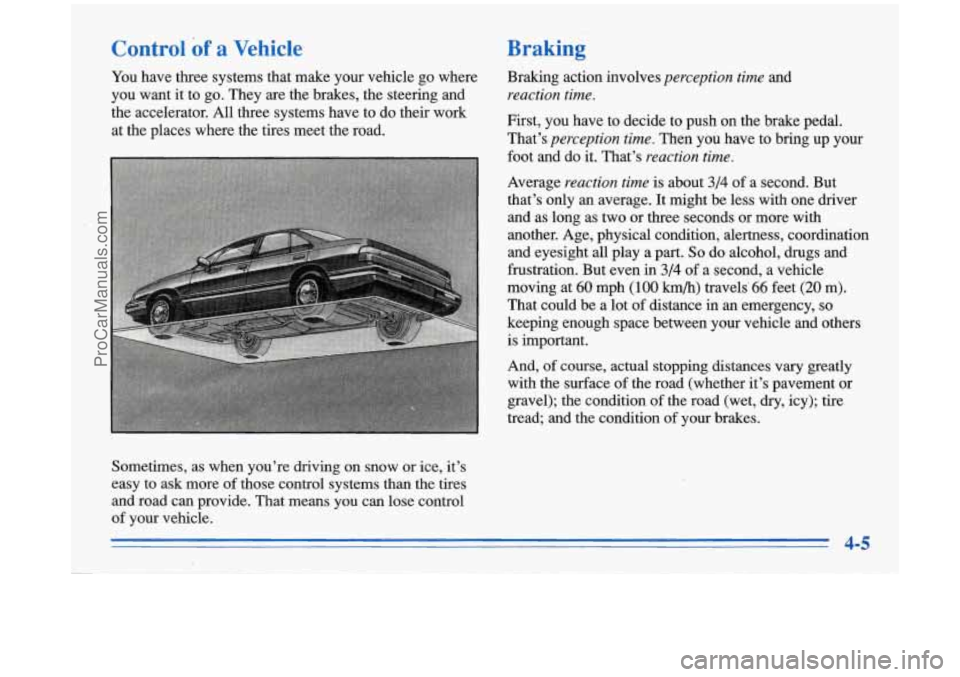
You have three systems that make your vehicle go where
you want it to go. They
are the brakes, the steering and
the acceIerator. All three systems have to do their work
at the places where the tires meet the road.
Sometimes, as when you’re driving on snow or ice, it’s
easy to ask more of those control systems than the tires
and road can provide. That means you can lose control
of your vehicle.
Braking
Braking action involves perception time and
reaction time.
First, you have to decide to push on the brake pedal.
That’s
perception time. Then you have to bring up your
foot and do it. That’s
reaction time.
Average reaction time is about 3/4 of a second. But
that’s only an average. It might be less with one driver
and as long as two or three seconds or more with
another. Age, physical condition, alertness, coordination
and eyesight
all play a part. So do alcohol, drugs and
frustration. But even in 3/4 of a second, a vehicle
moving
at 6O~mph (I00 h/h) travels’ 66 feet (20 m).
That could be a lot of distance in an emergency,
so
keeping enough space between your vehicle and others
is important.
And,
of course, actual stopping distances vary greatly
with the surface of the road (whether it’s pavement or
gravel); the condition
of the road (wet, dry, icy); tire
tread; and the condition
of your brakes.
ProCarManuals.com
Page 183 of 388
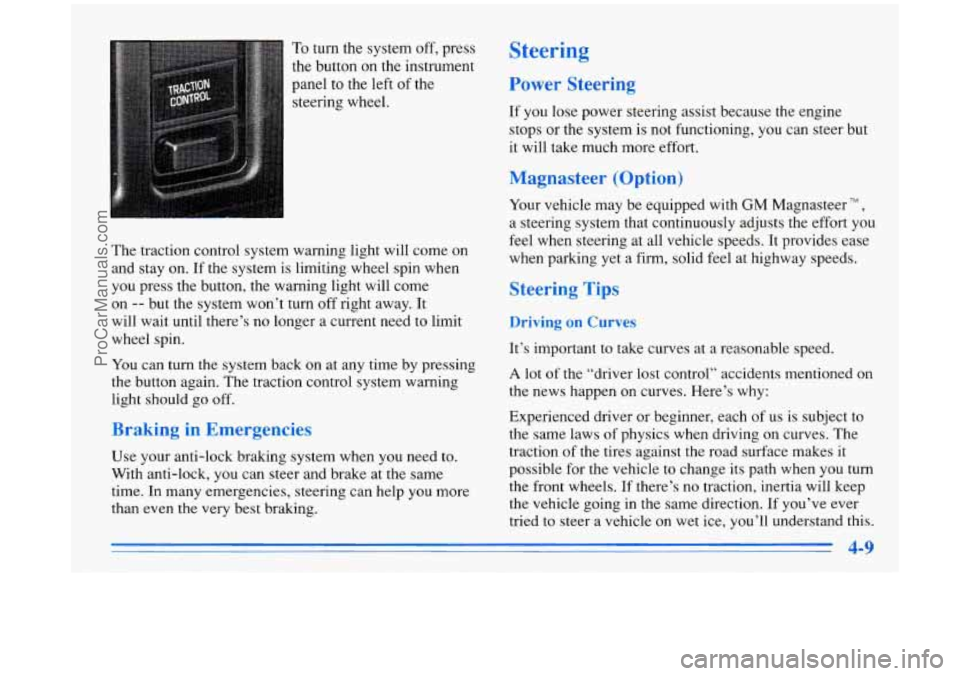
To turn the system off, press
the button on the instrument
panel to the left of the
steering wheel.
The traction control system warning light will come
on
and stay on. If the system is limiting wheel spin when
you press the button, the warning light will come
on
-- but the system won’t turn off right away. It
will wait until there’s no longer a current need to limit
wheel spin.
You can turn the system back on at any time by pressing
the button again. The traction control system warning
light should go off.
Braking in Emergencies
Use your anti-lock braking system when you need to.
With anti-lock,
you can steer and brake at the same
time. In many emergencies, steering can help you more
than even
the very best braking.
Steering
Power Steering
If you lose power steering assist because the engine
stops or the system is not functioning, you can steer but
it will take much more effort.
Magnasteer (Option)
Your vehicle may be equipped with GM Magnasteer TM ,
a steering system that continuously adjusts the effort you
feel when steering at all vehicle speeds. It provides ease
when parking yet a firm, solid feel at highway speeds.
Steering Tips
Driving on Curves
It’s important to take curves at a reasonable speed.
A lot of the “driver lost control” accidents mentioned on
the news happen on curves. Here’s why:
Experienced driver or beginner, each of
us is subject to
the same laws of physics when driving on curves. The
traction of the tires against the road surface makes it
possible for the vehicle to change its path when
you turn
the front wheels.
If there’s no traction, inertia will keep
the vehicle going in the same direction. If you’ve ever
tried to steer a vehicle on wet ice, you’ll understand
this.
4-9
-
ProCarManuals.com
Page 184 of 388
The traction you can get in a curve depends on the
condition of your tires and the road surface, the angle at
which the curve
is banked, and your speed. While you’re
in a curve, speed is the one factor you can control.
Suppose you’re steering through a sharp curve. Then you suddenly accelerate. Both control systems
-- steering and
acceleration
-- have to do their work where the tires meet
the road. Unless you have traction control and the system
is on, adding the sudden acceleration can demand too
much of those places. You can lose control.
What should
you do if this ever happens? Ease up on the
accelerator pedal, steer the vehicle the way
you want it
to go, and slow down.
Speed
limit signs near curves warn that you should
adjust your speed. Of course, the posted speeds are
based on good weather and road conditions. Under less
favorable conditions you’ll want to go slower.
If you need to reduce your speed as you approach a
curve, do it before you enter the curve, while your front
wheels are straight ahead. Try
to adjust your speed
so you can “drive” through the
curve. Maintain a reasonable, steady speed. Wait to
accelerate until you are out
of the curve, and then
accelerate gently into the straightaway.
L Erne ncie!
There are times when steenng can De more effective than
braking. For example, you come over a hill and find a
truck stopped
in your lane, or a car suddenly pulls out
from nowhere, or a chld darts out from between parked
cars and stops right
in front of you. You can avoid these
problems by braking
-- if you can stop in time. But
sometimes you can’t; there isn’t room. That’s the time \
for
evasive action
-- steering around the problem.
Your Buick can perform very well in emergencies like
these. First apply your brakes. (See “Braking in
Emergencies” earlier in this section.) It
is better to
remove as much speed as you can from a possible
collision. Then steer around the problem, to the left or
right depending on the space available.
ProCarManuals.com
Page 185 of 388
Off-Road Recovery
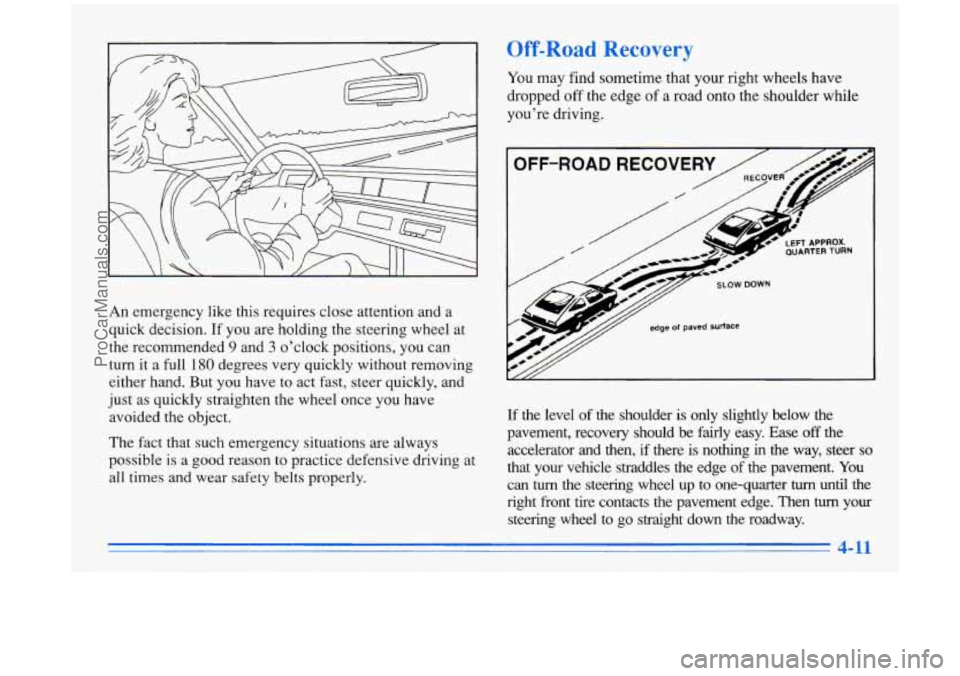
An emergency like this requires close attention and a
quick decision. If you are holding the steering wheel at
the recommended
9 and 3 o’clock positions, you can
turn it a full
180 degrees very quickly without removing
either hand. But
you have to act fast, steer quickly, and
just as quickly straighten the wheel once you have
avoided the object.
The fact that such emergency situations are always
possible
is a good reason to practice defensive driving at
all times and wear safety belts properly. You
may find sometime that your right wheels have
dropped
off the edge of a road onto the shoulder while
you’re driving.
OFF-ROAD RECOVERY
7/ SLOW DOWN
y// edge of paved surface -
If the level of the shoulder is only slightly below the
pavement, recovery should be fairly easy. Ease
off the
accelerator
and then, if there is nothing in the way, steer so
that your vehicle straddles the edge of the pavement. You
can the steering wheel up
to one-quarter turn until the
right front tire contacts the pavement edge. Then turn your
steering wheel to go straight down the roadway.
4-11
ProCarManuals.com
Page 187 of 388
0 Check your mirrors, glance over your shoulder, and
start your left lane change signal before moving out
of the right lane to pass. When you are far enough
ahead
of the passed vehicle to see its front in your
inside mirror, activate your right lane change signal
and move back into the right lane. (Remember that
your right outside mirror is convex. The vehicle you
just passed may seem
to be farther away from you
than it really is.)
0 Try not to pass more than one vehicle at a time on
two-lane roads. Reconsider before passing the
next vehicle.
0 Don’t overtake a slowly moving vehicle too rapidly.
Even though the brake lamps are not flashing,
it may
be slowing down or starting to turn.
following driver to get ahead
of you. Perhaps you
can ease a little to the right.
0 If you’re being passed, make it easy for the
Loss of Control
Let’s review what driving experts say about what
happens when the three control systems (brakes, steering
and acceleration) don’t have enough friction where the
tires meet the road to do what the driver has asked.
In any emergency, don’t give up. Keep trying to steer and
constantly seek an escape route or area of less danger.
Skidding
In a skid, a driver can lose control of the vehicle.
Defensive drivers avoid most skids by taking reasonable
care suited to existing conditions, and by not “overdriving”\
those conditions. But skids are always possible.
The three types of skids correspond
to your Buick’s
three control systems. In the braking skid, your wheels
aren’t rolling. In the steering or cornering skid, too
much speed or steering in a curve causes tires to slip and
lose cornering force. And in the acceleration skid, too
much throttle causes the driving wheels to spin.
A cornering skid is best handled by easing your foot off
the accelerator pedal.
If you have the traction control system, remember: It
helps avoid only the acceleration skid.
If
you do not have traction control, or if the system is
off, then an acceleration skid is also best handled by
easing your foot off the accelerator pedal.
If your vehicle starts to slide, ease your foot off the
accelerator pedal and quickly steer the way you want the
vehicle
to go. If you start steering quickly enough, your
vehicle may straighten
out. Always be ready for a
second skid if it occurs.
ProCarManuals.com