change time BUICK PARK AVENUE 1996 Owner's Manual
[x] Cancel search | Manufacturer: BUICK, Model Year: 1996, Model line: PARK AVENUE, Model: BUICK PARK AVENUE 1996Pages: 388, PDF Size: 20.04 MB
Page 187 of 388
0 Check your mirrors, glance over your shoulder, and
start your left lane change signal before moving out
of the right lane to pass. When you are far enough
ahead
of the passed vehicle to see its front in your
inside mirror, activate your right lane change signal
and move back into the right lane. (Remember that
your right outside mirror is convex. The vehicle you
just passed may seem
to be farther away from you
than it really is.)
0 Try not to pass more than one vehicle at a time on
two-lane roads. Reconsider before passing the
next vehicle.
0 Don’t overtake a slowly moving vehicle too rapidly.
Even though the brake lamps are not flashing,
it may
be slowing down or starting to turn.
following driver to get ahead
of you. Perhaps you
can ease a little to the right.
0 If you’re being passed, make it easy for the
Loss of Control
Let’s review what driving experts say about what
happens when the three control systems (brakes, steering
and acceleration) don’t have enough friction where the
tires meet the road to do what the driver has asked.
In any emergency, don’t give up. Keep trying to steer and
constantly seek an escape route or area of less danger.
Skidding
In a skid, a driver can lose control of the vehicle.
Defensive drivers avoid most skids by taking reasonable
care suited to existing conditions, and by not “overdriving”\
those conditions. But skids are always possible.
The three types of skids correspond
to your Buick’s
three control systems. In the braking skid, your wheels
aren’t rolling. In the steering or cornering skid, too
much speed or steering in a curve causes tires to slip and
lose cornering force. And in the acceleration skid, too
much throttle causes the driving wheels to spin.
A cornering skid is best handled by easing your foot off
the accelerator pedal.
If you have the traction control system, remember: It
helps avoid only the acceleration skid.
If
you do not have traction control, or if the system is
off, then an acceleration skid is also best handled by
easing your foot off the accelerator pedal.
If your vehicle starts to slide, ease your foot off the
accelerator pedal and quickly steer the way you want the
vehicle
to go. If you start steering quickly enough, your
vehicle may straighten
out. Always be ready for a
second skid if it occurs.
ProCarManuals.com
Page 205 of 388
Your vehicle can tow a trailer if it is equipped with the
3800 (L67) Supercharged engine or the 3800 (L36)
engine and proper trailer towing equipment. To identify
what the vehicle trailering capacity is for your vehicle,
you should read the information in “Weight of the
Trailer” that appears later in this section. But trailering
is different than just driving your vehicle by itself.
Trailering means changes in handling, durability, and
fuel economy. Successful, safe trailering takes correct
equipment, and it has to be used properly.
That’s the reason for this part. In it are many
time-tested, important trailering tips and safety rules.
Many of these are important for your safety and that of
your passengers.
So please read this section carefully
before you pull a trailer.
Load-pulling components such as the engine, transaxle,
wheel assemblies and tires are forced to work harder
against the drag
of the added weight. The engine is
required to operate at relatively higher speeds and under
greater loads, generating extra heat. What’s more, the
trailer adds considerably to wind resistance, increasing
the pulling requirements.
If You Do Decide To Pull A Trailer
If you do, here are some important points:
0
0
0
0
0
There are many different laws, including speed limit
restrictions, having to do with trailering. Make sure
your rig will be legal, not only where you live but
also where you’ll be driving.
A good source for this
information can be state or provincial police.
Consider using a sway control if your trailer will
weigh
2,000 lbs. (900 kg) or less. You should always
use a sway control if your trailer will weigh more
than
2,000 lbs. (900 kg). You can ask a hitch dealer
about sway controls.
Don’t tow a trailer at all during the first
1,000 miles
(1 600 km) your new vehicle is driven. Your engine,
axle or other parts could be damaged.
Then, during the first
500 miles (800 km) that vou
tow a trailer, don’t drive over
50 mph (80 kmi) and
don’t make starts at full throttle. This helps your
engine and other parts of your vehicle wear in at the
heavier loads.
Obey speed limit restrictions when towing a trailer.
Don’t drive faster than the maximum posted speed
for trailers (or no more than
55 mph (90 km/h)) to
save wear on your vehicle’s parts.
4-31
-
ProCarManuals.com
Page 210 of 388
Tbrn Signals When Towing a Trailer
The arrows on your instrument panel will flash
whenever you signal a turn or lane change. Properly
hooked up, the trailer lamps will also flash, telling other
drivers you’re about
to turn, change lanes or stop.
When towing a trailer, the arrows on your instrument
panel will flash for turns even if the bulbs on the trailer
are burned out. Thus, you may think drivers behind you
are seeing your signal when they are not. It’s important
to check occasionally to be sure the trailer bulbs are still
working.
Your vehicle
has bulb warning lights. When you plug a
trailer lighting system into your vehicle’s lighting
system, its bulb warning lights may not let you know if
one of your lamps goes out.
So, when you have a trailer
lighting system plugged in, be sure
to check your
vehicle and trailer lamps from time to time to be sure
they’re all working. Once you disconnect the trailer
lamps, the bulb warning lights again can tell you if one
of your vehicle lamps
is out.
Driving On Grades
Reduce speed and shift to a lower gear before you start
down a long or steep downgrade.
If you don’t shift
down, you might have to use your brakes
so much that
they would get hot and no longer work well.
On a long uphill grade,
shift down to THIRD (3) and
reduce your speed to around
45 mph (70 km/h) to reduce
the possibility of engine and transaxle overheating.
Parking on Hills
You really should not park your vehicle, with a trailer
attached, on a hill.
If something goes wrong, your rig
could start to move. People can be injured, and both
your vehicle and the trailer can
be damaged.
But if you ever have to park your rig on a hill, here’s
how
to do it:
1. Apply your regular brakes, but don’t shift into
PARK (P) yet.
2. Have someone place chocks under the trailer wheels.
3. When the wheel chocks are in place, release the
regular brakes until the chocks absorb the load.
4. Reapply the regular brakes. Then apply your parking
5. Release the regular brakes.
brake, and the shift
to PARK
(P).
4-36
ProCarManuals.com
Page 241 of 388
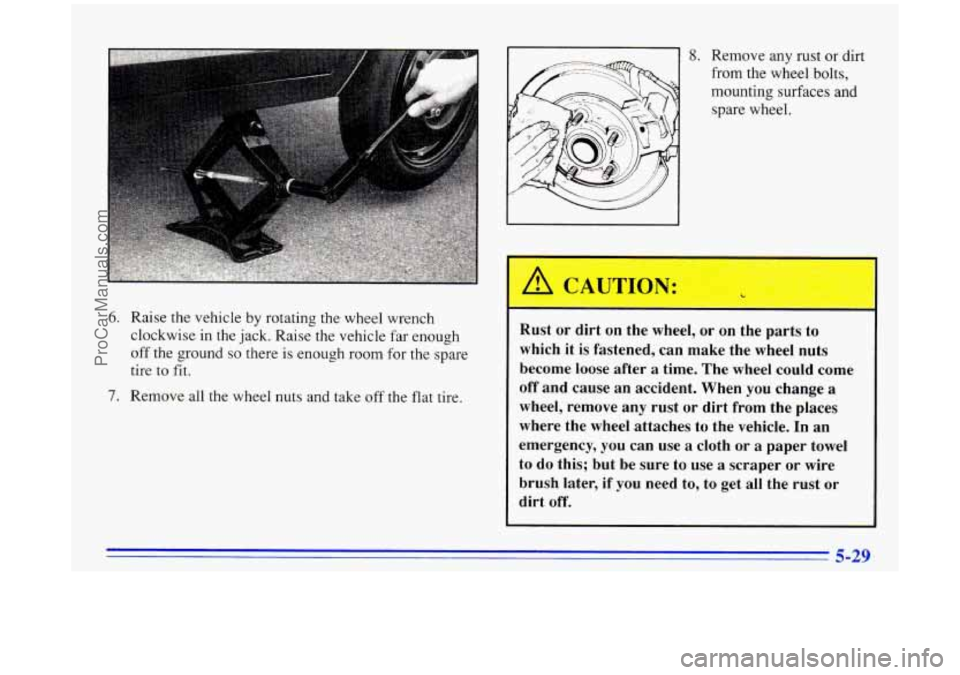
6. Raise the vehicle by rotating the wheel wrench
clockwise in the jack. Raise the vehicle far enough
off the ground
so there is enough room for the spare
tire to fit.
7. Remove all the wheel nuts and take off the flat tire.
8. Remove any rust or dirt
from the wheel bolts,
mounting surfaces and
spare wheel.
~ Rust or dirt on the wheel, or on the parts to
' which it is fastened, can make the wheel nuts
become loose after a time. The wheel could come
off and cause an accident. When
you change a
wheel, remove any rust or dirt from the places
where the wheel attaches to the vehicle. In an
emergency, you can use
a cloth or a paper towel
to do this; but be sure to use
a scraper or wire
brush later, if
you need to, to get all the rust or
dirt off.
ProCarManuals.com
Page 264 of 388
When to Change Engine Oil
See if any one of these is true for you:
0
Most trips are less than 5 to 10 miles (8 to 16 km).
This is particularly important when outside
temperatures are below freezing.
Most trips include extensive idling (such as frequent
driving in stop-and-go traffic).
Most trips are through dusty areas.
You frequently tow a trailer or use a carrier on top of
your vehicle.
The vehicle is used for delivery service, police, taxi
or other commercial application.
Driving under these conditions causes engine oil to
break down sooner.
If any one of these is true for your
vehicle, then you need to change your oil and filter
every
3,000 miles (5 000 km) or 3 months -- whichever
occurs first. (See “Change Oil Soon” in the Index.)
If none of them is true, change the oil and filter every
7,500 miles (12 500 km) or 12 months -- whichever
occurs first. Driving a vehicle with a fully warmed
engine under highway conditions causes engine oil to
break down slower.
If the optional CHANGE OIL SOON light comes on,
you will need to change your oil sooner than either
mileage specified. Depending upon driving habits, the
CHANGE OJL SOON light may come on as early as
2,000 miles
or less from the last time the oil life monitor
was reset. (See “Oil Life Monitor” in the Index.)
Always
reset the
oil life monitor after every oil change.
What to Do with Used Oil
Did you know that used engine oil contains certain
elements that may be unhealthy for your skin and could
even cause cancer? Don’t let used oil stay on your skin
for very long. Clean your skin and nails with soap and
water, or a good hand cleaner. Wash or properly throw
away clothing or rags containing used engine oil. (See
the manufacturer’s warnings about the use and disposal
of oil products.)
Used oil can be a real threat to the environment.
If you
change your own oil, be sure
to drain all free-flowing oil
from the filter before disposal. Don’t ever dispose of oil
by putting it in the trash, pouring it on
the ground, into
sewers, or into streams or bodies of water. Instead,
recycle it by taking
it to a place that collects used oil. If
you have a problem properly disposing of your used oil,
ask your dealer, a service station or a local recycling
center for help.
ProCarManuals.com
Page 268 of 388
How to Check and Add Oil
Check oil only when the engine is cold. Allow the
engine to cool two to three hours after running.
r
I
If you remove the supercharger oil fill plug while
the engine is hot, pressure may cause hot oil to
blow out of the oil fill hole. You may be burned.
Do not remove the plug until the engine cools.
1. Remove the wiring harness shield.
2. Clean the area around the oil fill plug before
removing
it.
3. Remove the oil fill plug using a 3/16 Allen wrench.
4. The oil level is correct when it just reaches the
bottom
of the threads of the inspection hole.
5. Replace the oil plug with the O-ring in place. Torque
to
88 lb-in (10 N-m).
6. Replace wiring harness shield.
Automatic Transaxle Fluid
When to Check and Change
A good time to check your automatic transaxle fluid
level is when the engine oil is changed.
Change both the fluid and filter every
50,000 miles
(83 000 km) if the vehicle is mainly driven under one or
more
of these conditions:
0 In heavy city traffic where the outside temperature
regularly reaches
90 OF (32 O C) or higher.
0 In hilly or mountainous terrain.
0 When doing frequent trailer towing.
Uses such as found in taxi, police or delivery service.
If you do not use your vehicle under any of these
conditions, the fluid and filter do not require changing.
See “Scheduled Maintenance Services” in the
Index.
ProCarManuals.com
Page 281 of 388
Replacing Brake System Parts
The braking system on a modern vehicle is complex.
Its many parts have to be of top quality and work well
together if the vehicle is to have really good braking.
Vehicles we design and test have top-quality
GM brake
parts in them,
as your Buick does when it is new. When
you replace parts of your braking system
-- for example,
when your brake linings wear down
and you have to
have new ones put in
-- be sure you get new genuine
GM replacement parts. If you don’t, your brakes may
no longer work properly. For example, if someone
puts in brake linings that are wrong for your vehicle,
the balance between your front and rear brakes can
change
-- for the worse. The braking performance
you’ve come to expect can change in many other ways
if someone puts
in the wrong replacement brake parts.
Battery
Every new Buick has a Delco Freedom@ battery. You
never have to add water to one of these. When it’s time
for a new battery, we recommend a Delco Freedom
battery. Get one that has the replacement number shown
on the original battery’s label.
Vehicle Storage
If you’re not going to drive your vehicle for 25 days
or more, take off the black, negative
(-) cable from
the battery. This will help keep your battery from
running down.
Batteries have acid that can burn you and gas
that can explode. You can be badly hurt if you
aren’t careful. See “Jump Starting” in the Index
for tips on working around
a battery without
getting hurt.
Contact your dealer to learn how to prepare your vehicle
for longer storage periods.
Also, for your audio system, see “Theft-Deterrent
Feature” in the Index.
ProCarManuals.com
Page 289 of 388
Tire Inspection and Rotation ,
Tires should be inspected every 6,000 to 8,000 miles
(10 000 to 13 000 km) for any signs of unusual wear.
If unusual wear is present, rotate yourtires as soon as
possible and check wheel alignment.
Also check for
damaged tires or wheels. See “When It’s The for New
Tires” and “Wheel Replacement” later in this section for
more information. When
rotating your tires, always use the correct rotation
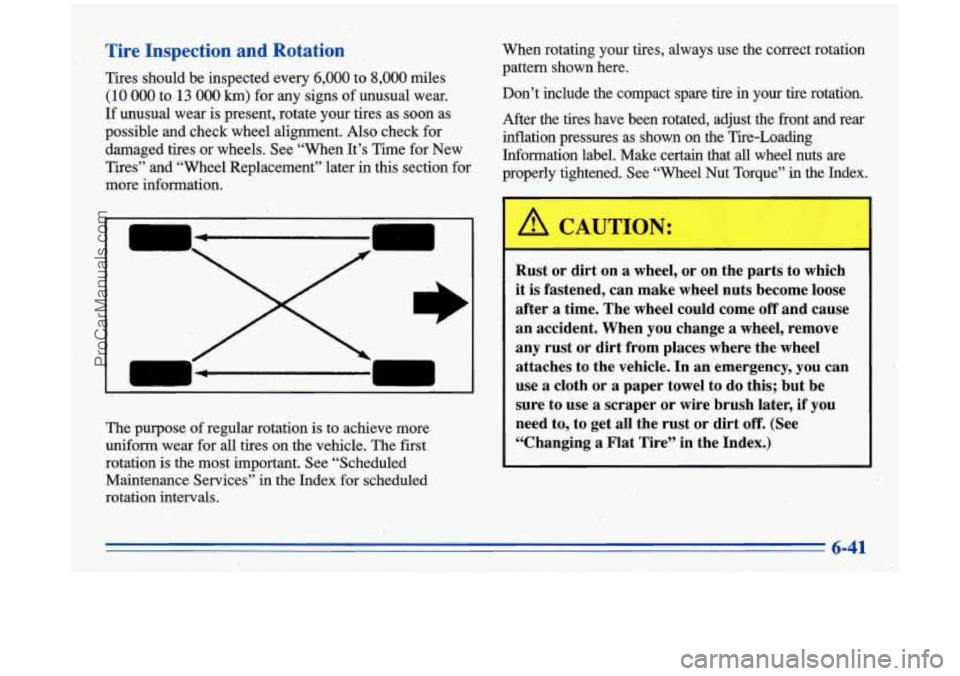
pattern shown here.
Don’t include the compact spare tire in your tire rotation.
After the tires have been rotated, adjust the front and rear
inflation pressures as shown on the Tire-Loading
Information label. Make certain that
all wheel nuts are
properly tightened. See “Wheel Nut Torque”
in the Index.
I I
The purpose of regular rotation is to achieve more
uniform wear for
all tires on the vehicle. The first
rotation is the most important. See “Scheduled
Maintenance Services”
in the Index for scheduled
rotation intervals.
A CAUTION:
I
Rust or dirt on a wheel, or on the parts to which
it
is fastened, can make wheel nuts become loose
after
a time. The wheel could come off and cause
an accident. When
you change a wheel, remove
any rust or dirt from places where the wheel
attaches
to the vehicle. In an emergency, you can
use
a cloth or a paper towel to do this; but be
sure to use a scraper or wire brush later, if you
need to, to get all the rust
or dirt off. (See
“Changing
a Flat Tire” in the Index.)
6-41
ProCarManuals.com
Page 385 of 388
I t.
I 1
Chains ..................................... 6-46
Changing a Flat
.............................. 5-22
Cleaning
.................................... 6-53
. Compact Spare ............................... 5-34
Inflation
.................................... 6-40
. Inflation Check ............................... 7-38
Inspection and Rotation
........................ 6-41
Loading
.................................... 4-28
Pressure
...................................... 6-40
Temperature
................................. 6-44
Traction
.................................... 6-44
Treadwear
.................................... 6-43
Uniform Quality Grading
....................... 6-43
Wear Indicators
............................... 6-42
Wheel Replacement
........................... 6-45
When It's Time for New
....................... 6-42
TorqueLock
.................................... 2-30
Torque, Wheel
Nut ......................... 5-31, 6-64
Towing
8 Trailer ................................ 4-30
Towing Your Vehicle
.............................. 5-7
Traction
Control System
................................ 4-8
Control System Wasrning Light
.............. 2-73, 4-8
Brakes
.'.................................... 4-34
DrivingonGrades
............................ 4-36
Drivingwith
................................. 4-34
Maintenance When Towing
..................... 4-37
TopStrap
...................................... 1-34
Trailer Hitches
..................................... 4-33 Parking
on
Hills .............................. 4-36
Safety Chains
................................ 4-34
Tongueweight
............................... 4-32
Total Weight on Tires
.......................... 4-33
Turnsignals
................................. 4-36
Weight
...................................... 4-32
Transaxle Fluid .Automatic
.........?......................... 6-20
Transmitters, Remote Keyless Entry
................. 2-7
Transportation, Courtesy
........ .I ................. 8-5
Trip Odometer
................................. 2-68
TrUnk AjarLight
................................... 2-81
Automatic Pull-Down Feature
................... 2-15
Release, Remote
.............................. 2-13
Towing
..................................... 4-30
Lock
....................................... 2-13
SecurityOverride
.............................. 2-14
TrUnkLamp
................................... 2-50
TTYUsers
..................................... 8-3
Turn Signal and Lane Change Indicator
............. 2-35
Turn Signal On Chime
........................... 2-36
Turn SignalNultifunction Lever
................... 2-34
Turn Signals When Towing a Trailer
................ 4-36
Twilight Sentinel
............................... 2-46
. underbody Flushing Service ..................... 7-41
Underbody Maintenance
......................... 6-54
l Universal Theft-Deterrent System .................. 2-16
.. ~~ i %ll ..
ProCarManuals.com