lock BUICK PARK AVENUE 2003 Manual PDF
[x] Cancel search | Manufacturer: BUICK, Model Year: 2003, Model line: PARK AVENUE, Model: BUICK PARK AVENUE 2003Pages: 372, PDF Size: 2.8 MB
Page 272 of 372
Front Turn Signal Lamps
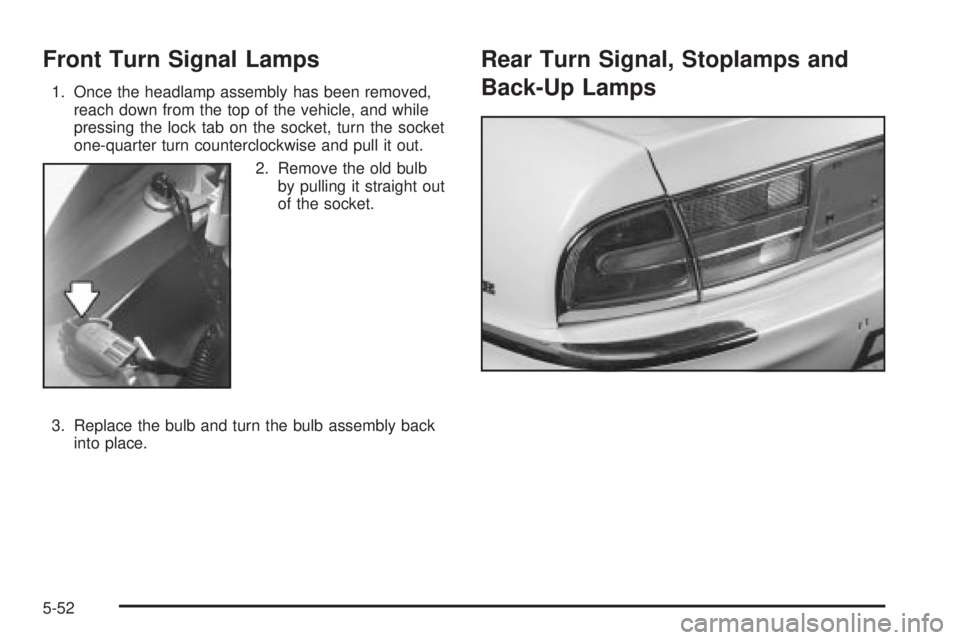
1. Once the headlamp assembly has been removed,
reach down from the top of the vehicle, and while
pressing the lock tab on the socket, turn the socket
one-quarter turn counterclockwise and pull it out.
2. Remove the old bulb
by pulling it straight out
of the socket.
3. Replace the bulb and turn the bulb assembly back
into place.
Rear Turn Signal, Stoplamps and
Back-Up Lamps
5-52
Page 275 of 372
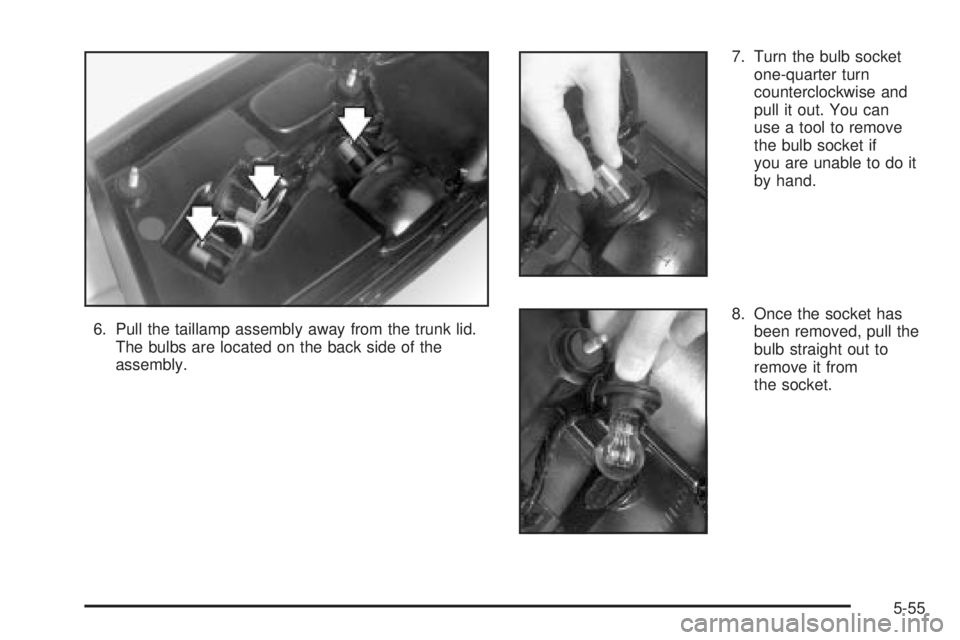
6. Pull the taillamp assembly away from the trunk lid.
The bulbs are located on the back side of the
assembly.7. Turn the bulb socket
one-quarter turn
counterclockwise and
pull it out. You can
use a tool to remove
the bulb socket if
you are unable to do it
by hand.
8. Once the socket has
been removed, pull the
bulb straight out to
remove it from
the socket.
5-55
Page 276 of 372
9. Replace it with a new bulb.
10. Reverse Steps 1 through 8 to reinstall the taillamp
assembly.
Rear Quarter Panel Turn Signal and
Stoplamps
1. Open the trunk.
2. On either side of the rear of the trunk is a plastic
retainer that holds the cargo net and taillamp
assembly in place. Unhook the cargo net from the
cargo net retainer and remove the retainer by
turning it counterclockwise.
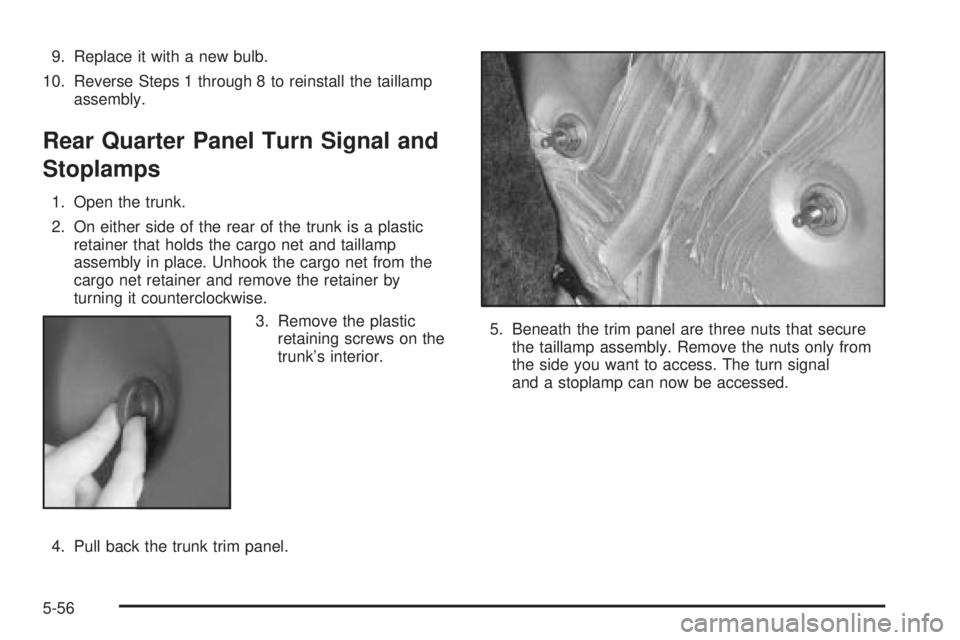
3. Remove the plastic
retaining screws on the
trunk's interior.
4. Pull back the trunk trim panel.5. Beneath the trim panel are three nuts that secure
the taillamp assembly. Remove the nuts only from
the side you want to access. The turn signal
and a stoplamp can now be accessed.
5-56
Page 277 of 372
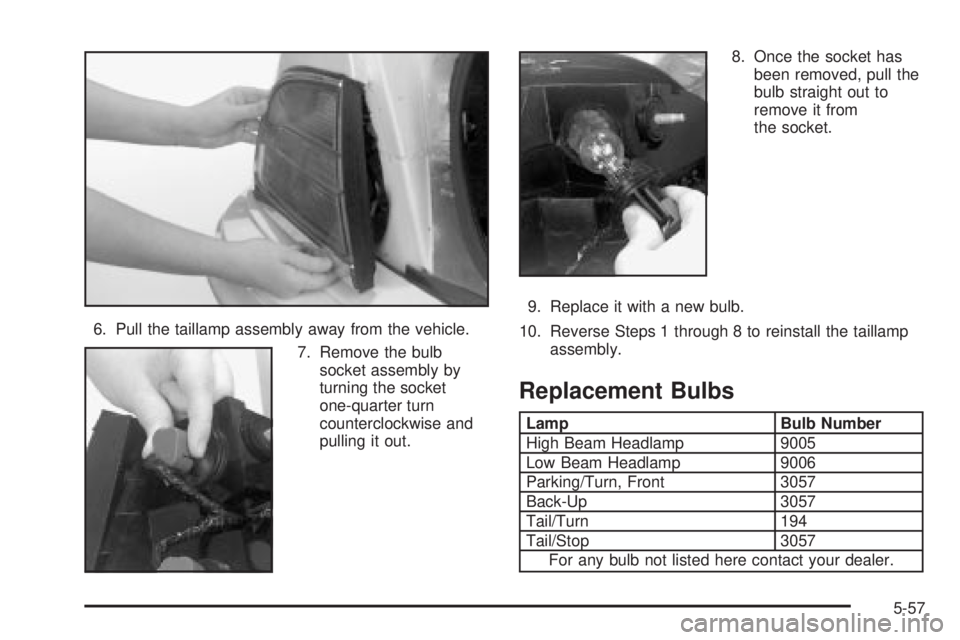
6. Pull the taillamp assembly away from the vehicle.
7. Remove the bulb
socket assembly by
turning the socket
one-quarter turn
counterclockwise and
pulling it out.8. Once the socket has
been removed, pull the
bulb straight out to
remove it from
the socket.
9. Replace it with a new bulb.
10. Reverse Steps 1 through 8 to reinstall the taillamp
assembly.
Replacement Bulbs
Lamp Bulb Number
High Beam Headlamp 9005
Low Beam Headlamp 9006
Parking/Turn, Front 3057
Back-Up 3057
Tail/Turn 194
Tail/Stop 3057
For any bulb not listed here contact your dealer.
5-57
Page 278 of 372
Windshield Wiper Blade
Replacement
Windshield wiper blades should be inspected at least
twice a year for wear or cracking. See ªWiper Blade
Checkº under
Part B: Owner Checks and Services on
page 6-19for more information.
Replacement blades come in different types and are
removed in different ways. For proper type and length,
see
Normal Maintenance Replacement Parts on
page 5-97.
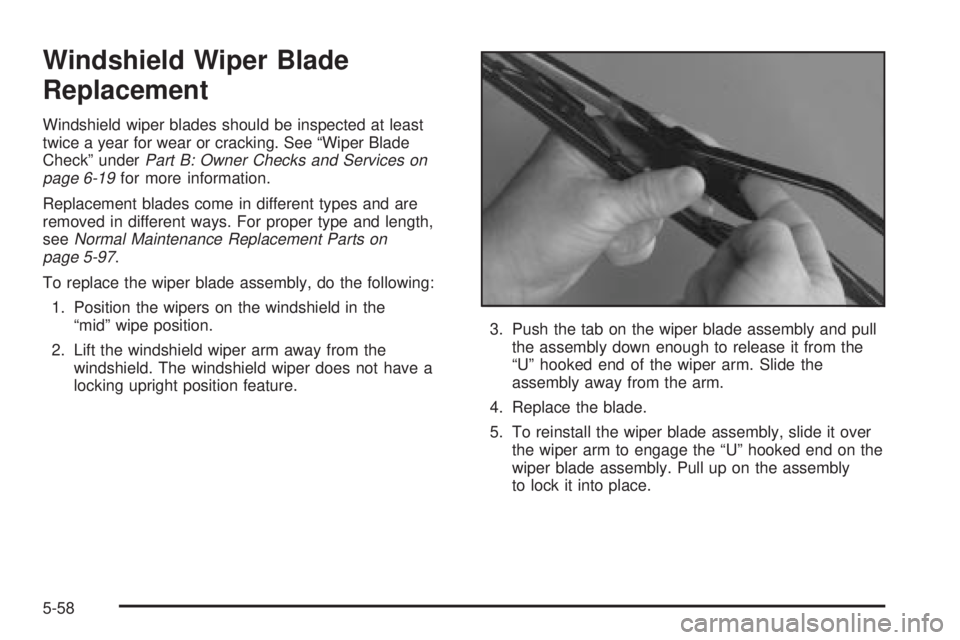
To replace the wiper blade assembly, do the following:
1. Position the wipers on the windshield in the
ªmidº wipe position.
2. Lift the windshield wiper arm away from the
windshield. The windshield wiper does not have a
locking upright position feature.3. Push the tab on the wiper blade assembly and pull
the assembly down enough to release it from the
ªUº hooked end of the wiper arm. Slide the
assembly away from the arm.
4. Replace the blade.
5. To reinstall the wiper blade assembly, slide it over
the wiper arm to engage the ªUº hooked end on the
wiper blade assembly. Pull up on the assembly
to lock it into place.
5-58
Page 281 of 372
The TIRE PRESSURE LOW message will appear on
the Driver Information Center (DIC) if pressure difference
(low pressure) is detected in one tire. The check tire
pressure system may not alert you if:
·more than one tire is low,
·the vehicle is moving faster than 65 mph (105 km/h),
·the system is not yet calibrated,
·the tire treadwear is uneven,
·the compact spare tire is installed,
·tire chains are being used, or
·the vehicle is being driven on a rough or
frozen road.
If the anti-lock brake system warning light comes on,
the check tire pressure system may not be working
properly. See your dealer for service. Also, see
Anti-Lock Brake System Warning Light on page 3-36.
The check tire pressure system detects differences
in tire rotation speeds that are caused by changes in
tire pressure. The system can alert you about a low
tire ± but it doesn't replace normal tire maintenance. See
Tires on page 5-59.When the TIRE PRESSURE LOW message appears on
the Driver Information Center, you should stop as
soon as you can and check all your tires for damage. If
a tire is ¯at, see
If a Tire Goes Flat on page 5-68.
Also check the tire pressure in all four tires as soon as
you can. See
In¯ation -- Tire Pressure on page 5-59.
Any time you adjust a tire's pressure or have one
or more tires repaired or replaced, you'll need to reset
(calibrate) the check tire pressure system. You'll
also need to reset the system whenever you rotate
the tires, buy new tires and install or remove the
compact spare.
Don't reset the check tire pressure system without ®rst
correcting the cause of the problem and checking
and adjusting the pressure in all four tires. If you reset
the system when the tire pressures are incorrect,
the check tire pressure system will not work properly
and may not alert you when a tire is low or high.
5-61
Page 289 of 372
A rear blowout, particularly on a curve, acts much like a
skid and may require the same correction you'd use
in a skid. In any rear blowout, remove your foot from the
accelerator pedal. Get the vehicle under control by
steering the way you want the vehicle to go. It may be
very bumpy and noisy, but you can still steer. Gently
brake to a stop, well off the road if possible.
{CAUTION:
Lifting a vehicle and getting under it to do
maintenance or repairs is dangerous without
the appropriate safety equipment and training.
The jack provided with your vehicle is
designed only for changing a ¯at tire. If it is
used for anything else, you or others could be
badly injured or killed if the vehicle slips off
the jack. Use the jack provided with your
vehicle only for changing a ¯at tire.
If a tire goes ¯at, the next part shows how to use your
jacking equipment to change a ¯at tire safely.
Changing a Flat Tire
If a tire goes ¯at, avoid further tire and wheel damage
by driving slowly to a level place. Turn on your
hazard warning ¯ashers.
{CAUTION:
Changing a tire can cause an injury. The
vehicle can slip off the jack and roll over you
or other people. You and they could be badly
injured. Find a level place to change your tire.
To help prevent the vehicle from moving:
1. Set the parking brake ®rmly.
2. Put the shift lever in PARK (P).
3. Turn off the engine.
To be even more certain the vehicle won't
move, you can put blocks at the front and rear
of the tire farthest away from the one being
changed. That would be the tire on the other
side of the vehicle, at the opposite end.
5-69
Page 292 of 372
Removing the Flat Tire and Installing
the Spare Tire
1. Use the wheel wrench to loosen the wheel nuts, but
don't remove them yet.
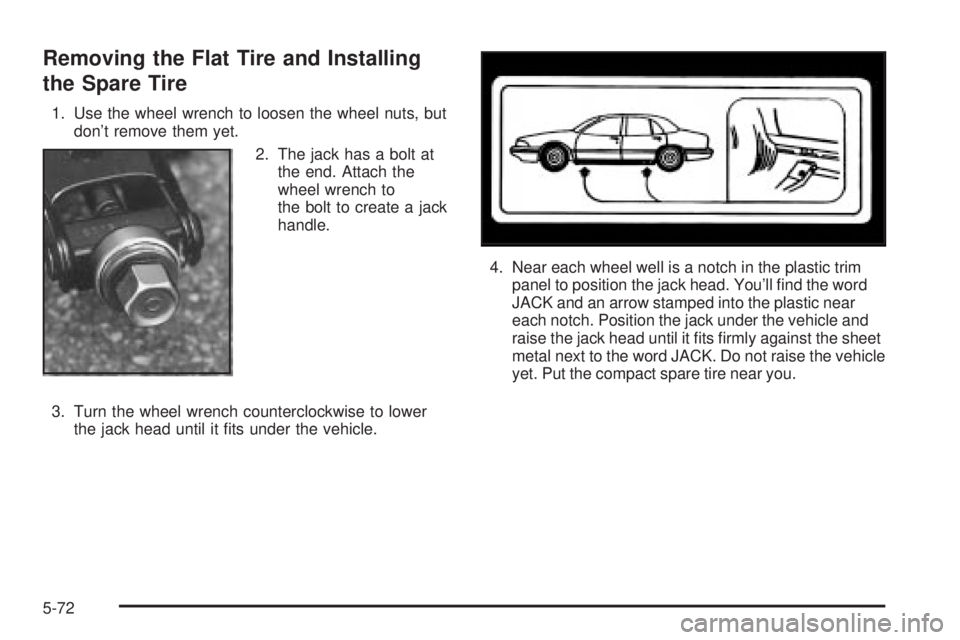
2. The jack has a bolt at
the end. Attach the
wheel wrench to
the bolt to create a jack
handle.
3. Turn the wheel wrench counterclockwise to lower
the jack head until it ®ts under the vehicle.4. Near each wheel well is a notch in the plastic trim
panel to position the jack head. You'll ®nd the word
JACK and an arrow stamped into the plastic near
each notch. Position the jack under the vehicle and
raise the jack head until it ®ts ®rmly against the sheet
metal next to the word JACK. Do not raise the vehicle
yet. Put the compact spare tire near you.
5-72
Page 293 of 372
{CAUTION:
Getting under a vehicle when it is jacked up is
dangerous. If the vehicle slips off the jack you
could be badly injured or killed. Never get
under a vehicle when it is supported only
by a jack.
{CAUTION:
Raising your vehicle with the jack improperly
positioned can damage the vehicle and even
make the vehicle fall. To help avoid personal
injury and vehicle damage, be sure to ®t the
jack lift head into the proper location before
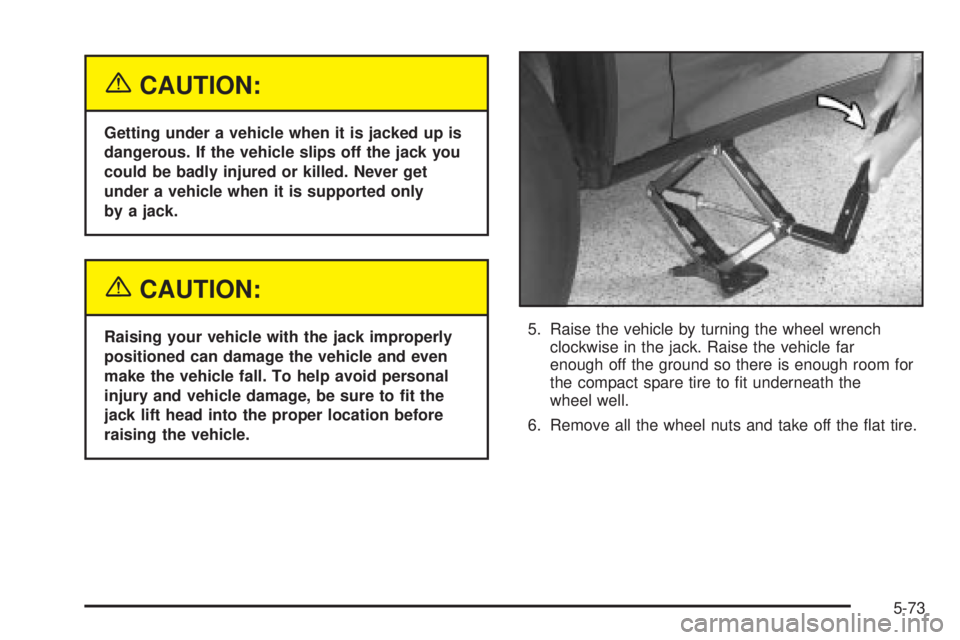
raising the vehicle.5. Raise the vehicle by turning the wheel wrench
clockwise in the jack. Raise the vehicle far
enough off the ground so there is enough room for
the compact spare tire to ®t underneath the
wheel well.
6. Remove all the wheel nuts and take off the ¯at tire.
5-73
Page 295 of 372
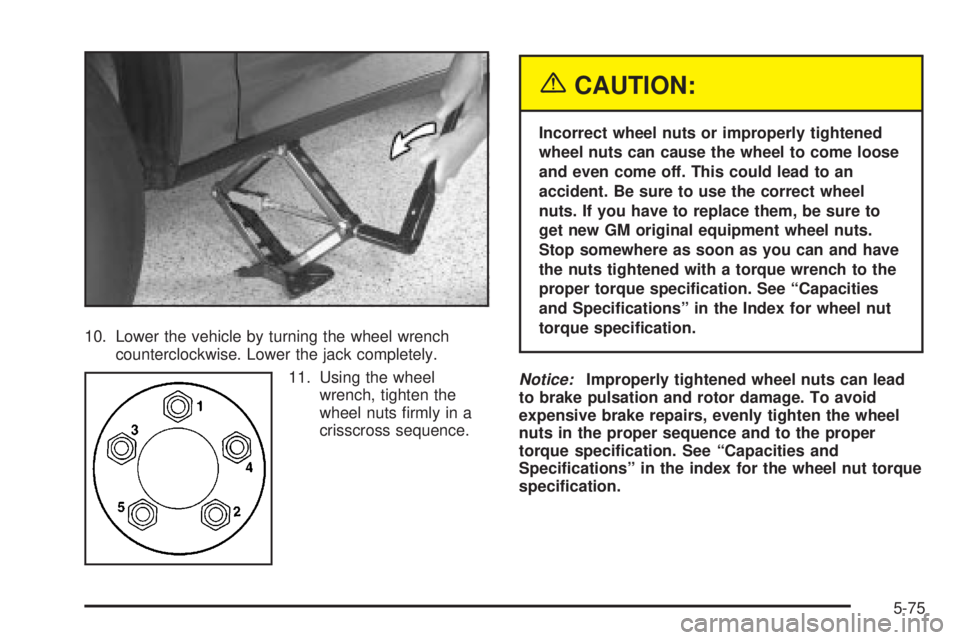
10. Lower the vehicle by turning the wheel wrench
counterclockwise. Lower the jack completely.
11. Using the wheel
wrench, tighten the
wheel nuts ®rmly in a
crisscross sequence.
{CAUTION:
Incorrect wheel nuts or improperly tightened
wheel nuts can cause the wheel to come loose
and even come off. This could lead to an
accident. Be sure to use the correct wheel
nuts. If you have to replace them, be sure to
get new GM original equipment wheel nuts.
Stop somewhere as soon as you can and have
the nuts tightened with a torque wrench to the
proper torque speci®cation. See ªCapacities
and Speci®cationsº in the Index for wheel nut
torque speci®cation.
Notice:Improperly tightened wheel nuts can lead
to brake pulsation and rotor damage. To avoid
expensive brake repairs, evenly tighten the wheel
nuts in the proper sequence and to the proper
torque speci®cation. See ªCapacities and
Speci®cationsº in the index for the wheel nut torque
speci®cation.
5-75