lock BUICK PARK AVENUE 2003 Manual Online
[x] Cancel search | Manufacturer: BUICK, Model Year: 2003, Model line: PARK AVENUE, Model: BUICK PARK AVENUE 2003Pages: 372, PDF Size: 2.8 MB
Page 307 of 372
Fuses and Circuit Breakers
The wiring circuits in your vehicle are protected from
short circuits by a combination of fuses and circuit
breakers. This greatly reduces the chance of damage
caused by electrical problems.
Look at the silver-colored band inside the fuse. If the
band is broken or melted, replace the fuse. Be sure you
replace a bad fuse with a new one of the identical
size and rating.
There are four fuse blocks in your vehicle: the main and
auxiliary instrument panel fuse blocks, the underhood
fuse block and the rear fuse block.
Main and Auxiliary Instrument Panel
Fuse Blocks
The main and auxiliary instrument panel fuse blocks are
located under the instrument panel, on the passenger's
side of the vehicle. Lamps, connectors and the
HVAC duct temperature sensors may need to be
disconnected and removed to allow access to these
fuse blocks.Remove the hush panel on the passenger's side to
reveal the fuses by performing the following steps:
1. Remove the two screws located along the front
edge of the panel.
2. Lower the hush panel.
3. Remove the fuse block cover.
4. Place the wide end of the fuse puller over the
plastic end of the fuse.
5. Squeeze the ends over the fuse and pull it out.
When ®nished, reinstall the fuse block cover and
the hush panel. Reinstall lamps, connectors and HVAC
duct temperature sensors if they were removed.
5-87
Page 308 of 372

Main Instrument Panel Fuse Block
Fuses Usage
SBM Interior Lamps
PDM PDM Module
A/C HVAC Motor, HVAC Mix Motors
Fuses Usage
IGN SENAuto Dimming Mirror, Driver HTS
Seat, Rear Defog Relay, MEM
Module, Cool LVL Sensor, Pass
Heated Seat
ELCHVAC Flat Pk Mtrs, Electronic Level
Control Sensor, Electronic Level
Control Sensor (R Bec)
ABS Anti-Lock Brake System Module
HVACHVAC Main Con Head,
HVAC Programmer, Instrument
Panel Cluster
CR CONTStepper Motor Cruise, Cruise
Switch
HUDHead-Up Display Switch, Head-Up
Display
CSTR/SBMHVAC Programmer, Instrument
Panel Cluster, SBM (275 to LCM)
(1135 to BTSI SL)
LP PK LUnderhood Lamp, Left
Park/Sidemarker, Left Park/Turn
Lamp, SBM, Left Tail Signal Lamp,
Left Tail/Stoplamp, Left Rear
Sidemarker
5-88
Page 309 of 372
Fuses Usage
LP PK RRight Park/Sidemarker Lamp,
Right ParK/Turn Lamp, Right
Tail/Sign Lamp, Right Tail/Stoplamp,
Right Rear Sidemarker,
Stop/Taillamp, Tail/Signal Lamp,
License Lamp, RFA
RUN Run/Accessory
WSW Wiper Motor
Blank Not Used
WSW/RFA Wiper Switch, RFA, Rain Sense
B/U LPAuto Dimming Mirror, Back-Up
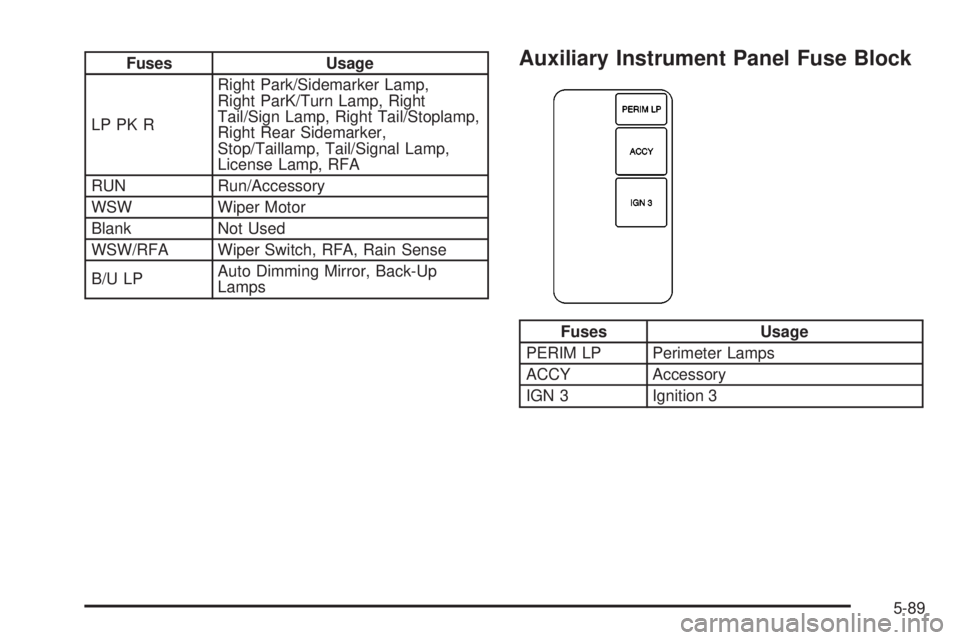
LampsAuxiliary Instrument Panel Fuse Block
Fuses Usage
PERIM LP Perimeter Lamps
ACCY Accessory
IGN 3 Ignition 3
5-89
Page 310 of 372
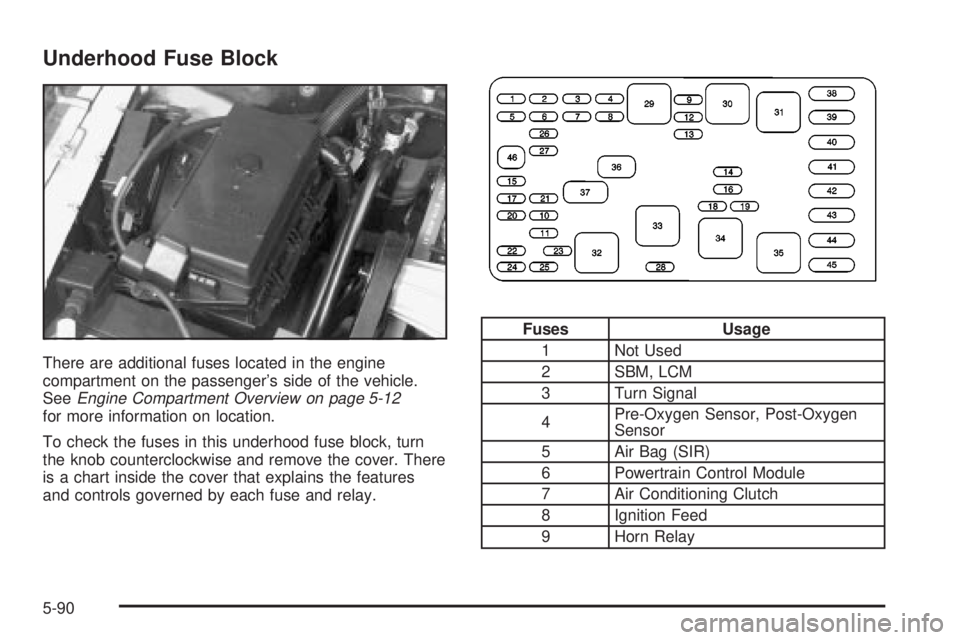
Underhood Fuse Block
There are additional fuses located in the engine
compartment on the passenger's side of the vehicle.
See
Engine Compartment Overview on page 5-12for more information on location.
To check the fuses in this underhood fuse block, turn
the knob counterclockwise and remove the cover. There
is a chart inside the cover that explains the features
and controls governed by each fuse and relay.
Fuses Usage
1 Not Used
2 SBM, LCM
3 Turn Signal
4Pre-Oxygen Sensor, Post-Oxygen
Sensor
5 Air Bag (SIR)
6 Powertrain Control Module
7 Air Conditioning Clutch
8 Ignition Feed
9 Horn Relay
5-90
Page 313 of 372
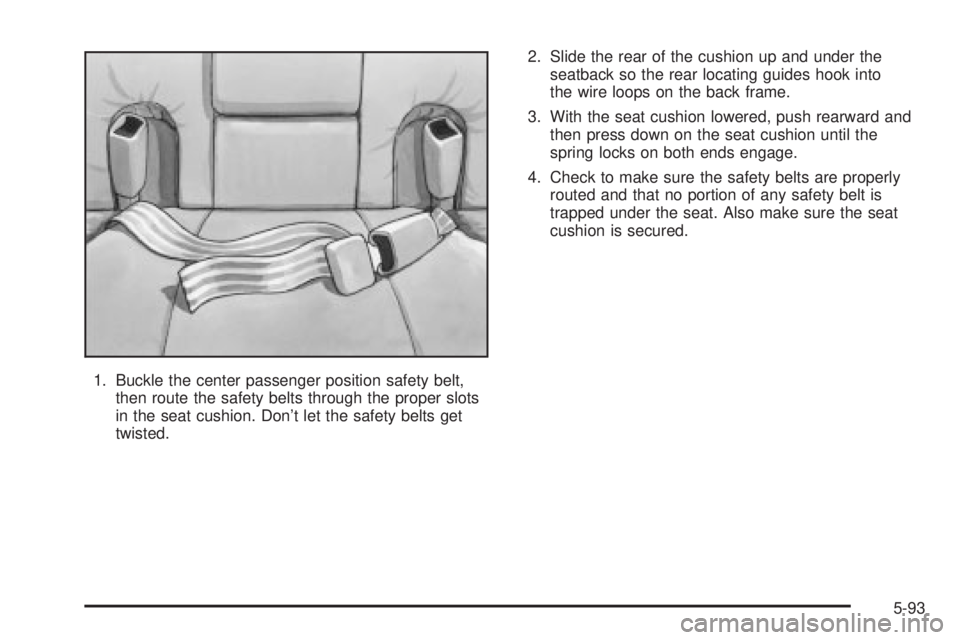
1. Buckle the center passenger position safety belt,
then route the safety belts through the proper slots
in the seat cushion. Don't let the safety belts get
twisted.2. Slide the rear of the cushion up and under the
seatback so the rear locating guides hook into
the wire loops on the back frame.
3. With the seat cushion lowered, push rearward and
then press down on the seat cushion until the
spring locks on both ends engage.
4. Check to make sure the safety belts are properly
routed and that no portion of any safety belt is
trapped under the seat. Also make sure the seat
cushion is secured.
5-93
Page 314 of 372
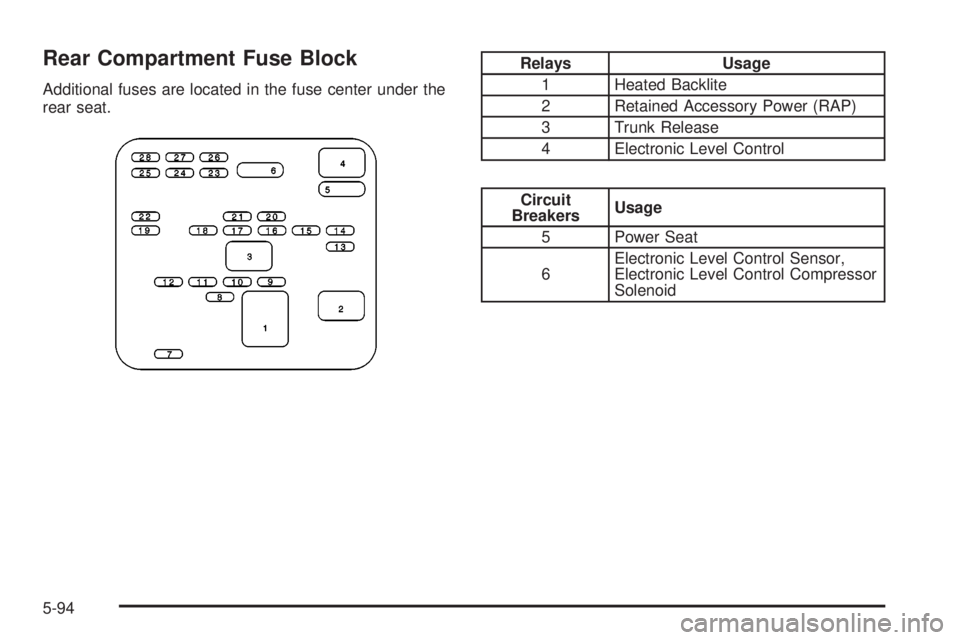
Rear Compartment Fuse Block
Additional fuses are located in the fuse center under the
rear seat.
Relays Usage
1 Heated Backlite
2 Retained Accessory Power (RAP)
3 Trunk Release
4 Electronic Level Control
Circuit
BreakersUsage
5 Power Seat
6Electronic Level Control Sensor,
Electronic Level Control Compressor
Solenoid
5-94
Page 338 of 372
At Least Twice a Year
Restraint System Check
Make sure the safety belt reminder light and all your
belts, buckles, latch plates, retractors and anchorages
are working properly. Look for any other loose or
damaged safety belt system parts. If you see anything
that might keep a safety belt system from doing its
job, have it repaired. Have any torn or frayed safety belts
replaced.
Also look for any opened or broken air bag coverings,
and have them repaired or replaced. (The air bag
system does not need regular maintenance.)
Wiper Blade Check
Inspect wiper blades for wear or cracking. Replace
blade inserts that appear worn or damaged or that
streak or miss areas of the windshield. Also see
ªWindshield Wiper and Wiper Bladesº under
Cleaning
the Outside of Your Vehicle on page 5-82.
Weatherstrip Lubrication
Silicone grease on weatherstrips will make them last
longer, seal better, and not stick or squeak. Apply
silicone grease with a clean cloth. During very cold,
damp weather more frequent application may be
required. See
Part D: Recommended Fluids and
Lubricants on page 6-25.
Automatic Transaxle Check
Check the transaxle ¯uid level; add if needed. SeeAutomatic Transaxle Fluid on page 5-22. A ¯uid loss
may indicate a problem. Check the system and repair if
needed.
At Least Once a Year
Key Lock Cylinders Service
Lubricate the key lock cylinders with the lubricant
speci®ed in Part D.
Body Lubrication Service
Lubricate all body door hinges. Also lubricate all hinges
and latches, including those for the hood, glove box
door and console door. Part D tells you what to
use. More frequent lubrication may be required when
exposed to a corrosive environment.
6-20
Page 339 of 372
Starter Switch Check
{CAUTION:
When you are doing this check, the vehicle
could move suddenly. If it does, you or others
could be injured. Follow the steps below.
1. Before you start, be sure you have enough room
around the vehicle.
2. Firmly apply both the parking brake and the regular
brake. See
Parking Brake on page 2-27if
necessary.
Do not use the accelerator pedal, and be ready to
turn off the engine immediately if it starts.
3. Try to start the engine in each gear. The starter
should work only in PARK (P) or NEUTRAL (N).
If the starter works in any other position, your
vehicle needs service.
Automatic Transaxle Shift Lock Control
System Check
{CAUTION:
When you are doing this check, the vehicle
could move suddenly. If it does, you or others
could be injured. Follow the steps below.
1. Before you start, be sure you have enough room
around the vehicle. It should be parked on a level
surface.
2. Firmly apply the parking brake. See
Parking Brake
on page 2-27if necessary.
Be ready to apply the regular brake immediately if
the vehicle begins to move.
3. With the engine off, turn the key to the RUN
position, but don't start the engine. Without applying
the regular brake, try to move the shift lever out
of PARK (P) with normal effort. If the shift lever
moves out of PARK (P), your vehicle needs service.
6-21
Page 340 of 372
Ignition Transaxle Lock Check
While parked, and with the parking brake set, try to turn
the ignition key to LOCK in each shift lever position.
·The key should turn to LOCK only when the
shift lever is in PARK (P).
·The key should come out only in LOCK.
Parking Brake and Automatic Transaxle
Park (P) Mechanism Check
{CAUTION:
When you are doing this check, your vehicle
could begin to move. You or others could be
injured and property could be damaged. Make
sure there is room in front of your vehicle in
case it begins to roll. Be ready to apply the
regular brake at once should the vehicle begin
to move.Park on a fairly steep hill, with the vehicle facing
downhill. Keeping your foot on the regular brake, set the
parking brake.
·To check the parking brake's holding ability: With
the engine running and transaxle in NEUTRAL (N),
slowly remove foot pressure from the regular brake
pedal. Do this until the vehicle is held by the parking
brake only.
·To check the PARK (P) mechanism's holding ability:
With the engine running, shift to PARK (P). Then
release the parking brake followed by the regular
brake.
Underbody Flushing Service
At least every spring, use plain water to ¯ush any
corrosive materials from the underbody. Take care to
clean thoroughly any areas where mud and other debris
can collect.
6-22
Page 343 of 372
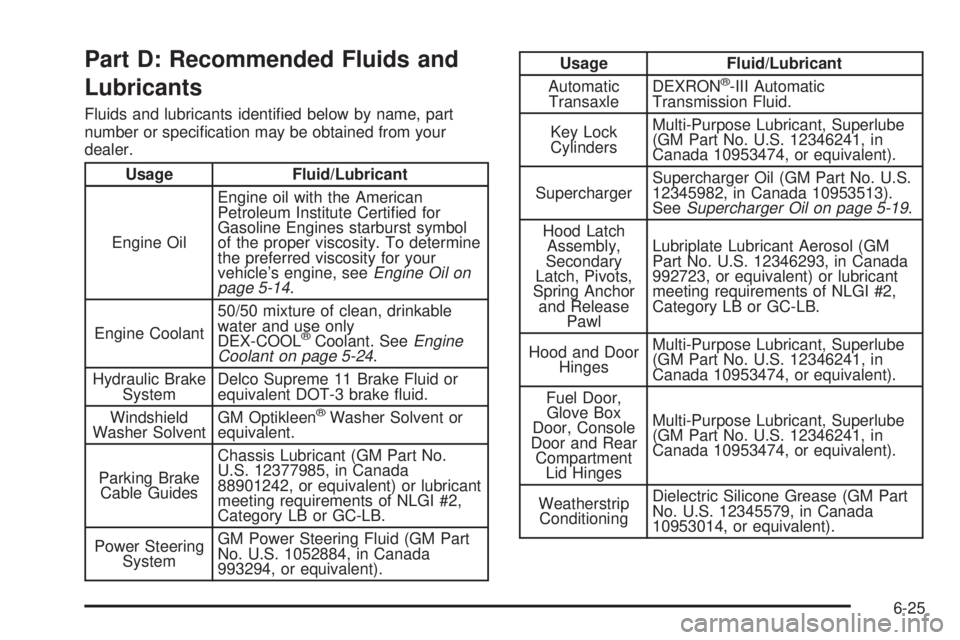
Part D: Recommended Fluids and
Lubricants
Fluids and lubricants identi®ed below by name, part
number or speci®cation may be obtained from your
dealer.
Usage Fluid/Lubricant
Engine OilEngine oil with the American
Petroleum Institute Certi®ed for
Gasoline Engines starburst symbol
of the proper viscosity. To determine
the preferred viscosity for your
vehicle's engine, see
Engine Oil on
page 5-14.
Engine Coolant50/50 mixture of clean, drinkable
water and use only
DEX-COOL
žCoolant. SeeEngine
Coolant on page 5-24.
Hydraulic Brake
SystemDelco Supreme 11 Brake Fluid or
equivalent DOT-3 brake ¯uid.
Windshield
Washer SolventGM Optikleen
žWasher Solvent or
equivalent.
Parking Brake
Cable GuidesChassis Lubricant (GM Part No.
U.S. 12377985, in Canada
88901242, or equivalent) or lubricant
meeting requirements of NLGI #2,
Category LB or GC-LB.
Power Steering
SystemGM Power Steering Fluid (GM Part
No. U.S. 1052884, in Canada
993294, or equivalent).
Usage Fluid/Lubricant
Automatic
TransaxleDEXRONž-III Automatic
Transmission Fluid.
Key Lock
CylindersMulti-Purpose Lubricant, Superlube
(GM Part No. U.S. 12346241, in
Canada 10953474, or equivalent).
SuperchargerSupercharger Oil (GM Part No. U.S.
12345982, in Canada 10953513).
See
Supercharger Oil on page 5-19.
Hood Latch
Assembly,
Secondary
Latch, Pivots,
Spring Anchor
and Release
PawlLubriplate Lubricant Aerosol (GM
Part No. U.S. 12346293, in Canada
992723, or equivalent) or lubricant
meeting requirements of NLGI #2,
Category LB or GC-LB.
Hood and Door
HingesMulti-Purpose Lubricant, Superlube
(GM Part No. U.S. 12346241, in
Canada 10953474, or equivalent).
Fuel Door,
Glove Box
Door, Console
Door and Rear
Compartment
Lid HingesMulti-Purpose Lubricant, Superlube
(GM Part No. U.S. 12346241, in
Canada 10953474, or equivalent).
Weatherstrip
ConditioningDielectric Silicone Grease (GM Part
No. U.S. 12345579, in Canada
10953014, or equivalent).
6-25