flat tire BUICK RANDEZVOUS 2002 User Guide
[x] Cancel search | Manufacturer: BUICK, Model Year: 2002, Model line: RANDEZVOUS, Model: BUICK RANDEZVOUS 2002Pages: 455, PDF Size: 2.86 MB
Page 323 of 455

5-20
Changing a Flat Tire
If a tire goes flat, avoid further tire and wheel damage
by driving slowly to a level place. Turn on your hazard
warning flashers.
CAUTION:
Changing a tire can cause an injury. The vehicle
can slip off the jack and roll over you or other
people. You and they could be badly injured.
Find a level place to change your tire. To help
prevent the vehicle from moving:
1. Set the parking brake firmly.
2. Put the shift lever in PARK (P).
3. Turn off the engine.
To be even more certain the vehicle won't move,
you can put blocks at the front and rear of the
tire farthest away from the one being changed.
That would be the tire on the other side of the
vehicle, at the opposite end.
The following steps will tell you how to use the jack and
change a tire.
Page 326 of 455
5-23
5. After removing the spare tire, turn the wrench
clockwise to raise the cable back up.
Do not store a full
-size or a flat road tire under the
vehicle. See ªStoring a Flat or Spare Tire and Toolsº
later in this section.
To continue changing the flat tire see ªRemoving the Flat
Tire and Installing the Spare Tireº later in this section.
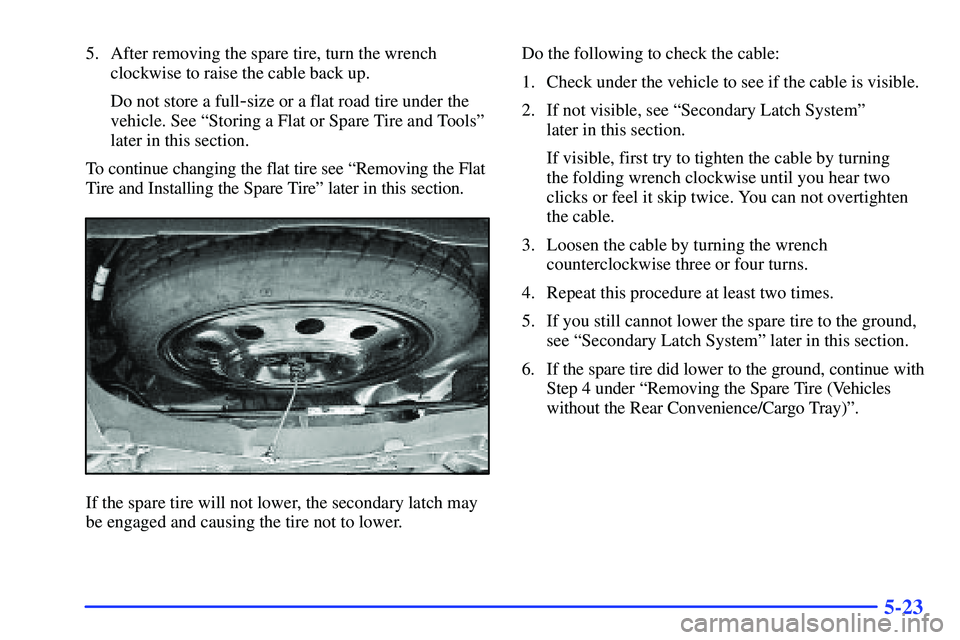
If the spare tire will not lower, the secondary latch may
be engaged and causing the tire not to lower.Do the following to check the cable:
1. Check under the vehicle to see if the cable is visible.
2. If not visible, see ªSecondary Latch Systemº
later in this section.
If visible, first try to tighten the cable by turning
the folding wrench clockwise until you hear two
clicks or feel it skip twice. You can not overtighten
the cable.
3. Loosen the cable by turning the wrench
counterclockwise three or four turns.
4. Repeat this procedure at least two times.
5. If you still cannot lower the spare tire to the ground,
see ªSecondary Latch Systemº later in this section.
6. If the spare tire did lower to the ground, continue with
Step 4 under ªRemoving the Spare Tire (Vehicles
without the Rear Convenience/Cargo Tray)º.
Page 328 of 455

5-25
5. To remove the spare tire from the cable, tilt the
retainer and slip it through the wheel opening.
6. After removing the spare tire, turn the wrench
clockwise to raise the cable back up.
Do not store a full
-size or a flat road tire under the
vehicle. See ªStoring a Flat or Spare Tire and Toolsº
later in this section.
To continue changing the flat tire see ªRemoving
the Flat Tire and Installing the Spare Tireº later in
this section.
If the spare tire will not lower, the secondary latch may
be engaged and causing the tire not to lower. Do the
following to check the cable:
1. Check under the vehicle to see if the cable is visible.
2. If not visible, see ªSecondary Latch Systemº later
in this section.
If visible, first try to tighten the cable by turning
the folding wrench clockwise until you hear two
clicks or feel it skip twice. You can not overtighten
the cable.
Page 331 of 455

5-28
7. Lower the jack by turning the folding wrench
counterclockwise. Keep lowering the jack until
the spare tire is resting on the folding wrench.8. Grasp the spare tire with both hands and pull it out
from under the vehicle.
9. Reach under the vehicle and remove the folding
wrench and jack.
10. When the spare tire has been completely lowered,
tilt the retainer and slip it through the wheel opening.
11. If the cable is hanging, turn the wrench clockwise
to raise the cable back up.
Have the hoist assembly inspected as soon as you can.
You will not be able to store a spare or flat tire using the
hoist assembly until it has been repaired or replaced.
Page 332 of 455

5-29 Removing the Flat Tire and Installing
the Spare Tire
1. If there is a wheel cover, loosen the plastic nut caps
with the wheel wrench. They won't come off. Then,
using the flat end of the wheel wrench, pry along the
edge of the cover until it comes off. Be careful; the
edges may be sharp. Don't try to remove the cover
with your bare hands.
If your vehicle has aluminum wheels, remove the
wheel nut caps using the wheel wrench.
2. Loosen the wheel
nuts
-- but do not
remove them
-- using
the folding wrench.
(Turn the handle about
180 degrees, then flip
the handle back to
the starting position.
This avoids taking the
wrench off the lug nut
for each turn.)For wheels with a wheel lock key, use the wheel lock
key between the lock nut and folding wrench. The key
is supplied in the front passenger door pocket.
NOTICE:
To help avoid damage to lock nut or wheel lock
key, do not use an impact wrench with this key.
3. Near each wheel,
there is a notch in
the vehicle's body.
Position the jack and
raise the jack head
until it fits firmly
into the notch in the
vehicle's frame nearest
the flat tire.
Page 334 of 455

5-31
4. Attach the folding wrench
to the jack, and turn
the wrench clockwise
to raise the jack head
3 inches (7.6 cm).
5. Raise the vehicle by turning the folding wrench
clockwise in the jack. Raise the vehicle far enough
off the ground so that there is enough room for the
spare tire to fit under the wheel well.
6. Remove all the wheel nuts and take off the flat tire.
7. Remove any rust or dirt
from the wheel bolts,
mounting surfaces and
spare wheel.
CAUTION:
Rust or dirt on the wheel, or on the parts to
which it is fastened, can make the wheel nuts
become loose after a time. The wheel could come
off and cause an accident. When you change a
wheel, remove any rust or dirt from the places
where the wheel attaches to the vehicle. In an
emergency, you can use a cloth or a paper towel
to do this; but be sure to use a scraper or wire
brush later, if you need to, to get all the rust or
dirt off.
CAUTION:
Never use oil or grease on studs or nuts. If you
do, the nuts might come loose. Your wheel could
fall off, causing a serious accident.
Page 336 of 455

5-33
NOTICE:
Improperly tightened wheel nuts can lead to
brake pulsation and rotor damage. To avoid
expensive brake repairs, evenly tighten the wheel
nuts in the proper sequence and to the proper
torque specification.
11. Don't try to put a wheel cover on the compact spare
tire. It won't fit. Store the wheel cover securely in
the rear of the vehicle until you have the flat tire
repaired or replaced.
NOTICE:
Wheel covers won't fit on your compact spare.
If you try to put a wheel cover on your compact
spare, you could damage the cover or the spare.
Storing a Flat or Spare Tire and Tools
CAUTION:
Storing a jack, a tire or other equipment in the
passenger compartment of the vehicle could
cause injury. In a sudden stop or collision, loose
equipment could strike someone. Store all these
in the proper place.
CAUTION:
The underbody-mounted spare tire needs to be
stored with the valve stem pointing down. If the
spare tire is stored with its valve stem pointing
upwards, its secondary latch won't work properly,
and the spare tire could loosen and suddenly fall
from your vehicle. If this happened when your
vehicle was being driven, the tire might contact
a person or another vehicle, causing injury and,
of course, damage to itself as well. Be sure the
underbody
-mounted spare tire is stored with its
valve stem pointing down.
Page 339 of 455

5-36
Storing the Flat Tire (Vehicles without the Stowable
Seat and without the Rear Convenience/Cargo Tray)
A. D-Ring
B. Wing Nut
C. J
-HookD. Valve Stem
E. Full
-Size Tire1. Flip up the D
-ring located in the rear cargo area.
2. Lay the tire in the rear cargo area of the vehicle with
the valve stem up with the center hole of the tire over
the D
-ring.
For vehicles with aluminum wheels, remove the
center trim cap by tapping the back of the cap with
the folding wrench.
3. Remove the J
-hook and the wing nut from the back
of the jack access door. Assemble the wing nut and
the J
-hook.
4. Install the wing nut and the J
-hook to the D-ring
through the center hole of the tire.
5. Tighten the wing nut to secure the tire to the floor.
Push and pull on the tire to make sure the tire is
secure and does not move.
6. Put back all tools as they were stored in the jack
storage compartment and put the compartment
cover back on.
To put the cover back on, slip the tabs on the side of the
cover into the cover opening. Push the cover in place
and push down the tabs on the cover so that it rests in
the groove. This secures the cover in place.
Page 340 of 455
5-37
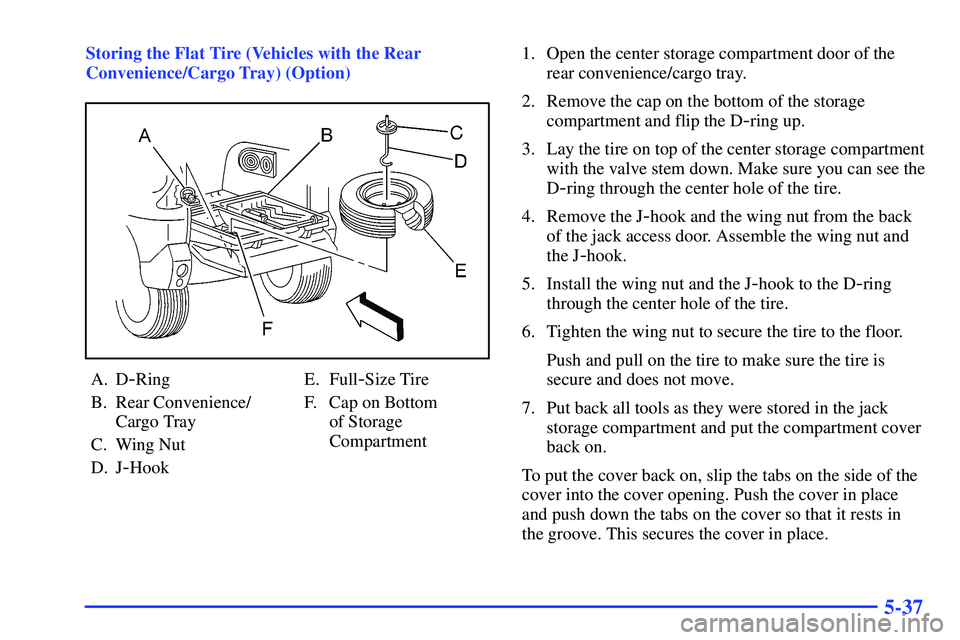
Storing the Flat Tire (Vehicles with the Rear
Convenience/Cargo Tray) (Option)
A. D-Ring
B. Rear Convenience/
Cargo Tray
C. Wing Nut
D. J
-HookE. Full
-Size Tire
F. Cap on Bottom
of Storage
Compartment1. Open the center storage compartment door of the
rear convenience/cargo tray.
2. Remove the cap on the bottom of the storage
compartment and flip the D
-ring up.
3. Lay the tire on top of the center storage compartment
with the valve stem down. Make sure you can see the
D
-ring through the center hole of the tire.
4. Remove the J
-hook and the wing nut from the back
of the jack access door. Assemble the wing nut and
the J
-hook.
5. Install the wing nut and the J
-hook to the D-ring
through the center hole of the tire.
6. Tighten the wing nut to secure the tire to the floor.
Push and pull on the tire to make sure the tire is
secure and does not move.
7. Put back all tools as they were stored in the jack
storage compartment and put the compartment cover
back on.
To put the cover back on, slip the tabs on the side of the
cover into the cover opening. Push the cover in place
and push down the tabs on the cover so that it rests in
the groove. This secures the cover in place.
Page 341 of 455

5-38
Storing the Flat Tire (Vehicles with the
Stowable Seat) (Option)
A. Rear Convenience/
Cargo Tray
B. Full
-Size Tire
C. D
-RingD. Stowable Seat Strap
E. Cargo Net Hook
F. J
-Hook
G. Wing Nut1. If the seatback is not in an upright position, move it
to an upright position.
2. There is a strap attached to each side of the stowable
seat. Hook the straps to the cargo net hook in the
rear of the vehicle.
3. Flip the D
-ring so it is pointing outward.
4. Open the convenience/cargo tray cover.
5. Stand the full
-size tire up, in the tray against the
back of the seat with the valve stem pointing out.
6. Remove the J
-hook and the wing nut from the back
of the jack access door. Assemble the wing nut and
the J
-hook.
7. Install the wing nut and the J
-hook to the D-ring
through the center hole of the tire.
8. Tighten the wing nut to secure the tire to the seatback.
Push and pull on the tire to make sure the tire
is secure and does not move.
9. Put back all tools as they were stored in the jack
storage compartment and put the compartment
cover back on.
To put the cover back on, slip the tabs on the side of the
cover into the cover opening. Push the cover in place
and push down the tabs on the cover so that it rests in
the groove. This secures the cover in place.