light BUICK REGAL 1993 Repair Manual
[x] Cancel search | Manufacturer: BUICK, Model Year: 1993, Model line: REGAL, Model: BUICK REGAL 1993Pages: 308, PDF Size: 16.35 MB
Page 183 of 308
1 CAUTION:
You could be injured if the vehicles roll. Set the
parking brake firmly on each vehicle. Put an
automatic transaxle
in “P” (Park) or a manual
transaxle
in “N” (Neutral).
3. Turn off the ignition on both vehicles. Turn off all
lights that aren’t needed, and radios. This will avoid
sparks and help save both batteries. And it could
save your radio!
4. Open the hoods and locate the batteries.
I
I A CAUTION:
An electric fan can start up even wheVv the engine
is not running and can injure you. Keep hands,
clothing and
tools away from any underhooc‘
electric
fan.
Find the positive (+) and negative (-) terminals on
each battery.
Your Buick has a remote positive (+)jump starting
terminal. The terminal is on the same side
of the
engine compartment as your battery.
You should always use the remote positive (+)
terminal instead of the positive (+) terminal on your
battery.
To uncover the remote positive (+) terminal, lift the
red plastic cap.
181
ProCarManuals.com
Page 184 of 308
1
I A CAUTION:
Using a match near a battery can cause battery
this, and some have been blinded. Use a
I gas to explode. People have been hurt doing
I
I flashlight if you need more light.
Be sure the battery has enough water. You don‘-
need to add water
to the Delco Freedom@ battery
installed
in every new GM vehicle. But if a battery
has filler caps, be sure the right amount of fluid
is there. If it is low, add water to take care of that
First. If you don’t, explosive gas could be present.
Battery fluid contains acid that can burn you.
Don’t get
it on you. If you accidentally get-it in
your eyes or on your skin, flush the place with
water and get medical help immediately.
1 I
5. Check that the jumper cables don’t have loose or
missing insulation. If they do, you could get a shock.
The vehicles could
be damaged, too.
I
Before you connect the cables, here are some basic
things
you should know. Positive (+) will go to
positive
(+) and negative (-) will go to negative (-) or
a metal engine
part. Don’t connect (+) to (-) or you’ll
get a short that would damage the battery and maybe
other
parts, too.
I A CAUTION:
Fans or other moving engine parts can injure you
badly. Keep your hands away from moving parts
I once the engines are running.
l 182
ProCarManuals.com
Page 194 of 308
Engine Overheating
You will find a coolant temperature gage on your
Buick's instrument panel.
You may also find a low coolant warning light
on your
Buick instrument panel.
If Steam Is Coming From Your Engine:
A CAUTION:
Steam from an overheated engine can burn you
badly, even
if you just open the hood. Stay away
from the engine
if you see or hear steam coming
from it. Just turn
it off and get everyone away
from the vehicle until it cools down. Wait
until
there is no sign of steam or coolant before
opening the hood.
'* -7ou keep driving when your engine is
overheated, the liquids
in it can catch fire. You or
others could be badly burned. Stop your engine
if it overheats, and get out of the vehicle until the
engine is cool.
If your engine catch
driving with
no coolant, your vehicle can be
badly damaged. The costly repairs
w?uld not b
covered by your warranty. ,, , 1 ,.
I If No Steam Is Coming From Your Engine:
If you get the overheat warning but see or hear no
steam,
the problem may not be too serious. Sometimes
the engine can get a little too hot when you:
0 Climb a long hill on a hot day.
0 Stop after high speed driving.
0 Idle for long periods in traffic.
Tow a trailer.
ProCarManuals.com
Page 212 of 308
A CAUTION:
Storing a jack, a tire or other equipment in the
passenger compartment
of the vehicle could
cause injury.
In a sudden stop or collision, loose
equipment could strike someone. Store all these
in the p-per place.
I
Compact Spare Tire
Although the compact spare was fully inflated when
your vehicle was new, it can lose air after a time. Check
the inflation pressure regularly. It should be
60 psi
(420 kPa). The compact spare is made to go up to 3,000
miles (5000 km), so you can finish your trip and have
your full-size tire repaired or replaced where you want.
Of course, it's best to replace your spare with a full-size
tire as
soon as you can. Your spare will last longer and
be in
good shape in case you need it again.
Your anti-lock brake system warning light may come
on
when you are driving with a compact spare. See
"Anti-Lock Brake System Warning Light"
in the Index.
NOTICE:
' Don't take your compact spare through an
automatic car wash with guide rails. The
compact spare can get caught
on the rails. Tha
can damage the tire and wheel, and maybe other
parts of your vehicle.
. :s:; ?<,. $3 I "' .. x. , ., . ", ,**~. I , z .. . . ... . ." . ..--;i.~""*rSl~~,~"." ~.~=:~~~~;~~~~;~,.~:,,~~~~~
Don't use your compact spare on some other vehicle.
And don't mix your compact spare or wheel with other
wheels
or tires. They won't fit. Keep your spare and its
wheel together.
Tire chains won't fit your compact spare. Using
them will damage your vehicle and destroy the
chains too. Don't use tire chains on your
g g*
compact spare. :&
s,,.-T +.?;:a: I--- b i ,, 2s: 7,' : *&".;&&;< S? ,.:~ 'p *. . yp& '?gPS ..ar.,%: __ . .,., _, < . '*Y ., .: ~ ,
ProCarManuals.com
Page 213 of 308
/;1 CAUTION:
I
Storing a jack, a tire, or other equipment in the
passenger compartment of the vehicle could
equipment could strike someone. Store
all the$$
in the proper place.
3use
injury. In a sudden stop or collision,
loose
!-
1
NOTICE:
Spinning your wheels can destroy parts of you1
vehicle
as well as the tires. If you spin the wheels
too fast while shifting your transaxle back and
forth, you
can destroy your transaxle
Aocking your vehicle to get it out:
If - You’re Stuck: In Sand; Mud’ Ice Or First, turn your steering wheel left and right. That will
Snow clear the area around your front wheels. Then shift back
What
you don’t want to do when your vehicle is stuck is and forth between “R” (Reverse) and a forward gear,
to spin your wheels. The method known as “rocking” spinning the wheels as little as possible. Release the
can help you get out when you’re stuck, but you must accelerator pedal while
you shift, and press lightly
on
use caution. the accelerator pedal when the transaxle is in gear. If
that doesn’t get
you out after a few tries, you may need
to be towed out. If you do need to be towed out, see
“Towing Your Vehicle”
in the Index.
IT you let your tires spin at h I speea, they can
explode and you or others could be injured. And
the transaxle or other parts of the vehicle can
overheat. That could cause an engine
compartment fire or other damage. When you’re
stuck, spin the wheels as little
as possible. Don’t
spin the wheels above
35 mph (55 km/h) as
shown on the speedometer.
211
ProCarManuals.com
Page 222 of 308
Before closing the hood, be sure all the filler caps are on
properly.
Then just pull the hood down and close it firmly.
Engine Oil
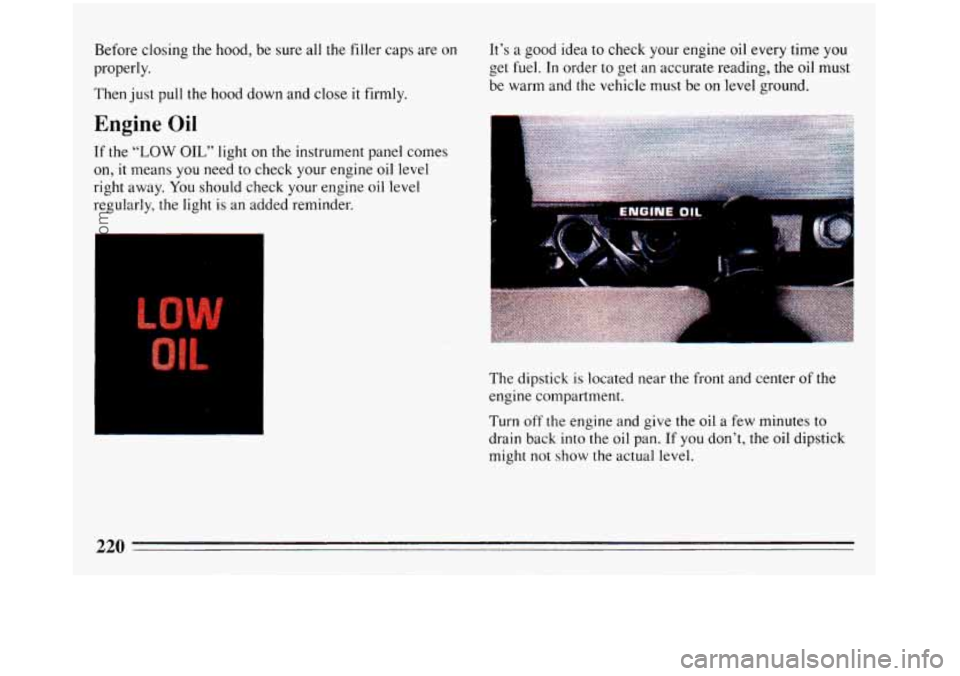
If the “LOW OIL” light on the instrument panel comes
on, it means you need to check your engine oil level
right away.
You should check your engine oil level
regularly, the light
is an added reminder. It’s
a good idea to check your engine oil every time you
get fuel.
In order to get an accurate reading, the oil must
be warm and the vehicle must be
on level ground.
The dipstick is located near the front and center
of the
engine compartment.
Turn
off the engine and give the oil a few minutes to
drain back into the oil pan. If you don’t, the oil dipstick
might not show the actual level.
ProCarManuals.com
Page 230 of 308
If the fluid level is low, add only enough of the proper
fluid to bring the level into the cross-hatched area on the
dipstick. It doesn’t take much fluid, generally less than a
pint. Don’t overfill. We recommend you use only fluid
labeled DEXRONB-IIE, because fluids with that label
are made especially for your automatic transaxle.
Damage caused by fluid other than DEXRONB-IIE is
not covered by your new vehicle warranty.
After adding fluid, recheck the fluid level as
described under “How
to Check.”
When the correct fluid level is obtained, push the
dipstick back in all the way.
Engine Coolant
The following explains your cooling system and how to
add coolant when
it is low. If you have a problem with
engine overheat.ing or if you need to add coolant to your
radiator, see “Engine Overheating”
in the Index.
The proper coolant for your Buick will:
0 Give freezing protection down to -34OF (-37OC) .
0 Give boiling protection up to 262 OF (128 “C) .
Protect against rust and corrosion.
0 Help keep the proper engine temperature.
0 Let the warning lights work as they should.
What to Use:
Use a mixture of one-half clean water (preferably
distilled) and one-half antifreeze that meets
“GM
Specification 1825-M,” which won’t damage aluminum
parts. You can also use a recycled coolant conforming to
GM Specification 1825-M with a complete coolant flush
and refill. Use GM Engine Coolant Supplement (sealer)
with any complete coolant change. If you use these, you
don’t need to add anything else.
can be aangerous. Plain water, or some other
liquid like alcohol, can boil before the proper
coolant mix will. Your vehicle’s coolant warning
system is set for the proper coolant mix. With
plain water or the wrong mix, your engine could
get too hot but you wouldn’t get the overhe-”
warning. Your engine could catch fire and
yuu or
others could be burned. Use a 50/50 mix of clean
water and a proper antifreeze.
G:~Z.+T~:, p:.t+d+s
228
ProCarManuals.com
Page 232 of 308
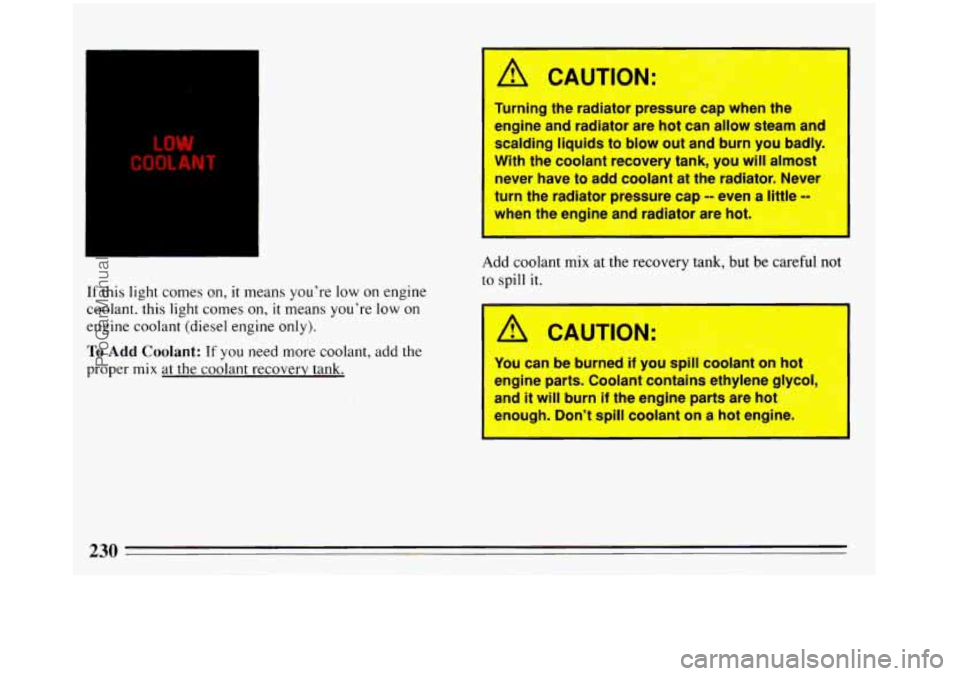
If this light comes on, it means you're low on engine
coolant. this light comes
on, it means you're low on
engine coolant (diesel engine only).
To Add Coolant: If you need more coolant, add the
proper mix at the coolant recovery tank.
A CAUTION:
Turning me raalaror pressure cap when the
--1gine and radiator are hot can allow steam ana
scalding liquids to blow out and burn you badly.
With the coolant recovery tank, you will almos'
never have to add coolant at the radiator. Never
turn the radiator pressure cap
-- even a little --
wt- -- +ha engine and radiator are hot.
Add coolant mix at the recovery tank, but be careful not
to spill it.
IU can be burned if you spill coolant on hot
gine parts. Coolant contains ethylene glycol,
and
it will burn if the engine parts are t
enough. Don't spill coolant on a hot engine.
230
ProCarManuals.com
Page 236 of 308
won’t work at all. So, it isn’t a good idea to “top off’
your brake fluid. Adding brake fluid won’t correct a
leak.
If you add fluid when your linings are worn, then
you’ll have too much fluid when you get new brake
linings. You should add (or remove) brake fluid,
as
necessary, only when work is done on the brake
hydraulic system.
a LAUTION:
1
If you have too much brake flui,, I. ;an sblll orl
the engine. The fluid will burn if the engine is hot
enough. You or others could be burned, and your
vehicle could be damaged. Add brake fluid only
when work is done on the brake hydraulic
-stem.
When your brake fluid falls to a low level, your brake
warning light will come on. See “Brake System Warning
Light” in the Index.
What to Add:
When you do need brake fluid, use only DOT-3 brake
fluid
-- such as Delco Supreme 11 @ (GM Part
N0.1052535). Use new brake fluid from a sealed
container only.
0
0
DOT-5 silicone brake fluid can damage
your vehicle. Don’t use it.
Don’t let someone put
in the wrong kind of
fluid. For example, just a few drops of
mineral-based oil, such as engine oil,
in
your brake system can damage brake
system parts
so badly that they’ll have to
be replaced.
Brake fluid can damage paint,
so be careful
not to spill brake fluid on your vehicle.
Replacing Brake System Parts
The braking system on a modern vehicle is complex. Its
many parts have to be
of top quality and work well
together if the vehicle is to have really good braking.
Vehicles we design and test have top-quality GM brake
parts in them, as your Buick does when
it is new. When
you replace parts of your braking system
-- for example,
when your brake linings wear down and
you have to
have new ones put in
-- be sure you get new genuine
GM replacement parts. If
you don’t, your brakes may no
longer work properly. For example, if someone puts
in
brake linings that are wrong for your vehicle, the
234
ProCarManuals.com
Page 238 of 308
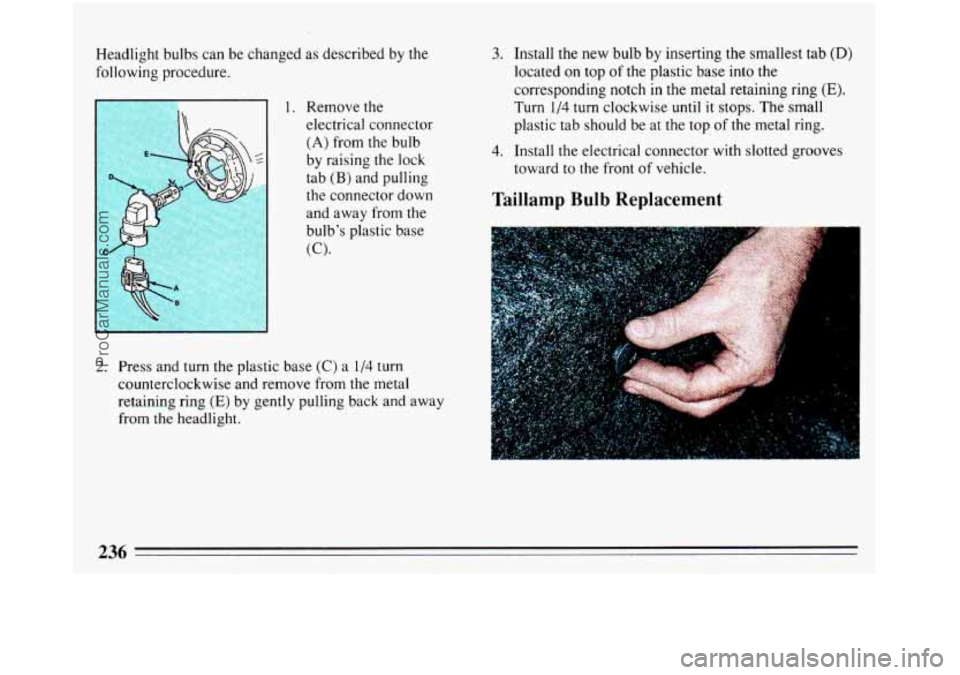
Headlight bulbs can be changed as described by the
following procedure.
1. Remove the
electrical connector
(A) from the bulb
by raising the lock tab
(B) and pulling
the connector down
and away from the
bulb’s plastic base
(C).
2. Press and turn the plastic base (C) a 1/4 turn
counterclockwise and remove from the metal
retaining ring
(E) by gently pulling back and away
from
the headlight.
3. Install the new bulb by inserting the smallest tab (D)
located on top of the plastic base into the
corresponding
notch in the metal retaining ring (E).
Turn 1/4 turn clockwise until it stops. The small
plastic tab should be at the top
of the metal ring.
4. Install the electrical connector with slotted grooves
toward
to the front of vehicle.
Taillamp Bulb Replacement
ProCarManuals.com