lock BUICK REGAL 1997 Manual Online
[x] Cancel search | Manufacturer: BUICK, Model Year: 1997, Model line: REGAL, Model: BUICK REGAL 1997Pages: 422, PDF Size: 21.34 MB
Page 309 of 422
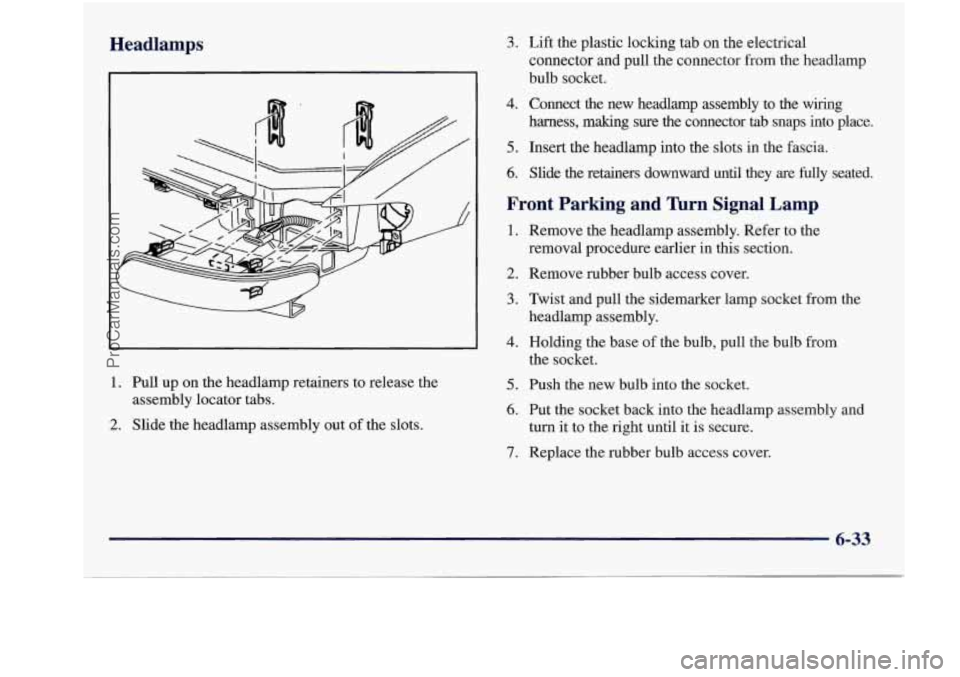
Headlamps
1. Pull up on the headlamp retainers to release the
2. Slide the headlamp assembly out of the slots.
assembly locator tabs.
3. Lift the plastic locking tab on the
electrical
connector and pull the connector from the headlamp
bulb socket.
4. Connect the new headlamp assembly to the wiring
5. Insert the headlamp into the slots in the fascia.
6. Slide the retainers downward until they are fully seated.
Front Parking and Tbrn Signal Lamp
1. Remove the headlamp assembly. Refer to the
removal procedure earlier in this section.
2. Remove rubber bulb access cover.
3. Twist and pull the sidemarker lamp socket from the
4. Holding the base of the bulb, pull the bulb from
5. Push the new bulb into the socket.
6. Put the socket back into the headlamp assembly and
turn it to the right until it is secure.
7. Replace the rubber bulb access cover.
harness, making sure
the connector tab snaps into place.
headlamp assembly.
the socket.
6-33
ProCarManuals.com
Page 314 of 422
2. Lift the plastic locking tab on the electrical
connector and pull the connector from the dome
lamp assembly.
3. Grasp the bulb housing located in the center of the
assembly and pull straight up.
4. Pull the bulb out of the socket.
5. Push in a new bulb.
6. Replace the socket into the dome lamp assembly.
7. Reconnect the dome lamp assembly to the wiring
harness, making sure the connector tab snaps into
place.
8. Reposition the dome lamp assembly to the roof, and
gently push the assembly into the base plate.
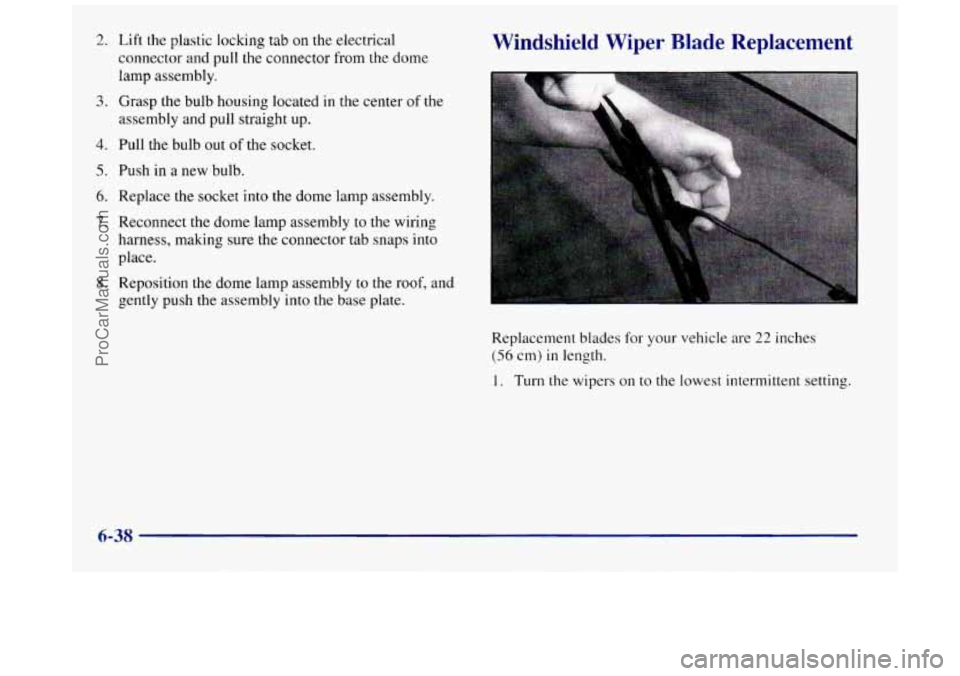
Windshield Wiper Blade Replacement
teplacement blades for your vehicle are 22 inches
56 cm) in length.
. Turn the wipers on to the lowest intermittent setting.
6-38
ProCarManuals.com
Page 335 of 422
Fuses and Circuit Breakers
The wiring circuits in your vehicle are protected
from short circuits by a combination of fuses, circuit
breakers and fusible thermal links in the wiring itself.
This greatly reduces the chance
of fires caused by
electrical problems.
Look at the silver-colored band inside the fuse. If
the band is broken or melted, replace the fuse. Be
sure you replace a bad fuse with a new one
of the
identical size and rating.
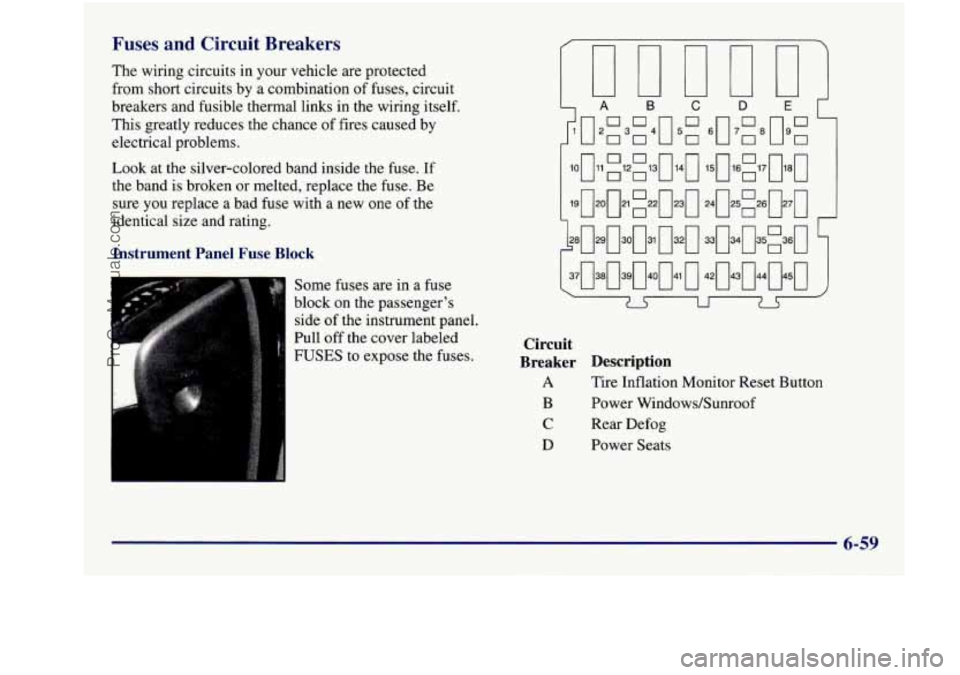
Instrument Panel Fuse Block
Some fuses are in a fuse
block on the passenger’s
side of the instrument panel.
Pull off the cover labeled
FUSES to expose the fuses.
B C D
Circuit
Breaker Description
A Tire Inflation Monitor Reset Button
B Power Windows/Sunroof
C Rear Defog
D Power Seats
6-59
ProCarManuals.com
Page 336 of 422
Fuse
1
4
6
8
10
13
14 15
17
18
19
20
22
23
24 26
27 Description
Ignition
Key Solenoid
Ignition Signal
-- Hot in Run and
Start
-- PCM, BCM U/H Relay
Power Mirrors
Panel Dimming Ignition Signal
-- Hot in Run, Unlock and
Start
-- Cluster, Powertrain Control
Module, Body Control Module
DRL Module
Interior Lamps
Door Locks
Taillamps, License Lp
Radio Heated Mirror
Cruise Control
Clusters
Cigarette Lighter
-- Auxiliary Power
Connection, Data Link
Stoplamps
Parklamps, Fog Lamps
Auxiliary Power Connection
-- Hot in
ACC and Run
Fuse
28
29
30
31
32
33
34
36
37
38
39
40
41
42
43
44
45
Description
Crank Signal -- Body Control Module,
Cluster, Powertrain Control Modules
Ignition Signal
-- HVAC Control Head
Shifter Lock Solenoid
Air Bag
Anti-lock Brake Controls, Body Control
Module
Hazard Flashers
Driver’s Heated Seat
Ignition Signal
-- Hot in ACC and
Run
-- Body Control Module
Anti-lock Brake Solenoids
Low Blower
Anti-lock Brakes
Turn Signals, Cornering Lamps
Radio, HVAC head, Keyless En
CEL
TEL
High Blower
Passenger’s Heated Seat
Steering Wheel Controls
Wipers ltry,
Clus
; ter,
6-60
ProCarManuals.com
Page 337 of 422
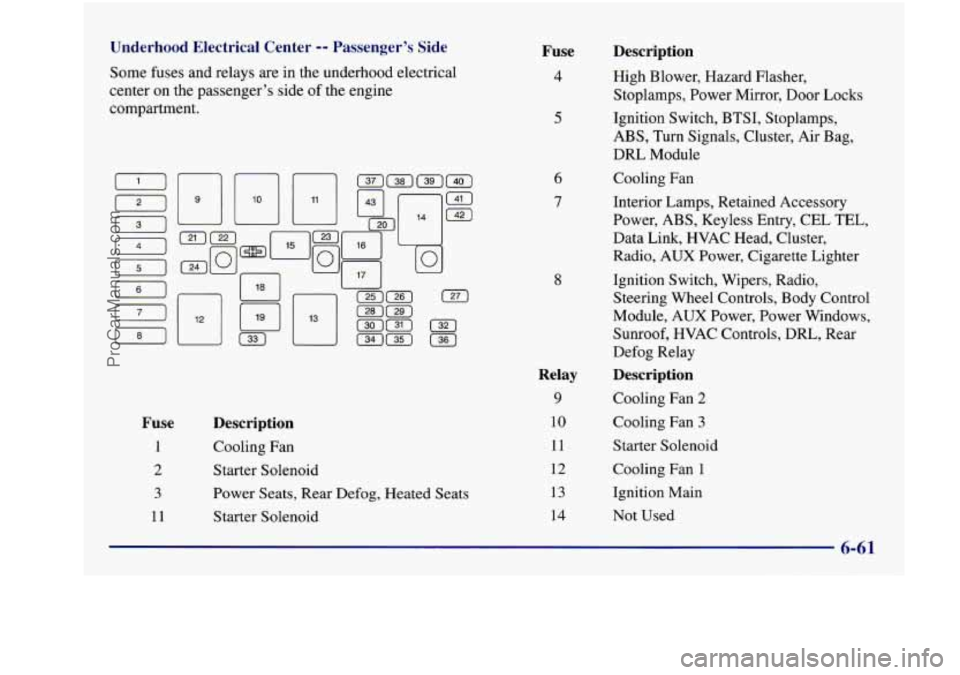
Underhood Electrical Center -- Passenger’s Side
Some fuses and relays are in the underhood electrical
center on the passenger’s side of the engine
compartment.
Fuse
1
2
3
11
Description
Cooling Fan
Starter Solenoid
Power Seats, Rear
Defog, Heated Seats
Starter Solenoid
Fuse
4
5
6
7
8
Relay
9
10
11
12
13
14
Description
High Blower, Hazard Flasher,
Stoplamps, Power Mirror, Door Locks
Ignition Switch, BTSI, Stoplamps,
ABS, Turn Signals, Cluster, Air Bag,
DRL Module
Cooling Fan
Interior Lamps, Retained Accessory
Power, ABS, Keyless Entry, CEL TEL,
Data Link,
HVAC Head, Cluster,
Radio, AUX Power, Cigarette Lighter
Ignition Switch, Wipers, Radio,
Steering Wheel Controls, Body Control
Module, AUX Power, Power Windows,
Sunroof, HVAC Controls, DRL, Rear
Defog Relay
Description
Cooling Fan 2
Cooling Fan
3
Starter Solenoid
Cooling Fan 1
Ignition Main
Not Used
6-61
ProCarManuals.com
Page 382 of 422
At Least Twice a Year Automatic Transaxle Check
Restraint System Check
Make sure the safety belt reminder light and all your
belts, buckles, latch plates, retractors and anchorages are
working properly. If your vehicle has a built-in child
restraint, also periodically make sure the harness straps,
latch plates, buckle, clip, retractors and anchorages are
working properly. Look for any other loose or damaged
safety belt and built-in child restraint system parts. If
you see anything that might keep a safety belt or built-in
child restraint system from doing its
job, have it
repaired. Have any torn or frayed safety belts or harness
straps replaced.
Also look for any opened or broken air bag coverings,
and have them repaired
or replaced. (The air bag system
does not need regular maintenance.)
Wiper Blade Check
Inspect wiper blades for wear or cracking. Replace blade
inserts that appear worn or damaged or that streak or
miss areas of the windshield. Also see “Wiper Blades,
Cleaning” in
the Index. Check the transaxle fluid
level; add if needed.
See “Automatic Transaxle” in the Index.
A fluid
loss may indicate a problem. Check the system and
repair if needed.
At Least Once a Year
Key Lock Cylinders Service
Lubricate the key lock cylinders with the lubricant
specified
in Part D.
Body Lubrication Service
Lubricate all hinges and latches including those for the
body doors, hood, rear compartment, glove box door,
console door and any folding seat hardware. Part
D tells
you what to use. More frequent lubrication may be
required when exposed to a corrosive environment.
7-40
ProCarManuals.com
Page 383 of 422
Starter Switch Check Brake-Transaxle Shift Interlock (BTSI) Check
When you are doing this check, the vehicle could
move suddenly. If it does, you or others could be
injured. Follow the steps below.
I A CAUTION:
When you are doing this check, the vehicle could
move suddenly. If it does, you or others could be
injured. Follow the steps below.
1.
2.
3.
Before you start, be sure you have enough room
around the vehicle.
Firmly apply both the parking brake (see “Parking
Brake”
in the Index if necessary) and the
regular brake.
NOTE: Do not use the accelerator pedal, and be
ready to turn off
the engine immediately if it starts.
Try to start the engine
in each gear. The starter
should work only
in PARK (P) or NEUTRAL (N). If
the starter works in any other position, your vehicle
needs service.
1.
2.
3.
Before you start, be sure you have enough room
around the vehicle. It should be parked on
a
level surface.
Firmly apply the parking brake (see “Parking Brake”
in the Index if necessary).
NOTE: Be ready to apply the regular brake
immediately if
the vehicle begins to move.
With the engine off, turn
the key to the RUN
position, but don’t start the engine. Without applying
the regular brake, try to move
the shift lever out of
PARK (P) with normal effort. If the shift lever
moves out
of PARK (P), your vehicle’s BTSI
needs service.
7-41
ProCarManuals.com
Page 384 of 422
Ignition Transaxle Lock Check
While parked, and with the parking brake
set, try to turn
the ignition key to LOCK in each shift lever position.
0 The key should turn to LOCK only when the shift
lever is in PARK
(P).
0 The key should come out only in LOCK.
Parking Brake and Automatic Transaxle PARK
(P)
Mechanism Check
When you are doing this check, your vehicle
could begin to move. You or others could be
injured and property could be damaged. Make
sure there is room in front
of your vehicle in case
it begins to roll. Be ready to apply the regular
brake at once should the vehicle begin to move. Park on
a fairly steep hill, with the vehicle facing
downhill. Keeping your foot on the regular brake, set the
parking brake.
0
0
To check the parking brake’s holding ability: With
the engine running and transaxle in NEUTRAL
(N),
slowly remove foot pressure from the regular brake
pedal.
Do this until the vehicle is held by the parking
brake only.
To check the PARK (P) mechanism’s holding ability:
With the engine running, shift to PARK (P). Then
release all brakes.
Underbody Flushing Service
At least every spring, use plain water
to flush any
corrosive materials from
the underbody. Take care to
clean thoroughly any areas where mud and other debris
can collect.
7-42
ProCarManuals.com
Page 386 of 422
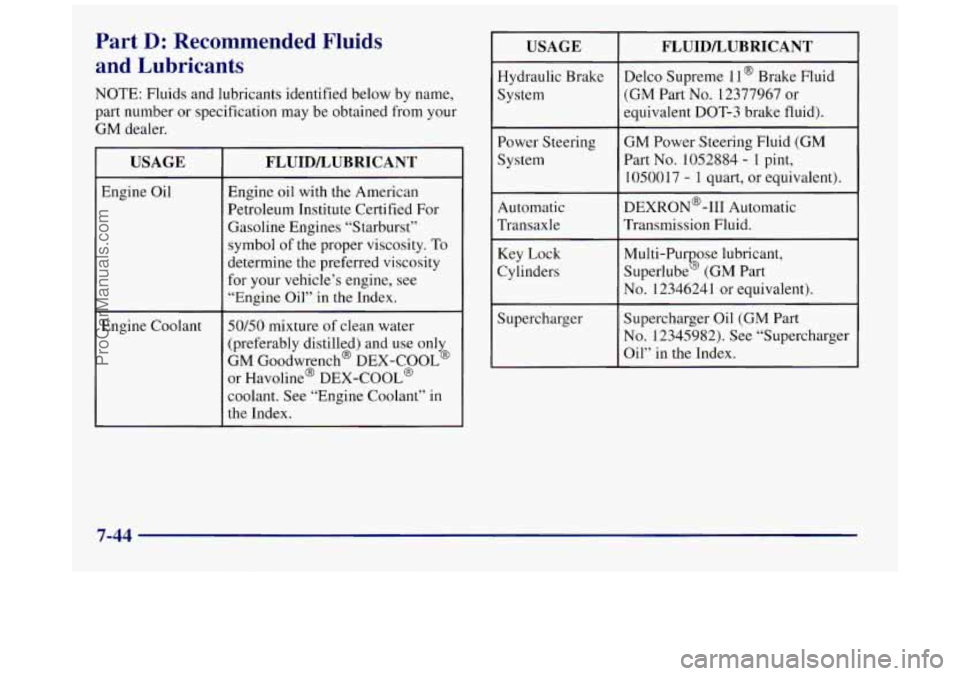
Part D: Recommended Fluids
and Lubricants
NOTE: Fluids and lubricants identified below by name,
part number or specification may be obtained from your
GM dealer.
USAGE
Engine Oil
Engine Coolant
FLUIDLUBRICANT
Engine oil with the American
Petroleum Institute Certified For
Gasoline Engines “Starburst”
symbol
of the proper viscosity. To
determine the preferred viscosity
for your vehicle’s engine, see
“Engine Oil”
in the Index.
50/50 mixture of clean water
(preferably distilled) and use only
GM Goodwrench’ DEX-COOL@
or Havoline@ DEX-COOL’
coolant. See “Engine Coolant”
in
the Index.
USAGE
Hydraulic Brake
System
Power Steering
System
Automatic
Transaxle
Key Lock
Cylinders
Supercharger
FLUIDLUBRICANT
Delco Supreme 11 ’ Brake Fluid
(GM Part
No. 12377967 or
equivalent DOT-3 brake fluid).
GM Power Steering Fluid (GM
Part
No. 1052884 - 1 pint,
1050017
- 1 quart, or equivalent).
DEXR0N’-I11 Automatic
Transmission Fluid.
Multi-Pur ose lubricant,
Superlube (GM Part
No. 1234624 1 or equivalent).
Supercharger
Oil (GM Part
No. 12345982). See “Supercharger
Oil” in the Index.
b
7-44
ProCarManuals.com
Page 407 of 422
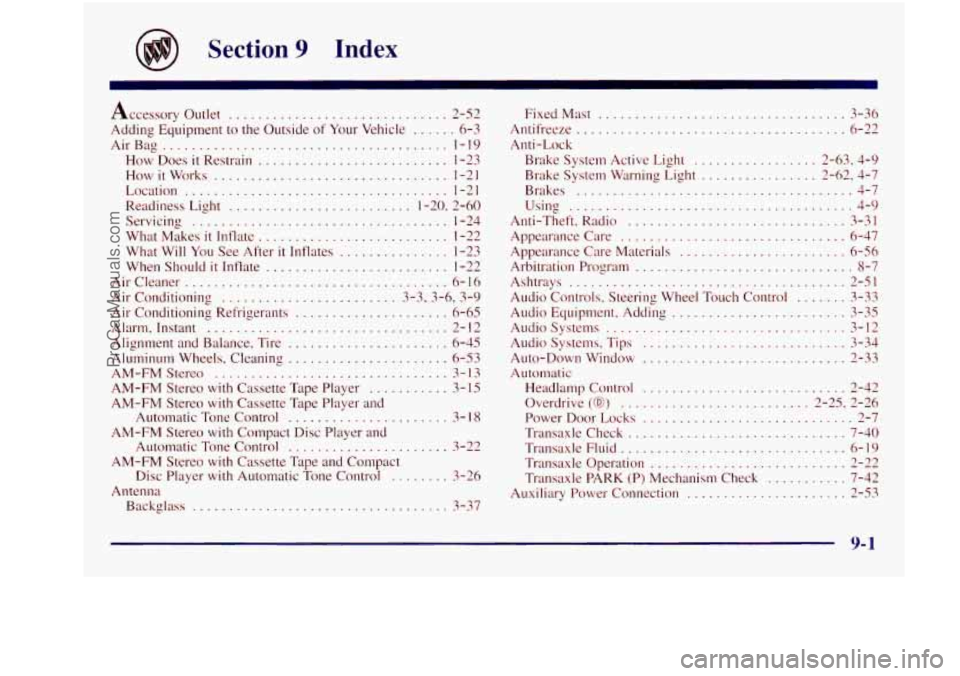
Section 9 Index
Accessory outlet .............................. 2-52
Adding Equipment to the Outside
of Your Vehicle ...... 6-3
AirBag
....................................... 1-19
How Does it Restrain .......................... 1-23
How
it Works ................................ 1-2 1
Location .................................... 1-21
Readiness Light
......................... 1-20. 2-60
Servicing
................................... 1-24
What Makes
it Inflate .......................... 1-22
What Will You See After
it Inflates ............... 1-23
When Should it Inflate ......................... 1-22
Aircleaner .................................... 6-16
Air Conditioning
........................ 3-3.3-6. 3-9
Air Conditioning Refrigerants ..................... 6-65
Alarm. Instant
................................. 2- 12
Alignment and Balance. Tire
...................... 6-45
Aluminum Wheels. Cleaning
...................... 6-53
AM-FMStereo ................................ 3-13
AM-FM Stereo with Cassette Tape Player and
AM-FM Stereo with Compact Disc Player and
AM-FM Stereo
with Cassette Tape and Compact
Antenna AM-FM Stereo
with Cassette Tape Player ........... 3- I5
Automatic Tone Control
...................... 3- 18
Automatic Tone Control
...................... 3-22
Disc Player
with Automatic Tone Control ........ 3-26
Backglass
................................... 3-37 Fixed Mast
.................................. 346
Antifreeze ..................................... 6-22
Anti-Lock
Brake System Active Light
................. 2.63. 4.9
Brake System Wa-ning Light
................ 2.62. 4.7
Brakes
...................................... 4-7
Using
....................................... 4-9
Anti.Theft. Radio .............................. 3-31
Appearancecare
............................... 6-47
Appearance Care Materials
....................... 6-56
Arbitration Program
.............................. 8-7
Ashtrays
...................................... 2-51
Audio Controls. Steering Wheel Touch Control
....... 3-33
Audio Equipment. Adding ........................ 3-35
AudioSyste~ns
................................. 3-12
Auto-Down Window
............................ 2-33
Automatic
Audio Systems.
Tips
............................ 3-34
Headlamp Control ............................ 2-42
Overdrive
(a) .......................... 2.25. 2.26
Power Door Locks
............................. 2-7
Transaxle Check
.............................. 7-40
Transaxle Fluid
............................... 6-19
Transaxle Operation ........................... 2-22
Transaxle PARK
(P) Mechanism Check ........... 7-42
Auxiliary Power Connection
...................... 2-53
ProCarManuals.com