instrument panel BUICK REGAL 2004 Service Manual
[x] Cancel search | Manufacturer: BUICK, Model Year: 2004, Model line: REGAL, Model: BUICK REGAL 2004Pages: 354, PDF Size: 4.16 MB
Page 277 of 354
When to Check
Check your tires once a month or more.
Don’t forget your compact spare tire. It should be at
60 psi (420 kPa).
How to Check
Use a good quality pocket-type gage to check tire
pressure. You can’t tell if your tires are properly inated
simply by looking at them. Radial tires may look
properly inated even when they’re underinated. Check
the tire’s ination pressure when the tires are cold.
Cold means your vehicle has been sitting for at least
three hours or driven no more than 1 mile (1.6 km).
Remove the valve cap from the tire valve stem. Press
the tire gage rmly onto the valve to get a pressure
measurement. If the cold tire ination pressure matches
the recommended pressure on the Tire and Loading
Information label, no further adjustment is necessary. If
the ination pressure is low, add air until you reach
the recommended amount.
If you overll the tire, release air by pushing on the
metal stem in the center of the tire valve. Recheck the
tire pressure with the tire gage.
Be sure to put the valve caps back on the valve stems.
They help prevent leaks by keeping out dirt and
moisture.
Tire Pressure Monitor System
The tire ination monitor system detects differences in
tire rotation speeds that are caused by changes in
tire pressure. The system can alert you if a tire is
low – but it does not replace normal tire maintenance.
SeeTires on page 5-61.
When the LOW TIRE light comes on the instrument
panel, stop as soon as you can and check all the tires
for damage. If a tire is at, seeIf a Tire Goes Flat
on page 5-77. Also, check the tire pressure in all four
tires as soon as possible. SeeInation - Tire Pressure
on page 5-68.
In order for the tire ination system to function properly,
the vehicle must be driven between 45 and 90 minutes
before the system determines the tire pressure in
each tire. The driving time may be longer depending on
an individual’s driving habits. The data does not have
to be accumulated during a single trip. Once determined,
the system will store the tire pressures until the
system is reset.
The system normally takes 15 to 20 minutes of driving
time in each of three speed ranges to determine tire
pressures. The speed ranges are 15 to 40 mph (25 to
65 km/h), 40 to 65 mph (65 to 105 km/h) and above
65 mph (105 km/h). When the storage of the tire ination
information is complete, the LOW TIRE light will come on
the instrument panel after two to eight minutes if one tire
is inated 12 psi (83 kPa) less than the other three tires.
5-69
Page 278 of 354
Detection thresholds may be higher and detection times
may be longer on rough roads, curves and at high
speeds. The system is not capable of ination differences
at speeds greater than 70 mph (110 km/h).
The tire ination monitor system will not alert you if the
pressure in more than one tire is low, if the system
is not properly calibrated, or if the vehicle is moving
faster than 70 mph (110 km/h).
The LOW TIRE light will stay on while the ignition is on,
until the system is reset
Do not reset the tire ination monitor system without
rst correcting the cause of the problem and checking
and adjusting the pressure in all four tires. If the
system is reset when the tire pressures are incorrect, it
will not function properly and may not alert you when
a tire is low.
Any time a tire’s pressure is adjusted, the tires are
rotated, or one or more tires is repaired or replaced, the
tire ination monitor system will need to be reset. The
system also needs to be reset when new tires are
purchased and if the vehicle’s battery has been
disconnected.To reset the system:
1. Turn the ignition to RUN.
2. Remove the passenger’s side instrument panel
cover to get to the fuse block.
3. Press and hold the RESET button in the fuse block
for about ve seconds.
4. The LOW TIRE light will come on and ash three
times. Then it will go off. If the light does not go
off, see your dealer for service.
Tire Inspection and Rotation
Tires should be rotated every 5,000 to 8,000 miles
(8 000 to 13 000 km).
Any time you notice unusual wear, rotate your tires as
soon as possible and check wheel alignment. Also
check for damaged tires or wheels. SeeWhen It Is Time
for New Tires on page 5-72andWheel Replacement
on page 5-75for more information.
The purpose of regular rotation is to achieve more
uniform wear for all tires on the vehicle. The rst rotation
is the most important. SeeScheduled Maintenance
on page 6-4for scheduled rotation intervals.
5-70
Page 300 of 354
Cleaning the Top of the Instrument
Panel
Use only mild soap and water to clean the top surfaces
of the instrument panel. Sprays containing silicones
or waxes may cause annoying reections in the
windshield and even make it difficult to see through the
windshield under certain conditions.
Cleaning Interior Plastic Components
Use only a mild soap and water solution on a soft cloth
or sponge. Commercial cleaners may affect the
surface nish.
Cleaning Glass Surfaces
Glass should be cleaned often. GM Glass Cleaner or a
liquid household glass cleaner will remove normal
tobacco smoke and dust lms on interior glass. See
Vehicle Care/Appearance Materials on page 5-96.
Notice:If you use abrasive cleaners when cleaning
glass surfaces on your vehicle, you could scratch
the glass and/or cause damage to the rear window
defogger and the integrated radio antenna. When
cleaning the glass on your vehicle, use only a soft
cloth and glass cleaner.
Care of Safety Belts
Keep belts clean and dry.
{CAUTION:
Do not bleach or dye safety belts. If you do, it
may severely weaken them. In a crash, they
might not be able to provide adequate
protection. Clean safety belts only with mild
soap and lukewarm water.
Weatherstrips
Silicone grease on weatherstrips will make them last
longer, seal better, and not stick or squeak. Apply
silicone grease with a clean cloth at least every six
months. During very cold, damp weather more frequent
application may be required. SeeRecommended
Fluids and Lubricants on page 6-12.
5-92
Page 305 of 354
Vehicle Identication
Vehicle Identication Number (VIN)
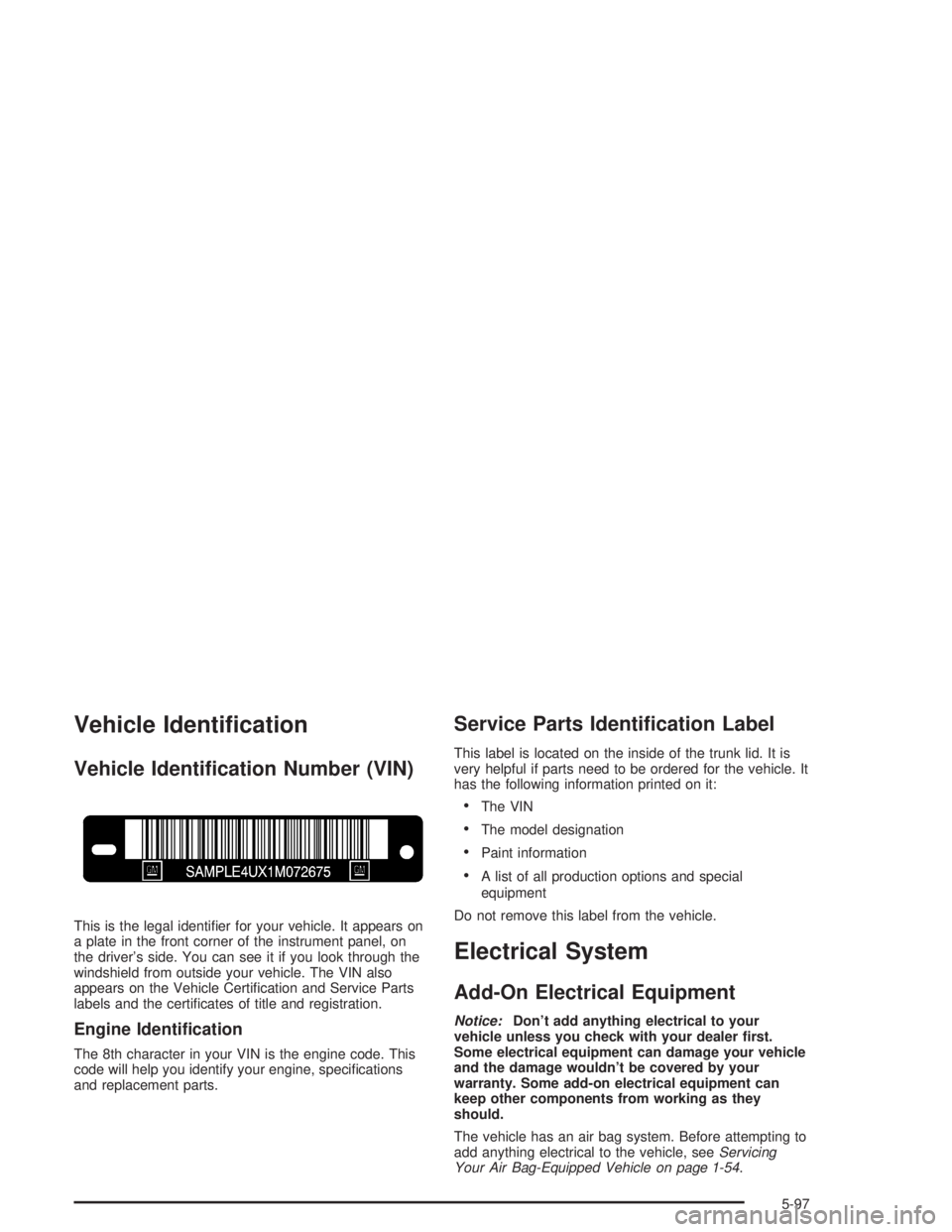
This is the legal identier for your vehicle. It appears on
a plate in the front corner of the instrument panel, on
the driver’s side. You can see it if you look through the
windshield from outside your vehicle. The VIN also
appears on the Vehicle Certication and Service Parts
labels and the certicates of title and registration.
Engine Identication
The 8th character in your VIN is the engine code. This
code will help you identify your engine, specications
and replacement parts.
Service Parts Identication Label
This label is located on the inside of the trunk lid. It is
very helpful if parts need to be ordered for the vehicle. It
has the following information printed on it:
The VIN
The model designation
Paint information
A list of all production options and special
equipment
Do not remove this label from the vehicle.
Electrical System
Add-On Electrical Equipment
Notice:Don’t add anything electrical to your
vehicle unless you check with your dealer rst.
Some electrical equipment can damage your vehicle
and the damage wouldn’t be covered by your
warranty. Some add-on electrical equipment can
keep other components from working as they
should.
The vehicle has an air bag system. Before attempting to
add anything electrical to the vehicle, seeServicing
Your Air Bag-Equipped Vehicle on page 1-54.
5-97
Page 306 of 354
Headlamp Wiring
The headlamp wiring is protected by a circuit breaker in
the underhood fuse block. An electrical overload will
cause the headlamps to go on and off, or in some cases
to remain off. If this happens, have the headlamp
system checked right away.
Windshield Wiper Fuses
The windshield wiper motor is protected by a circuit
breaker and a fuse. If the motor overheats due to heavy
snow, etc., the wiper will stop until the motor cools. If
the overload is caused by some electrical problem, have
it xed.
Power Windows and Other Power
Options
Circuit breakers in the instrument panel fuse block
protect the power windows and other power accessories.
When the current load is too heavy, the circuit breaker
opens and closes, protecting the circuit until the
problem is xed.
Fuses and Circuit Breakers
The wiring circuits in the vehicle are protected from
short circuits by a combination of fuses, circuit breakers
and in the fuse block wiring itself. This greatly reduces
the chance of res caused by electrical problems.
Look at the silver-colored band inside the fuse. If the
band is broken or melted, replace the fuse. Make sure a
bad fuse is replaced with a new one of the identical
size and rating.
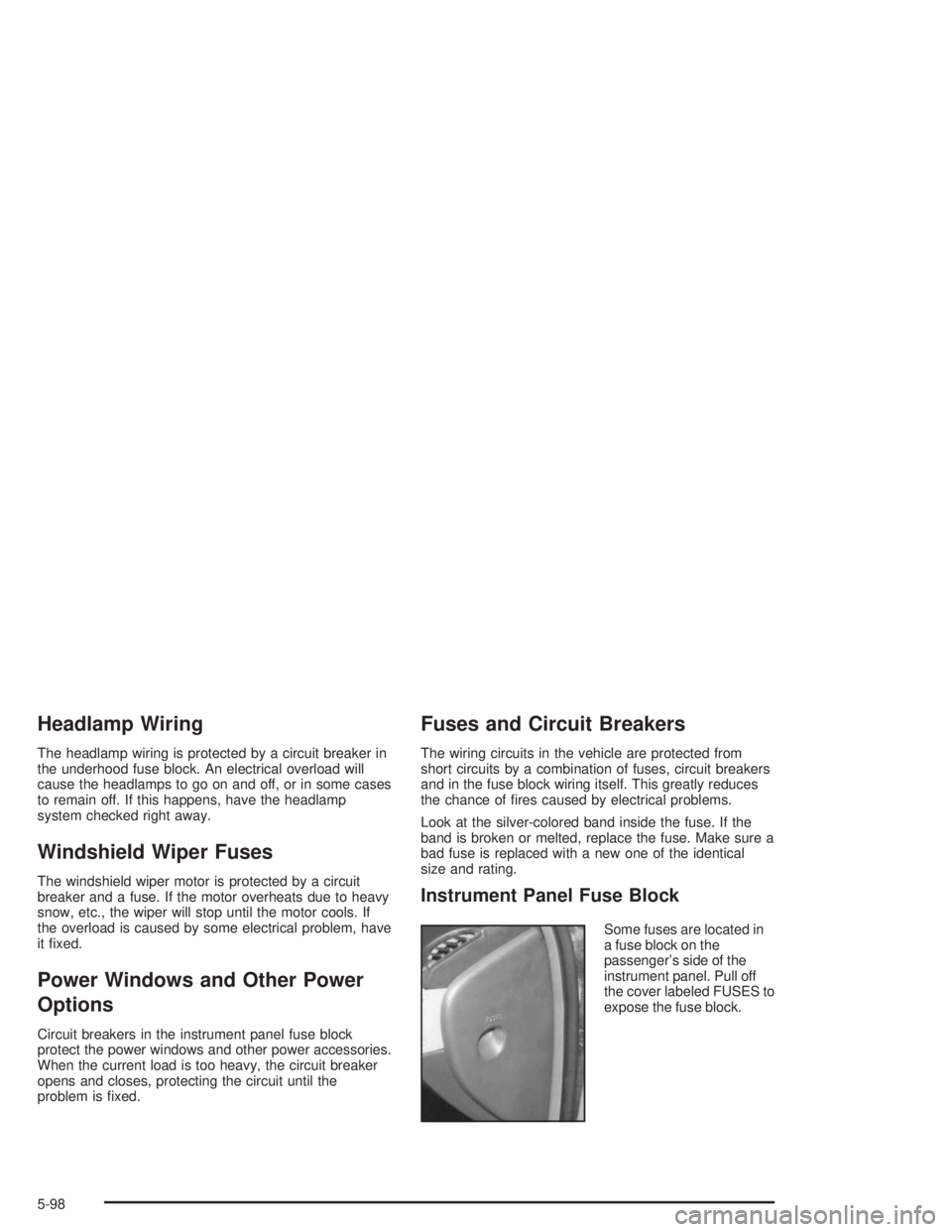
Instrument Panel Fuse Block
Some fuses are located in
a fuse block on the
passenger’s side of the
instrument panel. Pull off
the cover labeled FUSES to
expose the fuse block.
5-98
Page 308 of 354
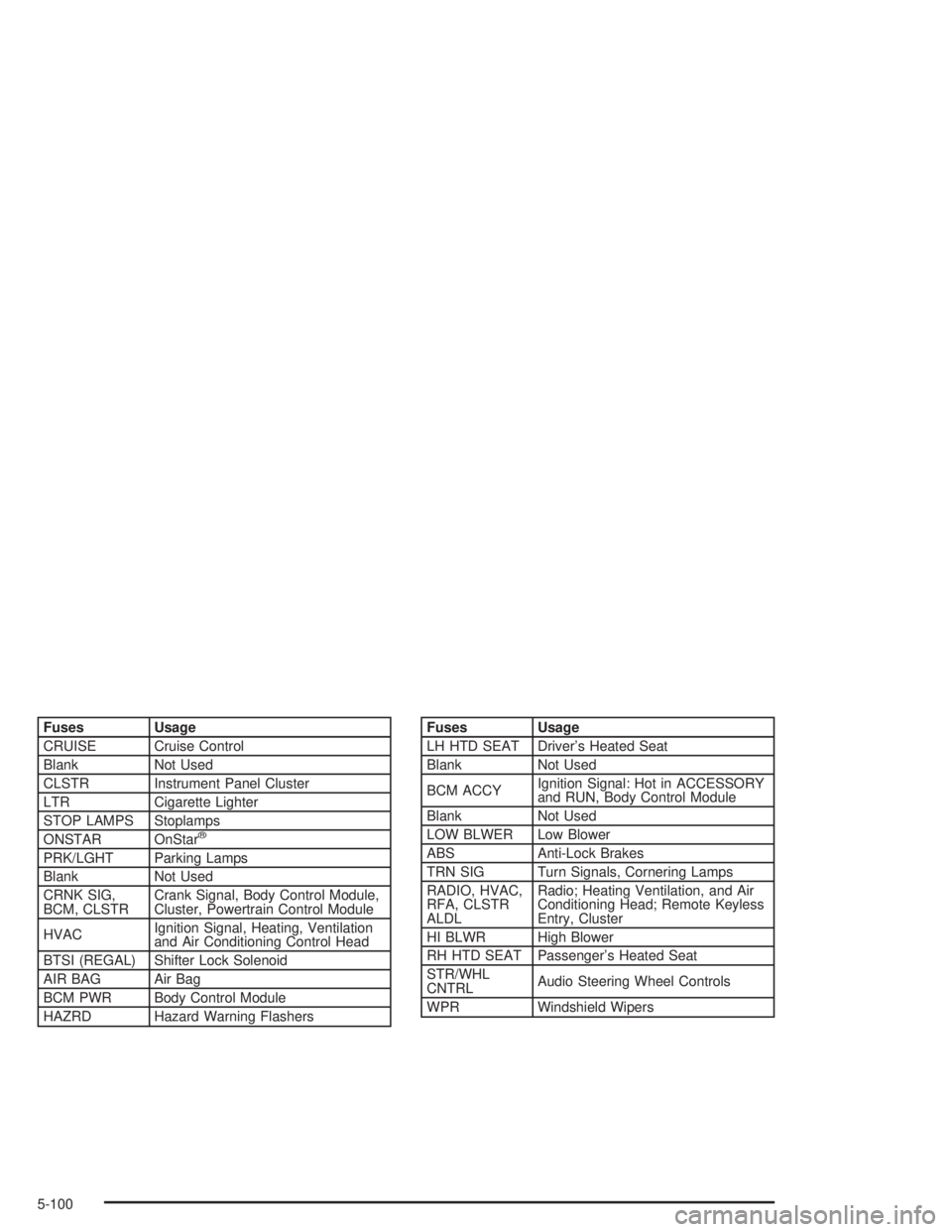
Fuses Usage
CRUISE Cruise Control
Blank Not Used
CLSTR Instrument Panel Cluster
LTR Cigarette Lighter
STOP LAMPS Stoplamps
ONSTAR OnStar
®
PRK/LGHT Parking Lamps
Blank Not Used
CRNK SIG,
BCM, CLSTRCrank Signal, Body Control Module,
Cluster, Powertrain Control Module
HVACIgnition Signal, Heating, Ventilation
and Air Conditioning Control Head
BTSI (REGAL) Shifter Lock Solenoid
AIR BAG Air Bag
BCM PWR Body Control Module
HAZRD Hazard Warning Flashers
Fuses Usage
LH HTD SEAT Driver’s Heated Seat
Blank Not Used
BCM ACCYIgnition Signal: Hot in ACCESSORY
and RUN, Body Control Module
Blank Not Used
LOW BLWER Low Blower
ABS Anti-Lock Brakes
TRN SIG Turn Signals, Cornering Lamps
RADIO, HVAC,
RFA, CLSTR
ALDLRadio; Heating Ventilation, and Air
Conditioning Head; Remote Keyless
Entry, Cluster
HI BLWR High Blower
RH HTD SEAT Passenger’s Heated Seat
STR/WHL
CNTRLAudio Steering Wheel Controls
WPR Windshield Wipers
5-100
Page 330 of 354
Customer Assistance and
Information
Customer Satisfaction Procedure
Your satisfaction and goodwill are important to
your dealer and to Buick. Normally, any concerns with
the sales transaction or the operation of your vehicle will
be resolved by your dealer’s sales or service
departments. Sometimes, however, despite the best
intentions of all concerned, misunderstandings can
occur. If your concern has not been resolved to your
satisfaction, the following steps should be taken:
STEP ONE:Discuss your concern with a member of
dealership management. Normally, concerns can
be quickly resolved at that level. If the matter has
already been reviewed with the sales, service or parts
manager, contact the owner of the dealership or
the general manager.
STEP TWO:If after contacting a member of dealership
management, it appears your concern cannot be
resolved by the dealership without further help, contact
the Buick Customer Assistance Center by calling
1-800-521-7300. In Canada, contact GM of Canada
Customer Communication Centre in Oshawa by calling
1-800-263-3777 (English) or 1-800-263-7854 (French).We encourage you to call the toll-free number in order
to give your inquiry prompt attention. Please have
the following information available to give the Customer
Assistance Representative:
Vehicle Identication Number (This is available from
the vehicle registration or title, or the plate at the
top left of the instrument panel and visible through
the windshield.)
Dealership name and location
Vehicle delivery date and present mileage
When contacting Buick, please remember that your
concern will likely be resolved at a dealer’s facility. That
is why we suggest you follow Step One rst if you
have a concern.
STEP THREE:Both General Motors and your dealer
are committed to making sure you are completely
satised with your new vehicle. However, if you continue
to remain unsatised after following the procedure
outlined in Steps One and Two, you should le with the
BBB Auto Line Program to enforce any additional
rights you may have. Canadian owners refer to your
Warranty and Owner Assistance Information booklet for
information on the Canadian Motor Vehicle Arbitration
Plan (CAMVAP).
7-2
Page 343 of 354
Checking Your Restraint Systems......................1-54
Chemical Paint Spotting...................................5-95
Child Restraints
Child Restraint Systems...............................1-32
Infants and Young Children...........................1-29
Lower Anchorages and Top Tethers
for Children (LATCH System).....................1-38
Older Children.............................................1-27
Securing a Child Restraint Designed
for the LATCH System..............................1-40
Securing a Child Restraint in a Center
Rear Seat Position...................................1-42
Securing a Child Restraint in a Rear
Outside Seat Position...............................1-40
Securing a Child Restraint in the Right
Front Seat Position...................................1-44
Top Strap...................................................1-36
Top Strap Anchor Location............................1-37
Where to Put the Restraint...........................1-35
Cigarette Lighter.............................................3-17
Cleaning
Inside of Your Vehicle..................................5-90
Outside of Your Vehicle................................5-93
Underbody Maintenance...............................5-95
Weatherstrips..............................................5-92
Cleaning Aluminum or Chrome-Plated Wheels.....5-94
Cleaning Exterior Lamps/Lenses.......................5-93Cleaning Fabric/Carpet....................................5-90
Cleaning Glass Surfaces..................................5-92
Cleaning Interior Plastic Components.................5-92
Cleaning Leather............................................5-91
Cleaning the Top of the Instrument Panel...........5-92
Cleaning Tires................................................5-95
Cleaning Vinyl................................................5-91
Cleaning Windshield and Wiper Blades..............5-94
Climate Control System
Air Filter, Passenger Compartment.................3-25
Dual..........................................................3-17
Dual Automatic............................................3-20
Outlet Adjustment........................................3-24
Compact Spare Tire........................................5-89
Control Buttons...............................................3-43
Control of a Vehicle.......................................... 4-5
Convenience Net............................................2-36
Coolant
Engine Temperature Gage............................3-34
Engine Temperature Warning Light.................3-34
Heater, Engine............................................2-20
Cooling System..............................................5-32
Cornering Lamps............................................3-13
Courtesy Lamps.............................................3-14
Cruise Control.................................................. 3-8
Cruise Control Light........................................3-40
Current and Past Model Order Forms................7-12
3
Page 347 of 354

How to Add Fluid............................................5-26
How to Check........................................5-24, 5-69
How to Check and Add Oil...............................5-22
How to Check Power Steering Fluid..................5-41
How to Use This Manual...................................... ii
How to Wear Safety Belts Properly...................1-11
Hydroplaning..................................................4-20
I
If No Steam Is Coming From Your Engine..........5-31
If Steam Is Coming From Your Engine...............5-30
If the Light Is Flashing.....................................3-36
If the Light Is On Steady.................................3-37
If You Are Caught in a Blizzard.........................4-28
If You Are Stuck in Sand, Mud, Ice or Snow.......4-30
If You Do Decide To Pull A Trailer.....................4-40
Ignition Positions.............................................2-18
Illumination on Remote Activation........................ 2-7
Infants and Young Children, Restraints...............1-29
Ination - Tire Pressure...................................5-68
Instrument Panel
Cluster.......................................................3-27
Overview..................................................... 3-2
Instrument Panel Brightness.............................3-14
Instrument Panel Fuse Block............................5-98
Interior Lamps................................................3-14
J
Jump Starting.................................................5-47
K
Keyless Entry System....................................... 2-3
Keys............................................................... 2-2
L
Lamps
Exterior......................................................3-11
Interior.......................................................3-14
Lap Belt........................................................1-20
Lap-Shoulder Belt...................................1-12, 1-22
LATCH System
Child Restraints...........................................1-38
Securing a Child Restraint Designed
for the LATCH System..............................1-40
Leaving Your Vehicle.......................................2-11
Leaving Your Vehicle With the Engine
Running.....................................................2-26
Light
Air Bag Readiness.......................................3-30
Anti-Lock Brake System Warning...................3-32
7