steering BUICK REGAL 2013 Owner's Guide
[x] Cancel search | Manufacturer: BUICK, Model Year: 2013, Model line: REGAL, Model: BUICK REGAL 2013Pages: 412, PDF Size: 6.06 MB
Page 212 of 412
Black plate (16,1)Buick Regal Owner Manual - 2013 - crc - 11/5/12
9-16 Driving and Operating
{WARNING
Turning off the vehicle while
moving may cause loss of power
assist in the brake and steering
systems and disable the airbags.
While driving, only shut the
vehicle off in an emergency.
If the vehicle cannot be pulled over,
and must be shut off while driving,
turn the ignition to ACC/
ACCESSORY.
The ignition switch can bind in the
LOCK/OFF position with the wheels
turned off center. If this happens,
move the steering wheel from right
to left while turning the key to ACC/
ACCESSORY. If this does not work,
then the vehicle needs service.
2 (ACC/ACCESSORY): This
position unlocks the steering wheel.
Some accessories can be used in
this position. 3 (ON/RUN):
The ignition switch
stays in this position when the
engine is running. This position can
be used to operate the electrical
accessories, as well as to display
some warning and indicator lights.
This position can also be used for
service and diagnostics, and to
verify the proper operation of the
malfunction indicator lamp as may
be required for emission inspection
purposes.
The battery could be drained if the
key is left in the ON/RUN position
with the engine off. The vehicle
might not start if the battery is
allowed to drain for an extended
period of time.
4 (START): This position starts the
engine. When the engine starts,
release the key. The ignition switch
will return to ON/RUN for normal
driving.
If the ignition becomes difficult to
turn, see Keys on page 2‑1.
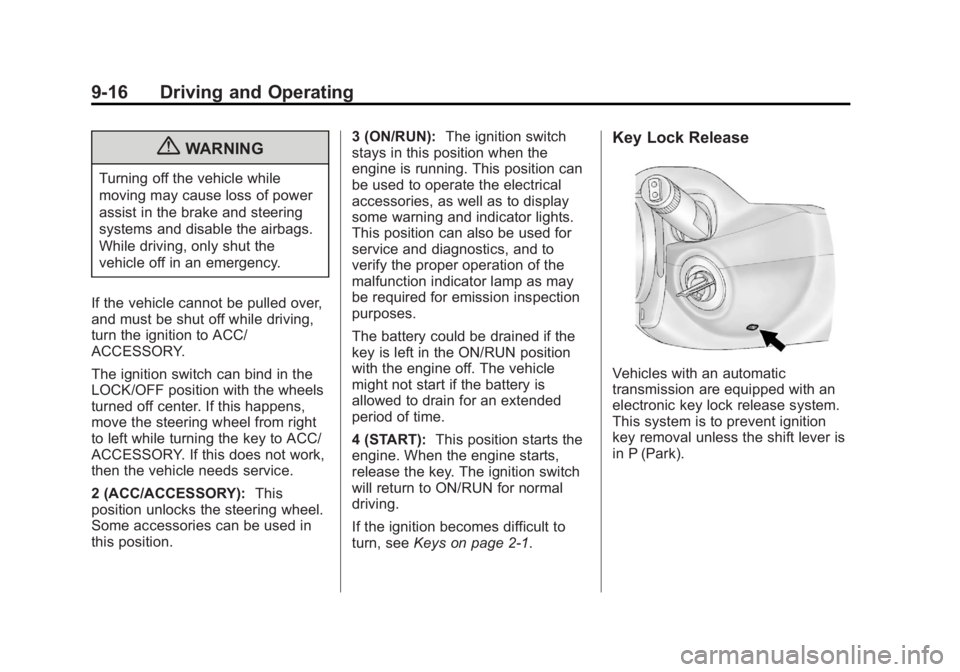
Key Lock Release
Vehicles with an automatic
transmission are equipped with an
electronic key lock release system.
This system is to prevent ignition
key removal unless the shift lever is
in P (Park).
Page 214 of 412
Black plate (18,1)Buick Regal Owner Manual - 2013 - crc - 11/5/12
9-18 Driving and Operating
information. When the vehicle is
shifted into P (Park), the ignition
system will switch to OFF.
Do not turn the engine off when the
vehicle is moving. This will cause a
loss of power assist in the brake
and steering systems and disable
the airbags.
If the vehicle must be shut off in an
emergency:
1. Brake using a firm and steadypressure. Do not pump the
brakes repeatedly. This may
deplete power assist, requiring
increased brake pedal force.
2. Shift the vehicle to N (Neutral). This can be done while the
vehicle is moving. After shifting
to N (Neutral), firmly apply the
brakes and steer the vehicle to a
safe location.
3. Come to a complete stop. Shift to P (Park) with an automatic
transmission, or Neutral with a
manual transmission. Turn the
ignition to LOCK/OFF. 4. Set the parking brake. See
Parking Brake on page 9‑32.
{WARNING
Turning off the vehicle while
moving may cause loss of power
assist in the brake and steering
systems and disable the airbags.
While driving, only shut the
vehicle off in an emergency.
If the vehicle cannot be pulled over,
and must be shut off while driving,
press and hold the engine START/
STOP button for longer than
two seconds, or press twice in
five seconds.
ACC/ACCESSORY (Amber
Indicator Light): This mode allows
you to use some electrical
accessories when the engine is off.
With the ignition off, pressing the
button one time without the brake
pedal applied will place the ignition
system in ACC/ACCESSORY. The ignition will switch from ACC/
ACCESSORY to OFF after
five minutes to prevent battery
run down.
ON/RUN/START (Green Indicator
Light):
This mode is for driving and
starting. With the ignition off, and
the brake pedal applied, pressing
the button once will place the
ignition system in ON/RUN/START.
Once engine cranking begins,
release the button. Engine cranking
will continue until the engine starts.
See Starting the Engine on
page 9‑19 for more information. The
ignition will then remain in ON/RUN.
Service Only Mode
This power mode is available for
service and diagnostics, and to
verify the proper operation of the
malfunction indicator lamp as may
be required for emission inspection
purposes. With the vehicle off, and
the brake pedal not applied,
pressing and holding the button for
more than five seconds will place
the vehicle in Service Only Mode.
Page 228 of 412
Black plate (32,1)Buick Regal Owner Manual - 2013 - crc - 11/5/12
9-32 Driving and Operating
If driving safely on a wet road and it
becomes necessary to slam on the
brakes and continue braking to
avoid a sudden obstacle, a
computer senses that the wheels
are slowing down. If one of the
wheels is about to stop rolling, the
computer will separately work the
brakes at each wheel.
ABS can change the brake pressure
to each wheel, as required, faster
than any driver could. This can help
you steer around the obstacle while
braking hard.
As the brakes are applied, the
computer keeps receiving updates
on wheel speed and controls
braking pressure accordingly.
Remember: ABS does not change
the time needed to get a foot up to
the brake pedal or always decrease
stopping distance. If you get too
close to the vehicle in front of you,there will not be enough time to
apply the brakes if that vehicle
suddenly slows or stops. Always
leave enough room up ahead to
stop, even with ABS.
Using ABS
Do not pump the brakes. Just hold
the brake pedal down firmly and let
ABS work. You might hear the ABS
pump or motor operating and feel
the brake pedal pulsate, but this is
normal.
Braking in Emergencies
ABS allows you to steer and brake
at the same time. In many
emergencies, steering can help
more than even the very best
braking.
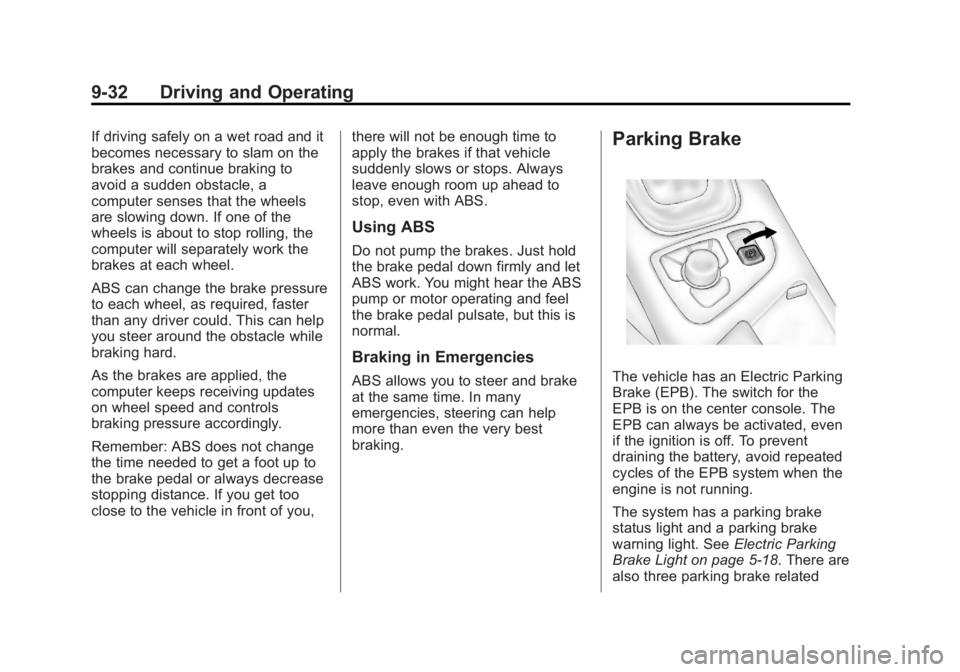
Parking Brake
The vehicle has an Electric Parking
Brake (EPB). The switch for the
EPB is on the center console. The
EPB can always be activated, even
if the ignition is off. To prevent
draining the battery, avoid repeated
cycles of the EPB system when the
engine is not running.
The system has a parking brake
status light and a parking brake
warning light. See
Electric Parking
Brake Light on page 5‑18. There are
also three parking brake related
Page 235 of 412
Black plate (39,1)Buick Regal Owner Manual - 2013 - crc - 11/5/12
Driving and Operating 9-39
Tour:Use for long-distance
highway driving. This setting
provides a smooth, soft ride. Press
and release the TOUR button and
the light on the button comes on.
This mode provides a comfortable,
smooth ride. Press the button again
and the system returns to the
Standard mode.
Sport: Use where personal
preference or road conditions
demand more control. This setting
provides responsive, controlled
handling. Press and release the
SPORT button. The light on the
button comes on, and the
appropriate message displays on
the DIC. Press the button again.
The system returns to the Standard
mode and the appropriate message
displays on the DIC.
IDCS automatically comes on in the
Standard mode when the vehicle is
started. When the Sport and Tour
modes are turned off, the system
returns to the Standard mode.Standard Mode
.The shock absorbers allow a
normal ride.
.The powertrain reacts normally
to the accelerator pedal.
.Power steering assistance is
normal.
Tour Mode
.The shock absorbers allow a
softer ride.
.The powertrain reacts normally
to the accelerator pedal.
.Power steering assistance is
normal.
Sport Mode
.The shock absorbers stiffen to
provide better contact with the
road surface.
.The powertrain reacts more
quickly to the accelerator pedal.
.Power steering assistance is
reduced.
Drive Mode Control
Drive Mode Control (DMC) analyzes
the driving style and the active state
of the vehicle and automatically
changes the settings within the
selected driving mode. When there
is a more noticeable change in
driving style or conditions, the
driving mode is changed to Sport
until the previous driving style
returns.
If Standard mode is selected and
sport driving is detected, several
settings of the Standard mode
change to sport settings. If sport
driving increases, DMC changes to
Sport mode.
If Tour mode is selected and sudden
braking or cornering is necessary,
DMC changes the suspension
settings to Sport mode to increase
vehicle stability.
When the driving characteristic or
the active state of the vehicle
returns to the previous style, DMC
changes the settings to the
preselected driving mode.
Page 236 of 412
Black plate (40,1)Buick Regal Owner Manual - 2013 - crc - 11/5/12
9-40 Driving and Operating
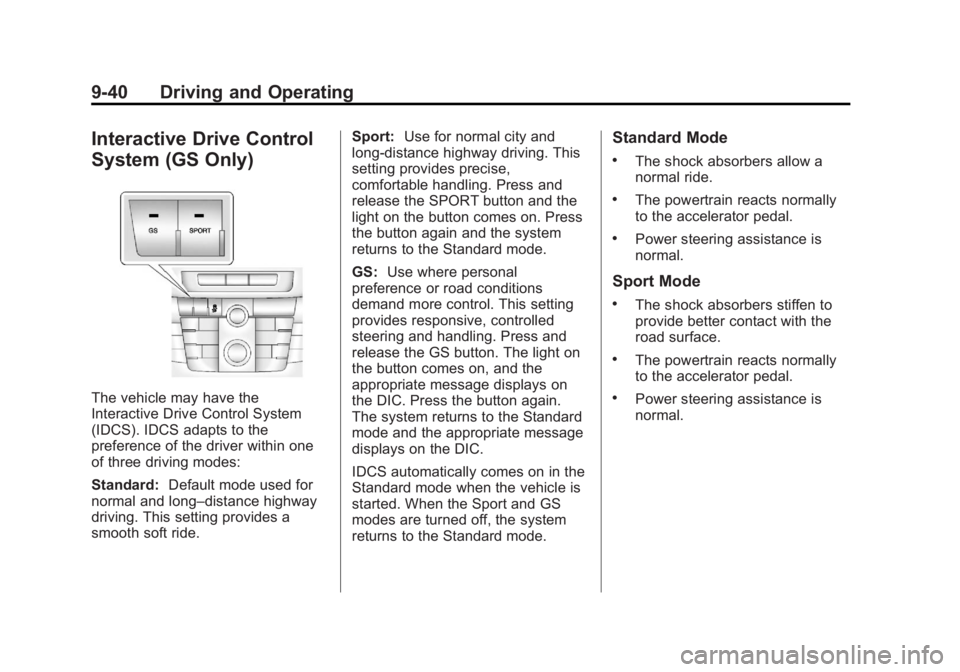
Interactive Drive Control
System (GS Only)
The vehicle may have the
Interactive Drive Control System
(IDCS). IDCS adapts to the
preference of the driver within one
of three driving modes:
Standard:Default mode used for
normal and long–distance highway
driving. This setting provides a
smooth soft ride. Sport:
Use for normal city and
long-distance highway driving. This
setting provides precise,
comfortable handling. Press and
release the SPORT button and the
light on the button comes on. Press
the button again and the system
returns to the Standard mode.
GS: Use where personal
preference or road conditions
demand more control. This setting
provides responsive, controlled
steering and handling. Press and
release the GS button. The light on
the button comes on, and the
appropriate message displays on
the DIC. Press the button again.
The system returns to the Standard
mode and the appropriate message
displays on the DIC.
IDCS automatically comes on in the
Standard mode when the vehicle is
started. When the Sport and GS
modes are turned off, the system
returns to the Standard mode.
Standard Mode
.The shock absorbers allow a
normal ride.
.The powertrain reacts normally
to the accelerator pedal.
.Power steering assistance is
normal.
Sport Mode
.The shock absorbers stiffen to
provide better contact with the
road surface.
.The powertrain reacts normally
to the accelerator pedal.
.Power steering assistance is
normal.
Page 237 of 412
Black plate (41,1)Buick Regal Owner Manual - 2013 - crc - 11/5/12
Driving and Operating 9-41
GS Mode
.Additional stiffness in the shock
absorbers for increased body
control.
.The powertrain reacts more
quickly to the accelerator pedal.
.Power steering assistance is
reduced.
There is no automatic Drive Mode
Control (DMC) in this vehicle.
Cruise Control
With cruise control, the vehicle can
maintain a speed of about 40 km/h
(25 mph) or more without keeping
your foot on the accelerator. Cruise
control does not work at speeds
below 40 km/h (25 mph).
On vehicles with the Traction
Control System (TCS) or StabiliTrak,
the system may begin to limit wheel
spin while you are using cruise
control. If this happens, the cruise
control will automatically disengage.
See Traction Control System (TCS)
on page 9‑35 orStabiliTrak
®System
on page 9‑36.
{WARNING
Cruise control can be dangerous
where you cannot drive safely at
a steady speed. So, do not use
the cruise control on winding
roads or in heavy traffic.
(Continued)
WARNING (Continued)
Cruise control can be dangerous
on slippery roads. On such roads,
fast changes in tire traction can
cause excessive wheel slip, and
you could lose control. Do not use
cruise control on slippery roads.
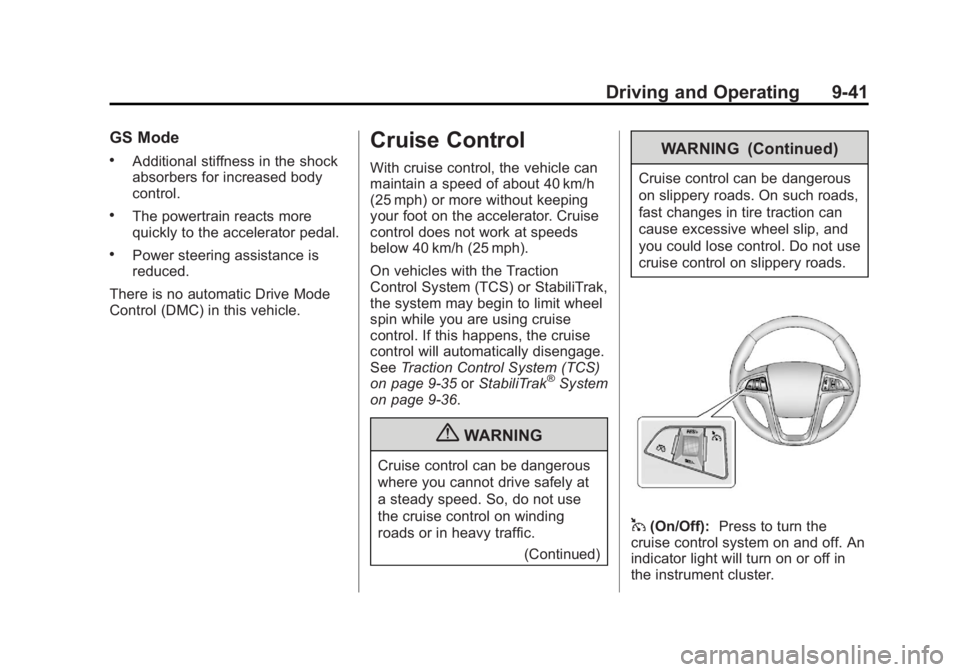
1(On/Off):Press to turn the
cruise control system on and off. An
indicator light will turn on or off in
the instrument cluster.
Page 239 of 412
Black plate (43,1)Buick Regal Owner Manual - 2013 - crc - 11/5/12
Driving and Operating 9-43
Each time this is done, the
vehicle goes about 1.6 km/h
(1 mph) slower.
Passing Another Vehicle While
Using Cruise Control
Use the accelerator pedal to
increase the vehicle's speed. When
you take your foot off the pedal, the
vehicle will slow down to the
previous set cruise control speed.
Using Cruise Control on Hills
How well the cruise control works
on hills depends upon the vehicle's
speed, load, and the steepness of
the hills. When going up steep hills,
you might have to step on the
accelerator pedal to maintain the
vehicle's speed. When going
downhill, you might have to brake or
shift to a lower gear to maintain the
vehicle's speed. When the brakes
are applied, the cruise control
shuts off. Ending Cruise Control
There are three ways to end cruise
control:
.To disengage cruise control,
step lightly on the brake pedal or
clutch; when cruise control
disengages, the indicator light
will not be lit.
.Press*on the steering wheel.
.To turn off the cruise control,
press
1on the steering wheel.
Erasing Speed Memory
The cruise control set speed is
erased from memory by pressing
1
or if the ignition is turned off.
Object Detection
Systems
Ultrasonic Parking Assist
If available, the Ultrasonic Front and
Rear Parking Assist (UFRPA) or
Ultrasonic Rear Parking Assist
(URPA) system assists the driver
with parking and avoiding objects.
At speeds less than 8 km/h (5 mph),
the system detects objects up to
1.5 m (5 ft) behind the vehicle, and
at least 25 cm (10 in) off the ground.
If the vehicle has the UFRPA
system, it also detects objects 1.2 m
(4 ft) in front of the vehicle.
{WARNING
The parking assist system does
not detect children, pedestrians,
bicyclists, animals, or objects
located below the bumper or that
are too close or too far from the
vehicle. It is not available at (Continued)
Page 249 of 412
Black plate (1,1)Buick Regal Owner Manual - 2013 - crc - 11/5/12
Vehicle Care 10-1
Vehicle Care
General Information
General Information . . . . . . . . . . 10-2
California Proposition65 Warning . . . . . . . . . . . . . . . . . 10-2
California Perchlorate Materials Requirements . . . . 10-3
Accessories and Modifications . . . . . . . . . . . . . . . 10-3
Vehicle Checks
Doing Your OwnService Work . . . . . . . . . . . . . . . 10-3
Hood . . . . . . . . . . . . . . . . . . . . . . . . 10-4
Engine Compartment Overview . . . . . . . . . . . . . . . . . . . 10-5
Engine Oil . . . . . . . . . . . . . . . . . . 10-10
Engine Oil Life System . . . . . 10-12
Automatic Transmission Fluid . . . . . . . . . . . . . . . . . . . . . . 10-13
Manual Transmission Fluid . . . . . . . . . . . . . . . . . . . . . . 10-14
Hydraulic Clutch . . . . . . . . . . . . 10-14
Engine Air Cleaner/Filter . . . . 10-14
Cooling System . . . . . . . . . . . . 10-16
Engine Coolant . . . . . . . . . . . . . 10-17
Engine Overheating . . . . . . . . 10-20 Power Steering Fluid (2.0L
L4 Engine) . . . . . . . . . . . . . . . . 10-22
Power Steering Fluid (2.4L L4 Engine with or without
eAssist) . . . . . . . . . . . . . . . . . . . 10-23
Washer Fluid . . . . . . . . . . . . . . . 10-23
Brakes . . . . . . . . . . . . . . . . . . . . . 10-23
Brake Fluid . . . . . . . . . . . . . . . . . 10-24
Battery . . . . . . . . . . . . . . . . . . . . . 10-26
Starter Switch Check . . . . . . . 10-27
Automatic Transmission Shift Lock Control Function
Check . . . . . . . . . . . . . . . . . . . . . 10-27
Ignition Transmission Lock Check . . . . . . . . . . . . . . . . . . . . . 10-28
Park Brake and P (Park) Mechanism Check . . . . . . . . 10-28
Wiper Blade Replacement . . . . . . . . . . . . . . 10-28
Headlamp Aiming
Headlamp Aiming . . . . . . . . . . 10-29
Bulb Replacement
Bulb Replacement . . . . . . . . . . 10-30
Halogen Bulbs . . . . . . . . . . . . . . 10-30
High Intensity Discharge(HID) Lighting . . . . . . . . . . . . . 10-30 Headlamps, Front Turn
Signal and Parking
Lamps . . . . . . . . . . . . . . . . . . . . 10-30
Fog Lamps . . . . . . . . . . . . . . . . . 10-32
Taillamps, Turn Signal, Stoplamps, and Back-Up
Lamps . . . . . . . . . . . . . . . . . . . . 10-32
License Plate Lamp . . . . . . . . 10-33
Replacement Bulbs . . . . . . . . . 10-33
Electrical System
High Voltage Devices and Wiring . . . . . . . . . . . . . . . . . . . . . 10-34
Electrical System Overload . . . . . . . . . . . . . . . . . . 10-34
Fuses and Circuit Breakers . . . . . . . . . . . . . . . . . . 10-35
Engine Compartment Fuse Block . . . . . . . . . . . . . . . . . . . . . 10-35
Instrument Panel Fuse Block . . . . . . . . . . . . . . . . . . . . . 10-39
Wheels and Tires
Tires . . . . . . . . . . . . . . . . . . . . . . . . 10-41
All-Season Tires . . . . . . . . . . . . 10-42
Winter Tires . . . . . . . . . . . . . . . . 10-42
Summer Tires . . . . . . . . . . . . . . 10-42
Tire Sidewall Labeling . . . . . . 10-43
Tire Designations . . . . . . . . . . . 10-45
Page 252 of 412
Black plate (4,1)Buick Regal Owner Manual - 2013 - crc - 11/5/12
10-4 Vehicle Care
All Vehicles
{WARNING
It can be dangerous to work on
your vehicle if you do not have
the proper knowledge, service
manual, tools, or parts. Always
follow owner manual procedures
and consult the service manual
for your vehicle before doing any
service work.
If doing some of your own service
work, use the proper service
manual. It tells you much more
about how to service the vehicle
than this manual can. To order the
proper service manual, see Service
Publications Ordering Information
on page 13‑16.
This vehicle has an airbag system.
Before attempting to do your own
service work, see Airbag System
Check on page 3‑28. Keep a record with all parts receipts
and list the mileage and the date of
any service work performed. See
Maintenance Records on
page 11‑15.
Notice:
Even small amounts of
contamination can cause damage
to vehicle systems. Do not allow
contaminants to contact the
fluids, reservoir caps,
or dipsticks.
Hood
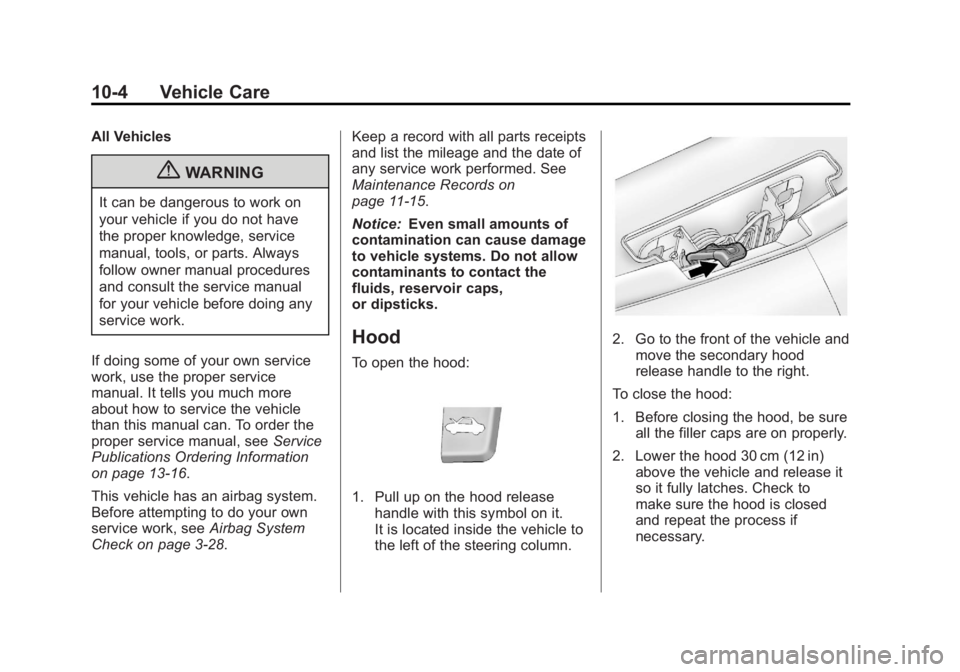
To open the hood:
1. Pull up on the hood release handle with this symbol on it.
It is located inside the vehicle to
the left of the steering column.
2. Go to the front of the vehicle andmove the secondary hood
release handle to the right.
To close the hood:
1. Before closing the hood, be sure all the filler caps are on properly.
2. Lower the hood 30 cm (12 in) above the vehicle and release it
so it fully latches. Check to
make sure the hood is closed
and repeat the process if
necessary.
Page 254 of 412
Black plate (6,1)Buick Regal Owner Manual - 2013 - crc - 11/5/12
10-6 Vehicle Care
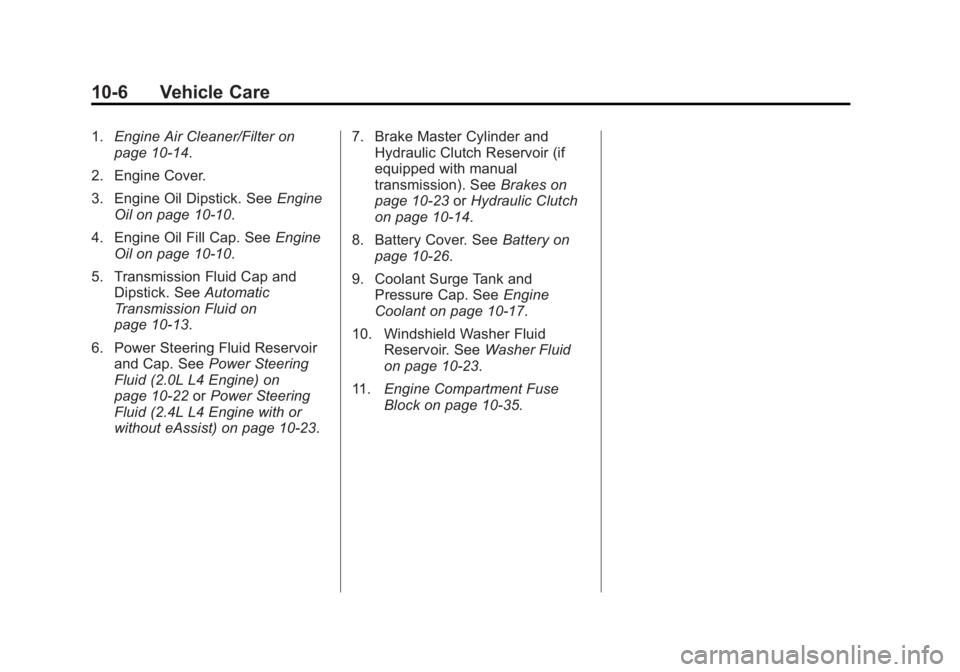
1.Engine Air Cleaner/Filter on
page 10‑14.
2. Engine Cover.
3. Engine Oil Dipstick. See Engine
Oil on page 10‑10.
4. Engine Oil Fill Cap. See Engine
Oil on page 10‑10.
5. Transmission Fluid Cap and Dipstick. See Automatic
Transmission Fluid on
page 10‑13.
6. Power Steering Fluid Reservoir and Cap. See Power Steering
Fluid (2.0L L4 Engine) on
page 10‑22 orPower Steering
Fluid (2.4L L4 Engine with or
without eAssist) on page 10‑23. 7. Brake Master Cylinder and
Hydraulic Clutch Reservoir (if
equipped with manual
transmission). See Brakes on
page 10‑23 orHydraulic Clutch
on page 10‑14.
8. Battery Cover. See Battery on
page 10‑26.
9. Coolant Surge Tank and Pressure Cap. See Engine
Coolant on page 10‑17.
10. Windshield Washer Fluid Reservoir. See Washer Fluid
on page 10‑23.
11. Engine Compartment Fuse
Block on page 10‑35.