service BUICK RIVIERA 1993 User Guide
[x] Cancel search | Manufacturer: BUICK, Model Year: 1993, Model line: RIVIERA, Model: BUICK RIVIERA 1993Pages: 324, PDF Size: 16.01 MB
Page 117 of 324
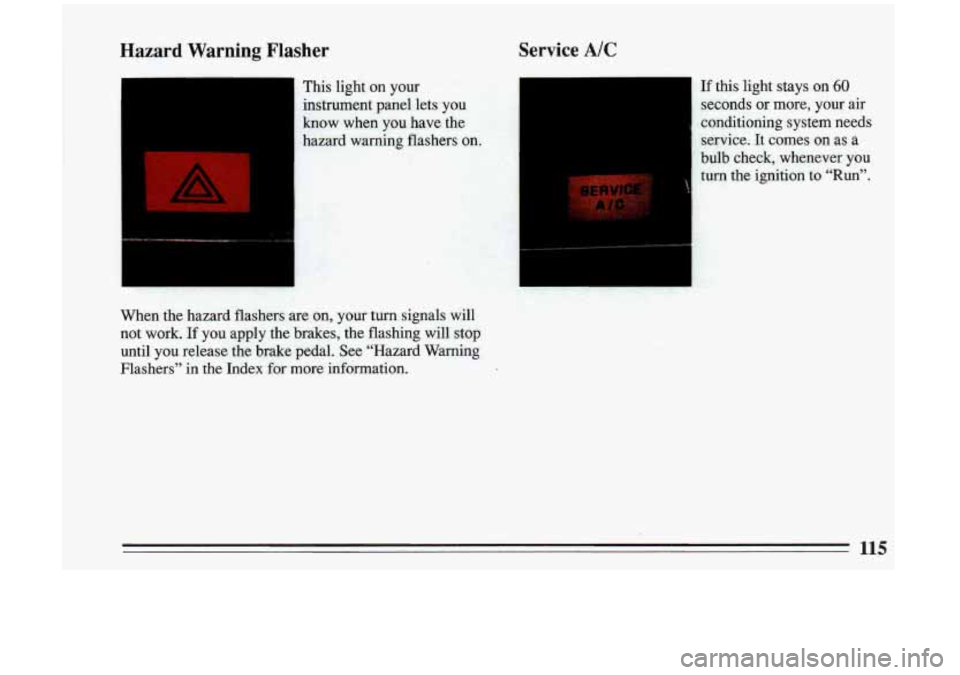
Hazard Warning Flasher Service A/C
- This light
on your
instrument panel lets you
know when you have the
hazard warning flashers
on.
When the hazard flashers are on, your turn signals will
not work.
If you apply the brakes, the flashing will stop
until’you release the brake pedal. See “Hazard Warning
Flashers” in the Index for more information.
If this light stays on 60
seconds or more, your air
conditioning system needs service. It comes
on as a
bulb cheek, whenever you
turn the ignition to “Run”.
Page 139 of 324
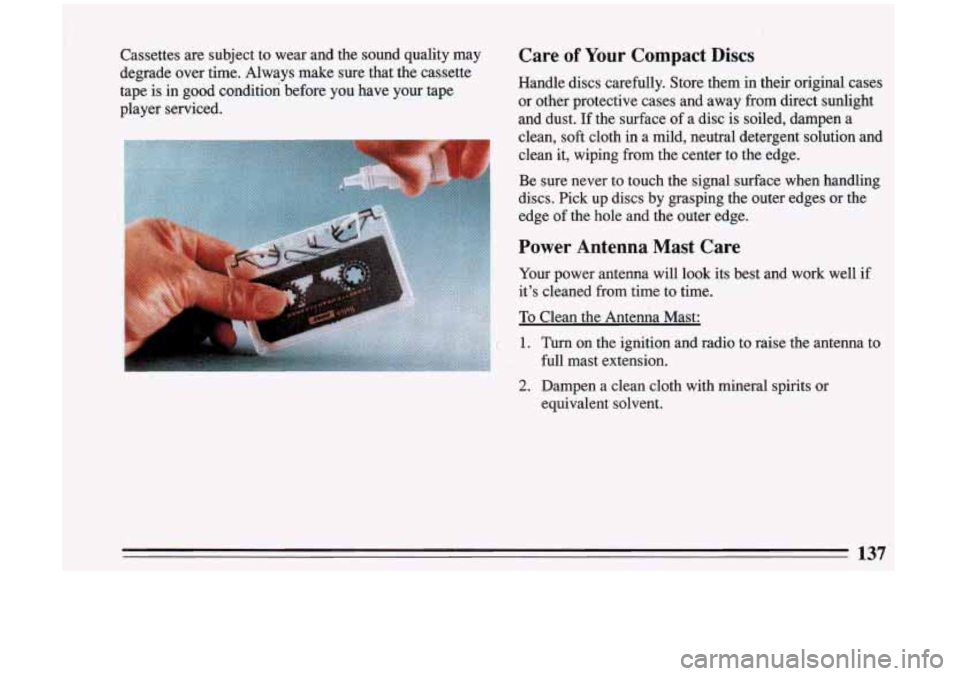
Cassettes are subject to wear and the sound quality may
degrade over time. Always make sure that the cassette
tape is in good condition before you have your tape
player serviced.
i
Care of Your Compact Discs
Handle discs carefully. Store them in their original cases
or other protective cases and away from direct sunlight
and dust. If the surface
of a disc is soiled, dampen a
clean,
soft cloth in a mild, neutral detergent solution and
clean it, wiping from the center to the edge.
Be sure never to touch the signal surface when handling
discs. Pick up discs by grasping the outer edges or the
edge of the hole and the outer edge.
Power Antenna Mast Care
Your power antenna will look its best and work well if
it’s cleaned from time to time.
To Clean the Antenna Mast:
1. Turn on the ignition and radio to raise the antenna to
full mast extension.
2. Dampen a clean cloth with mineral spirits or
equivalent solvent.
137
Page 144 of 324
1 - J
HOSPITAL INFORMATION
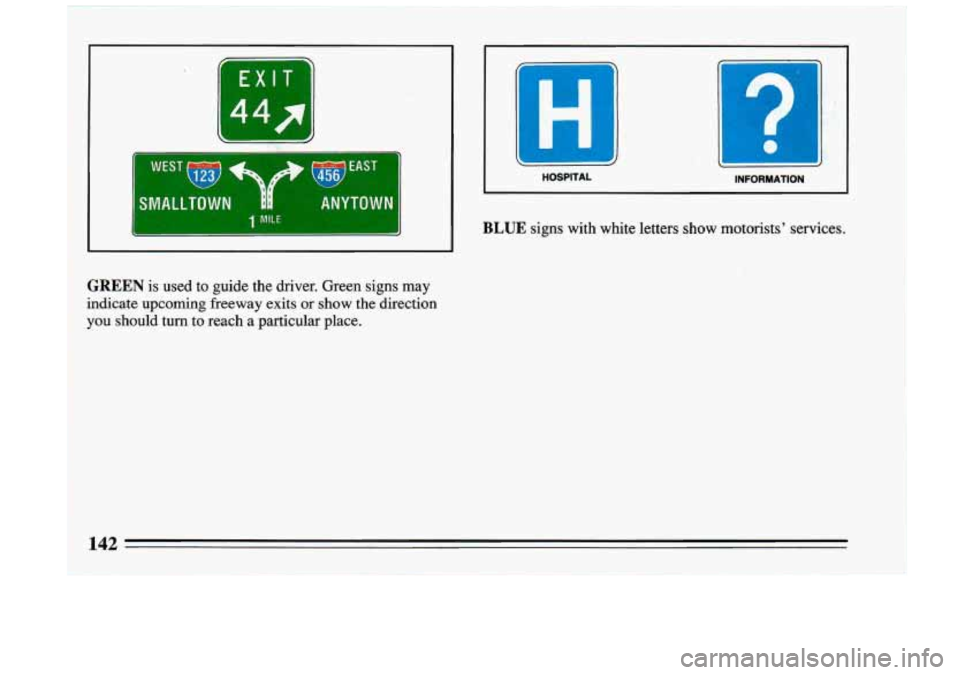
BLUE signs with white letters show motorists' services.
I GREEN is used to guide the driver. Green signs may
indicate
upcoming freeway exits or show the direction
you should turn to reach a particular place.
I
142
Page 158 of 324
I A CAUTION:
Anti-lock doesn’t change the time you need to
get your foot up
to the brake pedal. If you get
too close to the vehicle in front of you, you
won’t have time to apply your brakes
if that
vehicle suddenly slows or stops. Always leave
enough room up ahead to stop, even though
you have anti-lock brakes.
. 5 ’,.
To Use Anti-Lock:
Don’t pump the brakes. Just hold the brake pedal down
and let anti-lock work for you. You may hear the
anti-lock pump or motor operate, and feel the brake
pedal pulsate, but this is normal.
.
Disc Brake Wear Indicators
Your Buick has four-wheel disc brakes.
Disc brake pads have built-in wear indicators that make a
high-pitched warning sound when the brake pads are worn and new pads are needed. The sound may come and
go or
be heard all the time your vehicle is moving (except
when you are pushing on the brake pedal firmly).
I ‘
A CAUTION:
The brake wear warning sound means that
sooner or later your brakes won’t work well.
That could lead to an accident. When you hear
the brake wear warning sound, have your
:~
vehicle serviced. &tz
some driving conditions or climates may cause a brake
squeal when the brakes are first applied or lightly
applied.
This does not mean something is wrong with
your brakes.
Brake linings should always be replaced as complete
axle sets.
156
Page 165 of 324
by alcohol or drugs, with night vision problems, or by
fatigue.
Here are some tips on night driving.
0
0
0
0
0
0
0
Drive defensively. Remember, this is the most
dangerous time.
Don’t drink and drive. (See “Drunken Driving” in
the Index for more on this problem.)
Adjust your inside rearview mirror to reduce the
glare
from headlights behind you.
Since you can’t see as well, you may need to slow
down and keep more space between you and other
vehicles. It’s hard to tell how fast the vehicle ahead
is going just by looking at its tail’lights.
Slow’’ down, especially on higher speed roads. Your
headlights can light up only
so much road ahead.
In remote areas, watch for’animals.
If you’re tired, pull off the road in a safe place and
rest.
Night Vision
No one can see as well at night as in the daytime. But as
we get older these differences increase. A 50-year-old
driver may require at least twice as much light to see the
same thing at night as a 20-year-old. What you
do in the daytime can also affect your night
I
vision. For example, if you spend the day in bright
sunshine you are wise to wear sunglasses. Your eyes will
have less trouble adjusting to night.
But if you’re driving, don’t wear sunglasses at night.
They may cut down on glare from headlights, but they
also make a lot of things invisible that should remain
visible
- such as parked cars, obstacles, pedestrians, or
even trains blocking railway crossings. You may want to
put on your sunglasses after you have pulled into a
brightly-lighted service or refreshment area. Eyes
shielded from that glare may adjust more quickly to
darkness back on the road. But be sure to remove your
sunglasses before you leave the service area.
You can be temporarily blinded by approaching lights. It
can take a second or two, or even several seconds, for
your eyes
to readjust to the dark. When you are faced
with severe glare (as from a driver who doesn’t lower
the hi.gh beams, or a vehicle with misaimed headlights),
slow down a little. Avoid staring directly into the
approaching lights.
If there is a line of opposing traffic,
make occasional glances over the line of headlights to
make certain that one of the vehicles isn’t starting to
move into your lane. Once you are past the bright lights,
give
your eyes time to readjust before resuming speed.
163 ,
Page 174 of 324
~ Before Leaving on a
Long Trip 0 Weather Forecasts: What’s the weather outlook along
your route? Should
you delay your trip a short time
Make sure you’re ready. Try to be well rested. If you to avoid a major storm system?
must start when you’re not fresh
-- such as after a day’s
work
-- don’t plan to make too many miles that first part 0 Maps: Do you have up-to-date maps?
I
of the journey. Wear comfortable clothing and shoes you
can easily drive in. On the Road
Is your vehicle ready for a long trip? If you keep it
serviced and maintained, it’s ready to go. If it needs
service, have it done before starting out. Of course,
you’ll find experienced and able service experts in
Buick dealerships all across North America. They’ll be
ready and willing to help if
you need it.
Here are
some things you can check before a trip:
0 Windshield Washer Fluid: Is the reservoir full? Are
all windows clean inside and outside?
0 Wiper Blades: Are they in good shape!
0 Fuel, Engine Oil, Other Fluids: Have you checked all
levels?
0 Lights: Are they all working? Are the lenses clean?
0 Tires: They are vitally important to a safe,
trouble-free trip.
Is the tread good enough for
long-distance driving?
Are the tires all inflated to the
recommended pressure? Unless you
are the only driver, it is good to share
the
driving task with others. Limit turns behind the wheel to
about
100 miles (160 km) or two hours at a sitting.
Then, either change drivers or stop for some refreshment
like coffee, tea or soft drinks and some limbering up. But do stop and move around. Eat lightly along the way.
Heavier meals tend to make some people sleepy.
On two-lane highways or undivided multilane highways
that do not have controlled access, you’ll want to watch for some situations not usually found on freeways.
Examples are: stop signs and signals, shopping centers with direct access to the highway, no passing zones and school zones, vehicles turning left and right off the road,
pedestrians, cyclists, parked vehicles. td even animals.
Highway Hypnosis
Is there actually such a condition as “highway
hypnosis”?
Or is it just plain falling asleep at the wheel?
Call
it highway hypnosis, lack of awareness, or
whatever.
172
Page 175 of 324
There is something about an easy stretch of road with
the same scenery, along with the hum of the tires on the
road, the drone of the engine, and the
rush of the wind
against the vehicle that can make you sleepy. Don't let it
happen to you! If it does, your vehicle can leave the
road in less than a second. and you could crash and be
injured.
What can you do about highway hypnosis? First, be
aware that
it can happen.
Then here are some tips:
0 Make sure your vehicle is well ventilated, with a
comfortably cool interior.
0 Keep your eyes moving. Scan the road ahead and to
the sides. Check your rearview mirrors frequently
and your instruments from time to time. This can
help you avoid a fixed stare.'
Wear good sunglasses in bright light. Glare can
cause drowsiness. But don't wear sunglasses at
night. They will drastically reduce your overall vision at the very time you need all the seeing power
you have.
If you get sleepy, pull off the road into a rest, service,
or parking area and take a nap, get some exercise, or
both. For safety, treat drowsiness on the highway as
an emergency.
As in any driving situation, keep pace with traffic and
allow adequate following distances.
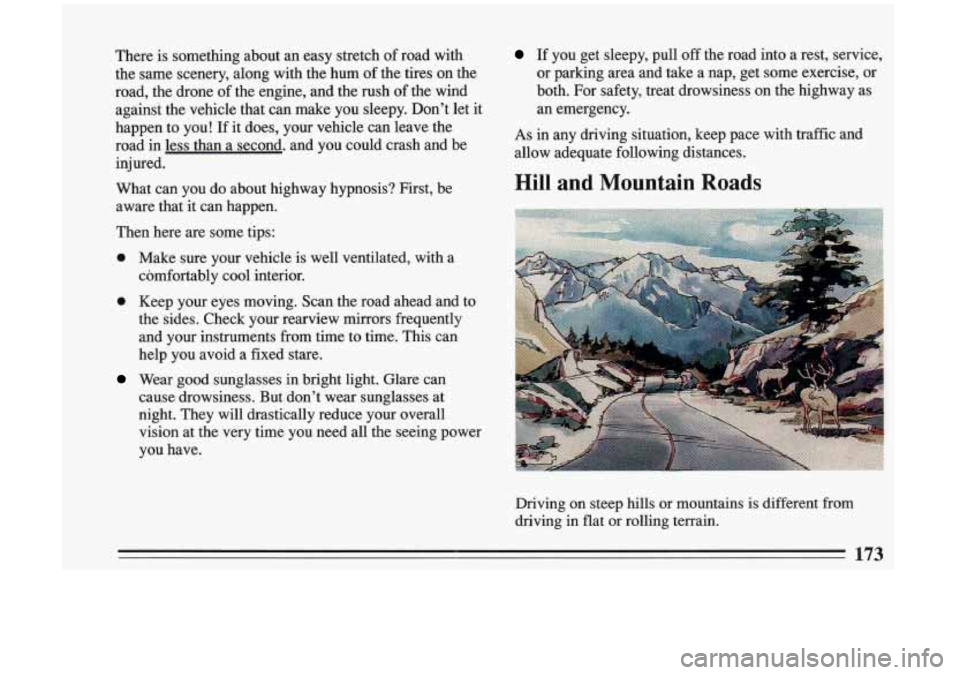
Hill and Mountain Roads
Driving on steep hills or mountains is different from
driving in flat or rolling terrain.
'I
173
Page 192 of 324
I ‘I
I 1
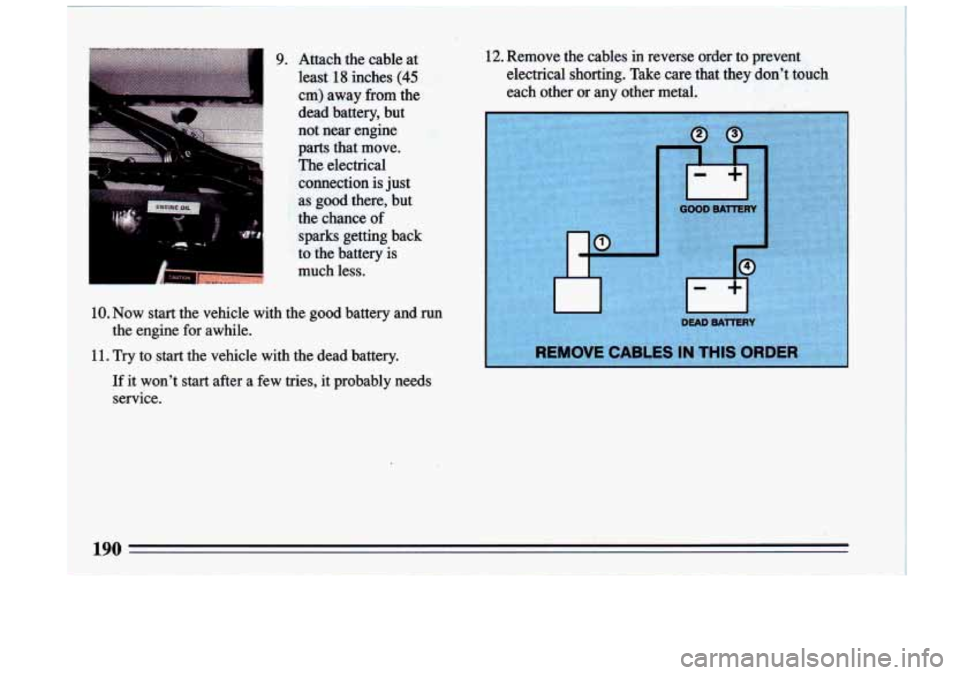
9. Attach the cable at least
18 inches (45
cm) away from the
dead battery, but
not near engine
parts that move.
The electrical
.connection is just
as good there,, but
‘the. chance of
sparks. getting back
to the battery is
much less.
.. 10. Now start the vehicle with the good battery and run
11. Try to start the vehicle with the dead battery.
the engine for awhile.
If it won’t
start after
a few tries, it probably needs
service.
12. Remove the cables in reverse order to prevent
electrical shorting. Take care that they don’t touch
each other or any other metal.
Page 193 of 324
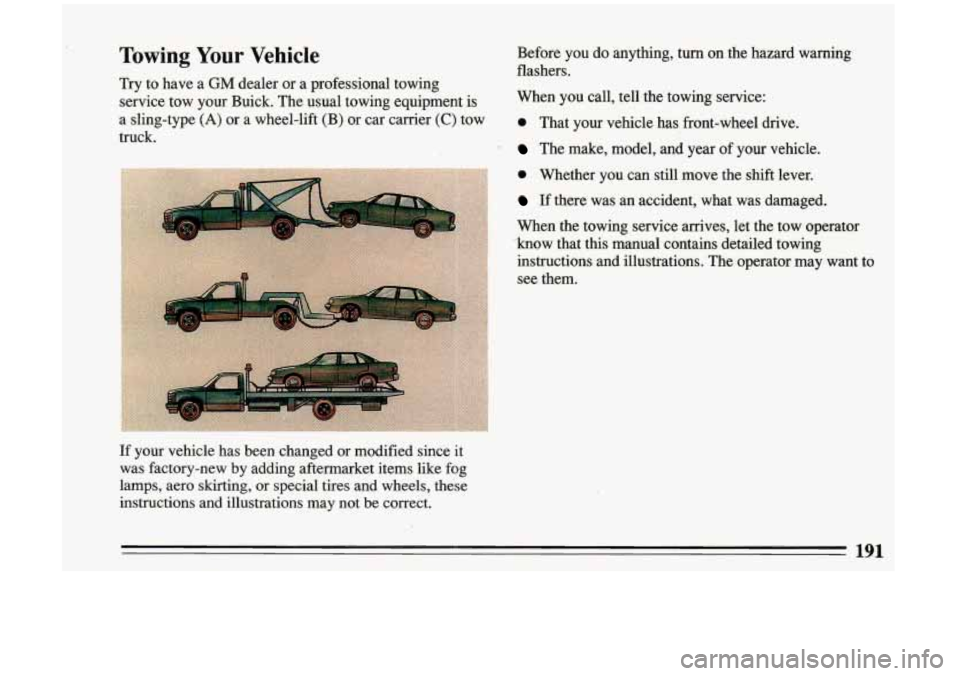
Towing Your Vehicle Before you do anything, turn on the hazard warning
flashers.
Try to have a
GM dealer or a professional towing
service tow your Buick. The usual towing equipment is When you call, tell the towing service:
a sling-type
(A) Or a wheel-lift (B) Or Car carrier (c) tow 0 That your vehicle has front-wheel drive.
truck.
. The make, model, and year of your vehicle.
If your ‘vehicle has been changed or modified since it
was factory-new by adding aftermarket items like fog
lamps, aero skirting,
or special tires and wheels, these
instructions and illustrations may not be correct.
0 Whether you can still move the shift lever.
If there was an accident, what was damaged.
When the towing service arrives, let the tow operator
-know that this manual contains detailed towing instructions and illustrations. The operator may want to
see them.
191
Page 194 of 324
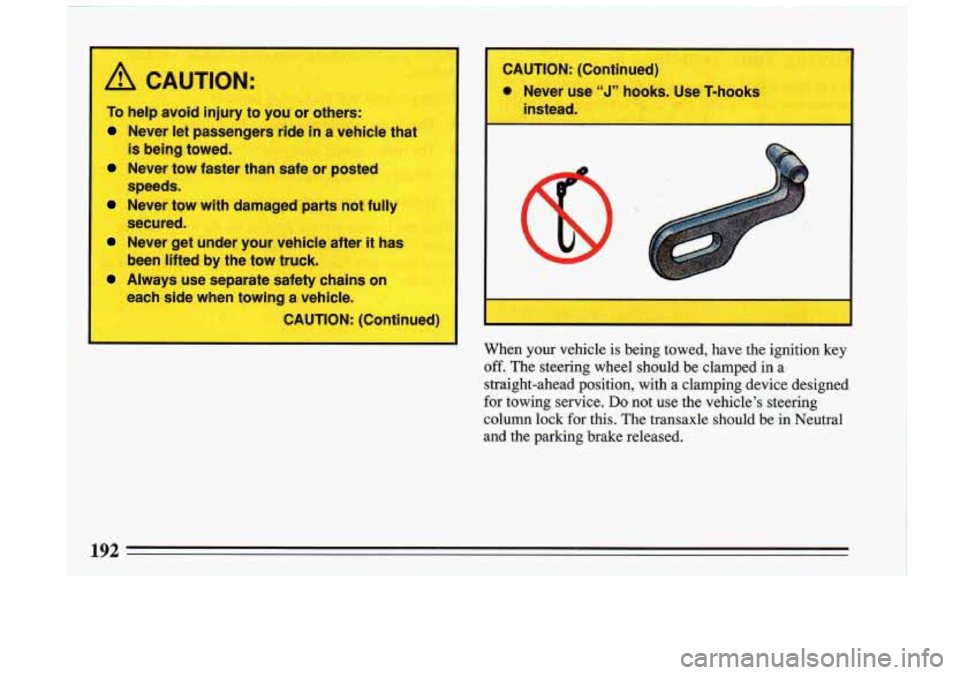
/! CA TlON:
To help-avok rjury to you or others:
Never let passengers ride in a vehicle that I
Never tow fastt than safe or postec
Never tow ith damaged parts not fully
Never get under your vehicle after it has
Always use separate safety chains on
is being towed.
speec
secured.
been lifted by the tow truck.
each.side when towing a vehicle.
CAUTION: (Continued)
CAUTION: (Continued)
0 Never use “J” hooks. Use T-hooks
instead.
When your vehicle is being towed, have the ignition key off. The steering wheel should be clamped in a.
straight-ahead position, with a clamping device designed
for towing service.
Do not use the vehicle’s steering
column lock for this. The transaxle should be in Neutral
and the parking brake released.
192