battery CADILLAC CT5 2023 Owner's Manual
[x] Cancel search | Manufacturer: CADILLAC, Model Year: 2023, Model line: CT5, Model: CADILLAC CT5 2023Pages: 526, PDF Size: 6.85 MB
Page 161 of 526
Cadillac CT5 Owner Manual (GMNA-Localizing-U.S./Canada-16500419) -
2023 - CRC - 5/6/22
160 Lighting
Battery Power
Protection
This feature helps prevent the
battery from being drained,
if the interior courtesy lamps
or reading lamps are
accidentally left on. If any of
these lamps are left on, they
automatically turn off after
10 minutes, if the ignition is off.
The lamps will not come back
on again until one of the
following occurs:
.The ignition is turned on.
.The doors are closed and
then re-opened.
Exterior Lighting
Battery Saver
The exterior lamps turn off
about 10 minutes after the
vehicle is turned off, if the
parking lamps or headlamps
have been manually left on.
This protects against draining
the battery. To restart the
10-minute timer, turn theexterior lamp control to the
O
position and then back to the
;or2position.
To keep the lamps on for more
than 10 minutes, the vehicle
must be on or in
accessory mode.
Page 193 of 526
Cadillac CT5 Owner Manual (GMNA-Localizing-U.S./Canada-16500419) -
2023 - CRC - 5/6/22
192 Infotainment System
.The 12-volt battery has been
disconnected for
several days.
.The vehicle is driving in
heavy traffic where driving is
at low speeds, and the
vehicle is stopped and
started repeatedly.
Problems with Route
Guidance
Inappropriate route guidance
can occur under one or more
of the following conditions:
.The turn was not made on
the road indicated.
.Route guidance might not be
available when using
automatic rerouting for the
next right or left turn.
.The route might not be
changed when using
automatic rerouting.
.There is no route guidance
when turning at an
intersection.
.Plural names of places might
be announced occasionally.
.It could take a long time to
operate automatic rerouting
during high-speed driving.
.Automatic rerouting might
display a route returning to
the set waypoint if heading
for a destination without
passing through a set
waypoint.
.The route prohibits the
entry of a vehicle due to a
regulation by time or season
or any other regulation
which may be given.
.Some routes might not be
searched.
.The route to the destination
might not be shown if there
are new roads, if roads have
recently changed, or if
certain roads are not listed
in the map data. See Maps
0182.
To recalibrate the vehicle's
position on the map, park with
the vehicle running for two to
five minutes, until the vehicle
position updates. Make sure
the vehicle is parked in a location that is safe and has a
clear view of the sky and away
from large obstructions.
If the System Needs
Service
If the navigation system needs
service, see your dealer.
Map Data Updates
The map data in the vehicle is
the most up-to-date
information available when the
vehicle was produced. The
map data is updated
periodically, provided that the
map information has changed
and the vehicle has a relevant
service plan.
See www.gmnavdisc.com for
details on ordering,
purchasing, and installing a
new or replacement SD card.
Features are subject to
change. For more information
on this feature, visit your
brand website. See Online
Account
0488 for details.
Page 249 of 526
Cadillac CT5 Owner Manual (GMNA-Localizing-U.S./Canada-16500419) -
2023 - CRC - 5/10/22
248 Driving and Operating
Caution
During a first time track or
racing event, high axle
temperatures can occur.
Damage could be caused to
the axle and would not be
covered by the vehicle
warranty. Do not drive as
long or as fast the first time
the vehicle is driven on the
track or raced.
.The axle lubricant should be
replaced with new lubricant.
.On vehicles without a
differential cooler, additional
cooling capacity is required
for continuous competitive
driving. The V-Series
Blackwing has a differential
cooler, so no additional
cooling capacity is
necessary.
Engine OilCaution
If the vehicle is used for
track events and
competitive driving, the
engine may use more oil
than it would with normal
use. Low oil levels can
damage the engine. Check
the oil level often and
maintain the proper level.
See Engine Oil 0383.
Check the oil level often during
track events and competitive
driving, and keep the oil level
at or near the upper mark. See
“Checking the Engine Oil" in
Engine Oil 0383.
Fuel
Use premium unleaded
gasoline with a posted octane
rating of 93 at a track event.
Unleaded gasoline with a
posted octane rating of 91 may be used, but
performance will be degraded.
See Prohibited Fuels
0361.
Automatic or Manual
Transmission Fluid
Have the transmission fluid
set to the track specific oil
level prior to track usage.
Transmission fluid should be
changed after every 15 hours
of track usage. Any
transmission level set or
change should be performed
at the dealer.
Brakes
Battery Disconnect
Disconnect the battery before
servicing the hydraulic brake
system. It is critical to
disconnect the battery before
bleeding the system, replacing
the pads, or any other work.
The battery must be
disconnected to prevent the
brake master cylinder from
pressurizing the hydraulic
system during its automated
Page 250 of 526
Cadillac CT5 Owner Manual (GMNA-Localizing-U.S./Canada-16500419) -
2023 - CRC - 5/10/22
Driving and Operating 249
self diagnostic tests that may
occur when a door is opened
or the remote key is present.
{Warning
To avoid personal injury and/
or vehicle damage, always
disconnect the battery
before performing service
work on the hydraulic brake
system. Bleeding the brake
system with the battery
connected can lead to
excessive pressurization of
the system during automatic
diagnostic tests or diagnosis
of a leak or air in the braking
system. A Diagnostic
Trouble Code (DTC) may set
and vehicle speed may be
limited.Brake Cooling (V-Series
Blackwing)
Prior to any track event, high
speed driving event,
or competitive driving,
complete the following:
1. Ensure all the brake cooling parts are correctly
secured and installed.
2. Inspect and replace any deflectors that have
damage.
3. Inspect for blockage in the front brake cooling duct
prior to every event.
4. Remove front tire deflector (if equipped).
If improved brake cooling is
desired on vehicles with
cast-iron brakes (RPO JGH),
install the ball joint protector
front shields, remove both
upper and lower rear rotor
shields, and install the rear
lower control arm cooling
deflectors, per the
instructions included with the
brake cooling kit. These parts are for track use only. After
track events, reinstall the
original front and rear rotor
shields and remove the rear
lower control arm cooling
deflectors.
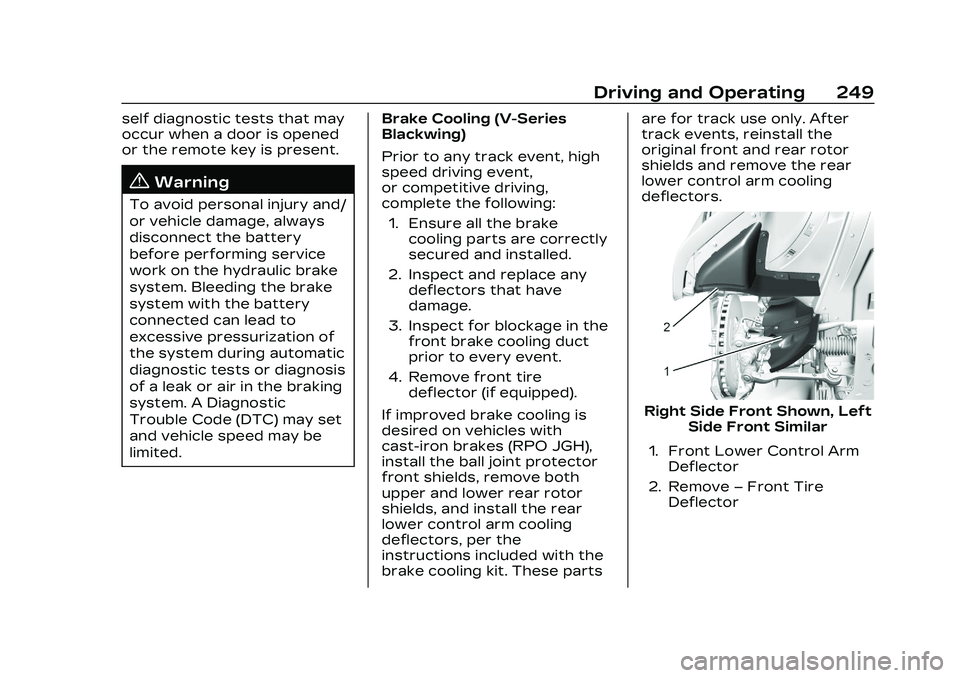
Right Side Front Shown, Left
Side Front Similar
1. Front Lower Control Arm Deflector
2. Remove –Front Tire
Deflector
Page 251 of 526

Cadillac CT5 Owner Manual (GMNA-Localizing-U.S./Canada-16500419) -
2023 - CRC - 5/10/22
250 Driving and Operating
3. Front Brake Cooling Duct
Brake Pad Wear Sensors
If equipped, the brake pad
wear sensors need to be
removed from the brake
calipers prior to any track or
racing event. The original
sensors can be reinstalled if
significant brake pad wear is
not observed. Refer to Brake
Pad Life System (If Equipped)
0 403. If the sensors are not
reinstalled after the track
event, install brake pad wear
sensor plugs. See your dealer. The V-Series Blackwing is
equipped with brake pad wear
sensors which are track
capable and should not be
disabled for track and racing.
A message will display in the
Driver Information Center
(DIC) when the brake pads
show excessive wear.
Brake Fluid
Replace existing brake fluid
with a qualified DOT 4 high
performance brake fluid from
a sealed container. Brake fluid
with a dry boiling point >310 °C
(590 °F) is qualified. If high
performance brake fluid is
used, replace it with GM
approved brake fluid before
driving on public roads. If high
performance brake fluid is in
the vehicle and the age of the
brake fluid is over a month old
or unknown, replace the brake
fluid before track events and
competitive driving. Do not use
silicone or DOT 5 brake fluids.
It is critical to disconnect the
battery before bleeding the
system, replacing the pads,
or any other work. The battery
must be disconnected to
prevent the brake master
cylinder from pressurizing the
hydraulic system during its
automated self diagnostic
tests that can possibly occur
when a door is opened or the
remote key is present.
Check the fluid level before
each competitive driving
event.
Brake System Flushing &
Bleeding
The J56 brake system
requires specific processes
for bleeding and fluid flushing.
These can be found in the
service manual.
Properly bleeding the brake
system is required for proper
operation of the hydraulic
brake system.
Page 252 of 526

Cadillac CT5 Owner Manual (GMNA-Localizing-U.S./Canada-16500419) -
2023 - CRC - 5/10/22
Driving and Operating 251
Brake Leak Detection
The hydraulic braking system
has advanced diagnostic
capability to help detect
hydraulic leaks, trapped air,
and other performance issues.
These diagnostics are active
when the hydraulic system is
powered. In order to avoid
inadvertently setting a leak
Diagnostic Trouble Code
(DTC), disconnect the battery
before servicing the brake
system.
If the vehicle sets a DTC
related to a brake system leak,
the Brake System Warning
Light will come on and vehicle
speed may be limited to 100
kph (62 mph). Any time a leak
DTC is set, the vehicle should
be inspected carefully for
evidence of a leak and should
be repaired immediately. See
your dealer.Brake Fade Warning Assist
The Brake Fade Warning
Assist system monitors the
performance of the brake
system. If the system detects
brake fade, or if the brake fluid
is near the boiling point, the
driver will be alerted.
The Brake Fade Warning
Assist system is designed for
use with the factory-installed
brake pads or GM approved
replacement pads. If the brake
pads on the vehicle need to be
replaced, use GM approved
brake pads. If this is not done,
the brake fade warning
system may not function
properly.
Stage 1 :
The DIC displays a
“Reduce Braking to Avoid
Overheating” message, a
chime sounds and brake pedal
effort and travel is increased.
When the message displays,
the driver should back up
braking points and reduce
brake usage in order to reduce brake temperature. This will
allow for continued lapping
with no speed limitations.
Stage 2 :
The DIC displays a
Brakes Overheated Service
Now message, a chime
sounds, and brake pedal effort
and travel is further increased.
This code indicates that the
brake fluid temperature is
excessive and is about to boil.
The system limits vehicle
speed to 100 km/h (62 mph).
The driver should immediately
start a cool down lap if on the
track. If this message displays,
the vehicle needs to be
serviced. The brake system
needs to cool down, and the
brake fluid must be
immediately flushed with DOT
4 for street use, or to a
qualified DOT 4 race fluid for
track use. Boiled brake fluid is
compromised and must be
replaced.
Page 262 of 526

Cadillac CT5 Owner Manual (GMNA-Localizing-U.S./Canada-16500419) -
2023 - CRC - 5/10/22
Driving and Operating 261
To save fuel, run the engine
for short periods to warm the
vehicle and then shut the
engine off and partially close
the window. Moving about to
keep warm also helps.
If it takes time for help to
arrive, when running the
engine, push the accelerator
pedal slightly so the engine
runs faster than the idle
speed. This keeps the battery
charged to restart the vehicle
and to signal for help with the
headlamps. Do this as little as
possible, to save fuel.
If the Vehicle Is Stuck
Slowly and cautiously spin the
wheels to free the vehicle
when stuck in sand, mud, ice,
or snow.
The Traction Control System
(TCS) can often help to free a
stuck vehicle. See Traction
Control/Electronic Stability
Control0291. If TCS cannot free the vehicle,
turn TCS off and use the
rocking method. See
“Rocking
the Vehicle to Get it Out”
following.
{Warning
If the vehicle's tires spin at
high speed, they can
explode, and you or others
could be injured. The vehicle
can overheat, causing an
engine compartment fire or
other damage. Spin the
wheels as little as possible
and avoid going above
56 km/h (35 mph).
Rocking the Vehicle to Get
it Out
Turn the steering wheel left
and right to clear the area
around the front wheels. Turn
off any traction system. Shift
back and forth between
R (Reverse) and a low forward
gear, spinning the wheels as
little as possible. To prevent
transmission wear, wait until the wheels stop spinning
before shifting gears. Release
the accelerator pedal while
shifting, and press lightly on
the accelerator pedal when
the transmission is in gear.
Slowly spinning the wheels in
the forward and reverse
directions causes a rocking
motion that could free the
vehicle. If that does not get
the vehicle out after a few
tries, it might need to be
towed out. If the vehicle does
need to be towed out, see
Transporting a Disabled
Vehicle
0455.
Vehicle Load Limits
It is very important to know
how much weight the
vehicle can carry. This
weight is called the vehicle
capacity weight and
includes the weight of all
occupants, cargo, and all
nonfactory-installed
options. Two labels on the
vehicle may show how
Page 267 of 526

Cadillac CT5 Owner Manual (GMNA-Localizing-U.S./Canada-16500419) -
2023 - CRC - 5/10/22
266 Driving and Operating
Caution (Continued)
.Check engine oil with
every refueling and add if
necessary. Oil and fuel
consumption may be
higher than normal during
the first
2 414 km (1,500 mi).
.To break in new tires,
drive at moderate speeds
and avoid hard cornering
for the first
322 km (200 mi). New tires
do not have maximum
traction and may tend
to slip.
.New brake linings also
need a break-in period.
Avoid making hard stops
during the first
322 km (200 mi). This is
recommended every time
brake linings are replaced.
.Should the vehicle be used
for racing or competitive
driving (after break-in), the
rear axle lubricant must be
replaced beforehand.See Track Events and
Competitive Driving (V-Series
and V-Series Blackwing)
0246.
On new vehicles, the various
mechanical and electrical
systems experience a
“break-in” period during the
first 6,400 km (4,000 miles) of
routine driving. As the vehicle
is driven, the mechanical
systems adjust to provide
optimal fuel economy and
transmission shift
performance.
Electrical systems will adapt
and calibrate during the
break-in period. A one-time
occurrence of clicks and
similar vehicle noises is normal
during this process.
Normal driving charges the
vehicle’s battery to achieve
the best operation of the
vehicle, including fuel
economy.
Composite Materials
This vehicle may be equipped
with parts containing carbon
fiber, sheet-molding
compound, or other composite
materials. Dealer-installed
accessories may also contain
composite materials.
{Warning
Exposed edges of parts
containing carbon fiber and
other composite materials
can be sharp. Contact with
these parts could result in
injury. Use caution to avoid
contacting these parts,
including when washing the
vehicle. If the parts are
damaged, replace the parts
promptly with replacements
from your dealer.
Page 269 of 526

Cadillac CT5 Owner Manual (GMNA-Localizing-U.S./Canada-16500419) -
2023 - CRC - 5/10/22
268 Driving and Operating
The vehicle may have an
electric steering column lock.
The lock is activated when the
vehicle is switched to OFF and
the driver door is opened.
A sound may be heard as the
lock actuates or releases. The
steering column lock may not
release with the wheels
turned off center. If this
happens, the vehicle may not
start. Move the steering wheel
from left to right while
attempting to start the
vehicle. If this does not work,
the vehicle needs service.
Do not turn the engine off
when the vehicle is moving.
This will cause a loss of power
assist in the brake and
steering systems and disable
the airbags.
If the vehicle must be shut off
in an emergency:1. Brake using a firm and steady pressure. Do not
pump the brakes
repeatedly. This may deplete power assist,
requiring increased brake
pedal force.
2. Shift the vehicle to N (Neutral). This can be
done while the vehicle is
moving. After shifting to
N (Neutral), firmly apply the
brakes and steer the
vehicle to a safe location.
3. Come to a complete stop. Shift to P (Park) with an
automatic transmission,
or Neutral with a manual
transmission. Turn the
ignition off.
4. Set the parking brake. See Electric Parking Brake
0288.
{Warning
Turning off the vehicle while
moving may cause loss of
power assist in the brake
and steering systems and
disable the airbags. While
driving, only shut the vehicle
off in an emergency. If the vehicle cannot be pulled
over, and must be shut off
while driving, press and hold
ENGINE START/STOP for
longer than two seconds,
or press twice within
five seconds.
Accessory Mode (Amber
Indicator Light) :
This mode
allows the use of some
electrical accessories when
the engine is off.
With the ignition off, pressing
the button once without the
brake pedal applied will place
the ignition system in
accessory mode.
The ignition will switch from
accessory mode to OFF after
five minutes to prevent
battery rundown.
ON/RUN/START (Green
Indicator Light) : This mode is
for driving and starting. With
the ignition off, and the brake
pedal applied, pressing the
button once will place the
ignition system in ON/RUN/
START. Once engine cranking
Page 271 of 526

Cadillac CT5 Owner Manual (GMNA-Localizing-U.S./Canada-16500419) -
2023 - CRC - 5/10/22
270 Driving and Operating
If the remote key is not in
the vehicle, if there is
interference, or if the
remote key battery is low,
a Driver Information
Center (DIC) message will
display. See Remote Key
Operation09.
Caution
Cranking the engine for long
periods of time, by pressing
ENGINE START/STOP
immediately after cranking
has ended, can overheat and
damage the cranking motor,
and drain the battery. Wait
at least 15 seconds between
each try, to let the cranking
motor cool down.
2. If the engine does not start after five to 10 seconds,
especially in very cold
weather (below −18 °C or
0 °F), it could be flooded
with too much gasoline.
Try pushing the
accelerator pedal all the
way to the floor and hold it there, then press ENGINE
START/STOP for up to a
maximum of 15 seconds.
Wait at least 15 seconds
between each try, to allow
the cranking motor to cool
down. When the engine
starts, let go of the button
and the accelerator. If the
vehicle starts briefly but
then stops again, do the
same thing. This clears the
extra gasoline from the
engine. Do not race the
engine immediately after
starting it. Operate the
engine and transmission
gently until the oil warms
up and lubricates all
moving parts.
Stopping the Engine
If the vehicle has an automatic
transmission, move the shift
lever to P (Park) and press and
hold ENGINE START/STOP on
the instrument panel, until the
engine shuts off. If the shift
lever is not in P (Park), the
engine shuts off and the
ignition goes to accessory
mode. The DIC displays SHIFT
TO PARK. Once the shift lever
is moved to P (Park), the
vehicle turns off.
If the vehicle has a manual
transmission, before getting
out of the vehicle, shift to
1 (First) or R (Reverse) and
apply the parking brake. Then
turn off the ignition off by
pressing ENGINE START/
STOP and release the clutch
pedal when the engine has
stopped.
If the remote key is not
detected inside the vehicle
when it is turned off the DIC
displays a message.
Stop/Start System
If equipped, the Stop/Start
system will shut off the engine
to help conserve fuel. It has
components designed for the
increased number of starts.