brake CADILLAC CT5 2023 Repair Manual
[x] Cancel search | Manufacturer: CADILLAC, Model Year: 2023, Model line: CT5, Model: CADILLAC CT5 2023Pages: 526, PDF Size: 6.85 MB
Page 291 of 526

Cadillac CT5 Owner Manual (GMNA-Localizing-U.S./Canada-16500419) -
2023 - CRC - 5/10/22
290 Driving and Operating
Warning (Continued)
use proper care when
driving may result in injury,
death, or vehicle damage.
See Defensive Driving0242.
When the vehicle is stopped
on a grade, Hill Start Assist
(HSA) temporarily prevents
the vehicle from rolling in an
unintended direction during
the transition from brake
pedal release to accelerator
pedal apply. The brakes
release when the accelerator
pedal is applied or
automatically release after a
few seconds. The brakes may
also release under other
conditions. Do not rely on HSA
to hold the vehicle.
HSA is available when the
vehicle is facing uphill in a
forward gear, or when facing
downhill in R (Reverse). The
vehicle must come to a
complete stop on a grade for
HSA to activate.
Automatic Vehicle
Hold (AVH)
{Warning
Do not rely on this feature.
It does not replace the need
to pay attention and drive
safely. You may not hear or
feel alerts or warnings
provided by this system.
Failure to use proper care
when driving may result in
injury, death, or vehicle
damage. When Automatic Vehicle Hold
(AVH) is turned on and the
vehicle is braked to a stop,
AVH prevents the vehicle from
moving during the transition
from brake pedal release to
accelerator pedal apply. The
brakes release when the
accelerator pedal is applied.
The brakes may also release
under other conditions. Do not
rely on AVH to hold the
vehicle.
If the accelerator pedal is not
applied within a few minutes,
the Electric Parking Brake will
apply. The parking brake will
also apply if the driver door is
opened or the driver seat belt
is unfastened while AVH is
holding the vehicle.
AVH can be turned on by
pressing AUTO HOLD. The
indicator light on the switch
will come on. The AVH light on
the instrument panel will come
on while AVH is actively
Page 292 of 526
Cadillac CT5 Owner Manual (GMNA-Localizing-U.S./Canada-16500419) -
2023 - CRC - 5/10/22
Driving and Operating 291
holding the vehicle. See
Automatic Vehicle Hold (AVH)
Light0129.
Ride Control
Systems
Traction Control/
Electronic Stability
Control
The vehicle has a Traction
Control System (TCS) and
StabiliTrak/Electronic Stability
Control (ESC). These systems
help limit wheel slip and assist
the driver in maintaining
control, especially on slippery
road conditions.
TCS activates if it senses that
any of the drive wheels are
spinning or beginning to lose
traction. When this happens,
the system brakes the
spinning wheel(s) and/or
reduces engine power to limit
wheel spin. StabiliTrak/ESC activates
when the computer senses a
difference between the
intended path and the
direction the vehicle is actually
traveling. StabiliTrak/ESC
selectively applies braking
pressure at any one of the
vehicle's brakes to help steer
the vehicle in the intended
direction.
If cruise control is being used
and TCS or StabiliTrak/ESC
begins to limit wheel spin,
cruise control will disengage.
Cruise control may be turned
back on when road conditions
allow.
Both systems come on
automatically when the vehicle
is started and begins to move.
The systems may be heard or
felt while they are operating
or while performing diagnostic
checks. This is normal and
does not mean there is a
problem with the vehicle.
It is recommended to leave
both systems on for normal
driving conditions, but it may
be necessary to turn TCS off
if the vehicle gets stuck in
sand, mud, ice, or snow. See If
the Vehicle Is Stuck
0261 and
“Turning the Systems Off and
On” later in this section.
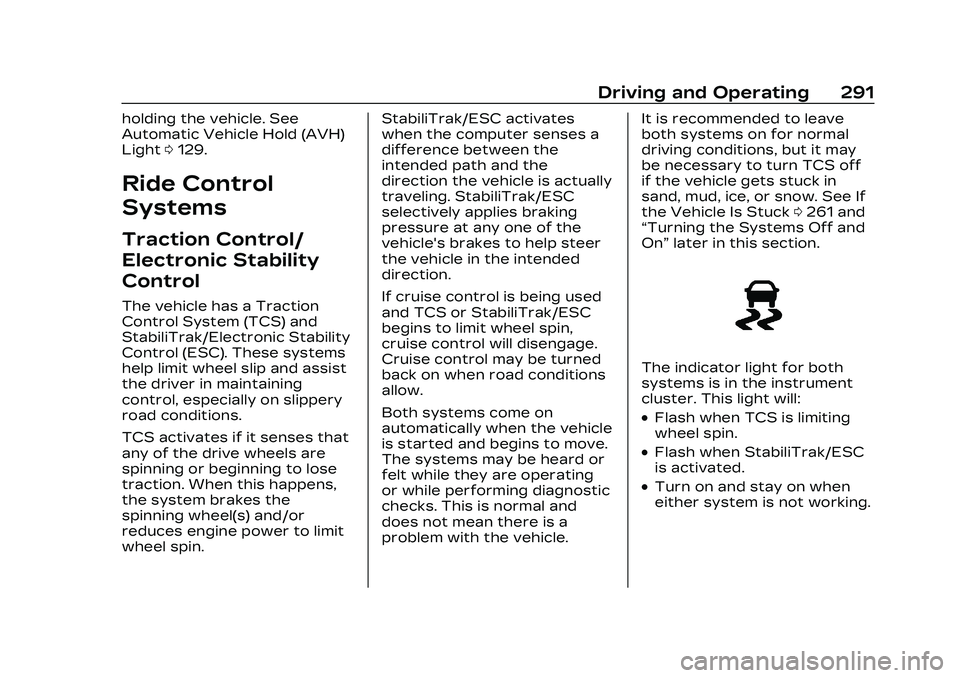
The indicator light for both
systems is in the instrument
cluster. This light will:
.Flash when TCS is limiting
wheel spin.
.Flash when StabiliTrak/ESC
is activated.
.Turn on and stay on when
either system is not working.
Page 293 of 526

Cadillac CT5 Owner Manual (GMNA-Localizing-U.S./Canada-16500419) -
2023 - CRC - 5/10/22
292 Driving and Operating
If either system fails to turn on
or to activate, a message may
display in the Driver
Information Center (DIC), and
dcomes on and stays on to
indicate that the system is
inactive and is not assisting
the driver in maintaining
control. The vehicle is safe to
drive, but driving should be
adjusted accordingly.
If
dcomes on and stays on:
1. Stop the vehicle.
2. Turn the engine off and wait 15 seconds.
3. Start the engine.
Drive the vehicle. if
dcomes
on and stays on, the vehicle
may need more time to
diagnose the problem. If the
condition persists, see your
dealer.
Turning the Systems Off
and On
Caution
Do not repeatedly brake or
accelerate heavily when TCS
is off. The vehicle driveline
could be damaged.
To turn off only TCS, press
and release
g. The traction off
light
idisplays in the
instrument cluster. A DIC
message may display. To turn TCS on again, press
and release
g. The traction off
light
idisplayed in the
instrument cluster will turn off.
If TCS is limiting wheel spin
when
gis pressed, the system
will not turn off until the
wheels stop spinning.
To turn off both TCS and
StabiliTrak/ESC, press and
hold
guntil the traction off
light
iand StabiliTrak/ESC
OFF light
gcome on and stay
on in the instrument cluster.
A DIC message may display.
To turn TCS and StabiliTrak/
ESC on again, press and
release
g. The traction off
light
iand StabiliTrak/ESC
OFF light
gin the instrument
cluster turn off.
Adding accessories can affect
the vehicle's performance. See
Accessories and Modifications
0 374.
Page 297 of 526
Cadillac CT5 Owner Manual (GMNA-Localizing-U.S./Canada-16500419) -
2023 - CRC - 5/10/22
296 Driving and Operating
Through the DIC, the following
vehicle systems may be
available for customization in
this mode.
.Steering: Tour (default),
Sport, Track
.Suspension: Tour (default),
Sport, Track
.Brake Feel: Tour (default),
Sport, Track
.Engine Sound: Stealth, Tour
(Default), Sport, Track
For information on the range
of settings, see “Drive Mode
Customization.” V-Mode (V-Series and
V-Series Blackwing)
V-Mode is used to personalize
dynamic driving. This mode is
designed to allow the driver to
configure vehicle subsystems
to their own preference for
maximum handling. V-Mode
further enhances the driver’s
experience by adding an
Engine/Shift customization
option. Through the DIC, the
following vehicle systems may
be available for customization
in this mode.
.Steering: Tour, Sport
(default), Track
.Suspension: Tour, Sport,
(default), Track
.Engine/Shift: Snow/Ice, Tour,
Sport, (default), Track
.Brake Feel: Tour, Sport,
Track
.Engine Sound: Stealth, Tour,
Sport (default), Track
.PTM: OFF, WET, DRY,
SPORT, RACE 1, RACE 2
For information on the range
of settings, see “Drive Mode
Customization.”
Page 298 of 526
Cadillac CT5 Owner Manual (GMNA-Localizing-U.S./Canada-16500419) -
2023 - CRC - 5/10/22
Driving and Operating 297
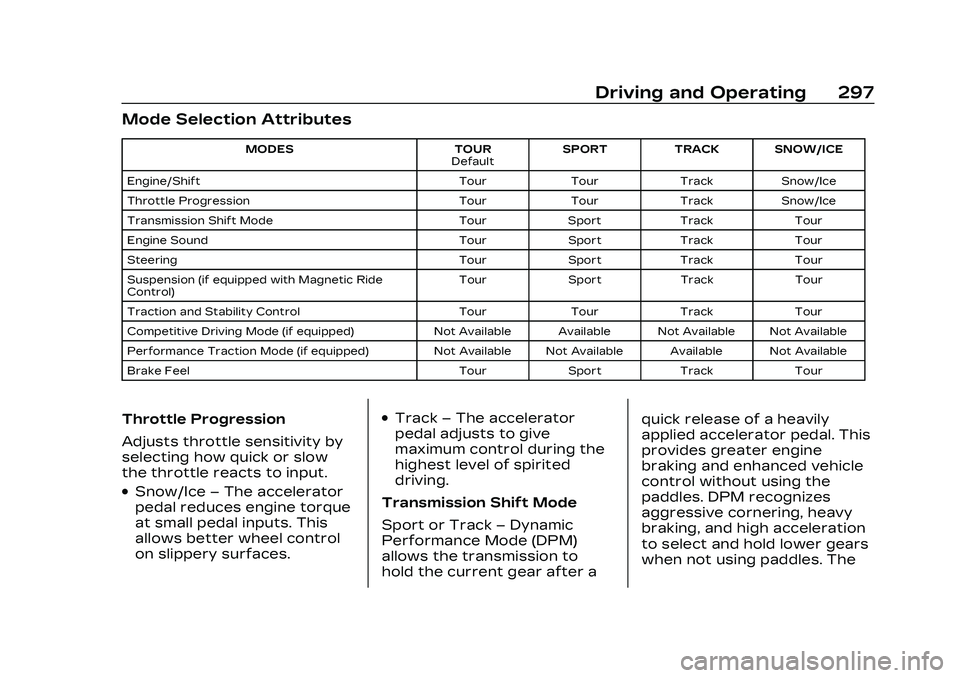
Mode Selection Attributes
MODESTOUR
Default SPORT
TRACK SNOW/ICE
Engine/Shift TourTourTrackSnow/Ice
Throttle Progression TourTourTrackSnow/Ice
Transmission Shift Mode TourSport Track Tour
Engine Sound TourSport Track Tour
Steering TourSport Track Tour
Suspension (if equipped with Magnetic Ride
Control) Tour
Sport Track Tour
Traction and Stability Control TourTourTrack Tour
Competitive Driving Mode (if equipped) Not Available Available Not Available Not Available
Performance Traction Mode (if equipped) Not Available Not Available Available Not Available
Brake Feel TourSport Track Tour
Throttle Progression
Adjusts throttle sensitivity by
selecting how quick or slow
the throttle reacts to input.
.Snow/Ice–The accelerator
pedal reduces engine torque
at small pedal inputs. This
allows better wheel control
on slippery surfaces.
.Track –The accelerator
pedal adjusts to give
maximum control during the
highest level of spirited
driving.
Transmission Shift Mode
Sport or Track –Dynamic
Performance Mode (DPM)
allows the transmission to
hold the current gear after a quick release of a heavily
applied accelerator pedal. This
provides greater engine
braking and enhanced vehicle
control without using the
paddles. DPM recognizes
aggressive cornering, heavy
braking, and high acceleration
to select and hold lower gears
when not using paddles. The
Page 299 of 526
Cadillac CT5 Owner Manual (GMNA-Localizing-U.S./Canada-16500419) -
2023 - CRC - 5/10/22
298 Driving and Operating
shifts are also firmer to
increase the quickness of
shifting.
Engine Sound
Adjusts the volume of engine
noise.
The sound level changes when
the variable exhaust
valves open.
Steering (Assist Effort)
Adjusts from a lighter steering
feel in Tour Mode to reduced
assist in Sport and Track
Mode for more steering feel.
Magnetic Ride Control (If
Equipped)
Adjusts the shock dampening
firmness from a comfort in
Tour Mode to an optimized
responsiveness tune in Sport
and Track.
Stability Control
.Competitive Mode allows
less computer control to
permit some slide and driftand is selected with the
TCS/StabiliTrak button
–
only available in Sport Mode.
.StabiliTrak/Electronic
Stability Control (ESC) can
be turned off by pressing
and holding the TCS/
StabiliTrak button for
five seconds.
Brake Feel
Adjusts brake pedal sensitivity
by selecting how quick or slow
the brakes respond to input.
Drive Mode Customization
The following settings can be
changed using the Drive Mode
Customization Menu. See
Settings > Vehicle > Drive
Mode Customization in the
center display to customize
My Mode or V-Mode.
Steering
Steering adjusts the effort
required to turn the steering
wheel. The steering wheel
offers better feedback in the Tour setting, but requires
more effort in the Sport and
Track settings.
–Tour, Sport, Track
Suspension
Suspension adjusts the
firmness of the suspension in
the vehicle. Suspension
adjusts the stiffness of the
shocks and/or springs. The
ride is more comfortable at
lower settings and is stiffer at
higher settings for better
control.
–Tour, Sport, Track
Brake Feel
Brake Feel adjusts the brake
pedal response. Settings
range from a slower response
for more comfortable driving
to the quickest response for
quicker deceleration. Brake
pedal travel decreases and
caliper pressure increases in
the Sport and Track settings.
–Tour, Sport, Track
Page 302 of 526

Cadillac CT5 Owner Manual (GMNA-Localizing-U.S./Canada-16500419) -
2023 - CRC - 5/10/22
Driving and Operating 301
SPORT
.For use by drivers who are
familiar with the track.
.Dry conditions only.
.Requires more driving skill
than DRY.
.StabiliTrak/ESC is on and
more engine power is
available than in DRY.
RACE 1
.For use by drivers who are
familiar with the track.
.Dry conditions only.
.Requires more driving skill
than modes DRY or SPORT.
.StabiliTrak/ESC is off and
available engine power is the
same as SPORT.
RACE 2
.For use by experienced
drivers who are familiar with
the track.
.Dry conditions only.
.Requires more driving skill
than in other modes.
.StabiliTrak/ESC is off and
engine power is available for
maximum cornering speed.
In any PTM Mode, Launch
Control is available. Use PTM
Race 2 for the most
consistent performance
during drag strip use. See
“Custom Launch Control” in
Track Events and Competitive
Driving (V-Series and V-Series
Blackwing) 0246.
Launch Control
If equipped, Launch Control is
available within Competitive
Driving Mode and PTM to
allow high levels of vehicle
acceleration in a straight line.
Launch Control is a form of
traction control that manages
tire spin while launching the
vehicle. This feature is
intended for use during closed
course race events where
consistent zero to
60 and quarter mile times are
desirable. Launch Control is only
available when the following
criteria are met:
.Competitive Driving Mode is
selected or any of the PTM
modes are selected. The
traction off light comes on in
the instrument cluster and
the appropriate DIC
message displays.
.The vehicle is not moving.
.The steering wheel is
pointing straight.
Automatic Transmissions
.The brake pedal is firmly
pressed to the floor,
equivalent to a panic brake
event.
.The accelerator pedal is
rapidly applied to wide open
throttle. If the vehicle rolls
due to wide open throttle,
release the throttle, press
the brake pedal more firmly,
and reapply the accelerator
to wide open throttle.
Page 303 of 526

Cadillac CT5 Owner Manual (GMNA-Localizing-U.S./Canada-16500419) -
2023 - CRC - 5/10/22
302 Driving and Operating
Launch Control will initially
limit engine speed as you
rapidly apply the accelerator
pedal to wide open throttle.
Allow the engine rpm to
stabilize. A smooth, quick
release of the brake pedal,
while maintaining the fully
pressed accelerator pedal, will
manage wheel slip.
After the vehicle is launched,
the system continues in
Competitive Driving Mode
or PTM.
Competitive Driving Mode,
PTM, and Launch Control are
systems designed for a closed
course race track and not
intended for public roads. The
systems are not intended to
compensate for lack of driver
experience or familiarity with
the race track.Limited-Slip
Differential
If equipped, the Electronic
Limited-Slip Differential (eLSD)
is automatically activated.
eLSD actively monitors vehicle
sensors and driver inputs to
determine the amount of
change for the conditions.
With eLSD, the vehicle has:
.Enhanced high-speed
control.
.Improved traction through
corners, allowing more
acceleration.
.More precise steering.
.Increased vehicle agility.
.Integration with StabiliTrak/
Electronic Stability
Control (ESC).
For vehicles with eLSD, driven
under severe conditions, the
rear axle fluid should be
changed. See Competitive
Driving Mode 0299 and
Maintenance Schedule 0471.
Cruise Control
{
Warning
Cruise control can be
dangerous where you
cannot drive safely at a
steady speed. Do not use
cruise control on winding
roads or in heavy traffic.
Cruise control can be
dangerous on slippery roads.
On such roads, fast changes
in tire traction can cause
excessive wheel slip, and
you could lose control. Do
not use cruise control on
slippery roads.
With cruise control, a speed of
about 40 km/h (25 mph) or
more can be maintained
without keeping your foot on
the accelerator. Cruise control
does not work at speeds
below about 40 km/h (25 mph).
If equipped with a manual
transmission, the cruise
control will remain active when
Page 304 of 526

Cadillac CT5 Owner Manual (GMNA-Localizing-U.S./Canada-16500419) -
2023 - CRC - 5/10/22
Driving and Operating 303
the gears are shifted. The
cruise is disengaged if the
clutch is pressed for several
seconds.
If the Traction Control/
StabiliTrak/Electronic Stability
Control (ESC) system begins
to limit wheel spin while using
cruise control, the cruise
control automatically
disengages. See Traction
Control/Electronic Stability
Control0291. If a collision
alert occurs when cruise
control is activated, cruise
control is disengaged. See
Forward Collision Alert (FCA)
System 0346. When road
conditions allow cruise control
to be safely used, it can be
turned back on.
Cruise control will disengage if
either TCS or StabiliTrak/ESC
is turned off.
If the brakes are applied,
cruise control disengages.
J: Press to turn the system
on and off. A white indicator
appears in the instrument
cluster when cruise is
turned on.
RES+ : If there is a set speed
in memory, press briefly to
resume to that speed or press
and hold to accelerate. If the
cruise control is already active,
use to increase vehicle speed.
To increase speed by 1 km/h
(1 mph), press RES+ to the first
detent. To increase speed to
the next 5 km/h (5 mph) mark
on the speedometer, press
RES+ to the second detent. SET−
:Press briefly to set the
speed and activate cruise
control. If the cruise control is
already active, use to
decrease vehicle speed. To
decrease speed by 1 km/h
(1 mph), press SET− to the first
detent. To decrease speed to
the next 5 km/h (5 mph) mark
on the speedometer, press
SET− to the second detent.
*:Press to disengage cruise
control without erasing the
set speed from memory.
Setting Cruise Control
If
Jis on when not in use,
SET− or RES+ could get
pressed and go into cruise
when not desired. Keep
Joff
when cruise is not being used.
1. Press
J.
2. Get up to the desired speed.
3. Press and release SET−. The desired set speed
briefly appears in the
instrument cluster.
Page 305 of 526

Cadillac CT5 Owner Manual (GMNA-Localizing-U.S./Canada-16500419) -
2023 - CRC - 5/10/22
304 Driving and Operating
4. Remove your foot from theaccelerator.
When the cruise control has
been set to the desired speed,
a green cruise control
indicator appears on the
instrument cluster and a
cruise set speed message
appears on the Head-Up
Display (HUD), if equipped.
Resuming a Set Speed
If the cruise control is set at a
desired speed and then the
brakes are applied or
*is
pressed, the cruise control is
disengaged without erasing
the set speed from memory.
Once the vehicle speed
reaches about 40 km/h
(25 mph) or more, press RES+
briefly. The vehicle returns to
the previous set speed. Increasing Speed While Using
Cruise Control
If the cruise control system is
already activated:
.Press and hold RES+ until
the desired speed is
reached, then release it.
.To increase vehicle speed in
small increments, briefly
press RES+ to the first
detent. For each press, the
vehicle goes about 1 km/h
(1 mph) faster.
.To increase vehicle speed in
larger increments, briefly
press RES+ to the second
detent. For each press, the
vehicle speed increases to
the next 5 km/h (5 mph) mark
on the speedometer.
The speedometer reading can
be displayed in either English
or metric units. See
Instrument Cluster (Base
Level) 0113 or
Instrument Cluster (Uplevel)
0 115. The increment value
used depends on the units
displayed. Reducing Speed While Using
Cruise Control
If the cruise control system is
already activated:
.Press and hold SET−
until
the desired lower speed is
reached, then release it.
.To decrease the vehicle
speed in small increments,
briefly press SET− to the
first detent. For each press,
the vehicle goes about
1 km/h (1 mph) slower.
.To decrease the vehicle
speed in larger increments,
briefly press SET− to the
second detent. For each
press, the vehicle speed
decreases to the next
5 km/h (5 mph) mark on the
speedometer.
The cruise control system may
automatically brake to slow
the vehicle down.