Ant CADILLAC DEVILLE 1994 7.G Owners Manual
[x] Cancel search | Manufacturer: CADILLAC, Model Year: 1994, Model line: DEVILLE, Model: CADILLAC DEVILLE 1994 7.GPages: 399, PDF Size: 20.97 MB
Page 245 of 399
Downloaded from www.Manualslib.com manuals search engine You can be burned if you spill coolant on hot engine parts,
Coolant
contains ethylene glycol and it will burn if the engine
parts are hot enough. Don’t spill coolant on a hot engine,
I
I --
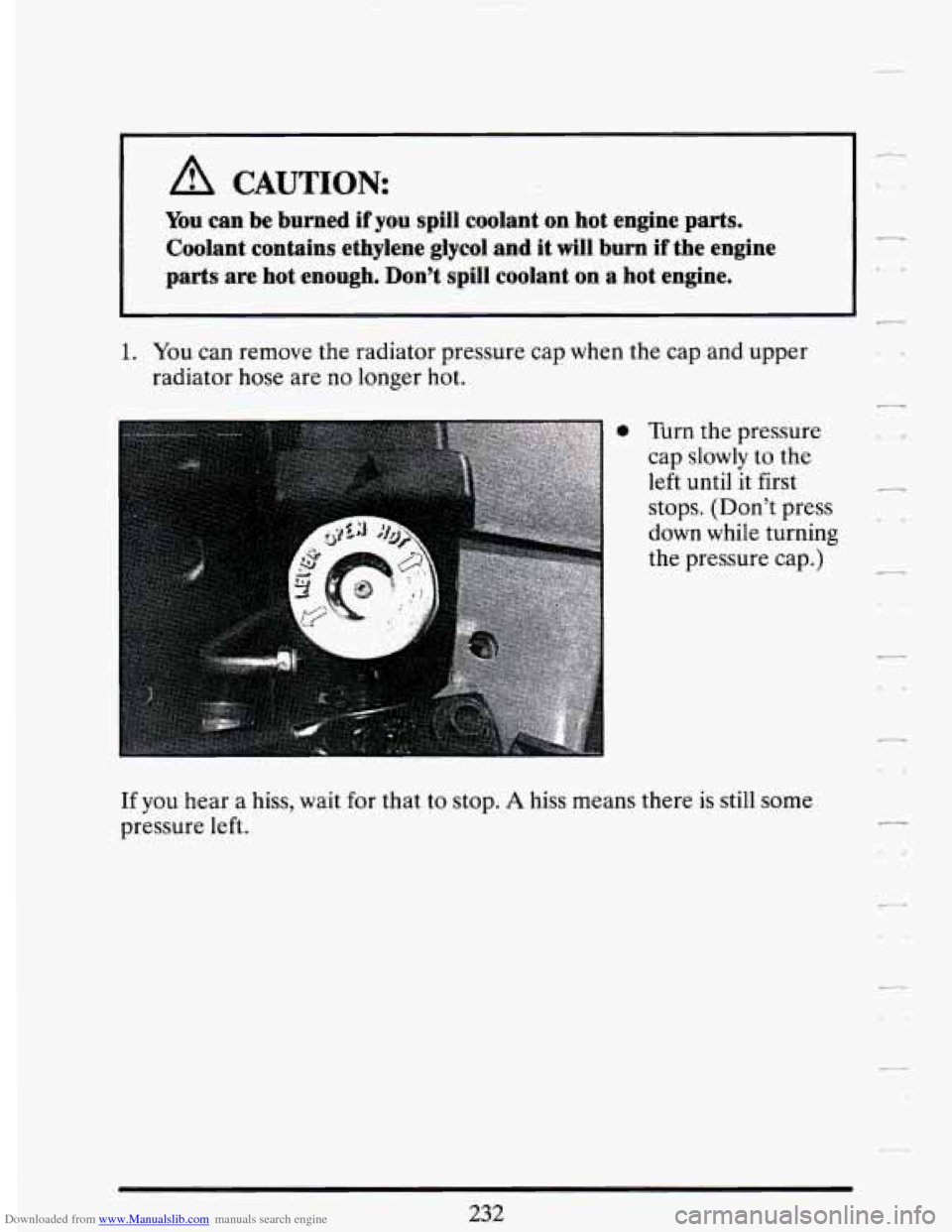
1. You can remove the radiator pressure cap when the cap and upper
radiator hose are no longer hot.
0 Turn the pressure
cap slowly to the
left until
it first
stops. (Don’t press
down while turning
the pressure cap.)
If you hear a hiss, wait for that to stop. A hiss means there is still some
pressure left.
232
Page 247 of 399
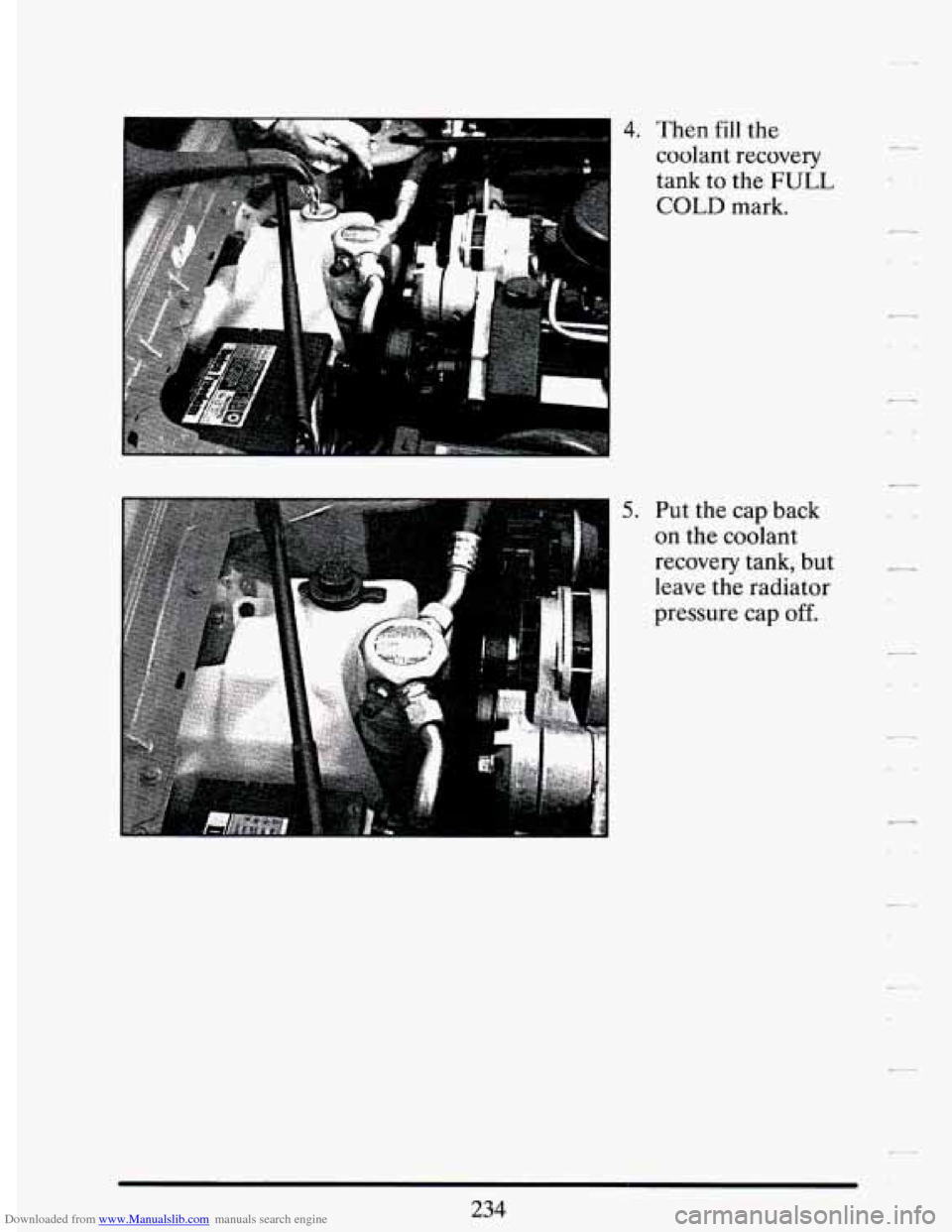
Downloaded from www.Manualslib.com manuals search engine 4. Then fill the
coolant recovery
tank to
the FULL
COLD mark.
5. Put the cap back
on
the coolant
recovery tank, but
leave the radiator
pressure cap
off.
234
c-
2.
LI
LA
Page 248 of 399
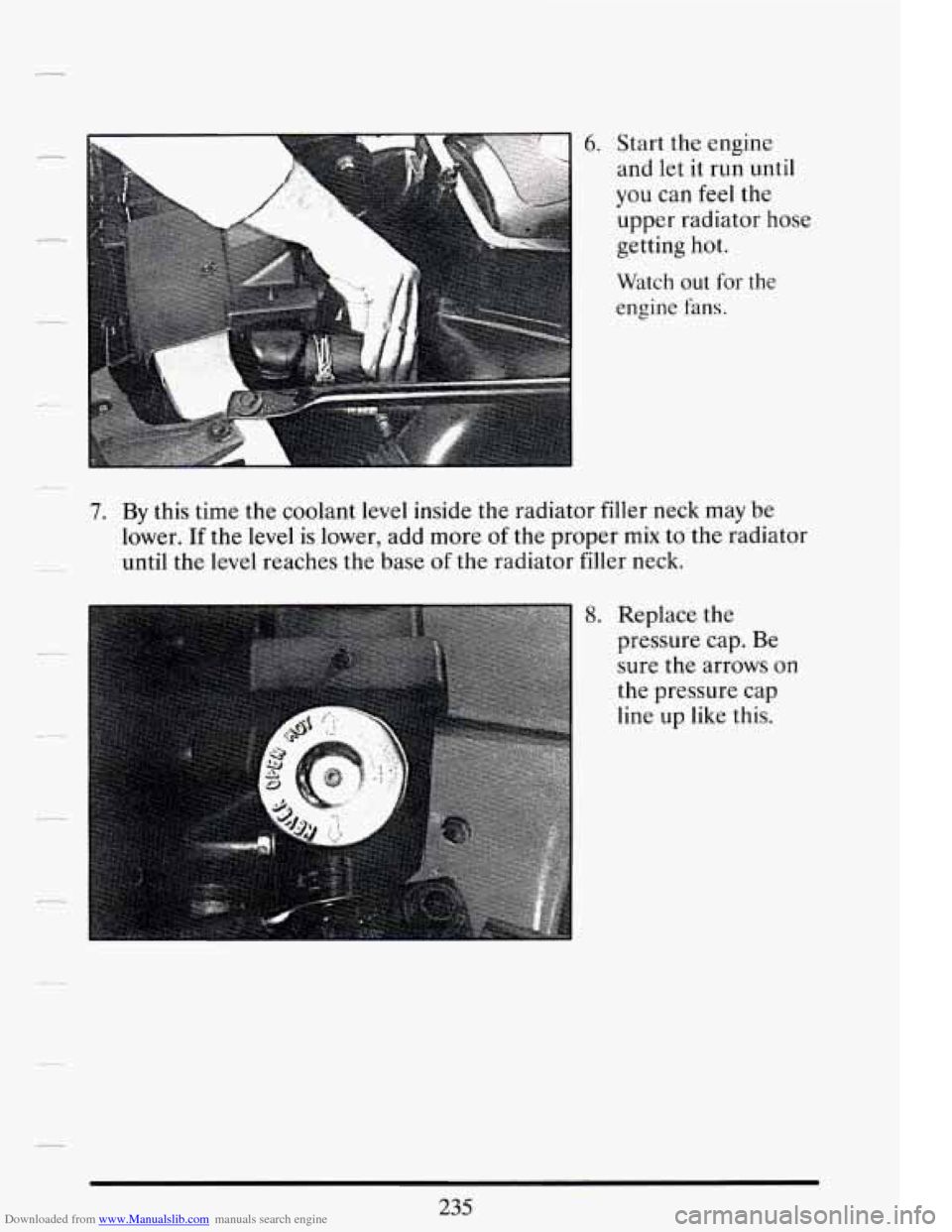
Downloaded from www.Manualslib.com manuals search engine 6. Start the engine
and let it run until
you can
feel the
upper radiator hose
getting hot.
Watch out for the
engine fans.
7. By this time the coolant level inside the radiator filler neck may be
lower. If the level is lower, add more of the proper mix to the radiator
until the level reaches the base
of the radiator filler neck.
8. Replace the
pressure cap. Be
sure the arrows on
the pressure cap
line up like this.
Page 249 of 399

Downloaded from www.Manualslib.com manuals search engine IFA TIRE GOES FLAT
It’s unusual for a tire to “blow out” while you’re driving, especially if you
maintain your tires properly. If air goes out of a tire, it’s much more likely
to leak out slowly. But
if you should ever have a “blowout,” here are a
few tips about what to expect and what to do:
If a front tire fails, the flat tire will create a drag that pulls
the vehicle
toward that side. Take your foot
off the accelerator pedal and grip the
steering wheel firmly. Steer to maintain lane position, then gently brake
to a stop well out of the traffic lane.
A rear blowout, particularly on a curve, acts much like a skid and may
require the same correction you’d use
in a skid. In any rear blowout,
remove your foot from the accelerator pedal. Get
the vehicle under
control by steering the way you want the vehicle to go. It may be
very
bumpy and noisy, but you can still steer. Gently brake to a stop, well off
the road if possible.
If a tire goes flat, the next section shows how to use your jacking
equipment to change a flat tire safely.
ro
t-
236
Page 258 of 399

Downloaded from www.Manualslib.com manuals search engine b__ Don’t try to put a wheel cover on your compact spare tire. It won’t fit.
Store the wheel cover in the trunk until you have the flat tire repaired or
replaced.
c_
I
I NOTICE:
~. Wheel covers won’t fit on your compact spare. If you try to put a
wheel cover on your compact spare, you
could damage the cover
or the spare.
1
L
]
COMPACT SPARE TIRE
~ Although the compact spare was fully inflated when your vehicle was
new,
it can lose air after a time. Check the inflation pressure regularly. It
should be
60 psi (420 kPa). After installing the compact spare on your
is correctly inflated. The compact spare is made to perform well at posted
speed limits for distances up
to 3,000 miles (5 000 km). The compact
~ spare is made to go up to 3,000 miles (5 000 km), so you can finish your
trip and have
your full-size. tire repaired or replaced where you want. Of
course, it’s best to replace your spare with a full-size tire as soon as you
can. Your spare will last longer and
be in good shape in case you need it
again.
Your anti-lock brake system warning light may come on when you are
Light” in the Index.
-_ vehicle, you should stop as soon as possible and make sure your spare tire
I__ driving with a compact spare. See “Anti-Lock Brake System Warning
245
Page 260 of 399
Downloaded from www.Manualslib.com manuals search engine - IF YOU’RE STUCK: IN SAND, MUD, ICE OR
SNOW
- What you don’t want to do when your vehicle is stuck is to spin your
wheels.
The method known as “rocking” can help you get out when
you’re stuck, but you must use caution.
-
.---
NOTICE:
Spinning your wheels can destroy parts of your vehicle as well
as the tires. If you spin the wheels too fast while shifting your
transaxle back and forth, you can destroy your transaxle.
Rocking your vehicle to get
it out:
First, turn your steering wheel left and right. That will clear the area
around your front wheels. Then shift back and forth between
“R’
(Reverse) and a forward gear, spinning the wheels as little as possible.
Release
the accelerator pedal while you shift, and press lightly on the
accelerator pedal when the transaxle
is in gear. If that doesn’t get you out
after a few tries, you may need to be towed out. If you do need to be
towed out, see “Towing Your Cadillac”
in the Index.
247
Page 261 of 399
Downloaded from www.Manualslib.com manuals search engine CI
I
I
Y ciii I
SERVICE AND APPEARANCE CARE
Here you will find information about the care of your Cadillac. This
section begins with service and fuel information, and then it shows how to
check important fluid and lubricant levels. There is also technical
information about your vehicle, and a section devoted to its appearance
care.
Your Cadillac dealer knows your vehicle best and wants you to be happy
with it. We hope you’ll
go to your dealer for all your service needs. You’ll
get genuine
GM parts and GM-trained and supported service people.
We hope
you’ll want to keep your GM vehicle all GM. Genuine GM parts
have one
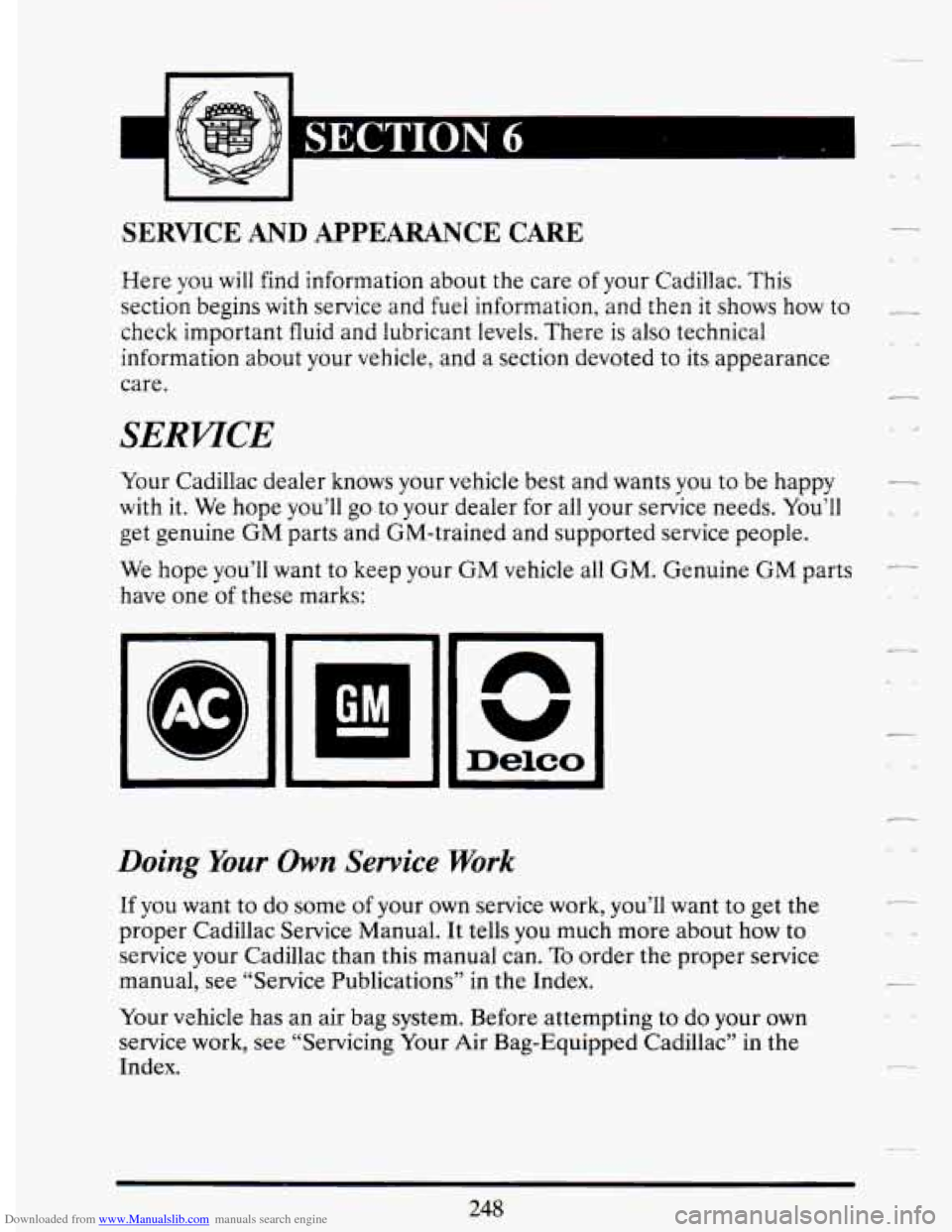
of these marks:
Doing Your Own Service Work
If you want to do some of your own service work, you’ll want to get the
proper Cadillac Service Manual. It tells you much more about how to
service your Cadillac than this manual can.
To order the proper service
manual,
see “Service Publications” in the Index.
Your vehicle has an air bag system. Before attempting to do your own
service
work, see “Servicing Your Air Bag-Equipped Cadillac” in the
Index.
248
Page 263 of 399

Downloaded from www.Manualslib.com manuals search engine not occur.) If you’re using 91 or higher octane unleaded gas and you still
get heavy knocking, your engine needs service.
What about gasoline with blending materials that contain oxygen
(oxygenates), such as MTBE or alcohol?
MTBE is “methyl tertiary-butyl ether.” Fuel that is no more than
15%
MTBE is fine for your Cadillac.
Ethanol is ethyl or grain alcohol. Properly-blended fuel that is no more
than
10% ethanol is fine for your Cadillac.
I Methanol is methyl or wood alcohol.
NOTICE:
Fuel that is more than 5% methanol is bad for your vehicle.
Don’t use it. It can corrode metal parts in your fuel system and
also damage plastic and rubber parts. That damage wouldn’t be
covered under your warranty. And even at
5% or less, there must
be “cosolvents” and corrosion preventers in this fuel to help
avoid these problems.
Gasolines for Cleaner Air
Your use of gasoline with deposit control additives will help prevent
deposits from forming in your engine and
fuel system. That helps keep
your engine in tune and your emission control system working properly.
It’s good for your vehicle, and you’ll be doing your part for cleaner air.
Many gasolines are now blended with oxygenates. General Motors
recommends that you use gasolines with these blending materials, such as
MTBE and ethanol. By doing
so, you can help clean the air, especially in
those parts of the country that have high carbon monoxide levels.
In addition, some gasoline suppliers are now producing reformulated
gasolines. These gasolines are specially designed to reduce vehicle
emissions. General Motors reco.mmends that you use reformulated
gasoline. By doing
so, you can help clean the air, especially in those parts
of the country that have high ozone levels.
250
ip
Page 264 of 399
Downloaded from www.Manualslib.com manuals search engine - You should asK your service station operators if their gasolines contain
deposit control additives and oxygenates, and
if they have been
reformulated to reduce vehicle emissions.
- FUELS IN FOREIGN COUNTMES
If you plan on driving in another country outside the U.S. or Canada,
.+- unleaded fuel may be hard to find. Do not use leaded gasoline. If you use
even one tankful, your emission controls won’t work well or at all. With
continuous use, spark plugs can get fouled, the exhaust system can
-- corrode, and your engine oil can deteriorate quickly. Your vehicle’s
oxygen sensor will be damaged. All
of that means costly repairs that
wouldn’t be covered by your warranty.
~ To check on fuel availability, ask an auto club, or contact a major oil
company that does business in the country where you’ll be driving.
You can also write us at the following address for advice. Just tell us
__ where you’re going and give your Vehicle Identification Number (VIN).
General Motors Overseas Dist:ribution Corporation,
North American Export Sales (NAES)
1908 Colonel Sam Drive
Oshawa, Ontario
L1H 8P7
---. FUEL ECONOMY
Your fuel economy (miles per gallon or liters per 100 kilometers) can vary
have been driven through a standard test and their actual fuel economy
was recorded. These readings were adjusted and printed on the fuel
economy window sticker which was attached to your new Cadillac when it
-- was delivered and in the Gas Mileage Guide which is available from your
dealership.
~. depending on how your Cadillac is driven. Several vehicles like yours
The fuel economy estimates are based on results
of tests required by the
U. S. Environmental Protection Agency (EPA). These tests are used to
certify that vehicles meet the Federal emissions and fuel economy
standards. Cadillac tests prototypes of new vehicles and submits the
- results to the EPA. The EPA then confirms the accuracy of the figures
provided by Cadillac. The vehicles are driven by a professional driver
under controlled laboratory conditions, on an instrument similar
to a
w.
25 1
Page 265 of 399

Downloaded from www.Manualslib.com manuals search engine treadmill. These procedures ensure that each vehicle is tested under
identical conditions.
There are
two different fuel economy estimates for each vehicle, one for
city driving and one for highway driving.
To develop these two estimates,
separate tests are used to represent typical everyday city and rural
driving.
The test used to determine the city fuel economy estimate simulates a 7.5
mile (12 km), stop and go trip with an average speed of 20 mph (32
km/h). The trip takes 23 minutes and has 18 stops. About one fifth of the
time is spent idling,
as in waiting at traffic lights or in rush hour traffic.
Two kinds of engine starts are used: a cold start, which is similar to
starting a car
in the morning after it has been parked all night and a hot
start, which is similar to restarting a vehicle after it has been warmed up,
driven and stopped for a short time.
The test used to determine the highway fuel economy estimate represents
a mixture of "non-city" driving. Segments corresponding to different
kinds
of rural roads and interstate highways are included. The test
simulates
a 10 mile (17 km) trip with an average speed of 48 mph (77
km/h). The test is run from a hot start and has little idling time and no
stops.
To assure that the fuel economy numbers are most useful for consumers,
the EPA adjusts these laboratory test results to account for the difference
between controlled laboratory conditions and actual driving on the road.
The laboratory fuel economy results are adjusted downward to arrive at
the estimates on
the fuel economy window sticker and the Gas Mileage
Guide. The city estimate is lowered by 10 percent and the highway
estimate is lowered
by 22 percent from the laboratory test results.
Experience has proven that these adjustment.s make the mileage
estimates correspond more closely to the actual fuel economy realized by
the average driver.
Even though these figures are adjusted, they still represent what the
average driver will get. Your fuel economy may be significantly higher or
lower, depending on how, when, and where your vehicle is driven. Here
are some things you can
do to increase fuel economy;
0 Combine errands into one trip.
0 Turn the engine off rather than letting it idle for more than a minute.