wheel CADILLAC DEVILLE 1996 7.G User Guide
[x] Cancel search | Manufacturer: CADILLAC, Model Year: 1996, Model line: DEVILLE, Model: CADILLAC DEVILLE 1996 7.GPages: 354, PDF Size: 20.32 MB
Page 82 of 354
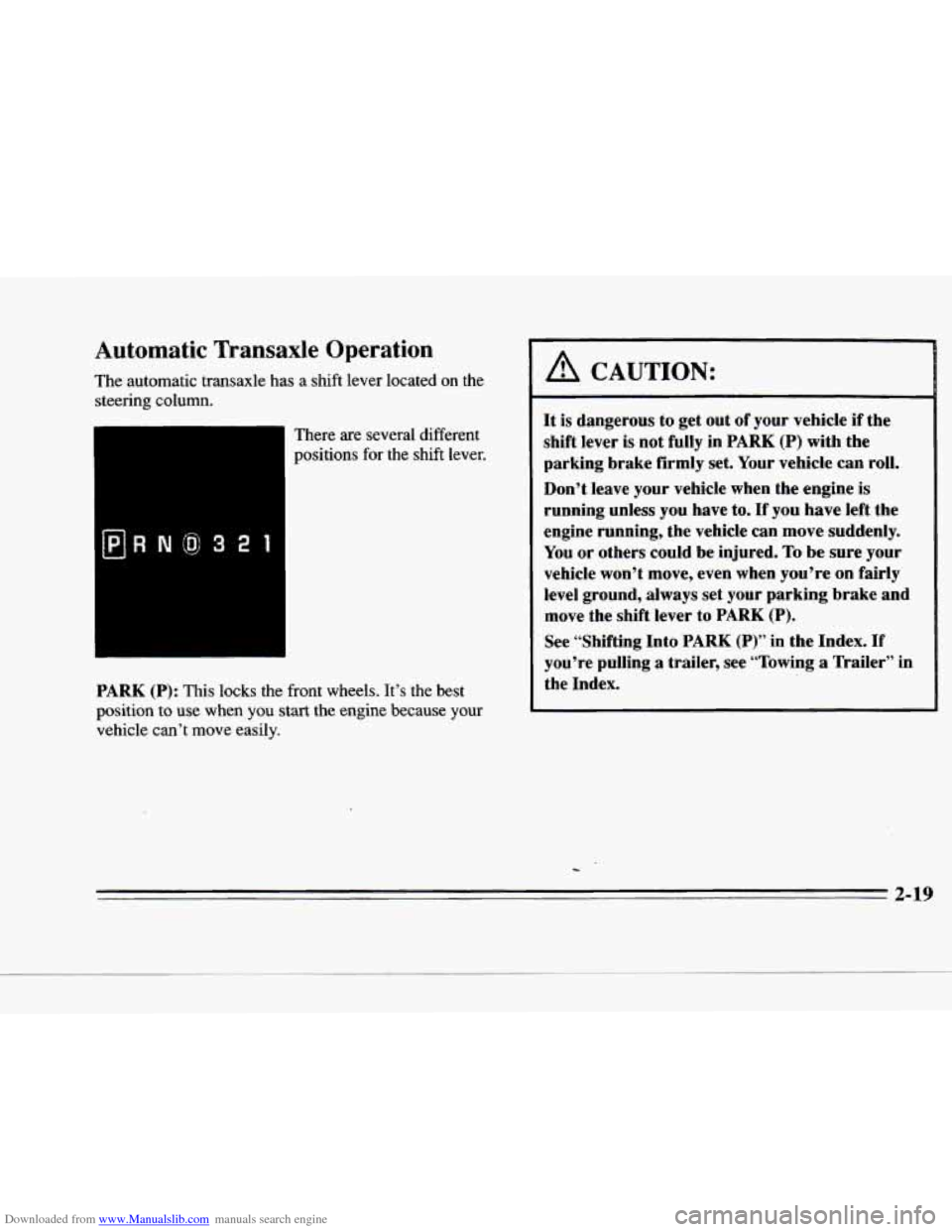
Downloaded from www.Manualslib.com manuals search engine Automatic Transaxle Operation
The automatic transaxle has a shift lever located on the
steering column.
There are several different
positions for the shift lever.
c PARK (P): This locks the front wheels. It’s the best
position to
use when you start the engine because your
vehicle can’t move easily.
A CAUTION:
It is dangerous to get out of your vehicle if the
shift lever
is not fully in PARK (P) with the
parking brake firmly set. Your vehicle can
roll.
Don’t leave your vehicle when the engine is
running unless you have to. If you have left the
engine running, the vehicle can move suddenly.
You or others could be injured.
To be sure your
vehicle won’t move, even when you’re on fairly
level ground, always set your parking brake and
move the
shift lever to PARK (P).
See “Shifting Into PARK (P)” in the Index. If
you’re pulling a trailer, see “Towing a Trailer” in
the Index.
2-19
Page 84 of 354
Downloaded from www.Manualslib.com manuals search engine r
r
Q
r
r
r
r
r
NEUTRAL (N): In this position, the engine doesn’t
connect with the wheels.
To restart when you’re already
moving, use
NEUTRAL (N) only. Also, use
NEUTRAL (N) when your vehicle is being towed.
I A CAUTION:
Shifting out of PARK (P) or NEUTRAL (N) while
your engine is “racing” (running at high ,speed) is
dangerous. Unless
your foot is firmly on the
brake pedal, your vehicle could move very
rapidly. You could lose control and hit people
or
objects. Don’t shift out of PARK (P) or
NEUTRAL (N) while your engine is racing.
I NOTICE:
Damage to your transaxle caused by shifting out
of PARK (P)
or NEUTRAL (N) with the engine
racing isn’t covered
by your warranty. OVERDRIVE
(a): This position is for normal driving.
If you need more power for passing, and you’re:
Going less than 35 mph (55 km/h), push the
accelerator pedal about haliivay down:
Going about 35 mph (55 km/h) or more, push the
accelerator all the way down.
The transaxle will shift down to the next gear and
have more power.
NOTICE:
If your vehicle seems to start up rather slowly, or
if it doesn’t seem to shift gears as you accelerate,
something may be wrong with
a transaxle system
sensor.
If you drive very far that way, your
vehicle can be damaged.
So if this happens, have
your vehicle serviced right
away. Until then, you
can use SECOND
(2) when you are driving less
than
35 mph (55 kdh) and OVERDRIVE (@)
for higher speeds.
2-21
Page 85 of 354
Downloaded from www.Manualslib.com manuals search engine THIRD (3): This position is also used for noma1
driving however,
it offers more power and lower fuel
economy than
OVERDRIVE (0).
Here are examples for using THIRD (3) instead of
OVERDRIVE (@):
0 When driving on hilly, winding roads.
0 When towing a trailer, so there is less shifting
between
gears.
0 When going down a steep hill.
SECOND (2): This position gives you more power. You
can use SECOND (2) on hills. It can help control your
speed
as you go down steep mountain roads, but then
you would also want
to use your brakes off and on.
I NOTICE:
~ ~~ ~~~ ~ ~~~~
Don’t shift into SECOND (2) unless you are going
slower than
65 rnph (105 kdh), or you can
damage your engine.
FIRST (1): This position gives you even more power
than
SECOND (2). You can use it on very steep hills,
or
in deep snow or mud. (If the shift lever is put in
FIRST (l), the transaxle won’t shift into first gear
until the vehicle is going slowly enough.)
I NOTICE:
~~
If your front wheels can’t rotate, don’t try to
drive. This might happen
if you were stuck in
very deep sand or mud or were up against a solid
object,
You could damage your transaxle.
Also, if you stop when going uphill, don’t hold
your vehicle there with only the accelerator
pedal. This could cause overheating and damage
the transaxle. Use your brakes
to hold your
vehicle in position on a hill.
-.
-4
-.
Page 93 of 354
Downloaded from www.Manualslib.com manuals search engine Your vehicle has RAP. When you stop your vehicle and Rear Window Lockout
turn the ignition key to OFF, you can still use your
power windows. The electrical power to operate the
windows will not shut off until
you open a door or 10
minutes have passed. If you want this power for another
10 minutes, turn the key to RUN and back to OFF.
Express-Down Window
This feature is present on the driver’s power window.
Pressing the control rearward
will lower the window
completely.
If you want to stop the window as it is
lowering, press
the control forward. Press the control
forward to raise the window.
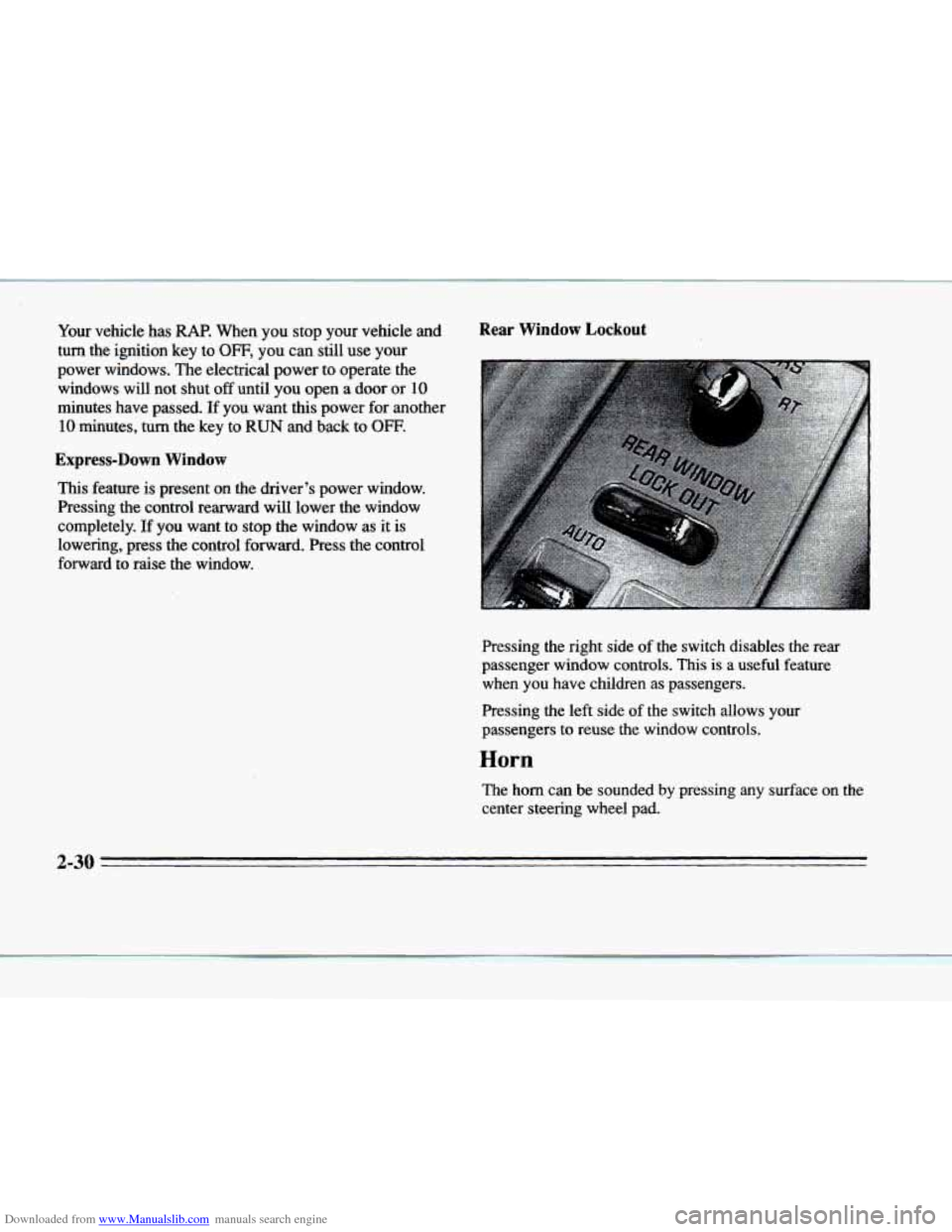
Pressing the right side
of the switch disables the rear
passenger window controls. This
is a useful feature
when you have children as passengers.
Pressing the
left side of the switch allows your
passengers to reuse the window controls.
Horn
The horn can be sounded by pressing any surface on the
center steering wheel pad.
2-30
Page 94 of 354
Downloaded from www.Manualslib.com manuals search engine Tilt Wheel
P
c
c
c
P
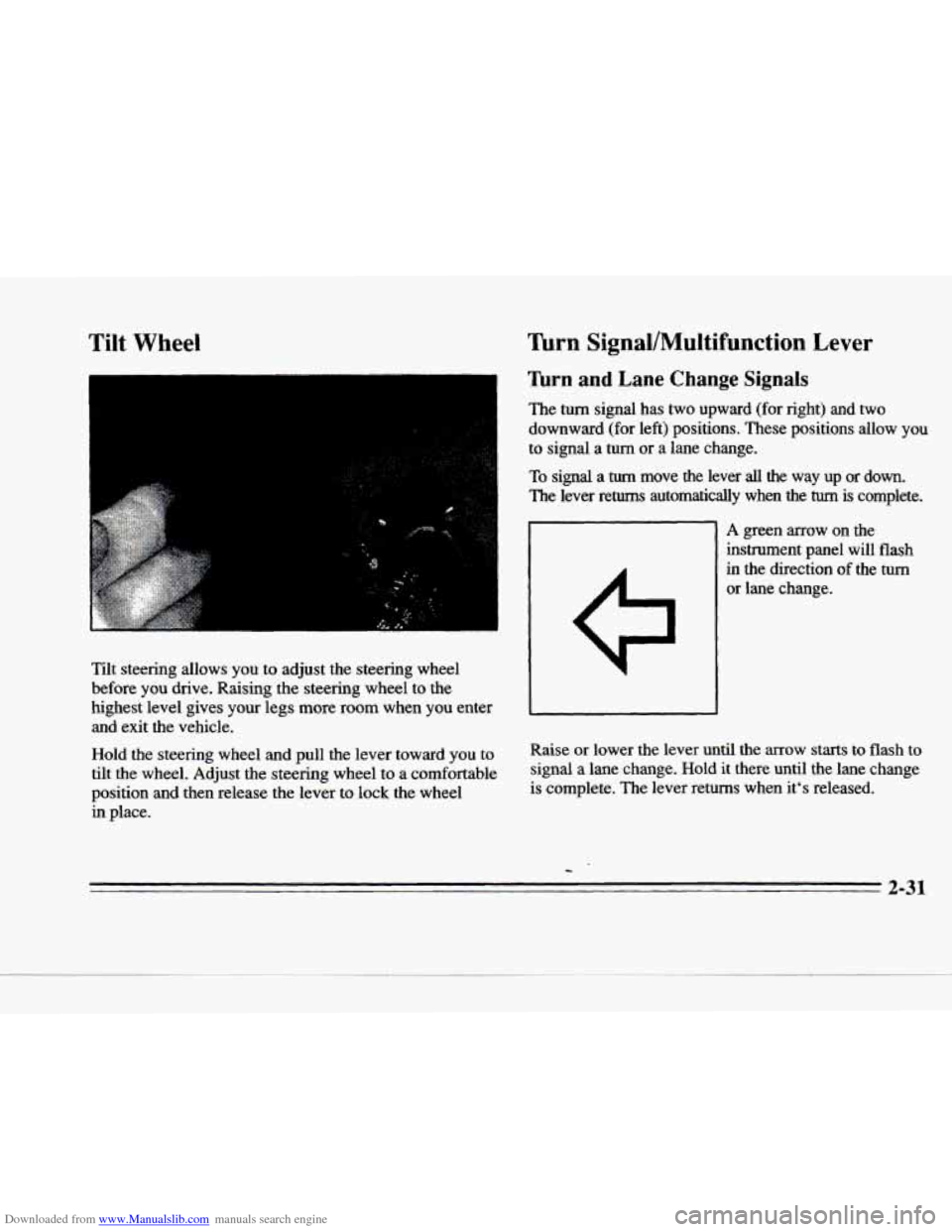
zit steering allows you to adjust the steering wheel
before you drive. Raising the steering wheel to the
highest level gives
your legs more room when you enter
and exit the vehicle.
Hold the steering wheel
and pull the lever toward you to
tilt the wheel. Adjust the steering wheel to a comfortable
position
and then release the lever to lock the wheel
in place.
Turn Signal/Multifunction Lever
lhrn and Lane Change Signals
The turn signal has two upward (for right) and two
downward (for left) positions.
These positions allow you
to signal a turn or a lane change.
To signal a turn move the lever all the way up or down.
The lever returns automatically when the turn is complete.
A green mow on the
instrument panel will
flash
in the direction of the turn
or lane change.
Raise or lower the lever until the
arrow starts to flash to
signal
a lane change. Hold it there until the lane change
is complete. The lever returns when it's released.
2-31
Page 99 of 354
Downloaded from www.Manualslib.com manuals search engine Cruise Control
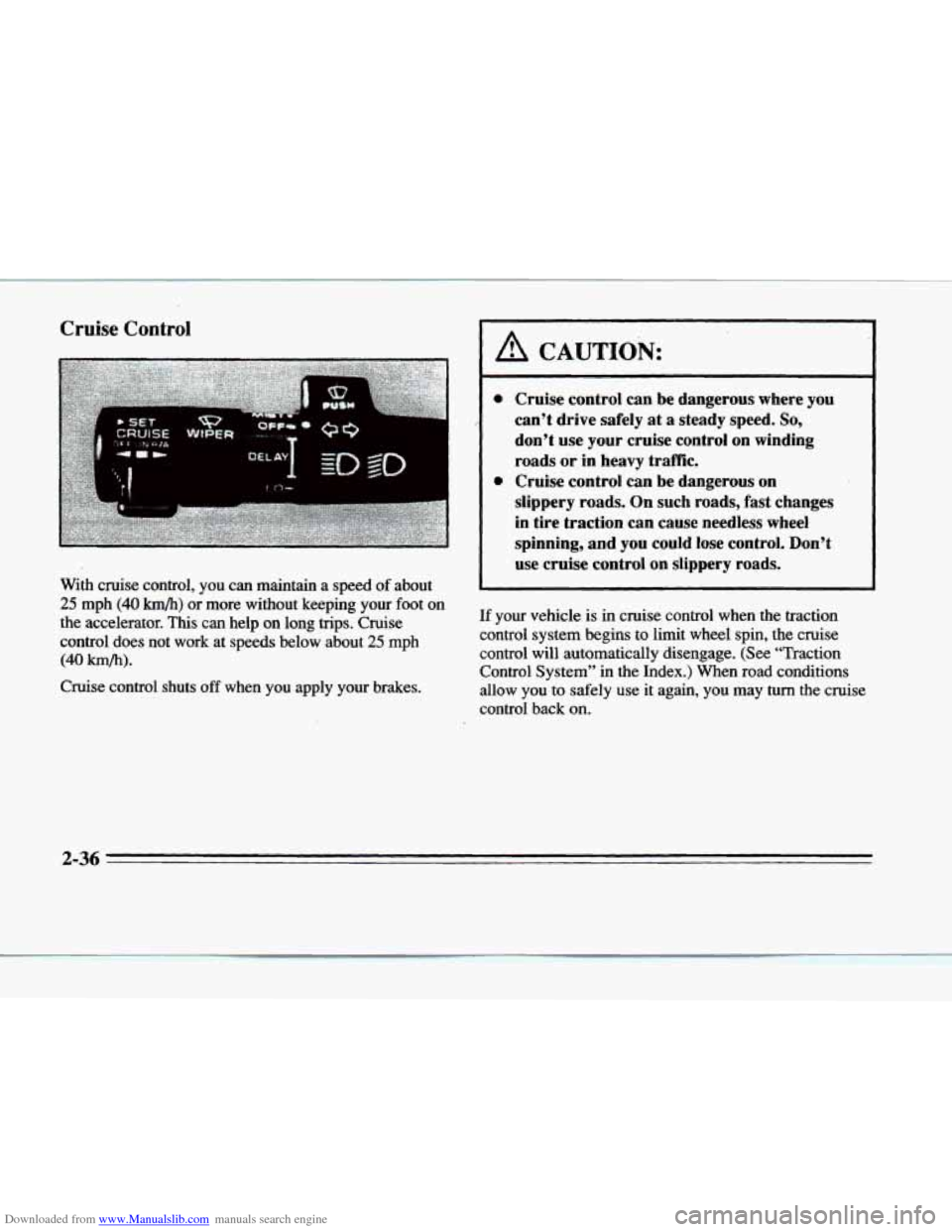
With cruise control, you can maintain a speed of about
25 mph (40 b/h) or more without keeping your foot on
the accelerator. This can help on long trips. Cruise
control does not work at speeds below about
25 mph
(40 km/h).
Cruise control shuts off when you apply your brakes.
A CAUTION:
e
e Cruise control can be dangerous where you
can’t drive safely at a steady speed.
So,
don’t use your cruise control on winding
roads
or in heavy traffic.
Cruise control can be dangerous on
slippery
roads. On such roads, fast changes
in tire traction can cause needless wheel
spinning, and
you could lose control. Don’t
use cruise control on slippery roads.
If your vehicle is in cruise control when the traction
control system begins
to limit wheel spin, the cruise
control will automatically disengage. (See “Traction Control System” in
the Index.) When road conditions
allow you to safely use it again, you may turn the cruise
control back on.
2-36
P
P
Page 118 of 354
Downloaded from www.Manualslib.com manuals search engine r
P
Visor Vanity Mirror Illuminated Rear Seat Visor Vanity Mirror
To use
one, turn the sunshade down and lift the cover to (Concours Only)
see the mirror.
Illuminated Visor Vanity Mirror
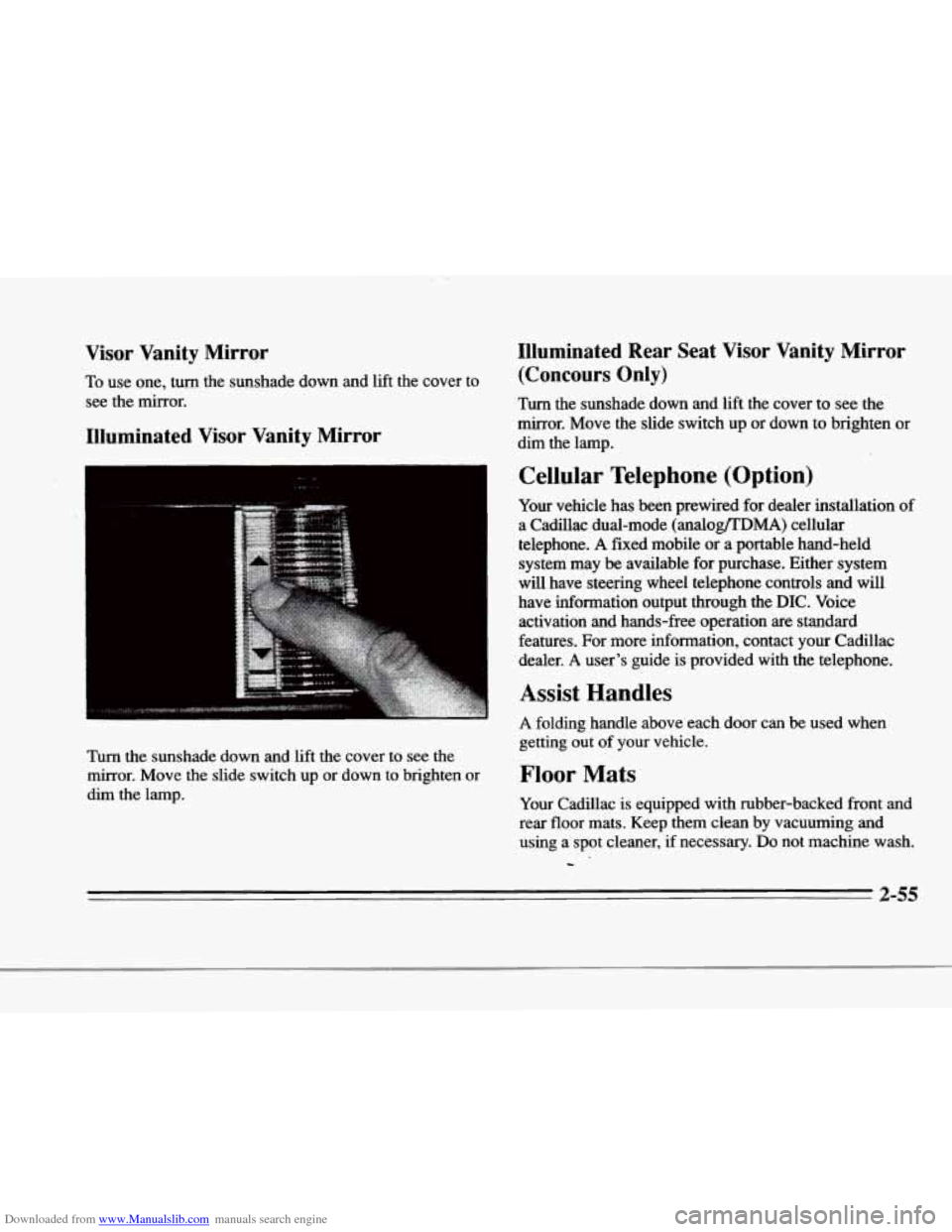
Turn the sunshade down and lift the cover to see the
mirror. Move the slide switch up or down to brighten or
dim the lamp.
Cellular Telephone (Option)
Turn the sunshade down and lift the cover to see the
mirror. Move the slide switch up or down to brighten
or
dim the lamp. Your vehicle has been prewired
for dealer installation of
a Cadillac dual-mode (analog/TDMA) cellular
telephone.
A fixed mobile or a portable hand-held
system may be available for purchase. Either system
will have steering wheel telephone controls
and will
have information output through the DIC. Voice
activation and hands-free operation are standard
features. For more information, contact your Cadillac
dealer.
A user's guide is provided with the telephone.
Assist Handles
A folding handle above each door can be used when
getting out
of your vehicle.
Floor Mats
Your Cadillac is equipped with rubber-backed front and
rear floor mats. Keep them clean by vacuuming and
using a spot cleaner,
if necessary. Do not machine wash.
2-55
Page 124 of 354
Downloaded from www.Manualslib.com manuals search engine F-
The instrument panel is designed to let you know at a
glance
how your Cadillac is running. You’ll know how
fast you’re going, how much fuel you’re using and
many
of the other things you’ll need to know to drive
safely and economically. The main components
of the
instrument panel are:
1. Air Outlets
2. Turn Signal/Multifunction Lever
3. Driver Information Center Control Buttons
c
4. Driver’s Side Air Bag
5. Cluster
6. Steering Column Shift Lever
7. Electronic Climate Controls
8. Audio System
9. Passenger’s Side Air Bag
10. Lamp Controls
11. Steering Wheel Touch Controls for Climate Control
12. Hood Release
13. Horn
14. Steering Wheel Touch Controls for Audio System
15. Astray and Cigarette Lighter
16. Glove Box
2-61
Page 130 of 354
Downloaded from www.Manualslib.com manuals search engine r
f
r:
r
f
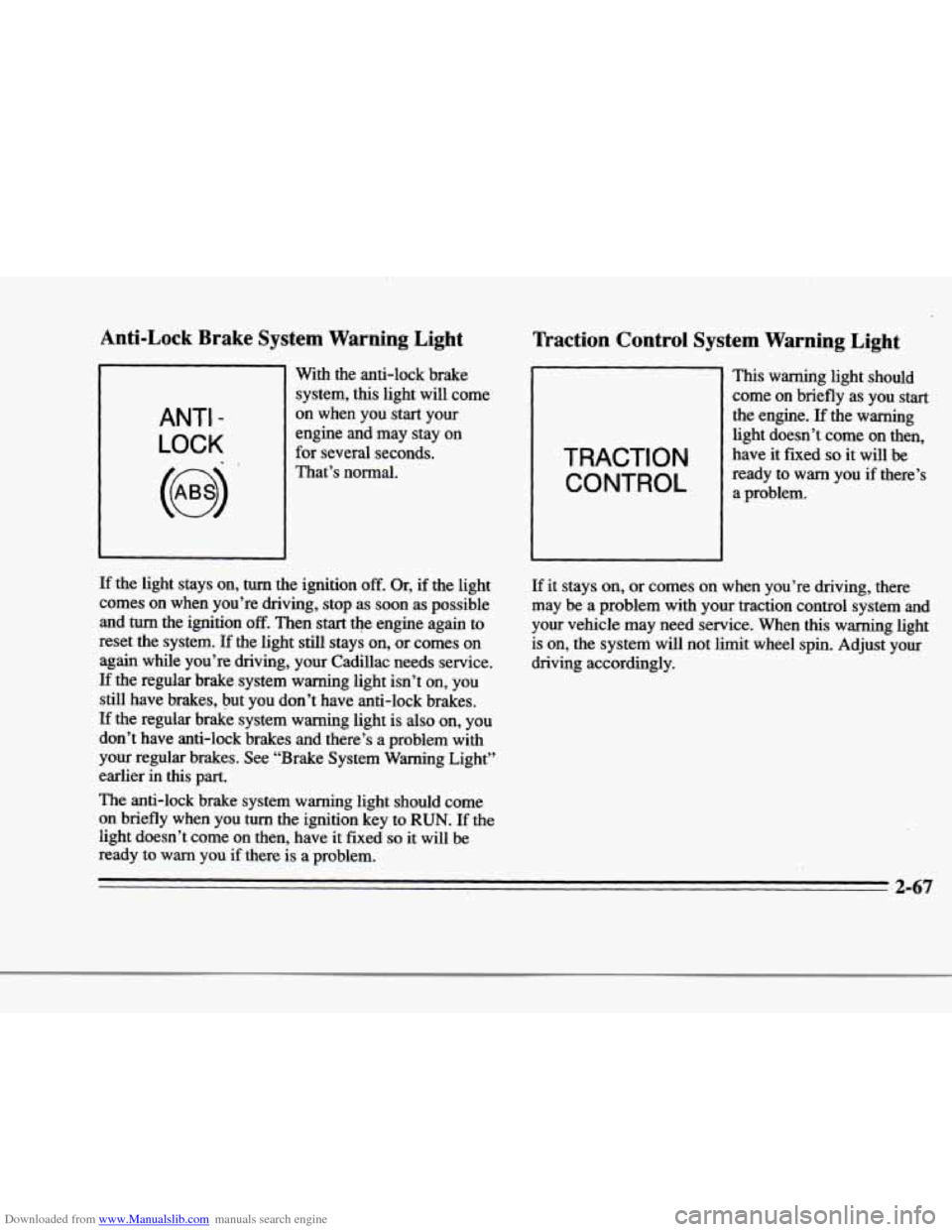
Anti-Lock Brake System Warning Light
ANTI -
LOCK -.
With the anti-lock brake system, this light will come
on when you start your
engine and may stay on
for several seconds.
That’s normal.
lkaction Control System Warning Light
This warning light should
come on briefly
as you start
the engine. If the waming
light doesn’t come on then,
have it fixed
so it will be
ready to warn you if there’s
a problem.
If the light stays on, turn the ignition off.
Or, if the light
comes on when you’re driving, stop as soon as possible
and
turn the ignition off. Then start $e engine again to
reset the system. If the light still stays on, or. comes
on
again while you’re driving, your Cadillac needs service.
If the regular brake system warning light isn’t on, you
still have brakes, but you don’t have anti-lock brakes.
If the regular brake system warning light is also on, you
don’t have anti-lock brakes and there’s a problem with
your regular brakes. See “Brake System Warning Light”
earlier
in this part.
The anti-lock brake system warning light should come
on briefly when you
turn the ignition key to RUN. If the
light doesn’t come on then, have
it fixed so it will be
ready to
warn you if there is a problem. If
it stays on, or comes on when you’re driving, there
may
be a problem with your traction control system and
your vehicle may need service. When this warning light
is on, the system will not
limit wheel spin. Adjust your
driving accordingly.
2-67
Page 142 of 354
Downloaded from www.Manualslib.com manuals search engine P-
,+
c
c
FUEL LEVEL VERY LOW - 11: This message serves
as a warning that the fuel level in the tank is critically
low. Stop for fuel immediately.
MONITORED SYSTEMS OK - I: This message only
appears in the “recall” mode by pressing the
RESET
button. It lets you know that no other messages are
stored or currently active.
PASS KEY NOT PROGRAMMED - 31: This
warning message displays when the PASS-Key pellet information has not been programmed into your vehicle.
See your Cadillac dealership for service.
PCM FAULT - 110: The circuit in the Powertrain
Control Module
(PCM) has shorted or is loose when this
message appears. Have your Cadillac serviced by your
dealership at once.
REDUCED ENGINE POWER - 41: This message
informs
the driver that due to wheel slippage your
vehicle
is reducing engine power to compensate for the
loss of traction. Accelerating too fast causing the tires to
spin
is an example of when this message would display.
REMOVE KEY - 70: This message will appear when
the Personalized Automotive Security System
(PASS-Key
11) is unable to read the pellet on the
ignition key or
an improper key pellet has been inserted.
Wait for the DIC to display STARTING DISABLED
DUE TO THEFT SYSTEM REMOVE IGNITION
KEY. The instrument panel cluster will then
run a timer
and change the messages to WAIT
3 MINUTES, WAIT
2 MINUTES,. WAIT 1 MINUTE and then START CAR.
When the REMOVE
KEY message is displayed, remove
the ignition key. Check the ignition key for damage. If it
is damaged,
it may need to be replaced. If you see no
damage, clean the pellet contacts with a soft cloth
or
napkin before inserting the key back into the ignition.
Have your vehicle serviced if the message still appears.
SERVICE A/C SYSTEM A/C COMPRESSOR
OFF
- 14: This message appears when the electronic
sensors that control the A/C and heating systems are no
longer working. Have the climate control system serviced
if you notice a drop in heating and A/C efficiency.
SERVICE AIR BAG - 83: There is a problem with the
Supplemental Inflatable Restraint (air bag) system when
this message appears. Let only a qualified technician work on your vehicle. See your Cadillac dealership for
service
at once.
2-79