instrument panel CADILLAC DEVILLE 1996 7.G Owner's Manual
[x] Cancel search | Manufacturer: CADILLAC, Model Year: 1996, Model line: DEVILLE, Model: CADILLAC DEVILLE 1996 7.GPages: 354, PDF Size: 20.32 MB
Page 149 of 354
Downloaded from www.Manualslib.com manuals search engine Fan Button
The button with the fan symbol adjusts the fan speed. Press the up
arrow to increase fan speed and the down
arrow to decrease fan speed.
Temperature Button
The red and blue temperature buttons adjust the air
temperature coming through the system. Press the blue
button for a eooler setting or the red button for a warmer setting. The outside temperature is always displayed
when your vehicle is running.
You can change it from
Fahrenheit to Celsius by pressing the
ENGNET
(English/metric) button on the DIC.
Mode Controls
The AUTO/ECON button automatically controls the
direction
of air delivery for air conditioning and non-air
conditioning modes.
Automatic Operation
When the system is set for AUTO, sensors will control
the air delivery mode.
Air will come from the floor,
middle or windshield outlets. The fan speed will vary as
the system maintains the selected temperature setting. Be
careful not to put anything over the solar sensor
located in the middle of the instrument panel near the
windshield. This sensor
is used by the automatic system
to regulate temperature.
To find your comfort zone, start with 75°F (24°C)
setting, allow about 20 minutes for the system to
regulate. Press the red or blue temperature buttons to
adjust the temperature if necessary. If you choose
60°F
(1 6" C), the system will remain at that maximum cooling
setting
and will not regulate fan speed. If you choose the
temperature of
90°F (32"C), the system will remain at
that maximum heating setting and will not regulate
fan
speed. Choosing either maximum setting will not cause
the system to heat or cool any faster.
With this setting,
the air conditioning compressor
automatically cycles when needed to cool the air. In cold
weather, when the system senses the need for heat, the
airflow will be directed
out the floor outlets. As. the
interior temperature approaches a desired setting, the
blower speed will decrease.
To maintain interior
comfort, the airflow may move to the instrument panel
air outlets and floor outlets
(BI-LEVEL mode). On
bright, sunny days in cold weather, the airflow may
come
out of the A/C outlets (A/C mode) to maintain
comfort and prevent stuffiness.
Page 152 of 354
Downloaded from www.Manualslib.com manuals search engine Electronic Solar Sensor
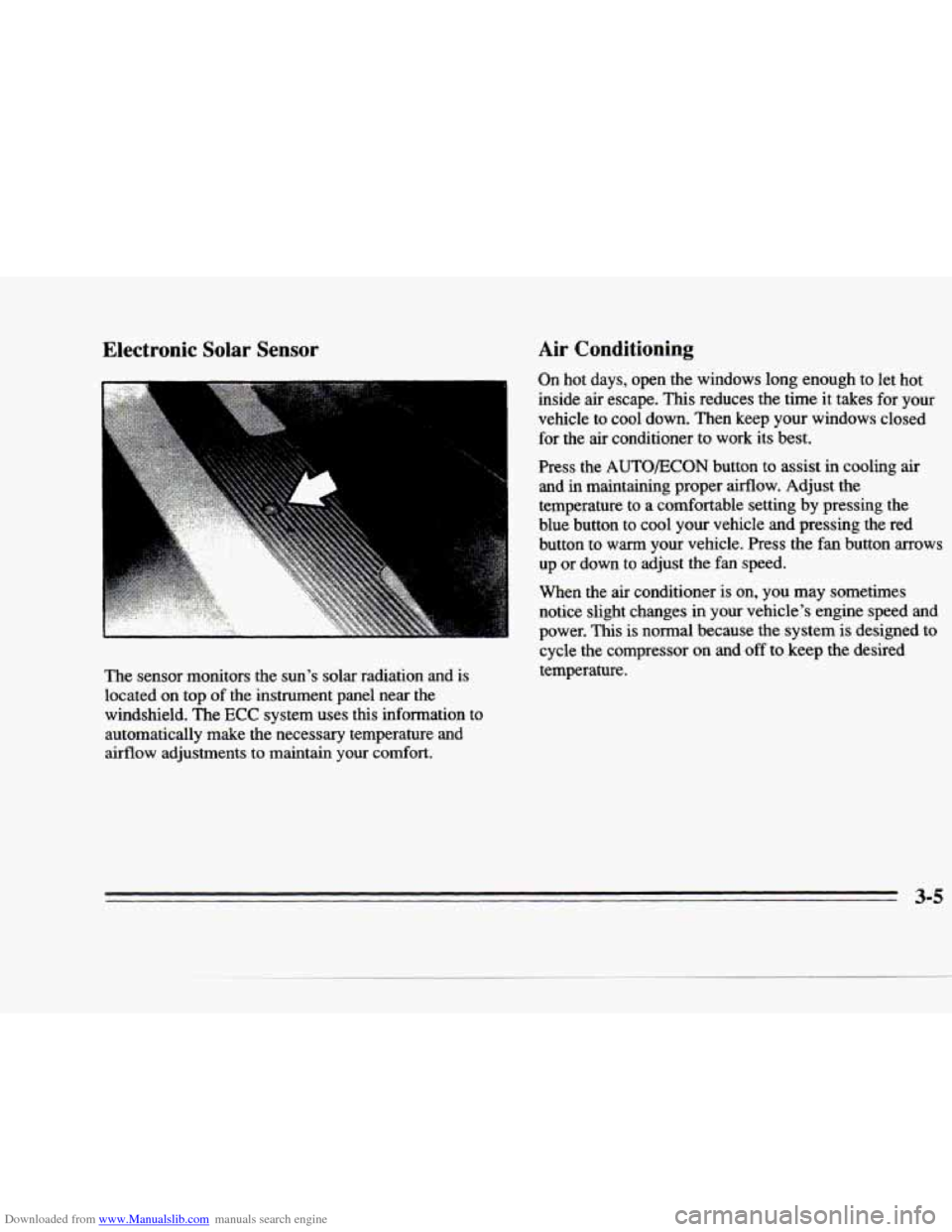
The sensor monitors the sun’s solar radiation and is
located
on top of the instrument panel near the
windshield. The
ECC system uses this information to
automatically
make the necessary temperature and
airflow adjustments to maintain your
comfort.
Air Conditioning
On hot days, open the windows long enough to let hot
inside
air escape. This reduces the time it takes for your
vehicle to cool down. Then keep your windows closed for the air conditioner to work its best.
Press the
AUTO/ECON button to assist in cooling air
and in maintaining proper airflow. Adjust the
temperature
to a comfortable setting by pressing the
blue button to cool your vehicle
and pressing the red
button to
warm your vehicle. Press the fan button arrows
up or down
to adjust the fan speed.
When the air conditioner is on, you may sometimes
notice slight changes in your vehicle’s engine speed and
power. This is normal because the system is designed to
cycle the compressor on and off to keep the desired
temperature.
3-5
Page 153 of 354
Downloaded from www.Manualslib.com manuals search engine Heating
rress the AUTOECON button to direct airflow out
of the floor outlets and to help save fuel. Adjust the
temperature, if necessary, by pressing the blue button
to decrease temperature and pressing the red button
to
increase temperature. Also remember to adjust the fan
speed by pressing the up or down arrow.
Outside air will be brought in and sent through the floor
outlets. The heater works best if you keep your windows
closed while using it.
Ventilation System
Your Cadillac's flow-through ventilation system
supplies outside air into the vehicle when it
is moving.
Outside
air will also enter the vehicle when the heater or
the air conditioning fan is running.
.I . .
....,.
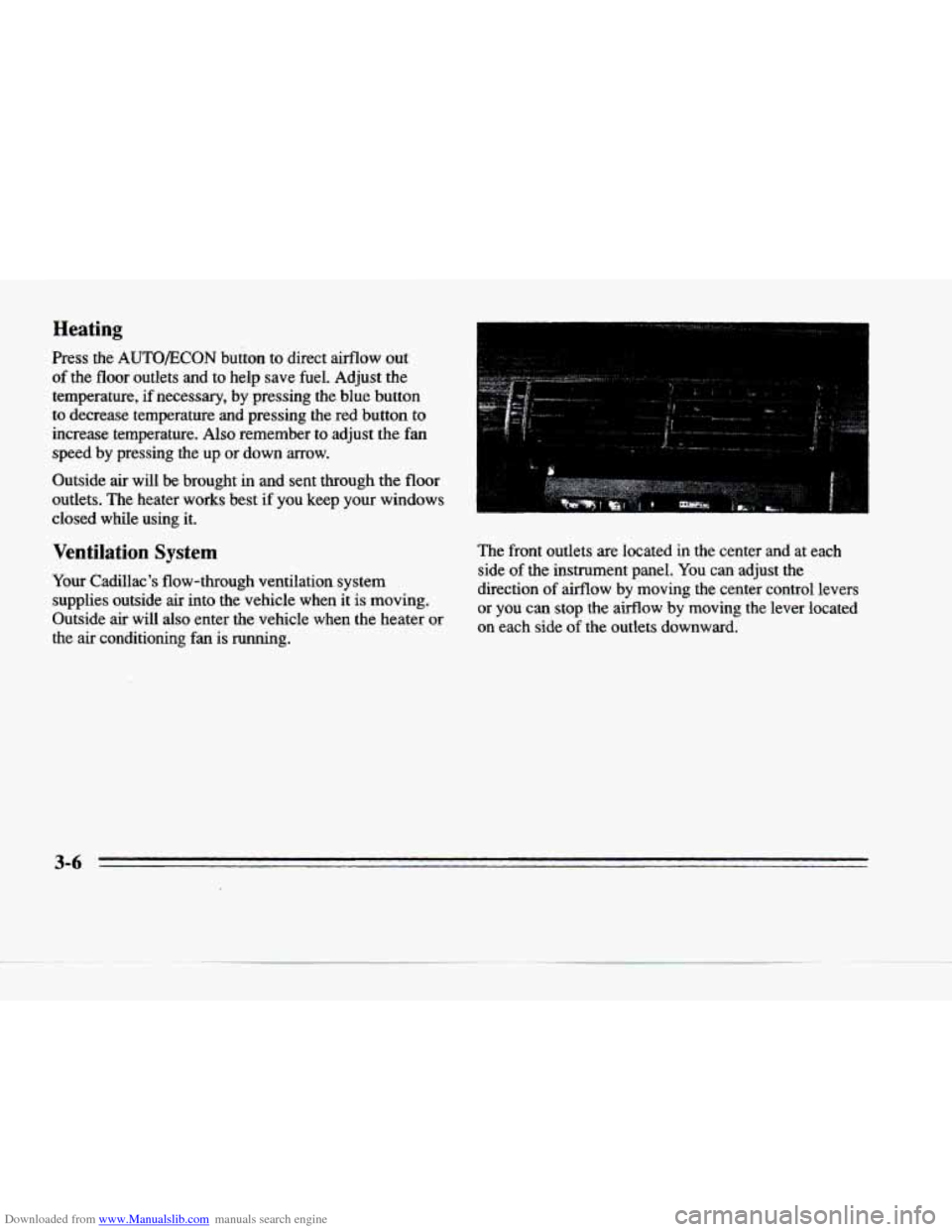
The front outlets are located in the center and at each
side
of the instrument panel. You can adjust the
direction
of airflow by moving the center control levers
or you can stop the airflow by moving the lever located
on each side
of the outlets downward.
3-6
Page 219 of 354
Downloaded from www.Manualslib.com manuals search engine lhrn Signals When Towing a nailer
When you tow a trailer, your vehicle may need a
different
turn signal flasher and extra wiring. Check
with your Cadillac dealer. The green
arrows on your
instrument panel will flash whenever you signal a
turn
or lane change. Properly hooked up, the trailer lamps
will
also flash, telling other drivers you’re about to turn,
change lanes or stop.
When towing a trailer, the green arrows on your
instrument panel will flash for turns even
if the bulbs on
the trailer
are burned out. Thus, you may think drivers
behind you are seeing your signal when they are not. It’s
important to check occasionally to be sure the trailer
bulbs are still working.
Driving On Grades
Reduce speed and shift to a lower gear before you start
down a long or steep downgrade.
I€ you don’t shift
down, you might have to use your
brakes so much that
they would get hot and no longer work well.
On a long uphill grade,
shift down and reduce your
speed to around
45 mph (70 b/h) or less to reduce the
possibility
of engine and transaxle overheating.
If your vehicle weighs more
than 1,OOO lbs. (450 kg),
you may want to drive in
THIRD (3) instead of
OVERDRIVE (@).
4-38
Page 225 of 354

Downloaded from www.Manualslib.com manuals search engine A
This light on the instrument
panel will flash indicating that the hazard warning
flashers are on.
The hazard warning flashers will work once the button
is
pressed in regardress of the key position.
Pull out on the
collar to turn the flashers off. When the
hazard warning flashers
are on, the turn signals won't
work since they
are already flashing.
5-2
Page 238 of 354
Downloaded from www.Manualslib.com manuals search engine Engine Overheating
You will find an ENGINE COOLANT HOT-IDLE
ENGINE message
or a STOP ENGINE ENGINE
OVERHEATED message on the DIC. There is also an
engine temperature warning light
on the instrument
panel. See “Engine Temperature Warning Light” in the
Index.
Overheated Engine Protection Operating
Mode
Y
Should a low coolant condition exist and the message
STOP ENGINE
ENGINE OVERHEATED is displayed,
an overheat protection mode which alternates firing
groups
of four cylinders helps prevent engine damage.
This operating mode
allows your vehicle to be driven
to a safe place in
an emergency; you may drive up to
50 miles (80 km). Towing a trailer in the overheat
protection mode should be avoided.
I NOTICE:
After driving in the Overheated Engine
Protection Operating Mode,
to avoid engine
damage, allow the engine to cool before
attempting any repair. The engine oil may be
severely degraded. Change the
oil and reset the
oil life indicator. See “Engine Oil, When to
~ Change” in the Index.
P
Page 263 of 354
Downloaded from www.Manualslib.com manuals search engine c-
I A CAUTION:
You can be injured and your vehicle could be
damaged if
you try to do service work on a
vehicle without knowing enough about it.
Be sure you have sufficient knowledge,
experience, and the proper replacement
parts and tools before you attempt any vehicle maintenance task.
Be sure to use the proper nuts, bolts and
other fasteners. “English’ and “metric”
fasteners can be easily confused. If you use
the wrong fasteners, parts can later break
or fall off. You could be hurt.
Fuel
Use premiurn unleaded gasoline rated at 91 octane or
higher.
At a minimum, it should meet specifications ASTM
D4814 in the United States and CGSB 3.5-M93 in Canada.
Improved gasoline specifications have been developed by
the American Automobile Manufacturers Association
(AAMA) for better vehicle performance and engine
protection. Gasolines meeting the
AAMA specification could provide improved driveability and emission control
system protection compared to other gasolines.
Be sure the posted octane for premium is at least
91. If
the octane is less than
91, you may get a heavy knocking
noise when you drive.
(In an emergency, you may be
able to use a lower octane
-- as low as 87 -- if heavy
knocking does not occur.) If you’re using
91 or higher
octane unleaded gasoline and you still hear heavy
knocking, your engine needs service.
If your vehicle is certified to meet California Emission
Standards (indicated on the underhood tune-up label),
it is designed to operate on fuels that meet California
specifications. If such fuels are not available
in states
adopting California emissions standards, your vehicle
will operate satisfactorily on fuels meeting federal
specifications, but emission control system performance
may be affected. The malfunction indicator lamp on
your instrument panel may
turn on and/or your vehicle
may fail a smog-check test. If this occurs, return to your
authorized Cadillac dealer for diagnosis to determine the
cause
of failure. In the event it is determined that the
cause of the condition is the type of fuels used, repairs
may not be covered by your warranty.
6-2
Page 264 of 354
Downloaded from www.Manualslib.com manuals search engine P
P
P
c
In Canada, some gasolines contain an octane-enhancing
additive called
“T. If you use such fuels, your
emission control system performance may deteriorate
and
the malfunction indicator lamp on your instrument
panel may turn on. If this happens, return
to your
authorized Cadillac dealer for service.
To provide cleaner air, all gasolines are now required to
contain additives that will help prevent deposits from
forming
in your engine and fuel system, allowing your
emission control system
to function properly. Therefore,
you should not have to add anything to the fuel. In
addition, gasolines containing oxygenates, such as ethers
and ethanol, and reformulated gasolines may be
available
in your area to help clean the air. General
Motors recommends that you use these gasolines if they
comply with
the specifications described earlier.
NOTICE:
Your vehicle was not designed for fuel that
contains methanol. Don’t use it. It can corrode
metal parts
in your fuel system and also damage
plastic and rubber parts. That damage wouldn’t
be covered under your warranty.
Fuels in Foreign Countrics
If you plan on driving in another country outside the
United States or Canada, the proper fuel may be hard to
find. Never use leaded gasoline or any other fuel not
recommended in
the previous text on fuel. Costly repairs
caused by
use of improper fuel wouldn’t be covered by
your warranty.
To check on fuel availability, ask an auto club, or
contact a major oil company that does business in the
country where you’ll be driving.
You can also write us at the following address for
advice. Just tell us where you’re going and give your
Vehicle Identification Number (VIN).
General Motors Overseas Distribution Corporation North American Export Sales
(NAES)
1908 Colonel Sam Drive
Oshawa, Ontario
L1H 8P7
6-3
Page 268 of 354
Downloaded from www.Manualslib.com manuals search engine Y
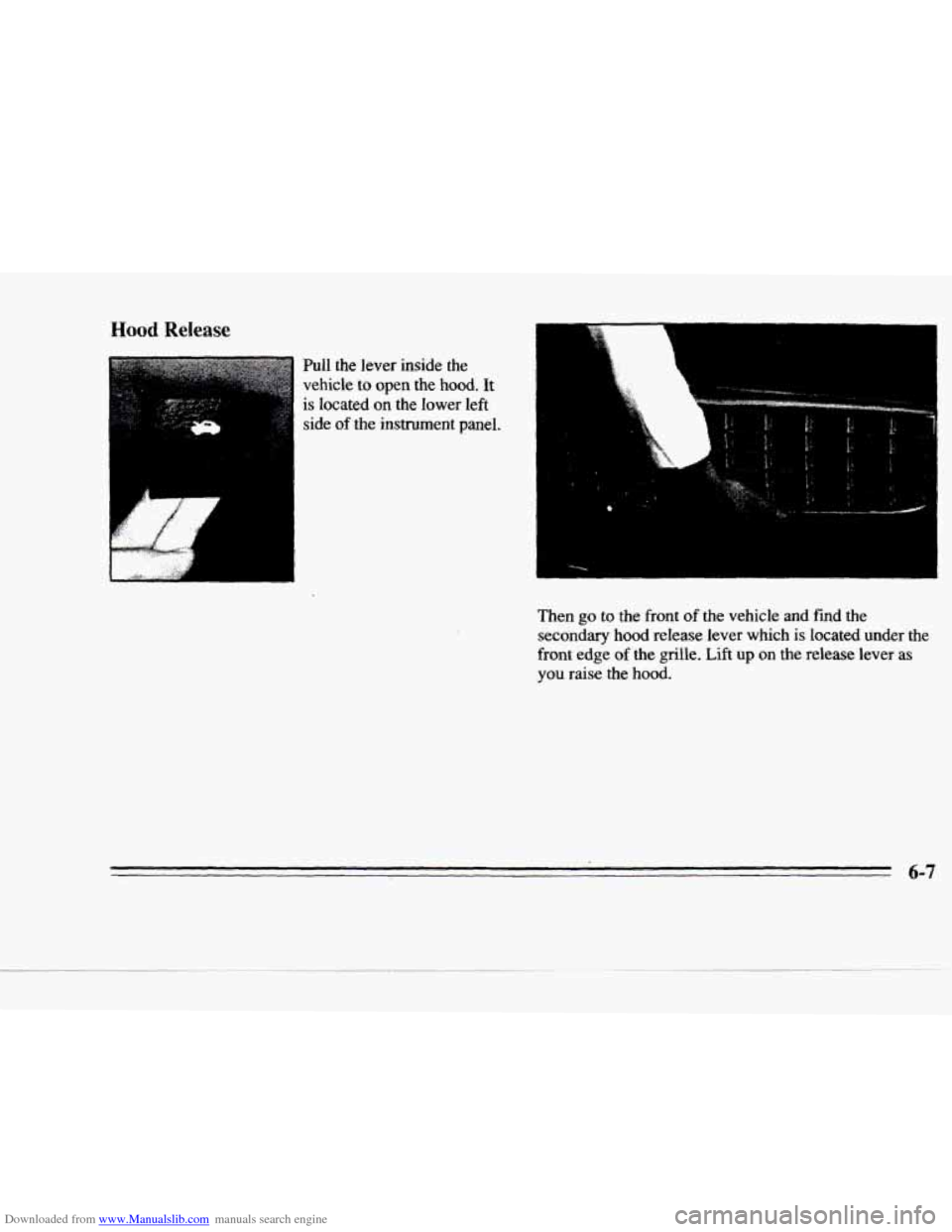
Hood Release
Pull the lever inside the
vehicle to open the hood. It
is located on the lower left
~ side of the instrument panel.
Then go to the front of the vehicle and find the
secondary hood release lever which is located under the
front edge
of the grille. Lift up on the release lever as
you raise the hood.
6-7
Page 308 of 354
Downloaded from www.Manualslib.com manuals search engine Cleaning Leather Cleaning Wood Panels
k
Use
a soft cloth with lukewarm water and a mild soap or
saddle soap.
For stubborn stains, use a GM Vinylbeather Cleaner
or equivalent product.
0 Never use oils, varnishes, solvent-based or abrasive
cleaners, furniture polish or shoe polish on leather.
dirt is allowed to work into the finish, it can harm
the leather.
Soiled leather should be cleaned immediately. If
Cleaning the Top of the Instrument Panel
Use only mild soap and water to clean the top surfaces
of the instrument panel. Sprays containing silicones or
waxes may cause annoying reflections
in the windshield
and even make
it difficult to see through the windshield
under certain conditions. Use
a clean cloth moistened in warm, soapy water (use
mild dish washing
soap). Dry the wood immediately
with a clean cloth.
Cleaning Speaker Covers
Vacuum around a speaker cover gently, so that the
speaker won’t be damaged. Some spots and stains will
clean
off better with just water and mild soap. If
something gets on one of them and you need to use a
solvent, follow these steps:
Gently scrape excess soil from the trim material with a clean, dull knife or scraper. Use very little cleaner,
light pressure and clean cloths (preferably
cheesecloth). Cleaning should start at
the outside of
the stain, “feathering” toward the center. Keep
changing
to a clean section of the cloth.
’ When you clean a stain from fabric, immediately
dry the area with a blow dryer to help prevent a
cleaning ring.
6-47