steering wheel CADILLAC DEVILLE 1997 7.G Owner's Manual
[x] Cancel search | Manufacturer: CADILLAC, Model Year: 1997, Model line: DEVILLE, Model: CADILLAC DEVILLE 1997 7.GPages: 386, PDF Size: 21.61 MB
Page 214 of 386
Downloaded from www.Manualslib.com manuals search engine Off-Road Recovery
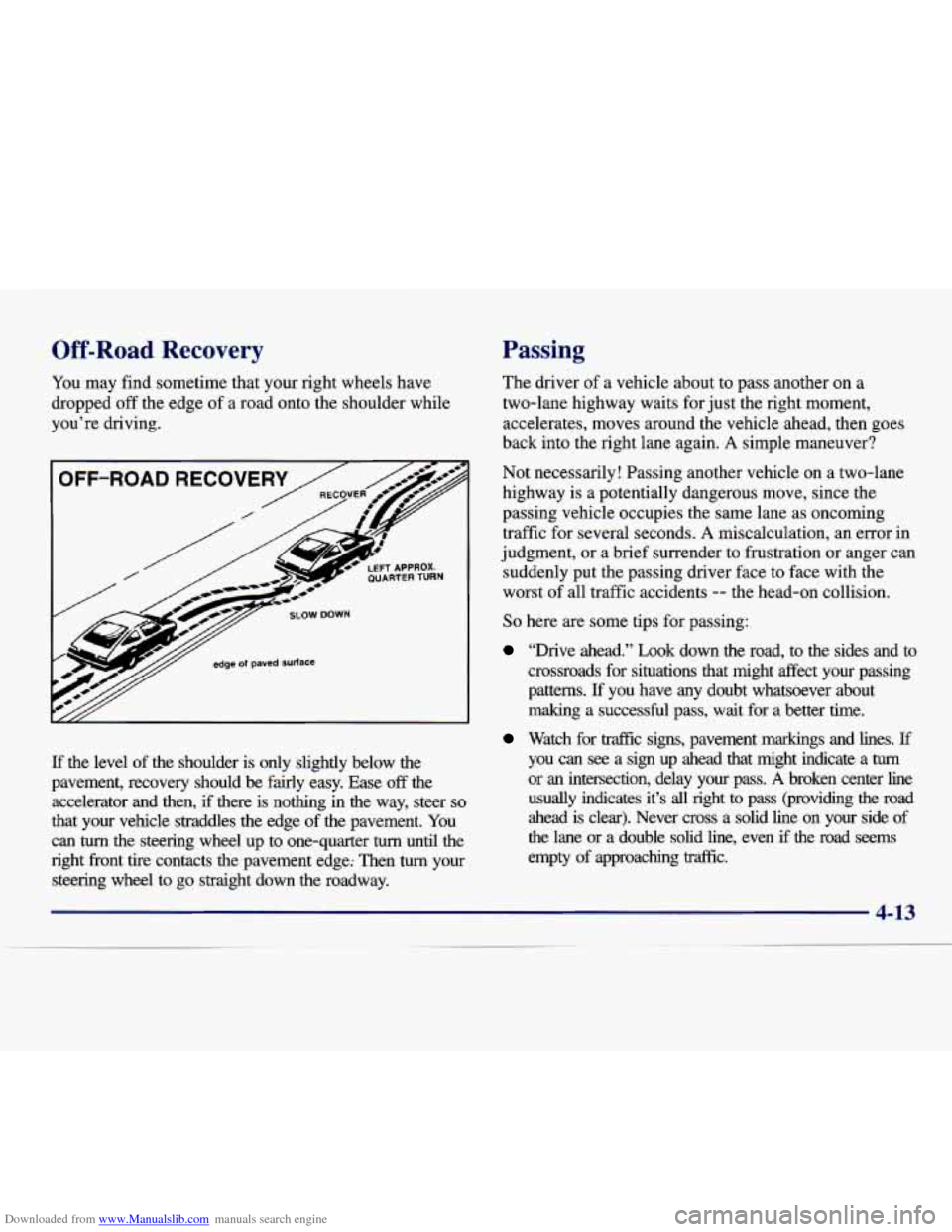
You may find sometime that your right wheels have
dropped off the edge of a road onto the shoulder while
you’re driving.
If the level of the shoulder is only slightly below the
pavement, recovery should be fairly easy.
Ease off the
accelerator and then,
if there is nothing in the way, steer so
that your vehicle straddles the edge of the pavement. You
can
turn the steering wheel up to one-quarter turn until the
right front tire contacts the pavement edge: Then
turn your
steering wheel to go straight down the roadway.
Passing
The driver of a vehicle about to pass another on a
two-lane highway waits for just the right moment,
accelerates, moves around the vehicle ahead, then goes
back into the right lane again.
A simple maneuver?
Not necessarily! Passing another vehicle on a two-lane
highway is a potentially dangerous move, since the
passing vehicle occupies the same lane
as oncoming
traffic for several seconds.
A miscalculation, an error in
judgment, or a brief surrender to frustration or anger can
suddenly put the passing driver face to face with the
worst of all traffic accidents
-- the head-on collision.
So here are some tips for passing:
“Drive ahead.” Look down the road, to the sides ana to
crossroads for situations that might affect your passing
patterns. If you have any doubt whatsoever about
making a successful pass,
wait for a better time.
Watch for traffic signs, pavement markings and lines. If
you can see a sign up ahead that might indicate a turn
or an intersection, delay your pass. A broken center line
usually indicates it’s all right to pass (providing the roa\
d
ahead is clear). Never cross a solid line on your side of
the lane or a double solid line, even
if the road seems
empty of approaching traffic.
4-13
Page 216 of 386

Downloaded from www.Manualslib.com manuals search engine Skidding
In a skid, a driver can lose control of the vehicle.
Defensive drivers avoid most skids by taking reasonable care suited to existing conditions, and by not “overdriving”\
those conditions. But skids are always possible.
The three types of skids correspond to your Cadillac’s
three control systems.
In the braking skid, your wheels
aren’t rolling. In the steering or cornering skid, too
much speed or steering in a curve causes tires to slip and
lose cornering force. And in the acceleration skid, too
much throttle causes the driving wheels to spin.
A cornering skid is best handled by easing your foot off
the accelerator pedal.
Remember: Any traction control system helps avoid
only the acceleration skid.
If your traction control system is off, then an
acceleration
skid is also best handled by easing your
foot
off the accelerator pedal.
If your vehicle starts to slide, ease your foot
off the
accelerator pedal and quickly steer the way
you want the
vehicle to
go. If you start steering quickly enough, your
vehicle may straighten out. Always be ready for a
second skid if it occurs.
If you have the DeVille Concours, you may see the
STABILITY
SYS ENGAGED message on the Driver
Information Center. See “Stability Engaged Message’’ in
the Index.
Of course, traction
is reduced when water, snow, ice,
gravel or other material is on the road. For safety, you’ll
want to slow down and adjust your driving to these
conditions. It is important to slow down on slippery
surfaces because stopping distance will be longer and
vehicle control more limited.
While driving on a surface with reduced traction, try
your best to avoid sudden steering, acceleration or
braking (including engine braking by shifting
to a lower
gear). Any sudden changes could cause the tires to slide.
You may not realize the surface is slippery until your
vehicle is skidding. Learn
to recognize warning
clues
-- such as enough water, ice or packed snow on
the road to make a “mirrored surface”
-- and slow
down when you have
any doubt.
Remember: Any anti-lock brake system (ABS) helps
avoid only the braking skid.
4-15
Page 239 of 386

Downloaded from www.Manualslib.com manuals search engine Passing
You’ll need more passing distance up ahead when
you’re towing
a trailer. And, because you’re a good deal
longer, you’ll need to go much farther beyond the
passed vehicle before you can return to your lane.
Backing Up
Hold the bottom of the steering wheel with one hand.
Then, to move the trailer to the left, just move that hand
to the left.
To move the trailer to the right, move your
hand to the right. Always back up slowly and, if
possible, have someone guide you.
Making Turns
NOTICE:
Making very sharp turns while trailering could
cause the trailer to come in contact with the
vehicle.
Your vehicle could be damaged. Avoid
making very sharp turns while trailering.
When you’re turning with a trailer, make wider turns
than normal.
Do this so your trailer won’t strike soft
shoulders, curbs, road signs, trees or other objects. Avoid
jerky or sudden maneuvers. Signal well
in advance.
Turn Signals When Towing a Trailer
When you tow a trailer, your vehicle may need a
different turn signal flasher and/or extra wiring. Check
with your Cadillac dealer. The green arrows on your
instrument panel will flash whenever you signal a turn or lane change. Properly hooked up, the trailer lamps
will also flash, telling other drivers you’re about to turn,\
change lanes or stop.
When towing a trailer, the green arrows on your
instrument panel will flash for turns even if the bulbs on
the trailer
are burned out. Thus, you may think drivers
behind you
are seeing your signal when they are not. It’s
important to check occasionally to be sure the trailer
bulbs are still working.
Driving On Grades
Reduce speed and shift to a lower gear before you start
down a long or steep downgrade. If you don’t shift
down, you might have to use your brakes
so much that
they would get hot and no longer work well.
On a long uphill grade, shift down and reduce your
speed to around
45 mph (70 km/h) or less to reduce the
possibility of engine and transaxle overheating.
Page 254 of 386

Downloaded from www.Manualslib.com manuals search engine When your vehicle is being towed, have the ignition key
turned to the
OFF position. The steering wheel should
be clamped in a straight-ahead position, with a clamping
device designed for towing service. Do not use the
vehicle’s steering column lock
for this. The transaxle
should be
in NEUTRAL (N) and the parking
brake released.
Don’t have your vehicle towed on the drive wheels
unless you must.
If the vehicle must be towed on the
drive wheels, be sure to follow the speed and distance
restrictions later in
this section or your transaxle will be
damaged.
If these limitations must be exceeded, then the
drive wheels have to be supported on a dolly.
Front Towing
Tow Limits -- 35 mph (56 kph), 25 miles (40 km)
5-11
Page 268 of 386

Downloaded from www.Manualslib.com manuals search engine If a Tire Goes Flat
It’s unusual for a tire to “blow out” while you’re driving,
especially if you maintain your tires properly.
If air goes
out
of a tire, it’s much more likely to leak out slowly.
But if you should ever have a “blowout,” here are a few
tips about what to expect and what to do:
If a front tire fails, the flat tire will create a drag that
pulls the vehicle toward that side. Take your foot off the
accelerator pedal and grip the steering wheel firmly.
Steer to maintain lane position, and then gently brake to
a stop well out of the traffic lane.
A rear blowout, particularly on a curve, acts much like a
skid and may require the same correction you’d use in a
skid. In any rear blowout, remove your foot from the
accelerator pedal. Get the vehicle under control by
steering the way you want the vehicle to go. It may be
very bumpy and noisy, but you can still steer. Gently
brake to a stop
-- well off the road if possible.
If a tire goes flat, the next part shows how to use your
jacking equipment to change a flat tire safely.
Changing a Flat Tire
If a tire goes flat, avoid further tire and wheel damage
by driving slowly
to a level place. Turn on your hazard
Wi *
; flashers.
I-
Changing a tire can cause an injury. The vehicle
can slip
off the jack and roll over you or other
people. You and they could be badly injured.
Find
a level place to change your tire. To help
prevent the vehicle from moving:
1. Put the shift lever in PARK (P).
2. Set the parking brake firmly.
3. Turn off the engine.
To be even more certain the vehicle won’t move,
you can put blocks at the front and rear of the
tire farthest away from the one being changed.
That would be the tire on the other side of the
vehicle, at the opposite end.
Page 280 of 386

Downloaded from www.Manualslib.com manuals search engine I NOTICE:
I I
Spinning your wheels can destroy parts of your
vehicle as well as the tires. If you spin the wheels
too fast while shifting your transaxle back and
forth, you can destroy your transaxle.
Rocking Your Vehicle To Get It Out
First, turn your steering wheel left and right. That will
clear the area around your front wheels. You should turn
your traction control system off. (See “Traction Control
System” in the Index.) Then shift back and forth
between REVERSE
(R) and a forward gear, spinning the
wheels as little
as possible. Release the accelerator pedal
while you shift, and press lightly on the accelerator
pedal when the transaxle is
in gear. If that doesn’t get
If you do need to be towed out, see “Towing Your
Vehicle”
in the Index.
-.
For information about using tire chains on your vehicle, you out after a few tries, you may need to be towed out.
see “Tire Chains” in the Index.
Page 288 of 386

Downloaded from www.Manualslib.com manuals search engine Filling Your Tank The cap is behind a hinged door on the driver’s side of
your vehicle.
A CAUTION:
-
Gasoline vapor is highly flammable. It burns
violently, and that can cause very bad injuries.
Don’t smoke if you’re near gasoline or refueling
your vehicle. Keep sparks, flames and smoking
materials away from gasoline.
The fuel door release
button is located to the
left
of the steering wheel
next to the headlamp
knob
and on the Remote Keyless
Entry (RKE) transmitter. The button only
works in
PARK
(P) when the ignition
key is in any position.
Page 350 of 386

Downloaded from www.Manualslib.com manuals search engine I Fuse I Usage
AMP (Bose Only) Right and
Left Hand Bose
(Optional) Relay, Right and
Left Front
Speakers (On Door), Right and
Left Rear Speakers
I PZM I PZM
RADIOPHONE Radio Receiver, Radio Interface
Module (RIM)(Bose Only),
Phone, DAB Relay, Trunk
Release Relay, Fuel Door Release
Relay, HighLow Beam Relay
I CLUSTER I Steering Wheel Controls, Cluster
ACC PZM, Electrochromic Mirror,
Rain Sensor (Optional),
Accessory Relay
Fuse Usage
HTD MIR Right and Left Outside
Heated Mirror
HTD SEAT
R Passenger Heated Seat Relay
(Optional)
(Optional)
HTD SEAT
L Driver Heated Seat Relay
PULL DOWN Trunk Pull-Down Motor
HDLP WASH
Headlamp Wash Relay (Export),
Headlamp Wash Motor
ANTENNA Power Mast Antenna
RSS CV-RTD Module (CV-RSS)
(DeVille Concours Only)
6-67
Page 372 of 386
Downloaded from www.Manualslib.com manuals search engine ........ ..
Section 8 Index
ABS ......................................... 4.7
NC
Off For Engine Protection Message ............. 2-89
Adding Equipment to the Outside of
Your Cadillac ..... 6-3
AirBag
....................................... 1-22
How Does it Restrain
.......................... 1-27
How it Works
................................ 1-24
Location
.................................... 1-24
Readiness Light
......................... 1.23. 2.75
Servicing
................................... 1-29
What Makes it Inflate
.......................... 1-26
What Will You See After it Inflates
............... 1-27
When Should it Inflate
......................... 1-26
Aircleaner
.................................... 6-15
Air Conditioning
............................... 3-10
Air Conditioning Refrigerants
..................... 6-70
Alarm. Theft-Deterrent .......................... 2- 17
Alignment and Balance. Tire
...................... 6-46
Aluminum Wheels. Cleaning
...................... 6-54
Analog Control Buttons
.......................... 2-87
Antenna. Power
................................ 3-32
Antifreeze
..................................... 6-21
Air Control. Climate Control System ............. 3.3. 3.7
Analog Cluster Climate Control Panel
................ 3-6 Anti-Lock
Brake System Warning Light
................ 2.77. 4.7
Brakes
...................................... 4-7
Anti-Lockout Feature
............................ 2-7
Anti.Theft. Radio
.............................. 3-29
Appearancecare
............................... 6-48
Appearance Care Materials
....................... 6-57
Apply Brake To Shift Message
.................... 2-89
Arbitration Program
............................. 7-11
Armrest. Storage
.......................... 2.59. 2.60
Ashtrays
...................................... 2-61
Assist Handles
................................. 2-63
Astroroof
..................................... 2-64
Audio Equipment. Adding
........................ 3-31
Audio Steering Wheel Controls
.................... 3-30
Audio Systems
................................. 3-14
Automatic Door Locks
............................ 2-5
Automatic Overdrive
............................ 2-27
Automatic Transaxle ............................. 2-22
Fluid
....................................... 6-18
Operation
................................... 2-25
Shifting
..................................... 2-25
Starting Your Engine
.......................... 2-22
Automatic Pull-Down Feature
..................... 2-15
8-1
Page 374 of 386

Downloaded from www.Manualslib.com manuals search engine Cigarette Lighter ............................... 2-6 1
Circuit Breakers and Fuses ....................... 6-62
Cleaner. Air
................................... 6-15
Cleaning Aluminum or Chrome Wheels
................... 6-54
Fabric
................................. 6.49. 6.50
Glass
....................................... 6-52
Inside of Your Cadillac
........................ 6-49
Instrument Panel
............................. 6-5 1
Leather
..................................... 6-51
Outside of Your Cadillac
....................... 6-53
Speakercovers
.............................. 6-52
Special Problems
............................. 6-50
Stains
................................. 6.50. 6.51
Tires
....................................... 6-55
Vinyl
....................................... 6-51
Wheels
..................................... 6-54
Windshield and Wiper Blades
................... 6-53
WoodPanels
................................. 6-51
Climate Control Personalization
................... 3 . 14
Climate Control. Steering Wheel Controls
........... 3-14
Climate Control System
........................... 3-2
Clock. Setting the
............................... 3- 15
Coinholder
.................................... 2-59
Comfort Controls
................................ 3-2
Compact Disc Care
............................. 3-32
Compact Disc Player
............................ 3-26
Compact Disc Player Errors
....................... 3-29
Compact Spare Tire
............................. 5-35
Compass, Rearview Mirror with
................... 2-55
Console Shift Lever
............................. 2-3 1
Continuous Variable
- Real Time Dampening ......... 2-96 Control
of a Vehicle .............................. 4-6
ConvenienceNet
............................... 2-60
Convex Outside Mirror
.......................... 2-59
Coolant
....................................... 6-21
Heater. Engine
............................... 2-23
SurgeTank
.................................. 5-20
Cooling System
................................ 5-18
Cornering Lamps
............................... 2-47
Courtesy Lamps
................................ 2-51
Cruise Control
................................. 2-41
Cruise Engaged Message
......................... 2-91
Cupholders
............................... 2.59. 2.60
Customer Assistance for Text Telephone Users
......... 7-4
Customer Assistance Information
................... 7-1
Customer Satisfaction Procedure
.................... 7-2
CV-RTD (CV-RSS)
............................. 2-96
Damage. Finish
............................... 6-55
Damage. Sheet Metal
............................ 6-55
Daytime Running Lamps ......................... 2-46
DeadBattery
................................... 5-4
Defects. Reporting Safety
................... 7-12. 7.13
Defensive Driving
............................... 4-2
Defogger. Rear Window
......................... 3-13
Defogging
.................................... 3-13
Defrosting
.................................... 3-13
Digital Cluster Climate Control Panel
................ 3-2
Digital Control Buttons
.......................... 2-85
Dimensions.
Vehicle ............................ 6-70
DIC .......................................... 2-85
Dolby' B Noise Reduction
............. 3- 18.3-21. 3-25