high beam CADILLAC DTS 2008 1.G User Guide
[x] Cancel search | Manufacturer: CADILLAC, Model Year: 2008, Model line: DTS, Model: CADILLAC DTS 2008 1.GPages: 454, PDF Size: 2.48 MB
Page 177 of 454

If the battery continues to discharge, even with the
engine idling at a higher rpm setting, some electrical
loads will automatically be reduced. When this occurs,
the rear window defogger may take slightly longer
to clear the glass, the heated seats may not get as warm
as they usually do and the climate control fan may cut
back to a lower speed. For more battery saving
information, see “Battery Saver Active Message” under
DIC Warnings and Messages on page 3-75.
Electric Power Management
The vehicle has Electric Power Management (EPM) that
estimates the battery’s temperature and state of charge.
It then adjusts the voltage for best performance and
extended life of the battery.
When the battery’s state of charge is low, the voltage is
raised slightly to quickly put the charge back in. When
the state of charge is high, the voltage is lowered slightly
to prevent overcharging. If the vehicle has a voltmeter
gage or a voltage display on the Driver Information
Center (DIC), you may see the voltage move up
or down. This is normal. If there is a problem, an
alert will be displayed.The battery can be discharged at idle if the electrical
loads are very high. This is true for all vehicles.
This is because the generator (alternator) may not be
spinning fast enough at idle to produce all the power
that is needed for very high electrical loads.
A high electrical load occurs when several of the
following loads are on: headlamps, high beams, fog
lamps, rear window defogger, climate control fan at
high speed, heated seats, engine cooling fans, trailer
loads, and loads plugged into accessory power outlets.
EPM works to prevent excessive discharge of the
battery. It does this by balancing the generator’s output
and the vehicle’s electrical needs. It can increase
engine idle speed to generate more power, whenever
needed. It can temporarily reduce the power demands
of some accessories.
Normally, these actions occur in steps or levels, without
being noticeable. In rare cases at the highest levels
of corrective action, this action may be noticeable
to the driver. If so, a Driver Information Center (DIC)
message might be displayed, such as Battery Saver
Active or Service Battery Charging System. If this
message is displayed, it is recommended that the
driver reduce the electrical loads as much as possible.
SeeDIC Warnings and Messages on page 3-75.
3-39
Page 207 of 454

Highbeam On Light
This light comes on when
the high-beam headlamps
are in use.
SeeHeadlamp High/Low-Beam Changer on page 3-9
for more information.
Fuel Gage
The fuel gage shows
approximately how
much fuel is in the tank.
It works only when
the engine is on.If the fuel supply gets low, the FUEL LEVEL LOW
message will appear in the Driver Information Center
and a single chime will sound. SeeDIC Warnings
and Messages on page 3-75for more information.
Here are a few concerns some owners have had about
the fuel gage. All of these situations are normal and
do not indicate that anything is wrong with the fuel gage:
At the gas station the gas pump shuts off before
the gage reads full.
The gage may change when you turn, stop quickly
or accelerate quickly.
It takes a little more or less fuel to ll the tank than
the gage indicated. For example, the gage may
have indicated that the tank was half full, but
it actually took a little more or less than half the
tank’s capacity to ll the tank.
3-69
Page 339 of 454

Headlamp Aiming
The vehicle has a visual optical headlamp aiming
system. The aim has been preset at the factory and
should need no further adjustment.
However, if the vehicle is damaged in a crash, the
headlamp aim may be affected and adjustment may
be necessary.
If oncoming vehicles ash their high beams at you, this
may also mean the vertical aim needs to be adjusted.
It is recommended that the vehicle is taken to your
dealer/retailer for service if the headlamps need to
be re-aimed. It is possible however, to re-aim the
headlamps as described.
Notice:To make sure your headlamps are aimed
properly, read all the instructions before beginning.
Failure to follow these instructions could cause
damage to headlamp parts.The vehicle should:Be placed so the headlamps are 25 ft. (7.6 m) from
a light colored wall.
Have all four tires on a level surface which is level
all the way to the wall.
Be placed so it is perpendicular to the wall.
Not have any snow, ice, or mud on it.
Be fully assembled and all other work stopped while
headlamp aiming is being performed.
Be normally loaded with a full tank of fuel and one
person or 160 lbs (75 kg) sitting on the driver seat.
Have all tires properly inated.
Have the spare tire is in its original location in the
vehicle.
Headlamp aiming is done with the vehicle’s low-beam
headlamps. The high-beam headlamps will be correctly
aimed if the low-beam headlamps are aimed properly.
5-47
Page 342 of 454

Bulb Replacement
It is recommended that all bulbs be replaced by your
dealer/retailer.
High Intensity Discharge (HID)
Lighting
{CAUTION:
The low beam high intensity discharge lighting
system operates at a very high voltage. If you
try to service any of the system components,
you could be seriously injured. Have your
dealer/retailer or a qualied technician
service them.
Your vehicle has HID headlamps. After your vehicle’s
HID headlamp bulb has been replaced, you may notice
that the beam is a slightly different shade than it was
originally. This is normal.
Windshield Wiper Blade
Replacement
Windshield wiper blades should be inspected for wear
or cracking. SeeScheduled Maintenance on page 6-4
for more information on wiper blade inspection.
Replacement blades come in different types and are
removed in different ways. Here’s how to remove
the wiper blade:
1. Turn the engine off.
2. Lift the windshield wiper arm and blade away from
the windshield.
3. Pull the clip up from the blade connecting point,
and pull the blade assembly down toward the
windshield to remove it from the wiper arm.
5-50
Page 395 of 454
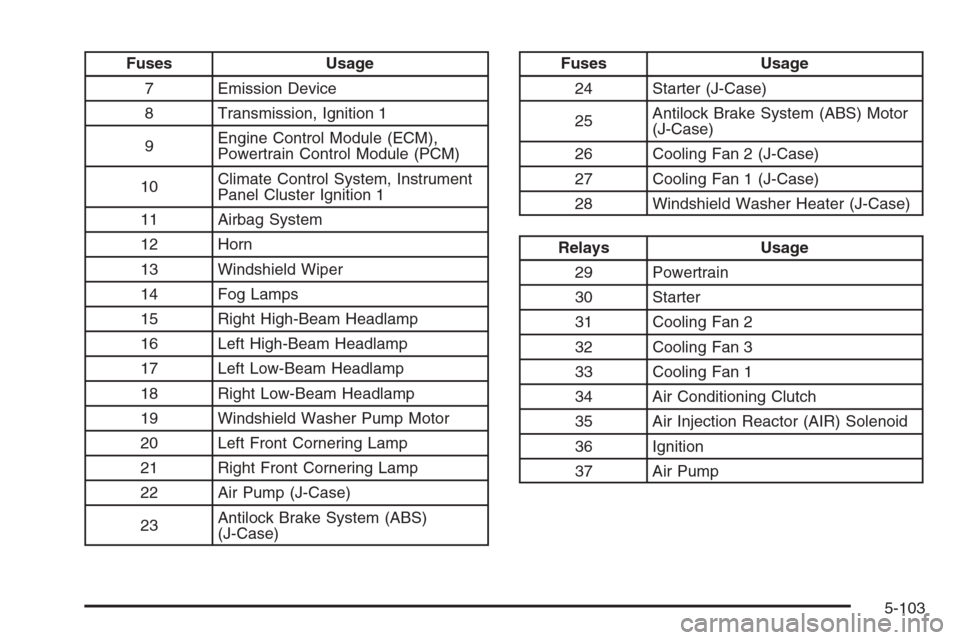
Fuses Usage
7 Emission Device
8 Transmission, Ignition 1
9Engine Control Module (ECM),
Powertrain Control Module (PCM)
10Climate Control System, Instrument
Panel Cluster Ignition 1
11 Airbag System
12 Horn
13 Windshield Wiper
14 Fog Lamps
15 Right High-Beam Headlamp
16 Left High-Beam Headlamp
17 Left Low-Beam Headlamp
18 Right Low-Beam Headlamp
19 Windshield Washer Pump Motor
20 Left Front Cornering Lamp
21 Right Front Cornering Lamp
22 Air Pump (J-Case)
23Antilock Brake System (ABS)
(J-Case)Fuses Usage
24 Starter (J-Case)
25Antilock Brake System (ABS) Motor
(J-Case)
26 Cooling Fan 2 (J-Case)
27 Cooling Fan 1 (J-Case)
28 Windshield Washer Heater (J-Case)
Relays Usage
29 Powertrain
30 Starter
31 Cooling Fan 2
32 Cooling Fan 3
33 Cooling Fan 1
34 Air Conditioning Clutch
35 Air Injection Reactor (AIR) Solenoid
36 Ignition
37 Air Pump
5-103
Page 446 of 454

Fuel............................................................... 5-5
Additives...................................................... 5-6
California Fuel.............................................. 5-6
Filling a Portable Fuel Container....................5-11
Filling the Tank............................................. 5-8
Fuels in Foreign Countries.............................. 5-7
Gage .........................................................3-69
Gasoline Octane........................................... 5-5
Gasoline Specications.................................. 5-5
Running Out of...........................................2-35
Fuses
Fuses and Circuit Breakers.........................5-101
Rear Underseat Fuse Block.........................5-104
Underhood Fuse Block...............................5-101
Windshield Wiper.......................................5-100
G
Gage
Engine Coolant Temperature.........................3-64
Fuel..........................................................3-69
Speedometer..............................................3-55
Tachometer.................................................3-55
Garage Door Opener.......................................2-52
Gasoline
Octane........................................................ 5-5
Specications............................................... 5-5
Glove Box.....................................................2-59
GM Mobility Reimbursement Program.................. 7-7
H
Hazard Warning Flashers................................... 3-6
Head Restraints............................................... 1-7
Headlamp
Aiming .......................................................5-47
Headlamp Wiring...........................................5-100
Headlamps
Bulb Replacement.......................................5-50
Daytime Running Lamps...............................3-35
Exterior Lamps............................................3-32
Flash-to-Pass..............................................3-13
High Intensity Discharge (HID) Lighting...........5-50
High/Low Beam Changer................................ 3-9
On Reminder..............................................3-35
Wiper Activated...........................................3-35
Heated Seats................................................... 1-3
Heated Steering Wheel..................................... 3-7
Heater...........................................................3-42
Engine Coolant...........................................2-26
Highbeam On Light.........................................3-69
High-Speed Operation, Tires.............................5-62
Highway Hypnosis...........................................4-14
Hill and Mountain Roads..................................4-15
Hood
Checking Things Under................................5-12
Release.....................................................5-12
Horn ............................................................... 3-6
How to Wear Safety Belts Properly...................1-16
6
Page 447 of 454

I
Ignition Positions.............................................2-23
Inadvertent Power Battery Saver.......................3-40
Infants and Young Children, Restraints...............1-34
Ination - Tire Pressure...................................5-60
Instrument Panel
Brightness..................................................3-37
Cluster.......................................................3-54
Overview..................................................... 3-4
J
Jump Starting.................................................5-42
K
Keyless Entry System....................................... 2-4
Keys............................................................... 2-3
L
Labeling, Tire Sidewall.....................................5-53
Lamps
Cornering...................................................3-37
Courtesy....................................................3-37
Exterior Lighting Battery Saver......................3-37
Footwell.....................................................3-38Lamps (cont.)
Inadvertent Power Battery Saver....................3-40
Reading.....................................................3-38
Lane Departure Warning..................................2-46
Lane Departure Warning Light..........................3-63
Lap Belt........................................................1-29
Lap-Shoulder Belt...........................................1-24
LATCH System
Child Restraints...........................................1-41
Light
Airbag Readiness........................................3-57
Anti-lock Brake System (ABS) Warning...........3-61
Brake System Warning.................................3-60
Charging System.........................................3-60
Cruise Control.............................................3-68
Engine Coolant Temperature Warning.............3-63
Fog Lamp ..................................................3-68
Highbeam On.............................................3-69
Lane Departure Warning...............................3-63
Lights On Reminder.....................................3-68
Malfunction Indicator....................................3-65
Oil Pressure...............................................3-67
Passenger Airbag Status Indicator..................3-58
Safety Belt Reminders..................................3-56
Security.....................................................3-68
StabiliTrak
®Indicator....................................3-62
TCS Warning Light......................................3-62
Tire Pressure..............................................3-64
Traction Control System (TCS) Warning..........3-62
7
Page 448 of 454

Lighting
Entry.........................................................3-37
Parade Dimming..........................................3-38
Lights
Exterior Lamps............................................3-32
Flash-to-Pass..............................................3-13
High/Low Beam Changer................................ 3-9
On Reminder..............................................3-35
Loading Your Vehicle.......................................4-20
Lockout Protection..........................................2-12
Locks
Central Door Unlocking System.....................2-10
Door ..........................................................2-10
Lockout Protection.......................................2-12
Power Door ................................................2-10
Programmable Automatic Door Locks.............2-11
Rear Door Security Locks.............................2-11
Loss of Control...............................................4-10
Lumbar
Massaging Controls....................................... 1-3
Power Controls............................................. 1-2
Lumbar Controls, Rear Power...........................1-10M
Magnetic Ride Control....................................... 4-6
Maintenance Schedule
Additional Required Services........................... 6-6
At Each Fuel Fill........................................... 6-9
At Least Once a Month................................6-10
At Least Once a Year..................................6-10
Introduction.................................................. 6-2
Maintenance Footnotes.................................. 6-8
Maintenance Record....................................6-16
Maintenance Replacement Parts....................6-14
Maintenance Requirements............................. 6-2
Owner Checks and Services........................... 6-9
Recommended Fluids and Lubricants.............6-13
Scheduled Maintenance................................. 6-4
Using.......................................................... 6-3
Your Vehicle and the Environment................... 6-2
Malfunction Indicator Light................................3-65
Manual, Using..................................................... ii
Massaging Lumbar Controls............................... 1-3
Memory Seat, Mirrors, Steering Wheel Controls.... 1-4
8