wheel CADILLAC DTS 2008 1.G User Guide
[x] Cancel search | Manufacturer: CADILLAC, Model Year: 2008, Model line: DTS, Model: CADILLAC DTS 2008 1.GPages: 454, PDF Size: 2.48 MB
Page 89 of 454
Remote Trunk Release
G
(Remote Trunk Release):The remote trunk
release button is located to the left of the steering wheel
next to the instrument panel brightness control. Press the
button to open the trunk. To use this feature, your vehicle
must be in PARK (P) or NEUTRAL (N) and the valet
lockout switch must be off.
You can also press the button with the trunk symbol on
the remote keyless entry transmitter to open the trunk.
To disable this feature, seeValet Lockout Switch on
page 2-18.
If the vehicle has lost power, the trunk can be accessed
using the Rear Seat Pass-Through. See Rear Seat
Pass-Through below.
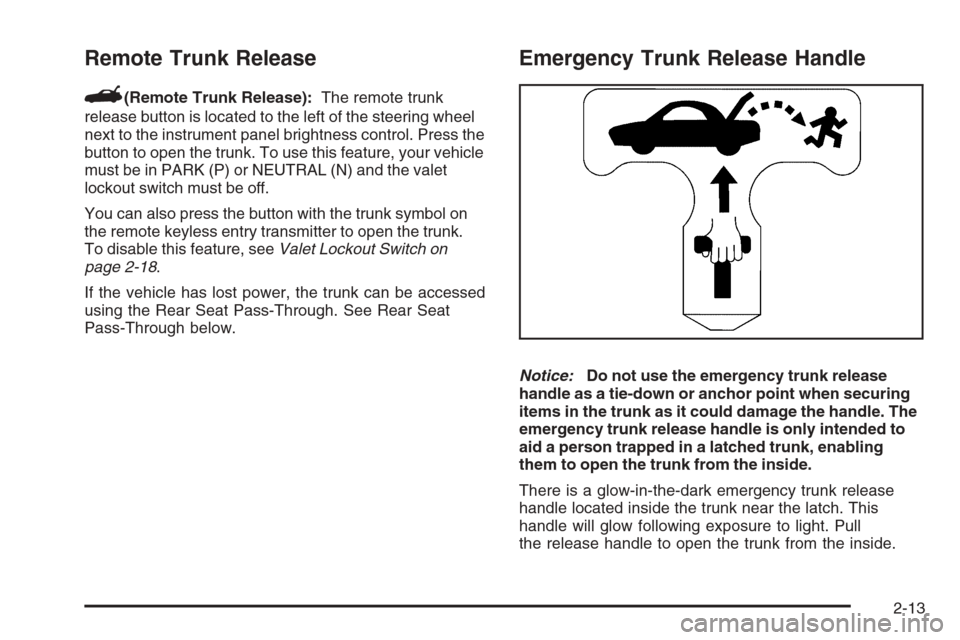
Emergency Trunk Release Handle
Notice:Do not use the emergency trunk release
handle as a tie-down or anchor point when securing
items in the trunk as it could damage the handle. The
emergency trunk release handle is only intended to
aid a person trapped in a latched trunk, enabling
them to open the trunk from the inside.
There is a glow-in-the-dark emergency trunk release
handle located inside the trunk near the latch. This
handle will glow following exposure to light. Pull
the release handle to open the trunk from the inside.
2-13
Page 99 of 454
Ignition Positions
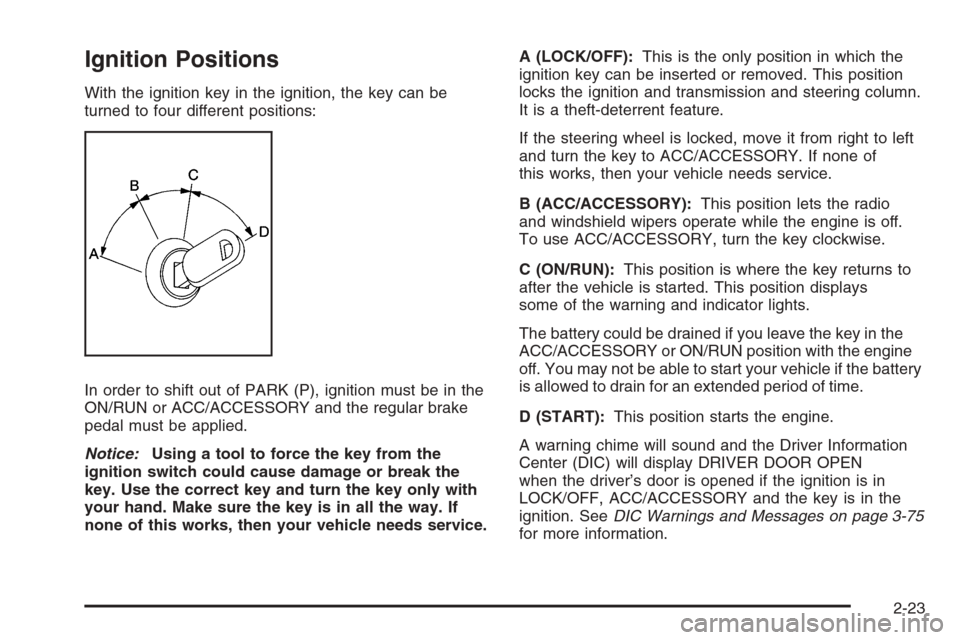
With the ignition key in the ignition, the key can be
turned to four different positions:
In order to shift out of PARK (P), ignition must be in the
ON/RUN or ACC/ACCESSORY and the regular brake
pedal must be applied.
Notice:Using a tool to force the key from the
ignition switch could cause damage or break the
key. Use the correct key and turn the key only with
your hand. Make sure the key is in all the way. If
none of this works, then your vehicle needs service.A (LOCK/OFF):This is the only position in which the
ignition key can be inserted or removed. This position
locks the ignition and transmission and steering column.
It is a theft-deterrent feature.
If the steering wheel is locked, move it from right to left
and turn the key to ACC/ACCESSORY. If none of
this works, then your vehicle needs service.
B (ACC/ACCESSORY):This position lets the radio
and windshield wipers operate while the engine is off.
To use ACC/ACCESSORY, turn the key clockwise.
C (ON/RUN):This position is where the key returns to
after the vehicle is started. This position displays
some of the warning and indicator lights.
The battery could be drained if you leave the key in the
ACC/ACCESSORY or ON/RUN position with the engine
off. You may not be able to start your vehicle if the battery
is allowed to drain for an extended period of time.
D (START):This position starts the engine.
A warning chime will sound and the Driver Information
Center (DIC) will display DRIVER DOOR OPEN
when the driver’s door is opened if the ignition is in
LOCK/OFF, ACC/ACCESSORY and the key is in the
ignition. SeeDIC Warnings and Messages on page 3-75
for more information.
2-23
Page 100 of 454
Key In the Ignition
Never leave your vehicle with the keys inside, as it is an
easy target for joy riders or thieves. If you leave the
key in the ignition and park your vehicle, a chime
will sound, when you open the driver’s door. Always
remember to remove your key from the ignition and take
it with you. This will lock your ignition and transmission.
Also, always remember to lock the doors.
The battery could be drained if you leave the key in the
ignition while your vehicle is parked. You may not be
able to start your vehicle after it has been parked for an
extended period of time.
Retained Accessory Power (RAP)
These vehicle accessories can be used for up to
10 minutes after the ignition key is turned off:
Audio System
Audio Steering Wheel Controls
Power Windows
Sunroof (if equipped)Power to these accessories will work up to 10 minutes
or until the driver’s door is opened. For an additional
10 minutes of power, close all the doors and turn the key
to ON/RUN and then back to LOCK/OFF.
Starting the Engine
Move your shift lever to PARK (P) or NEUTRAL (N).
Your engine will not start in any other position – this
is a safety feature. To restart when you are already
moving, use NEUTRAL (N) only.
Notice:Do not try to shift to PARK (P) if your
vehicle is moving. If you do, you could damage the
transmission. Shift to PARK (P) only when your
vehicle is stopped.
2-24
Page 103 of 454

Automatic Transmission Operation
The automatic transmission may have a shift lever
located either on the steering column or on the console
between the seats.
There are several different positions for the shift lever.
PARK (P):This position locks the front wheels. It is the
best position to use when you start the engine because
your vehicle cannot move easily.{CAUTION:
It is dangerous to get out of the vehicle if the
shift lever is not fully in P (Park) with the
parking brake rmly set. The vehicle can roll.
Do not leave the vehicle when the engine is
running unless you have to. If you have left the
engine running, the vehicle can move suddenly.
You or others could be injured. To be sure the
vehicle will not move, even when you are on
fairly level ground, always set the parking brake
and move the shift lever to P (Park). SeeShifting
Into Park on page 2-31. If you are pulling a
trailer, seeTowing a Trailer on page 4-27.
Make sure the shift lever is fully in PARK (P) before
starting the engine. Your vehicle has an automatic
transmission shift lock control system. You have to fully
apply your regular brakes before you can shift from
PARK (P) while the ignition key is in ON/RUN. If you
cannot shift out of PARK (P), ease pressure on the shift
lever. Push the shift lever all the way into PARK (P)
as you maintain brake application. Then move the shift
lever into another gear. SeeShifting Out of Park on
page 2-33.
2-27
Page 104 of 454

REVERSE (R):Use this gear to back up.
Notice:Shifting to R (Reverse) while the vehicle is
moving forward could damage the transmission.
The repairs would not be covered by the vehicle
warranty. Shift to R (Reverse) only after the vehicle
is stopped.
Also use this gear to rock your vehicle back and forth to
get out of snow, ice or sand without damaging your
transmission. SeeIf Your Vehicle is Stuck in Sand, Mud,
Ice, or Snow on page 4-19for additional information.
NEUTRAL (N):In this position, the engine does
not connect with the wheels. To restart when you are
already moving, use NEUTRAL (N) only. Also, use
NEUTRAL (N) when your vehicle is being towed.
{CAUTION:
Shifting into a drive gear while the engine is
running at high speed is dangerous. Unless
your foot is rmly on the brake pedal, the
vehicle could move very rapidly. You could lose
control and hit people or objects. Do not shift
into a drive gear while the engine is running at
high speed.
Notice:Shifting out of P (Park) or N (Neutral) with
the engine running at high speed may damage
the transmission. The repairs would not be covered
by the vehicle warranty. Be sure the engine is
not running at high speed when shifting the vehicle.
DRIVE (D):This position is for normal driving. It
provides the best fuel economy for your vehicle. If you
need more power for passing, and you are:
Going less than 35 mph (55 km/h), push the
accelerator pedal about halfway down.
Going about 35 mph (55 km/h) or more, push the
accelerator all the way down.
The transmission will shift down to the next gear and
have more power.
2-28
Page 126 of 454

Available Services with Safe & Sound Plan
Automatic Notication of Airbag Deployment
Advanced Automatic Crash Notication (AACN)
(If equipped)
Link to Emergency Services
Roadside Assistance
Stolen Vehicle Location Assistance
AccidentAssist
Remote Door Unlock/Vehicle Alert
OnStar Vehicle Diagnostics
GM Goodwrench On Demand Diagnostics
OnStar Hands-Free Calling with 30 complimentary
minutes
OnStar Virtual Advisor (U.S. Only)
Available Services included with
Directions & Connections Plan
All Safe and Sound Plan Services
Driving Directions - Advisor delivered or OnStar
Turn-by-Turn Navigation (If equipped)
RideAssist
Information and Convenience Services
OnStar Hands-Free Calling
OnStar Hands-Free Calling allows eligible OnStar
subscribers to make and receive calls using voice
commands. Hands-Free Calling is fully integrated into
the vehicle, and can be used with OnStar Pre-Paid
Minute Packages. Hands-Free Calling may also
be linked to a Verizon Wireless service plan in the U.S.
or a Bell Mobility service plan in Canada, depending
on eligibility. To nd out more, refer to the OnStar
Owner’s Guide in the vehicle’s glove box, visit
www.onstar.com or www.onstar.ca, or speak with an
OnStar advisor by pressing the OnStar button or calling
1-888-4-ONSTAR (1-888-466-7827).
OnStar Virtual Advisor
OnStar Virtual Advisor is a feature of OnStar Hands-Free
Calling that uses your minutes to access location-based
weather, local traffic reports, and stock quotes. By
pressing the phone button and giving a few simple voice
commands, you can browse through the various topics.
See the OnStar Owner’s Guide for more information
(Only available in the continental U.S.).
OnStar Steering Wheel Controls
Your vehicle may have a Talk/Mute button that can be
used to interact with OnStar Hands-Free Calling.
SeeAudio Steering Wheel Controls on page 3-118for
more information.
2-50
Page 139 of 454
Instrument Panel Overview...............................3-4
Hazard Warning Flashers................................3-6
Other Warning Devices...................................3-6
Horn .............................................................3-6
Tilt Wheel.....................................................3-6
Power Tilt Wheel and Telescopic Steering
Column......................................................3-7
Heated Steering Wheel...................................3-7
Turn Signal/Multifunction Lever.........................3-8
Turn and Lane-Change Signals........................3-9
Headlamp High/Low-Beam Changer..................3-9
Forward Collision Alert (FCA) System..............3-10
Flash-to-Pass...............................................3-13
Windshield Wipers........................................3-13
Rainsense™ II Wipers...................................3-14
Windshield Washer.......................................3-15
Cruise Control..............................................3-16
Adaptive Cruise Control.................................3-19
Exterior Lamps.............................................3-32
Wiper Activated Headlamps............................3-35
Headlamps on Reminder................................3-35
Daytime Running Lamps (DRL).......................3-35
Fog Lamps ..................................................3-36
Cornering Lamps..........................................3-37
Exterior Lighting Battery Saver........................3-37
Instrument Panel Brightness...........................3-37
Courtesy Lamps...........................................3-37Entry Lighting...............................................3-37
Parade Dimming...........................................3-38
Reading Lamps............................................3-38
Footwell Lamps............................................3-38
Battery Load Management.............................3-38
Electric Power Management...........................3-39
Inadvertent Power Battery Saver.....................3-40
Battery Run-Down Protection..........................3-40
Accessory Power Outlet(s).............................3-40
Ashtray(s)....................................................3-41
Analog Clock...............................................3-42
Climate Controls............................................3-42
Dual Climate Control System..........................3-42
Outlet Adjustment.........................................3-48
Rear Climate Control System.........................3-49
Passenger Compartment Air Filter...................3-51
Warning Lights, Gages, and Indicators............3-53
Instrument Panel Cluster................................3-54
Speedometer and Odometer...........................3-55
Tachometer.................................................3-55
Safety Belt Reminders...................................3-56
Airbag Readiness Light..................................3-57
Passenger Airbag Status Indicator...................3-58
Charging System Light..................................3-60
Brake System Warning Light..........................3-60
Antilock Brake System (ABS) Warning Light.....3-61
Section 3 Instrument Panel
3-1
Page 140 of 454
Traction Control System (TCS) Warning Light . . .3-62
StabiliTrak®Indicator Light.............................3-62
Lane Departure Warning Light........................3-63
Engine Coolant Temperature Warning Light......3-63
Engine Coolant Temperature Gage..................3-64
Tire Pressure Light.......................................3-64
Malfunction Indicator Lamp.............................3-65
Oil Pressure Light.........................................3-67
Security Light...............................................3-68
Fog Lamp Light............................................3-68
Lights On Reminder......................................3-68
Cruise Control Light......................................3-68
Highbeam On Light.......................................3-69
Fuel Gage...................................................3-69Driver Information Center (DIC).......................3-70
DIC Operation and Displays...........................3-70
DIC Warnings and Messages.........................3-75
DIC Vehicle Customization.............................3-87
Audio System(s).............................................3-96
Setting the Clock..........................................3-97
Radio(s) (MP3)...........................................3-100
Using an MP3............................................3-111
XM Radio Messages...................................3-117
Navigation/Radio System..............................3-118
Theft-Deterrent Feature................................3-118
Audio Steering Wheel Controls......................3-118
Radio Reception.........................................3-119
Backglass Antenna......................................3-120
XM™ Satellite Radio Antenna System............3-120
Section 3 Instrument Panel
3-2
Page 143 of 454
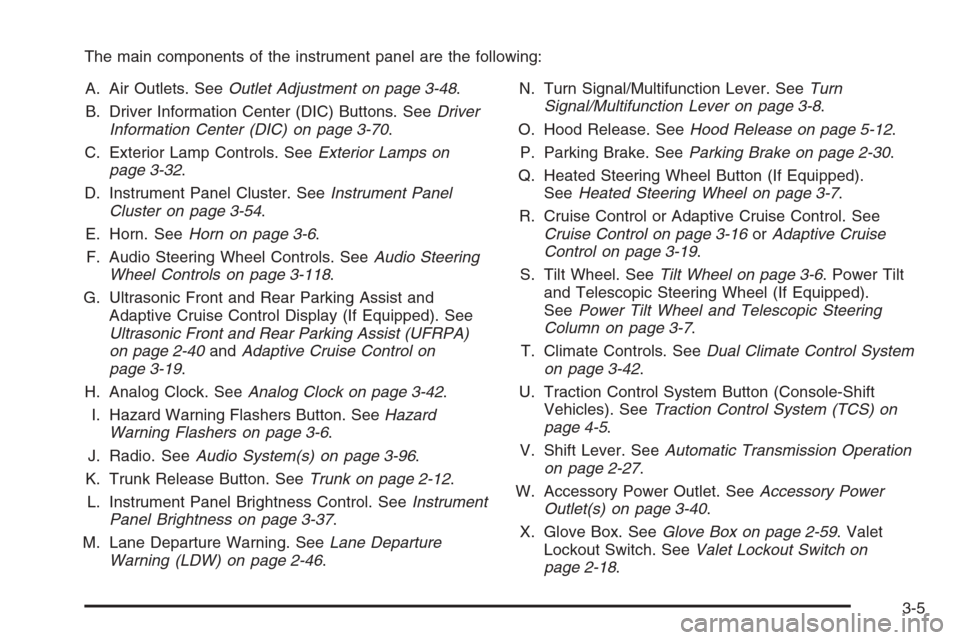
The main components of the instrument panel are the following:
A. Air Outlets. SeeOutlet Adjustment on page 3-48.
B. Driver Information Center (DIC) Buttons. SeeDriver
Information Center (DIC) on page 3-70.
C. Exterior Lamp Controls. SeeExterior Lamps on
page 3-32.
D. Instrument Panel Cluster. SeeInstrument Panel
Cluster on page 3-54.
E. Horn. SeeHorn on page 3-6.
F. Audio Steering Wheel Controls. SeeAudio Steering
Wheel Controls on page 3-118.
G. Ultrasonic Front and Rear Parking Assist and
Adaptive Cruise Control Display (If Equipped). See
Ultrasonic Front and Rear Parking Assist (UFRPA)
on page 2-40andAdaptive Cruise Control on
page 3-19.
H. Analog Clock. SeeAnalog Clock on page 3-42.
I. Hazard Warning Flashers Button. SeeHazard
Warning Flashers on page 3-6.
J. Radio. SeeAudio System(s) on page 3-96.
K. Trunk Release Button. SeeTrunk on page 2-12.
L. Instrument Panel Brightness Control. SeeInstrument
Panel Brightness on page 3-37.
M. Lane Departure Warning. SeeLane Departure
Warning (LDW) on page 2-46.N. Turn Signal/Multifunction Lever. SeeTurn
Signal/Multifunction Lever on page 3-8.
O. Hood Release. SeeHood Release on page 5-12.
P. Parking Brake. SeeParking Brake on page 2-30.
Q. Heated Steering Wheel Button (If Equipped).
SeeHeated Steering Wheel on page 3-7.
R. Cruise Control or Adaptive Cruise Control. See
Cruise Control on page 3-16orAdaptive Cruise
Control on page 3-19.
S. Tilt Wheel. SeeTilt Wheel on page 3-6. Power Tilt
and Telescopic Steering Wheel (If Equipped).
SeePower Tilt Wheel and Telescopic Steering
Column on page 3-7.
T. Climate Controls. SeeDual Climate Control System
on page 3-42.
U. Traction Control System Button (Console-Shift
Vehicles). SeeTraction Control System (TCS) on
page 4-5.
V. Shift Lever. SeeAutomatic Transmission Operation
on page 2-27.
W. Accessory Power Outlet. SeeAccessory Power
Outlet(s) on page 3-40.
X. Glove Box. SeeGlove Box on page 2-59. Valet
Lockout Switch. SeeValet Lockout Switch on
page 2-18.
3-5
Page 144 of 454

Hazard Warning Flashers
The hazard warning ashers let you warn the police and
others that you have a problem. The front and rear
turn signal lamps will ash on and off.
The hazard warning
asher button is on the
instrument panel.
Press the button to make the front and rear turn signal
lamps ash on and off. Press again to turn the
ashers completely off.
The hazard warning ashers work even if the key is not
in the ignition switch.
Other Warning Devices
If you carry reective triangles, you can set them up at
the side of the road about 300 feet (100 m) behind
your vehicle.
Horn
Press near or on the horn symbols on the steering
wheel pad to sound the horn.
Tilt Wheel
A tilt wheel lets you adjust the steering wheel before
you drive. You can raise the steering wheel to the
highest level to give your legs more room when you
enter and exit the vehicle.
The lever that lets you tilt the steering wheel is located
on the left side of the steering column.
To tilt the wheel, hold the
wheel and pull the lever.
Then move the wheel
to a comfortable position
and release the lever
to lock the wheel in place.
3-6