instrument panel CADILLAC DTS 2008 1.G Workshop Manual
[x] Cancel search | Manufacturer: CADILLAC, Model Year: 2008, Model line: DTS, Model: CADILLAC DTS 2008 1.GPages: 454, PDF Size: 2.48 MB
Page 319 of 454

Adding Coolant
If you need more coolant, add the proper DEX-COOL®
coolant mixture at the coolant surge tank, but only
when the engine is cool.
{CAUTION:
You can be burned if you spill coolant on hot
engine parts. Coolant contains ethylene glycol,
and it will burn if the engine parts are hot
enough. Do not spill coolant on a hot engine.
When replacing the pressure cap, make sure to turn the
cap until it clicks.
Coolant Surge Tank Pressure Cap
Notice:If the pressure cap is not tightly installed,
coolant loss and possible engine damage may
occur. Be sure the cap is properly and tightly
secured.
The coolant surge tank pressure cap must be fully
installed on the coolant surge tank. SeeEngine
Compartment Overview on page 5-14for more
information on location.
Engine Overheating
You will nd an ENGINE OVERHEATED IDLE ENGINE
message or an ENGINE OVERHEATED STOP ENGINE
message displayed in the Driver Information Center
(DIC). SeeDIC Warnings and Messages on page 3-75
for more information. You will also hear a chime.
There is also an engine temperature warning light
and/or gage on the instrument panel cluster. SeeEngine
Coolant Temperature Warning Light on page 3-63and
Engine Coolant Temperature Gage on page 3-64.
5-27
Page 356 of 454

Federal Communications
Commission (FCC) and Industry
and Science Canada
The Tire Pressure Monitor System (TPMS) operates
on a radio frequency and complies with Part 15 of
the FCC Rules. Operation is subject to the following
two conditions:
1. This device may not cause harmful interference.
2. This device must accept any interference received,
including interference that may cause undesired
operation.
The TPMS operates on a radio frequency and complies
with RSS-210 of Industry and Science Canada.
Operation is subject to the following two conditions:
1. This device may not cause interference.
2. This device must accept any interference received,
including interference that may cause undesired
operation of the device.
Changes or modications to this system by other than
an authorized service facility could void authorization to
use this equipment.
Tire Pressure Monitor Operation
The Tire Pressure Monitor System (TPMS) is designed
to warn the driver when a low tire pressure condition
exists. TPMS sensors are mounted onto each tire
and wheel assembly, excluding the spare tire and wheel
assembly. The TPMS sensors monitor the air pressure
in the vehicle’s tires and transmits the tire pressure
readings to a receiver located in the vehicle.
When a low tire pressure
condition is detected, the
TPMS illuminates the low
tire pressure warning light
located on the instrument
panel cluster.
5-64
Page 385 of 454

Instrument Panel, Vinyl, and Other
Plastic Surfaces
A soft cloth dampened with water may be used to
remove dust. If a more thorough cleaning is necessary,
a clean soft cloth dampened with a mild soap solution can
be used to gently remove dust and dirt. Never use spot
lifters or removers on plastic surfaces. Many commercial
cleaners and coatings that are sold to preserve and
protect soft plastic surfaces may permanently change
the appearance and feel of your interior and are not
recommended. Do not use silicone or wax-based
products, or those containing organic solvents to
clean your vehicle’s interior because they can alter
the appearance by increasing the gloss in a non-uniform
manner.
Some commercial products may increase gloss on your
instrument panel. The increase in gloss may cause
annoying reections in the windshield and even make
it difficult to see through the windshield under certain
conditions.
Wood Panels
Use a clean cloth moistened in warm, soapy water (use
mild dish washing soap). Dry the wood immediately
with a clean cloth.
Speaker Covers
Vacuum around a speaker cover gently, so that the
speaker will not be damaged. Clean spots with
just water and mild soap.
Care of Safety Belts
Keep belts clean and dry.
{CAUTION:
Do not bleach or dye safety belts. If you do,
it may severely weaken them. In a crash,
they might not be able to provide adequate
protection. Clean safety belts only with mild
soap and lukewarm water.
5-93
Page 391 of 454

Vehicle Identication
Vehicle Identication Number (VIN)
This is the legal identier for your vehicle. It appears on
a plate in the front corner of the instrument panel, on
the driver side. It can be seen through the windshield
from outside the vehicle. The VIN also appears on
the Vehicle Certication and Service Parts labels and
the certicates of title and registration.
Engine Identication
The eighth character in the VIN is the engine code. This
code helps identify the vehicle’s engine, specications,
and replacement parts. See “Engine Specications”
underCapacities and Specifications on page 5-109for
your vehicle’s engine code.
Service Parts Identication Label
This label is on the spare tire cover. It is very helpful if
you ever need to order parts. The label has the
following information:
Vehicle Identication Number (VIN)
Model designation
Paint information
Production options and special equipment
Do not remove this label from the vehicle.
5-99
Page 395 of 454
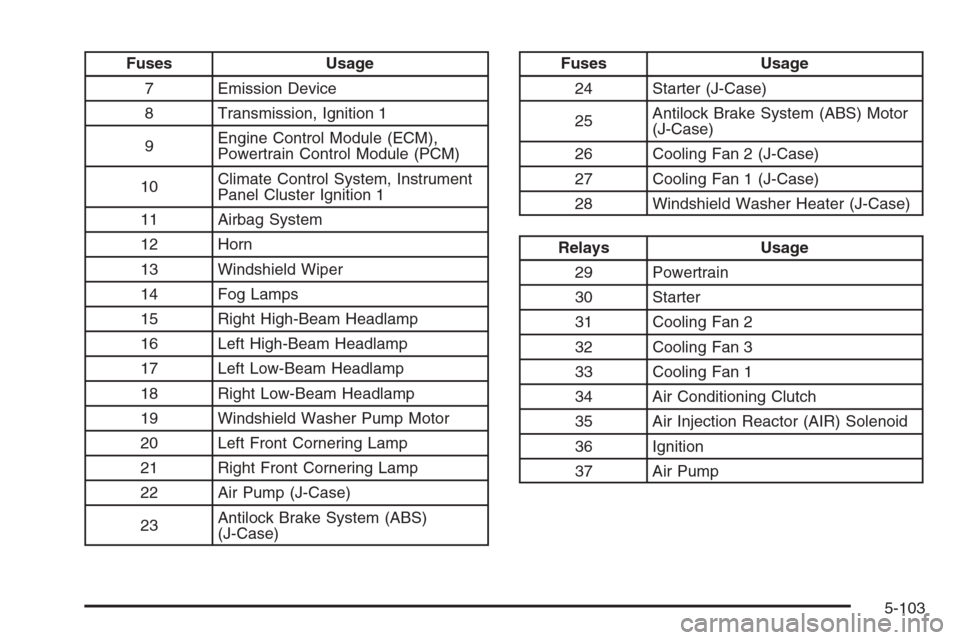
Fuses Usage
7 Emission Device
8 Transmission, Ignition 1
9Engine Control Module (ECM),
Powertrain Control Module (PCM)
10Climate Control System, Instrument
Panel Cluster Ignition 1
11 Airbag System
12 Horn
13 Windshield Wiper
14 Fog Lamps
15 Right High-Beam Headlamp
16 Left High-Beam Headlamp
17 Left Low-Beam Headlamp
18 Right Low-Beam Headlamp
19 Windshield Washer Pump Motor
20 Left Front Cornering Lamp
21 Right Front Cornering Lamp
22 Air Pump (J-Case)
23Antilock Brake System (ABS)
(J-Case)Fuses Usage
24 Starter (J-Case)
25Antilock Brake System (ABS) Motor
(J-Case)
26 Cooling Fan 2 (J-Case)
27 Cooling Fan 1 (J-Case)
28 Windshield Washer Heater (J-Case)
Relays Usage
29 Powertrain
30 Starter
31 Cooling Fan 2
32 Cooling Fan 3
33 Cooling Fan 1
34 Air Conditioning Clutch
35 Air Injection Reactor (AIR) Solenoid
36 Ignition
37 Air Pump
5-103
Page 422 of 454

Customer Assistance and
Information
Customer Satisfaction Procedure
Your satisfaction and goodwill are important to
your dealer and to Cadillac. Normally, any concerns
with the sales transaction or the operation of the vehicle
will be resolved by the dealer’s sales or service
departments. Sometimes, however, despite the best
intentions of all concerned, misunderstandings can
occur. If your concern has not been resolved to your
satisfaction, the following steps should be taken:
STEP ONE:Discuss your concern with a member of
dealership management. Normally, concerns can
be quickly resolved at that level. If the matter has
already been reviewed with the sales, service or parts
manager, contact the owner of the dealership or
the general manager.STEP TWO:If after contacting a member of dealership
management, it appears your concern cannot be
resolved by the dealership without further help, in the
United States, call the Cadillac Customer Assistance
Center, 24 hours a day, at 1-800-458-8006. In Canada,
call the Canadian Cadillac Customer Communication
Centre at 1-888-446-2000.
We encourage you to call the toll-free number in order
to give your inquiry prompt attention. Have the
following information available to give the Customer
Assistance Representative:
Vehicle Identication Number (VIN). This is
available from the vehicle registration or title, or the
plate at the top left of the instrument panel and
visible through the windshield.
Dealership name and location.
Vehicle delivery date and present mileage.
When contacting Cadillac, remember that your concern
will likely be resolved at a dealer’s facility. That is
why we suggest following Step One rst.
7-2
Page 441 of 454

A
Accessories and Modications............................ 5-3
Accessory Power Outlets.................................3-40
Adaptive Cruise Control...................................3-19
Adding Equipment to Your Airbag-Equipped
Vehicle.......................................................1-69
Additives, Fuel................................................. 5-6
Add-On Electrical Equipment...........................5-100
Air Cleaner/Filter, Engine.................................5-20
Air Conditioning..............................................3-42
Airbag
Passenger Status Indicator...........................3-58
Readiness Light..........................................3-57
Airbag System................................................1-53
Adding Equipment to Your Airbag-Equipped
Vehicle...................................................1-69
How Does an Airbag Restrain?......................1-61
Passenger Sensing System...........................1-63
Servicing Your Airbag-Equipped Vehicle..........1-68
What Makes an Airbag Inate?......................1-61
What Will You See After an Airbag Inates?....1-62
When Should an Airbag Inate?....................1-59
Where Are the Airbags?...............................1-56
Analog Clock..................................................3-42
Antenna, Backglass.......................................3-120
Antenna, XM™ Satellite Radio Antenna
System.....................................................3-120
Antilock Brake System (ABS)............................. 4-4
Anti-lock Brake, System Warning Light...............3-61Appearance Care
Aluminum or Chrome-Plated Wheels..............5-96
Care of Safety Belts....................................5-93
Chemical Paint Spotting...............................5-98
Cleaning Exterior Lamps/Lenses....................5-94
Fabric/Carpet..............................................5-91
Finish Care.................................................5-94
Finish Damage............................................5-97
Instrument Panel, Vinyl, and Other Plastic
Surfaces.................................................5-93
Interior Cleaning..........................................5-90
Leather......................................................5-92
Sheet Metal Damage...................................5-97
Speaker Covers..........................................5-93
Tires..........................................................5-97
Underbody Maintenance...............................5-97
Vehicle Care/Appearance Materials................5-98
Washing Your Vehicle...................................5-94
Weatherstrips..............................................5-94
Windshield and Wiper Blades........................5-95
Wood Panels..............................................5-93
Appointments, Scheduling Service.....................7-11
Ashtray(s)......................................................3-41
Audio System.................................................3-96
Audio Steering Wheel Controls....................3-118
Backglass Antenna.....................................3-120
Navigation/Radio System, see Navigation
Manual.................................................3-118
Radio Reception........................................3-119
Setting the Clock.........................................3-97
1
Page 443 of 454

Child Restraints (cont.)
Securing a Child Restraint in the
Center Front Seat Position........................1-49
Securing a Child Restraint in the
Right Front Seat Position..........................1-50
Where to Put the Restraint...........................1-40
Cleaning
Aluminum or Chrome-Plated Wheels..............5-96
Exterior Lamps/Lenses.................................5-94
Fabric/Carpet..............................................5-91
Finish Care.................................................5-94
Instrument Panel, Vinyl, and Other Plastic
Surfaces.................................................5-93
Interior.......................................................5-90
Leather......................................................5-92
Speaker Covers..........................................5-93
Tires..........................................................5-97
Underbody Maintenance...............................5-97
Washing Your Vehicle...................................5-94
Weatherstrips..............................................5-94
Windshield and Wiper Blades........................5-95
Wood Panels..............................................5-93
Climate Control System
Air Filter, Passenger Compartment.................3-51
Dual ..........................................................3-42
Outlet Adjustment........................................3-48
Rear ..........................................................3-49
Clock............................................................3-42
Clock, Setting.................................................3-97Coinholder(s)..................................................2-59
Collision Damage Repair..................................7-13
Compass.................................................1-9, 2-36
Content Theft-Deterrent....................................2-19
Control of a Vehicle.......................................... 4-3
Convenience Net............................................2-60
Coolant
Engine.......................................................5-24
Engine Temperature Gage............................3-64
Engine Temperature Warning Light.................3-63
Surge Tank Pressure Cap.............................5-27
Cooled Seats................................................... 1-3
Cooling System..............................................5-30
Cornering Lamps............................................3-37
Courtesy Lamps.............................................3-37
Cruise Control................................................3-16
Cruise Control, Forward Collision Alert (FAC)
System......................................................3-10
Cruise Control Light........................................3-68
Cupholders....................................................2-59
Customer Assistance Information
Courtesy Transportation................................7-11
Customer Assistance for Text Telephone (TTY)
Users....................................................... 7-6
Customer Assistance Offices........................... 7-6
Customer Satisfaction Procedure..................... 7-2
GM Mobility Reimbursement Program............... 7-7
Reporting Safety Defects to General Motors....7-16
3
Page 447 of 454

I
Ignition Positions.............................................2-23
Inadvertent Power Battery Saver.......................3-40
Infants and Young Children, Restraints...............1-34
Ination - Tire Pressure...................................5-60
Instrument Panel
Brightness..................................................3-37
Cluster.......................................................3-54
Overview..................................................... 3-4
J
Jump Starting.................................................5-42
K
Keyless Entry System....................................... 2-4
Keys............................................................... 2-3
L
Labeling, Tire Sidewall.....................................5-53
Lamps
Cornering...................................................3-37
Courtesy....................................................3-37
Exterior Lighting Battery Saver......................3-37
Footwell.....................................................3-38Lamps (cont.)
Inadvertent Power Battery Saver....................3-40
Reading.....................................................3-38
Lane Departure Warning..................................2-46
Lane Departure Warning Light..........................3-63
Lap Belt........................................................1-29
Lap-Shoulder Belt...........................................1-24
LATCH System
Child Restraints...........................................1-41
Light
Airbag Readiness........................................3-57
Anti-lock Brake System (ABS) Warning...........3-61
Brake System Warning.................................3-60
Charging System.........................................3-60
Cruise Control.............................................3-68
Engine Coolant Temperature Warning.............3-63
Fog Lamp ..................................................3-68
Highbeam On.............................................3-69
Lane Departure Warning...............................3-63
Lights On Reminder.....................................3-68
Malfunction Indicator....................................3-65
Oil Pressure...............................................3-67
Passenger Airbag Status Indicator..................3-58
Safety Belt Reminders..................................3-56
Security.....................................................3-68
StabiliTrak
®Indicator....................................3-62
TCS Warning Light......................................3-62
Tire Pressure..............................................3-64
Traction Control System (TCS) Warning..........3-62
7