lock CADILLAC DTS 2009 1.G Owners Manual
[x] Cancel search | Manufacturer: CADILLAC, Model Year: 2009, Model line: DTS, Model: CADILLAC DTS 2009 1.GPages: 462, PDF Size: 2.46 MB
Page 295 of 462

If you put things inside your vehicle, like suitcases,
tools, packages, or anything else, they will go
as fast as the vehicle goes. If you have to stop or
turn quickly, or if there is a crash, they will keep
going.
{CAUTION:
Things you put inside your vehicle can strike
and injure people in a sudden stop or turn, or
in a crash.
Put things in the trunk of your vehicle.
In a trunk, put them as far forward as you
can. Try to spread the weight evenly.
Never stack heavier things, like
suitcases, inside the vehicle so that some
of them are above the tops of the seats.
Do not leave an unsecured child restraint
in your vehicle.
When you carry something inside the
vehicle, secure it whenever you can.
Automatic Level Control
This feature keeps the rear of your vehicle level
as the load changes. It is automatic, you do
not need to adjust anything.
This type of level control is fully automatic and will
provide a better leveled riding position as well
as better handling under a variety of passenger
and loading conditions. An air compressor
connected to the rear shocks will raise or lower
the rear of the vehicle to maintain proper vehicle
height. The system is activated when the
ignition key is turned to ON/RUN and will
automatically adjust vehicle height thereafter.
The system may exhaust (lower vehicle height)
for up to ten minutes after the ignition key
has been turned to LOCK/OFF. You may hear the
air compressor operating when the height is
being adjusted.
4-25
Page 306 of 462

Tire Chains..................................................5-73
If a Tire Goes Flat........................................5-74
Changing a Flat Tire.....................................5-74
Removing the Spare Tire and Tools................5-76
Removing the Flat Tire and Installing the
Spare Tire................................................5-77
Storing a Flat or Spare Tire and Tools............5-83
Spare Tire...................................................5-85
Appearance Care............................................5-86
Interior Cleaning...........................................5-86
Fabric/Carpet...............................................5-87
Leather.......................................................5-88
Instrument Panel, Vinyl, and Other
Plastic Surfaces........................................5-88
Wood Panels...............................................5-89
Speaker Covers............................................5-89
Care of Safety Belts......................................5-89
Weatherstrips...............................................5-89
Washing Your Vehicle...................................5-90
Cleaning Exterior Lamps/Lenses.....................5-90
Finish Care..................................................5-90Windshield and Wiper Blades.........................5-91
Aluminum or Chrome-Plated Wheels and Trim. . . .5-92
Tires...........................................................5-93
Sheet Metal Damage.....................................5-93
Finish Damage.............................................5-93
Underbody Maintenance................................5-93
Chemical Paint Spotting.................................5-93
Vehicle Identication......................................5-94
Vehicle Identication Number (VIN).................5-94
Service Parts Identication Label.....................5-94
Electrical System............................................5-94
Add-On Electrical Equipment..........................5-94
Headlamp Wiring..........................................5-95
Windshield Wiper Fuses................................5-95
Power Windows and Other Power Options
.......5-95
Fuses and Circuit Breakers............................5-95
Underhood Fuse Block..................................5-95
Rear Underseat Fuse Block...........................5-98
Capacities and Specications........................5-103
Section 5 Service and Appearance Care
5-2
Page 307 of 462

Service
For service and parts needs, visit your dealer/retailer.
You will receive genuine GM parts and GM-trained and
supported service people.
Genuine GM parts have one of these marks:
Accessories and Modications
When non-dealer/non-retailer accessories are added
to the vehicle, they can affect vehicle performance and
safety, including such things as airbags, braking, stability,
ride and handling, emissions systems, aerodynamics,
durability, and electronic systems like antilock brakes,
traction control, and stability control. Some of these
accessories could even cause malfunction or damage
not covered by the vehicle warranty.
Damage to vehicle components resulting from the
installation or use of non-GM certied parts, including
control module modications, are not covered under the
terms of the vehicle warranty and may affect remaining
warranty coverage for affected parts.
GM Accessories are designed to complement and
function with other systems on the vehicle. Your GM
dealer/retailer can accessorize the vehicle using genuine
GM Accessories. When you go to your GM dealer/
retailer and ask for GM Accessories, you will know that
GM-trained and supported service technicians will
perform the work using genuine GM Accessories.
Also, seeAdding Equipment to Your Airbag-Equipped
Vehicle on page 1-69.
5-3
Page 312 of 462
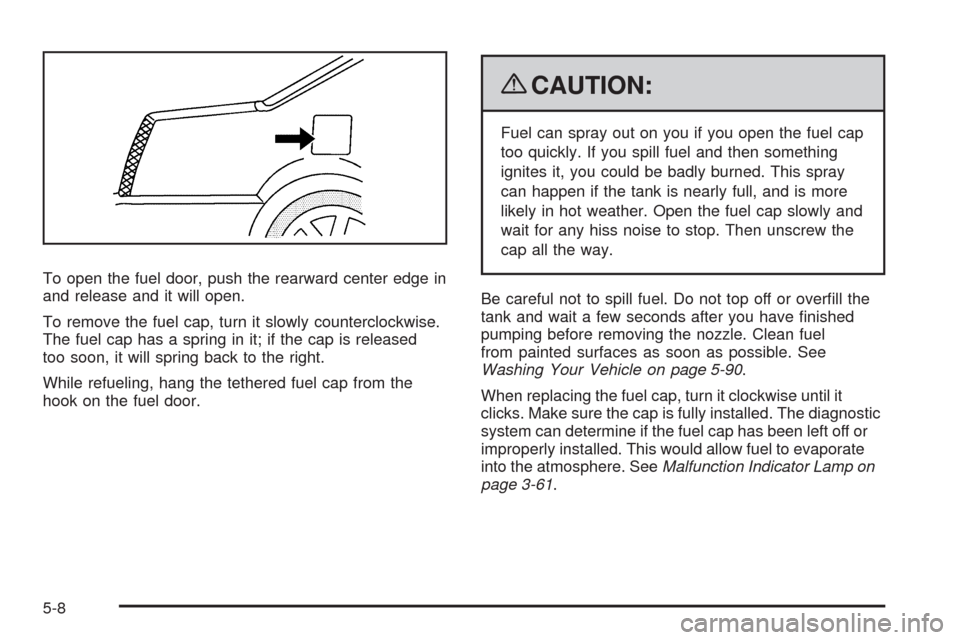
To open the fuel door, push the rearward center edge in
and release and it will open.
To remove the fuel cap, turn it slowly counterclockwise.
The fuel cap has a spring in it; if the cap is released
too soon, it will spring back to the right.
While refueling, hang the tethered fuel cap from the
hook on the fuel door.
{CAUTION:
Fuel can spray out on you if you open the fuel cap
too quickly. If you spill fuel and then something
ignites it, you could be badly burned. This spray
can happen if the tank is nearly full, and is more
likely in hot weather. Open the fuel cap slowly and
wait for any hiss noise to stop. Then unscrew the
cap all the way.
Be careful not to spill fuel. Do not top off or overll the
tank and wait a few seconds after you have nished
pumping before removing the nozzle. Clean fuel
from painted surfaces as soon as possible. See
Washing Your Vehicle on page 5-90.
When replacing the fuel cap, turn it clockwise until it
clicks. Make sure the cap is fully installed. The diagnostic
system can determine if the fuel cap has been left off or
improperly installed. This would allow fuel to evaporate
into the atmosphere. SeeMalfunction Indicator Lamp on
page 3-61.
5-8
Page 317 of 462

A.Underhood Fuse Block on page 5-95.
B. Remote Positive (+) Terminal. SeeJump Starting on
page 5-38.
C. Windshield Washer Fluid Reservoir. See “Adding
Washer Fluid” underWindshield Washer Fluid
on page 5-32.
D. Engine Coolant Surge Tank and Pressure Cap.
SeeEngine Coolant on page 5-23.
E. Remote Negative (−) Terminal. SeeJump Starting
on page 5-38.
F.Power Steering Fluid on page 5-31.
G. Engine Oil Fill Cap. See “When to Add Engine Oil”
underEngine Oil on page 5-13.
H. Engine Oil Dipstick. See “Checking Engine Oil”
underEngine Oil on page 5-13.
I. Brake Master Cylinder Reservoir. See “Brake Fluid”
underBrakes on page 5-33.
J. Automatic Transmission Fluid Cap and Dipstick
(Out of View). SeeAutomatic Transmission Fluid on
page 5-19.
K.Engine Air Cleaner/Filter on page 5-17.Engine Oil
Checking Engine Oil
It is a good idea to check the engine oil level at each
fuel ll. In order to get an accurate reading, the oil must
be warm and the vehicle must be on level ground.
The engine oil dipstick handle is a yellow loop. See
Engine Compartment Overview on page 5-12for
the location of the engine oil dipstick.
1. Turn off the engine and give the oil several minutes
to drain back into the oil pan. If this is not done, the
oil dipstick might not show the actual level.
2. Pull out the dipstick and clean it with a paper towel
or cloth, then push it back in all the way. Remove it
again, keeping the tip down, and check the level.
5-13
Page 321 of 462

How to Reset the Engine Oil Life
System
The Engine Oil Life System calculates when to change
the engine oil and lter based on vehicle use. Whenever
the oil is changed, reset the system so it can calculate
when the next oil change is required. If a situation occurs
where the oil is changed prior to a CHANGE ENGINE OIL
SOON message in the Driver Information Center (DIC)
being turned on, reset the system.
After the oil has been changed, the CHANGE ENGINE
OIL SOON message must be reset:
1. Turn the key to the ON/RUN position without
starting the engine.
2. Press the INFO button on the Driver Information
Center (DIC) until OIL LIFE REMAINING is
displayed. SeeDIC Operation and Displays on
page 3-68.
3. Press and hold the INFO RESET button until 100%
is displayed. This resets the oil life indicator.
4. Turn the key to LOCK/OFF.
If the CHANGE ENGINE OIL SOON message comes
back on when the vehicle is started, the engine oil
life system has not reset. Repeat the procedure.
What to Do with Used Oil
Used engine oil contains certain elements that can be
unhealthy for your skin and could even cause cancer.
Do not let used oil stay on your skin for very long. Clean
your skin and nails with soap and water, or a good
hand cleaner. Wash or properly dispose of clothing or
rags containing used engine oil. See the manufacturer’s
warnings about the use and disposal of oil products.
Used oil can be a threat to the environment. If you
change your own oil, be sure to drain all the oil from the
lter before disposal. Never dispose of oil by putting it in
the trash, pouring it on the ground, into sewers, or into
streams or bodies of water. Recycle it by taking it to a
place that collects used oil.
Engine Air Cleaner/Filter
SeeEngine Compartment Overview on page 5-12for
the location of the engine air cleaner/lter.
When to Inspect the Engine Air
Cleaner/Filter
Inspect the air cleaner/lter at the MaintenanceII
intervals and replace it at the rst oil change after each
50,000 mile (80 000 km) interval. SeeScheduled
Maintenance on page 6-4for more information. If you
are driving in dusty/dirty conditions, inspect the lter
at each engine oil change.
5-17
Page 324 of 462

Checking the Fluid Level
Prepare the vehicle as follows:
1. Park the vehicle on a level place. Keep the engine
running.
2. With the parking brake applied, place the shift lever
in P (Park).
3. With your foot on the brake pedal, move the shift
lever through each gear range, pausing for about
three seconds in each range. Then, position
the shift lever in P (Park).
4. Let the engine run at idle for three to ve minutes.
Then, without shutting off the engine, follow these steps:
1. Locate the transmission uid cap which is located
next to the radiator hose and below the engine air
cleaner/lter assembly on the driver side of the
vehicle. The cap is marked TRANS FLUID.
SeeEngine Compartment Overview on page 5-12
for more information on location.
2. After removing the engine air cleaner/lter assembly
to reach the transmission uid cap, turn the cap
counterclockwise to remove. Pull out the dipstick
and wipe it with a clean rag or paper towel.
3. Push it back in all the way, wait three seconds, and
then pull it back out again.4. Check both sides of the dipstick and read the
lower level. The uid level must be in the
cross-hatched area.
5. If the uid level is in the acceptable range, push
the dipstick back in all the way and turn the
handle clockwise.
6. Reinstall the engine air cleaner/lter assembly.
5-20
Page 325 of 462

How to Add Automatic Transmission
Fluid
Refer to the Maintenance Schedule to determine what
kind of transmission uid to use. SeeRecommended
Fluids and Lubricants on page 6-11.
If the uid level is low, add only enough of the proper
uid to bring the level into the cross-hatched area on the
dipstick.
1. Pull out the dipstick.
2. Using a long-neck funnel, add enough uid at the
dipstick hole to bring it to the proper level.
It does not take much uid, generally less than
one pint (0.5 L). Do not overll.Notice:Use of the incorrect automatic transmission
uid may damage the vehicle, and the damages
may not be covered by the vehicle’s warranty.
Always use the automatic transmission uid listed
inRecommended Fluids and Lubricants on
page 6-11.
3. After adding uid, recheck the uid level as
described under “How to Check Automatic
Transmission Fluid,” earlier in this section.
4. When the correct uid level is obtained, push the
dipstick back in all the way and turn the handle
clockwise.
5-21
Page 330 of 462
{CAUTION:
Steam and scalding liquids from a hot cooling
system can blow out and burn you badly. They are
under pressure, and if you turn the surge tank
pressure cap — even a little — they can come out
at high speed. Never turn the cap when the
cooling system, including the surge tank pressure
cap, is hot. Wait for the cooling system and surge
tank pressure cap to cool if you ever have to turn
the pressure cap.
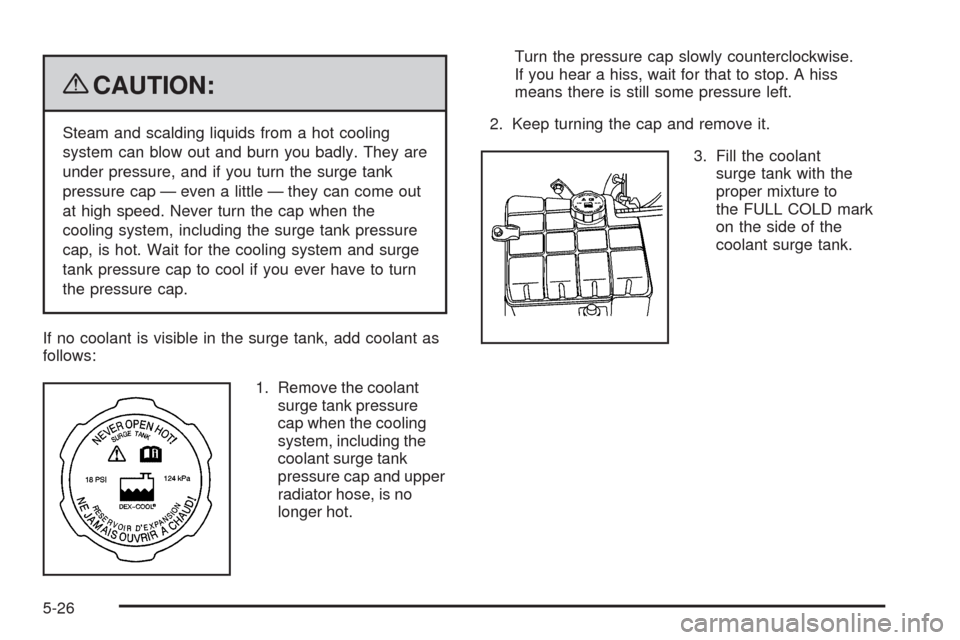
If no coolant is visible in the surge tank, add coolant as
follows:
1. Remove the coolant
surge tank pressure
cap when the cooling
system, including the
coolant surge tank
pressure cap and upper
radiator hose, is no
longer hot.Turn the pressure cap slowly counterclockwise.
If you hear a hiss, wait for that to stop. A hiss
means there is still some pressure left.
2. Keep turning the cap and remove it.
3. Fill the coolant
surge tank with the
proper mixture to
the FULL COLD mark
on the side of the
coolant surge tank.
5-26
Page 335 of 462

Power Steering Fluid
The power steering uid
reservoir is located next to
the underhood fuse block
on the passenger side of
the vehicle. SeeEngine
Compartment Overview
on page 5-12for more
information on location.
When to Check Power Steering Fluid
It is not necessary to regularly check power steering uid
unless you suspect there is a leak in the system or
you hear an unusual noise. A uid loss in this system
could indicate a problem. Have the system inspected
and repaired.
How to Check Power Steering Fluid
To check the power steering uid:
1. Turn the key off and let the engine compartment
cool down.
2. Wipe the cap and the top of the reservoir clean.
3. Unscrew the cap and wipe the dipstick with a
clean rag.
4. Replace the cap and completely tighten it.
5. Remove the cap again and look at the uid level on
the dipstick.
The level should be at the FULL COLD mark.
If necessary, add only enough uid to bring the
level up to the mark.
What to Use
To determine what kind of uid to use, see
Recommended Fluids and Lubricants on page 6-11.
Always use the proper uid.
Notice:Use of the incorrect uid may damage the
vehicle and the damages may not be covered by
the vehicle’s warranty. Always use the correct uid
listed inRecommended Fluids and Lubricants on
page 6-11.
5-31