instrument panel CADILLAC DTS 2011 1.G Owner's Manual
[x] Cancel search | Manufacturer: CADILLAC, Model Year: 2011, Model line: DTS, Model: CADILLAC DTS 2011 1.GPages: 470, PDF Size: 4.72 MB
Page 164 of 470
Black plate (2,1)Cadillac DTS Owner Manual - 2011
Section 4 Instrument Panel
Antilock Brake System (ABS) Warning Light . . . 4-51
Traction Control System (TCS) WarningLight . . . . . . . . . . . . . . . . . . . . . . . . . . . . . . . . . . . . . . . . . 4-51
StabiliTrak
®Indicator Light . . . . . . . . . . . . . . . . . . . . . 4-52
Lane Departure Warning (LDW) Light . . . . . . . . . . 4-52
Engine Coolant Temperature Warning Light . . . . 4-53
Engine Coolant Temperature Gauge . . . . . . . . . . . 4-53
Tire Pressure Light . . . . . . . . . . . . . . . . . . . . . . . . . . . . 4-54
Malfunction Indicator Lamp . . . . . . . . . . . . . . . . . . . . 4-54
Oil Pressure Light . . . . . . . . . . . . . . . . . . . . . . . . . . . . . 4-57
Security Light . . . . . . . . . . . . . . . . . . . . . . . . . . . . . . . . . . 4-57
Front Fog Lamp Light . . . . . . . . . . . . . . . . . . . . . . . . . . 4-58
Lights On Reminder . . . . . . . . . . . . . . . . . . . . . . . . . . . 4-58
Cruise Control Light . . . . . . . . . . . . . . . . . . . . . . . . . . . 4-58
Highbeam On Light . . . . . . . . . . . . . . . . . . . . . . . . . . . . 4-58
Fuel Gauge . . . . . . . . . . . . . . . . . . . . . . . . . . . . . . . . . . . . 4-59 Driver Information Center (DIC)
. . . . . . . . . . . . . . . . . .4-59
DIC Operation and Displays . . . . . . . . . . . . . . . . . . . 4-60
DIC Warnings and Messages . . . . . . . . . . . . . . . . . . 4-65
DIC Vehicle Customization . . . . . . . . . . . . . . . . . . . . 4-77
Audio System(s) . . . . . . . . . . . . . . . . . . . . . . . . . . . . . . . . . . 4-86
Setting the Clock . . . . . . . . . . . . . . . . . . . . . . . . . . . . . . 4-87
Radio(s) . . . . . . . . . . . . . . . . . . . . . . . . . . . . . . . . . . . . . . . 4-90
Using an MP3 . . . . . . . . . . . . . . . . . . . . . . . . . . . . . . . . 4-100
XM Radio Messages . . . . . . . . . . . . . . . . . . . . . . . . . 4-105
Navigation/Radio System . . . . . . . . . . . . . . . . . . . . . 4-106
Bluetooth
®. . . . . . . . . . . . . . . . . . . . . . . . . . . . . . . . . . . . 4-107
Theft-Deterrent Feature . . . . . . . . . . . . . . . . . . . . . . . 4-114
Audio Steering Wheel Controls . . . . . . . . . . . . . . . 4-114
Radio Reception . . . . . . . . . . . . . . . . . . . . . . . . . . . . . . 4-115
Backglass Antenna . . . . . . . . . . . . . . . . . . . . . . . . . . . 4-116
XM™ Satellite Radio Antenna System . . . . . . . . 4-116
4-2
Page 165 of 470
Black plate (3,1)Cadillac DTS Owner Manual - 2011
Instrument Panel Overview
Hazard Warning Flashers
|(Hazard Warning Flasher):Press this button
located on the instrument panel, to make the front and
rear turn signal lamps flash on and off. This warns
others that you are having trouble.
Press
|again to turn the flashers off.
Horn
Press near or on the horn symbols on the steering
wheel pad to sound the horn.
Tilt Wheel
This feature allows the position of the steering wheel to
be adjusted.
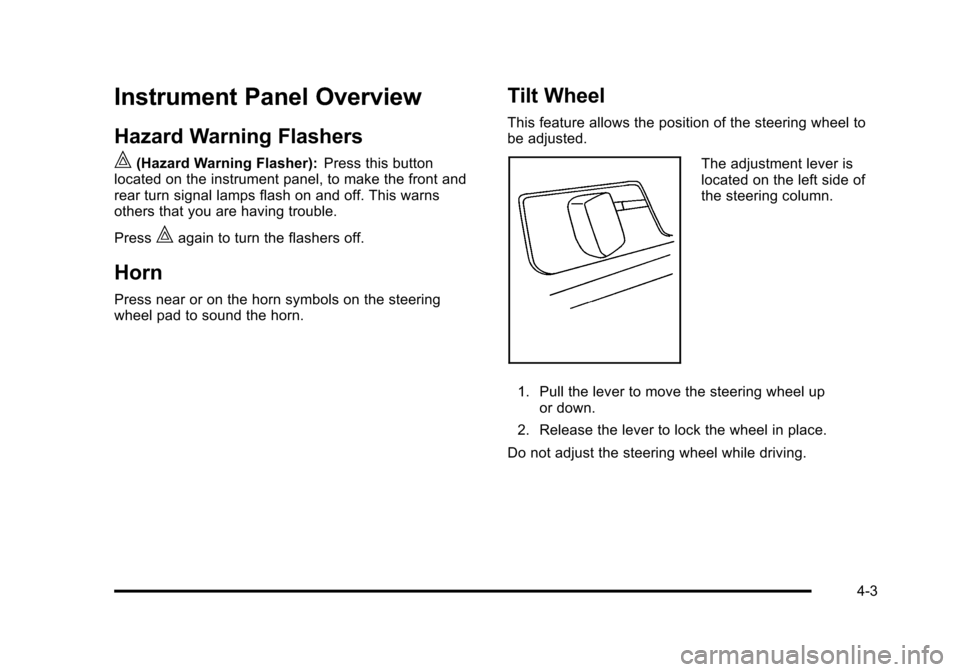
The adjustment lever is
located on the left side of
the steering column.
1. Pull the lever to move the steering wheel up or down.
2. Release the lever to lock the wheel in place.
Do not adjust the steering wheel while driving.
4-3
Page 167 of 470

Black plate (5,1)Cadillac DTS Owner Manual - 2011
Turn Signal/Multifunction Lever
The lever on the left side of the steering column
includes the following:
G:Turn and Lane-Change Signals
2 3:Headlamp High/Low-Beam Changer
N: Windshield Wipers
L: Windshield Washer
Flash-To-Pass Feature.
Information for these features is on the pages following.
Turn and Lane-Change Signals
An arrow on the
instrument panel cluster
flashes in the direction of
the turn or lane change.
For vehicles with the side blind zone alert system,
an arrow in the outside mirror flashes when the turn
signal is used. See Side Blind Zone Alert (SBZA)
on
page 3‑42for more information.
Move the lever all the way up or down to signal a turn.
Raise or lower the lever until the arrow starts to flash to
signal a lane change. Hold it there until the lane change
is complete. If the lever is briefly pressed and released,
the turn signal will flash three times.
The lever returns to its starting position when it is
released.
4-5
Page 168 of 470

Black plate (6,1)Cadillac DTS Owner Manual - 2011
If after signaling a turn or lane change the arrow flashes
rapidly or does not come on, a signal bulb may be
burned out.
Have the bulbs replaced. If the bulb is not burned out,
check the fuse. SeeFuses and Circuit Breakers
on
page 6‑104.
Turn Signal On Chime
If the turn signal is left on, a warning chime sounds and
the Driver Information Center (DIC) will display TURN
SIGNAL ON after driving about a mile as a reminder
to turn it off. See DIC Warnings and Messages
on
page 4‑65.
Headlamp High/Low-Beam Changer
Push forward to change the headlamps from low beam
to high. Pull the lever back and then release it to
change from high beam to low.
This light on the
instrument panel cluster
will be on, indicating
high-beam usage.
Forward Collision Alert (FCA)
System
For vehicles with this feature, read the following section
before using it.
This vehicle has systems that operate on a radio
frequency that comply with Part 15 of the Federal
Communications Commission (FCC) rules and with
Industry Canada Standards RSS‐210/220/310.
Operation is subject to the following two conditions:
1. The device may not cause interference.
2. The device must accept any interference received, including interference that may cause undesired
operation of the device.
Changes or modifications to this system by other than
an authorized service facility could void authorization to
use this equipment.
4-6
Page 169 of 470
Black plate (7,1)Cadillac DTS Owner Manual - 2011
The Forward Collision Alert (FCA) system provides an
audible and visual alert if you approach a vehicle too
quickly that is directly ahead. FCA also provides a
visual alert with no audible alert if you are following
another vehicle much too closely. The FCA alert symbol
is located on top of the instrument panel to the right of
the driver. FCA uses the Adaptive Cruise Control radar
to detect a vehicle directly ahead, in your path, within a
distance of 328 ft (100 m) and operates at speeds
above 20 mph (32 km/h).
{WARNING:
FCA is only a warning system and does not apply
the brakes. When you are approaching a vehicle
or object too rapidly or when you are following a
vehicle too closely that is ahead of you, FCA may
not provide you with enough time to avoid a
collision. FCA is not designed to warn the driver of
pedestrians or animals. Your complete attention is
always required while driving and you should be
ready to take action and apply the brakes. For
more information, seeDefensive Driving
on
page 5‑2
.
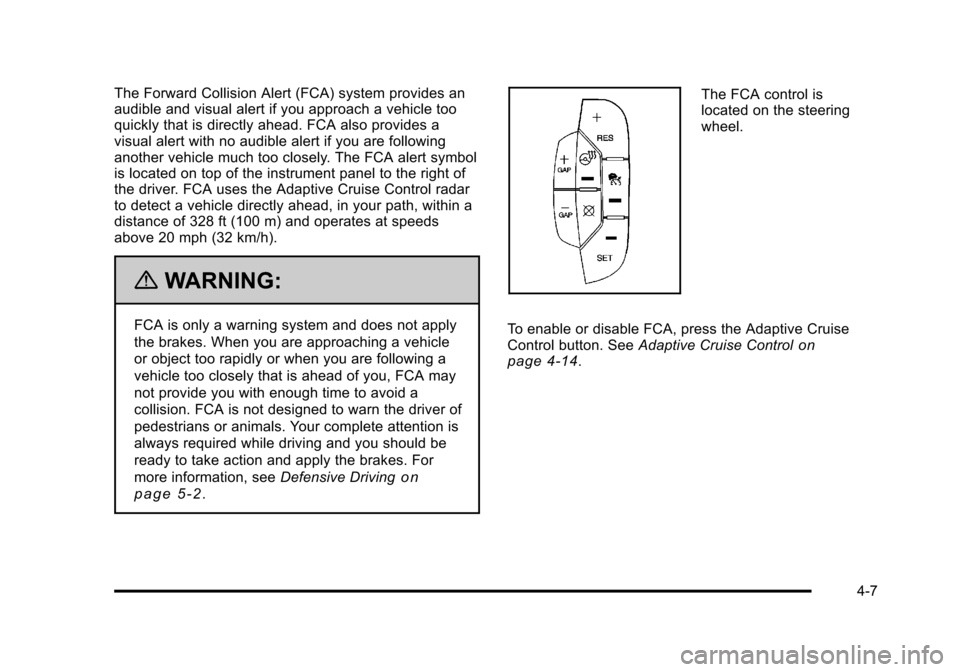
The FCA control is
located on the steering
wheel.
To enable or disable FCA, press the Adaptive Cruise
Control button. See Adaptive Cruise Control
on
page 4‑14.
4-7
Page 174 of 470

Black plate (12,1)Cadillac DTS Owner Manual - 2011
Cruise Control
With cruise control, a speed of approximately 40 km/h
(25 mph) or more can be maintained without keeping
your foot on the accelerator. Cruise control does not
work at speeds below about 40 km/h (25 mph). A cruise
control light appears in the instrument panel cluster
when the cruise control is on.
When the brakes are applied, the cruise control
shuts off.
{WARNING:
Cruise control can be dangerous where you
cannot drive safely at a steady speed. So, do not
use the cruise control on winding roads or in
heavy traffic.
Cruise control can be dangerous on slippery
roads. On such roads, fast changes in tire traction
can cause excessive wheel slip, and you could
lose control. Do not use cruise control on slippery
roads.If your vehicle is in cruise control when the Traction
Control System (TCS) begins to limit wheel spin, the
cruise control automatically turns off. See
Traction
Control System (TCS)
on page 5‑6. When road
conditions let you safely use it again, the cruise control
can be turned back on.
The cruise control buttons
are located on left side of
the steering wheel.
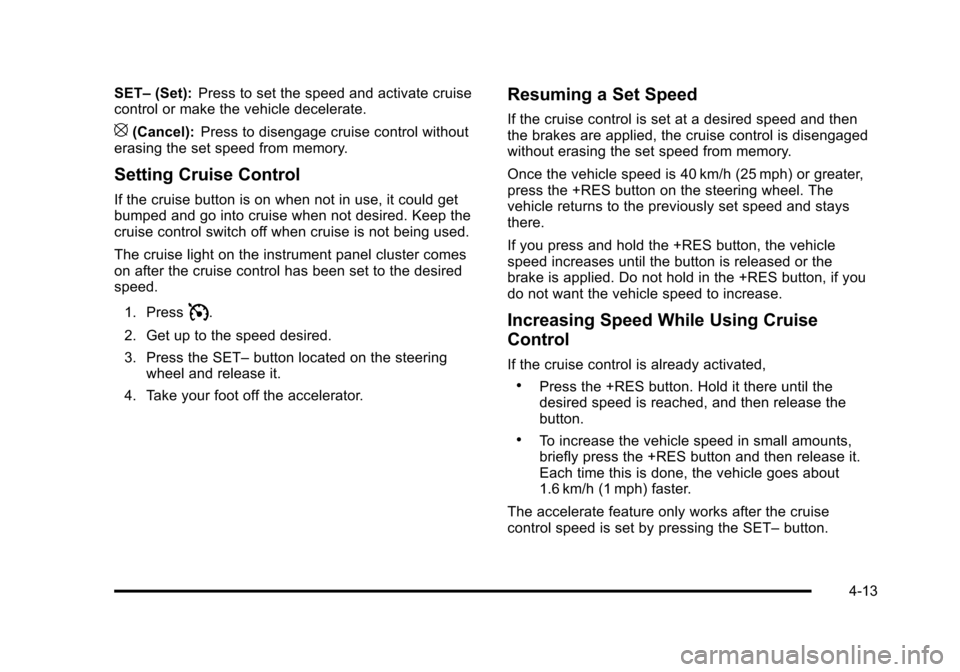
I(On/Off): Press to turn the cruise control system on
or off.
+ RES (Resume/Accelerate): Press briefly to make the
vehicle resume to a previously set speed or press and
hold to accelerate.
4-12
Page 175 of 470
Black plate (13,1)Cadillac DTS Owner Manual - 2011
SET–(Set): Press to set the speed and activate cruise
control or make the vehicle decelerate.
[(Cancel): Press to disengage cruise control without
erasing the set speed from memory.
Setting Cruise Control
If the cruise button is on when not in use, it could get
bumped and go into cruise when not desired. Keep the
cruise control switch off when cruise is not being used.
The cruise light on the instrument panel cluster comes
on after the cruise control has been set to the desired
speed.
1. Press
I.
2. Get up to the speed desired.
3. Press the SET– button located on the steering
wheel and release it.
4. Take your foot off the accelerator.
Resuming a Set Speed
If the cruise control is set at a desired speed and then
the brakes are applied, the cruise control is disengaged
without erasing the set speed from memory.
Once the vehicle speed is 40 km/h (25 mph) or greater,
press the +RES button on the steering wheel. The
vehicle returns to the previously set speed and stays
there.
If you press and hold the +RES button, the vehicle
speed increases until the button is released or the
brake is applied. Do not hold in the +RES button, if you
do not want the vehicle speed to increase.
Increasing Speed While Using Cruise
Control
If the cruise control is already activated,
.Press the +RES button. Hold it there until the
desired speed is reached, and then release the
button.
.To increase the vehicle speed in small amounts,
briefly press the +RES button and then release it.
Each time this is done, the vehicle goes about
1.6 km/h (1 mph) faster.
The accelerate feature only works after the cruise
control speed is set by pressing the SET– button.
4-13
Page 180 of 470

Black plate (18,1)Cadillac DTS Owner Manual - 2011
The on symbol is located on the display at the top of the
instrument panel to the right of the driver. When the on
symbol is lit on the display, it indicates that ACC is
active.
A message on the DIC will also display when ACC is
set. SeeDIC Warnings and Messages on page 4‑65.
Keep in mind speed limits, surrounding traffic speeds,
and weather conditions when adjusting your set speed.
If the vehicle is in ACC when the traction control system
begins to limit wheel spin, the ACC will automatically
disengage. See Traction Control System (TCS)
on
page 5‑6and StabiliTrak®Systemon page 5‑6.
When road conditions allow you to safely use it again,
the ACC can be turned back on.
Increasing Set Speed While Using ACC
If the ACC is already activated,
.Press the +RES button. Hold it there until the
desired set speed is displayed on the Driver
Information Center (DIC), then release the switch.
.To increase the set speed in small amounts, move
the switch briefly to +RES. Each time this is done,
the set speed increases by 1 km/h (1 mph).
Your vehicle will not reach the set speed until the
system determines there is not a vehicle in front of you.
At that point, your vehicle speed will increase to the set
speed.
Decreasing Set Speed While Using ACC
If the ACC is already activated,
.Press the SET– button until the lower speed
desired is reached, then release it.
.To slow down in small amounts, briefly press the
SET– button. Each time this is done, the set speed
decreases by 1 km/h (1 mph) slower.
Resuming a Set Speed
If the ACC is set at a desired speed and then the
brakes are applied, the ACC is disengaged without
erasing the set speed from memory.
Once the vehicle speed is 40 km/h (25 mph) or greater,
press the +RES button. The vehicle returns to the
previously set speed and stays there.
Selecting the Follow Distance (GAP)
When the system detects a slower moving vehicle, it
adjusts your vehicle speed and maintains the follow
distance (gap) you select.
Use the plus and minus buttons on the steering wheel
to adjust the follow distance.
Press the plus button to increase the distance or the
minus button to decrease the distance. The first button
press shows the current follow distance setting on
the DIC. The current follow distance setting will be
maintained until it is changed.
4-18
Page 181 of 470

Black plate (19,1)Cadillac DTS Owner Manual - 2011
There are six follow distances to choose from. The
follow distance selection ranges from near to far
(one second to two seconds follow time). The distance
maintained for a selected follow distance will vary
based on vehicle speed. The faster the vehicle speed
the further back your vehicle will follow. Consider traffic
and weather conditions when selecting the follow
distance. The range of selectable distances may not be
appropriate for all drivers and driving conditions. If you
prefer to travel at a follow distance farther than ACC
allows, disengage the system and drive manually.
Alerting the Driver
The ACC alert symbol is
located on the display at
the top of the instrument
panel to the right of the
driver.
The alert symbol flashes and a warning beep sounds
when driver action may be required. If ACC is engaged,
the alert symbol will flash when:
.ACC cannot apply sufficient braking because you
are approaching a vehicle too rapidly.
.The vehicle speed drops below about 32 km/h
(20 mph).
.A temporary condition prohibits ACC from
operating. See DIC Warnings and Messageson
page 4‑65for more information.
.A malfunction is detected in the system. See DIC
Warnings and Messageson page 4‑65for more
information.
See Defensive Driving on page 5‑2.
{WARNING:
Adaptive Cruise Control has only limited braking
ability to slow your vehicle. In some cases,
Adaptive Cruise Control may not have time to
slow your vehicle enough to avoid a collision. Be
ready to take action and apply the brakes
yourself. See Defensive Driving on page 5‑2.
4-19
Page 182 of 470
Black plate (20,1)Cadillac DTS Owner Manual - 2011
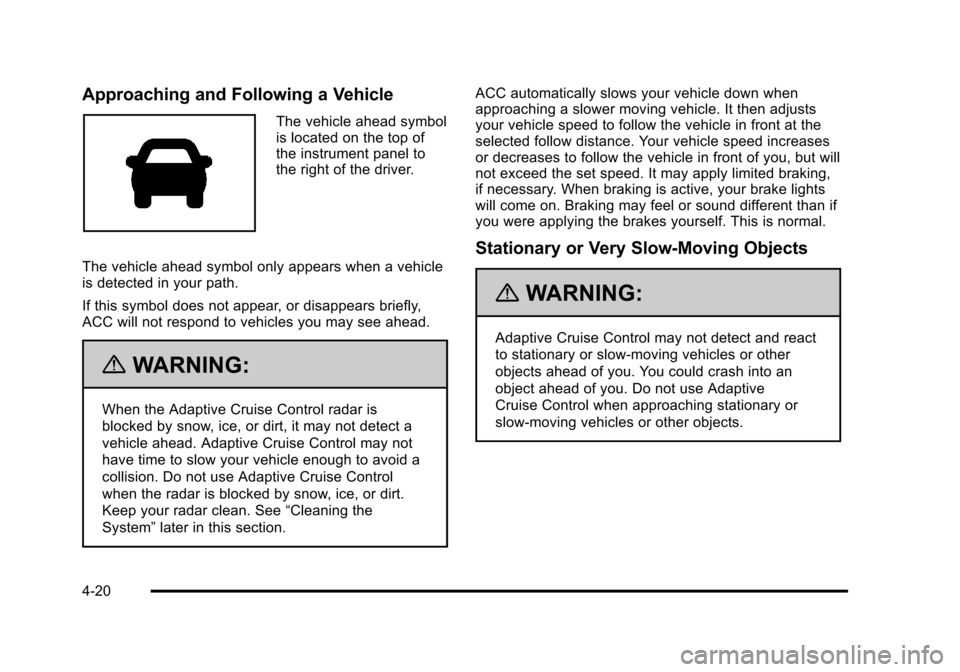
Approaching and Following a Vehicle
The vehicle ahead symbol
is located on the top of
the instrument panel to
the right of the driver.
The vehicle ahead symbol only appears when a vehicle
is detected in your path.
If this symbol does not appear, or disappears briefly,
ACC will not respond to vehicles you may see ahead.
{WARNING:
When the Adaptive Cruise Control radar is
blocked by snow, ice, or dirt, it may not detect a
vehicle ahead. Adaptive Cruise Control may not
have time to slow your vehicle enough to avoid a
collision. Do not use Adaptive Cruise Control
when the radar is blocked by snow, ice, or dirt.
Keep your radar clean. See “Cleaning the
System” later in this section. ACC automatically slows your vehicle down when
approaching a slower moving vehicle. It then adjusts
your vehicle speed to follow the vehicle in front at the
selected follow distance. Your vehicle speed increases
or decreases to follow the vehicle in front of you, but will
not exceed the set speed. It may apply limited braking,
if necessary. When braking is active, your brake lights
will come on. Braking may feel or sound different than if
you were applying the brakes yourself. This is normal.
Stationary or Very Slow-Moving Objects
{WARNING:
Adaptive Cruise Control may not detect and react
to stationary or slow‐moving vehicles or other
objects ahead of you. You could crash into an
object ahead of you. Do not use Adaptive
Cruise Control when approaching stationary or
slow‐moving vehicles or other objects.
4-20