instrument panel CADILLAC DTS 2011 1.G Workshop Manual
[x] Cancel search | Manufacturer: CADILLAC, Model Year: 2011, Model line: DTS, Model: CADILLAC DTS 2011 1.GPages: 470, PDF Size: 4.72 MB
Page 238 of 470

Black plate (76,1)Cadillac DTS Owner Manual - 2011
THEFT ATTEMPTED
This symbol appears with
this message.
This message displays if the content theft-deterrent
system has detected a break-in attempt while you were
away from your vehicle. See Content Theft-Deterrent
on
page 3‑19for more information.
TIGHTEN GAS CAP
This message displays when the fuel cap has not been
fully tightened. Recheck the fuel cap to ensure that it is
on and tightened properly.
TIRE LEARNING ACTIVE
This message displays when the Tire Pressure Monitor
System (TPMS) is re-learning the tire positions on your
vehicle. The tire positions must be re-learned after
rotating the tires or after replacing a tire or sensor. See
Tire Inspection and Rotation
on page 6‑65,
Tire Pressure Monitor Systemon page 6‑60, and
Inflation - Tire Pressureon page 6‑57for more
information.
TRACTION CONTROL OFF
This message displays when the Traction Control
System (TCS) is turned off. Adjust your driving
accordingly. See Traction Control System (TCS)
on
page 5‑6for more information.
TRACTION CONTROL ON
This message displays when the Traction Control
System (TCS) is turned on. See Traction Control
System (TCS)
on page 5‑6for more information.
TRANSMISSION HOT IDLE ENGINE
Notice: If you drive the vehicle while the
transmission fluid is overheating and the
transmission temperature warning is displayed
on the instrument panel cluster and/or DIC, you
can damage the transmission. This could lead to
costly repairs that would not be covered by the
warranty. Do not drive your vehicle with overheated
transmission fluid or while the transmission
temperature warning is displayed.
4-76
Page 284 of 470

Black plate (6,1)Cadillac DTS Owner Manual - 2011
StabiliTrak®System
The vehicle may have the StabiliTrak system which
combines antilock brake, traction and stability control
systems and helps the driver maintain directional
control of the vehicle in most driving conditions. This is
accomplished by selectively applying any one of the
vehicle's brakes and reducing engine power.
The StabiliTrak system comes on automatically
whenever the vehicle is started. The system cannot be
turned off.
This light will flash when
the system is operating.
The STABILITRAK NOT READY message may be
displayed in the Driver Information Center (DIC) and the
Traction Control System (TCS)/StabiliTrak warning light
on the instrument panel cluster comes on after first
driving the vehicle and exceeding 19 mph (30 km/h) for
30 seconds. The StabiliTrak system is off until the light
has turned off. This could take up to 15 minutes. The TCS/StabiliTrak warning light on the instrument
panel cluster will flash when the system is operating.
See
Traction Control System (TCS) Warning Light
on
page 4‑51and StabiliTrak®Indicator Lighton
page 4‑52for more information. The system may be
heard or felt while it is working. This is normal.
The SERVICE STABILITRAK message is displayed
and the TCS/StabiliTrak warning light on the instrument
panel cluster comes on if there is a problem with
the system. When this light and the SERVICE
STABILITRAK message are on, the system is not
working. Adjust your driving accordingly.
Traction Control System (TCS)
The vehicle has a Traction Control System (TCS) that
limits wheel spin. This is especially useful in slippery
road conditions. The system operates only if it senses
that the front wheels are spinning too much or
beginning to lose traction. When this happens, the
system works the front brakes and reduces engine
power (by closing the throttle and managing engine
spark) to limit wheel spin.
5-6
Page 294 of 470

Black plate (16,1)Cadillac DTS Owner Manual - 2011
Blizzard Conditions
Being stuck in snow can be in a serious situation. Stay
with the vehicle unless there is help nearby. If possible,
use theRoadside Service
on page 8‑7. To get help
and keep everyone in the vehicle safe:
.Turn on the Hazard Warning Flasherson
page 4‑3.
.Tie a red cloth to an outside mirror.
{WARNING:
Snow can trap engine exhaust under the vehicle.
This may cause exhaust gases to get inside.
Engine exhaust contains carbon monoxide (CO)
which cannot be seen or smelled. It can cause
unconsciousness and even death.
If the vehicle is stuck in the snow:
.Clear away snow from around the base of
your vehicle, especially any that is blocking
the exhaust pipe.
.Check again from time to time to be sure
snow does not collect there.
(Continued)
WARNING: (Continued)
.Open a window about 5 cm (two inches) on
the side of the vehicle that is away from the
wind to bring in fresh air.
.Fully open the air outlets on or under the
instrument panel.
.Adjust the Climate Control system to a setting
that circulates the air inside the vehicle and
set the fan speed to the highest setting. See
Climate Control System in the Index.
For more information about carbon monoxide, see
Engine Exhaust on page 3‑33.
Snow can trap exhaust gases under your vehicle.
This can cause deadly CO (carbon monoxide) gas
to get inside. CO could overcome you and kill you.
You cannot see it or smell it, so you might not
know it is in your vehicle. Clear away snow from
around the base of your vehicle, especially any
that is blocking the exhaust.
To save fuel, run the engine for only short periods as
needed to warm the vehicle and then shut the engine
off and close the window most of the way to save heat.
5-16
Page 309 of 470

Black plate (31,1)Cadillac DTS Owner Manual - 2011
When turning with a trailer, make wider turns than
normal. Do this so the trailer will not strike soft
shoulders, curbs, road signs, trees or other objects.
Avoid jerky or sudden maneuvers. Signal well in
advance.
Turn Signals When Towing a Trailer
The arrows on the instrument panel flash whenever
signaling a turn or lane change. Properly hooked up,
the trailer lamps also flash, telling other drivers the
vehicle is turning, changing lanes or stopping.
When towing a trailer, the arrows on the instrument
panel flash for turns even if the bulbs on the trailer are
burned out. For this reason you may think other drivers
are seeing the signal when they are not. It is important
to check occasionally to be sure the trailer bulbs are still
working.
Driving on Grades
Notice:Do not tow on steep continuous grades
exceeding 9.6 km (6 miles). Extended, higher than
normal engine and transmission temperatures may
result and damage the vehicle. Frequent stops are
very important to allow the engine and transmission
to cool. Reduce speed and shift to a lower gear
beforestarting
down a long or steep downgrade. If the transmission is
not shifted down, the brakes might have to be used so
much that they would get hot and no longer work well.
On a long uphill grade, shift down and reduce the
vehicle's speed to around 45 mph (70 km/h) to reduce
the possibility of the engine and the transmission
overheating. If the engine does overheat, see Engine
Overheating on page 6‑29.
Parking on Hills
{WARNING:
Parking the vehicle on a hill with the trailer
attached can be dangerous. If something goes
wrong, the rig could start to move. People can be
injured, and both the vehicle and the trailer can be
damaged. When possible, always park the rig on
a flat surface.
If parking the rig on a hill: 1. Press the brake pedal, but do not shift into P (Park) yet. Turn the wheels into the curb if facing downhill
or into traffic if facing uphill.
2. Have someone place chocks under the trailer wheels.
5-31
Page 312 of 470

Black plate (2,1)Cadillac DTS Owner Manual - 2011
Section 6 Service and Appearance Care
Tire Chains . . . . . . . . . . . . . . . . . . . . . . . . . . . . . . . . . . . . 6-73
If a Tire Goes Flat . . . . . . . . . . . . . . . . . . . . . . . . . . . . . 6-73
Tire Sealant and Compressor Kit . . . . . . . . . . . . . . 6-75
Tire Sealant and Compressor Kit Storage . . . . . . 6-82
Changing a Flat Tire . . . . . . . . . . . . . . . . . . . . . . . . . . . 6-83
Removing the Spare Tire and Tools . . . . . . . . . . . . 6-84
Removing the Flat Tire and Installing theSpare Tire . . . . . . . . . . . . . . . . . . . . . . . . . . . . . . . . . . . 6-86
Storing a Flat or Spare Tire and Tools . . . . . . . . . 6-91
Spare Tire . . . . . . . . . . . . . . . . . . . . . . . . . . . . . . . . . . . . . 6-93
Appearance Care . . . . . . . . . . . . . . . . . . . . . . . . . . . . . . . . . 6-94
Interior Cleaning . . . . . . . . . . . . . . . . . . . . . . . . . . . . . . 6-94
Fabric/Carpet . . . . . . . . . . . . . . . . . . . . . . . . . . . . . . . . . . 6-95
Leather . . . . . . . . . . . . . . . . . . . . . . . . . . . . . . . . . . . . . . . . 6-96
Instrument Panel, Vinyl, and Other Plastic Surfaces . . . . . . . . . . . . . . . . . . . . . . . . . . . . . . . . . . . . . 6-97
Wood Panels . . . . . . . . . . . . . . . . . . . . . . . . . . . . . . . . . . 6-97
Speaker Covers . . . . . . . . . . . . . . . . . . . . . . . . . . . . . . . 6-97
Care of Safety Belts . . . . . . . . . . . . . . . . . . . . . . . . . . . 6-97
Weatherstrips . . . . . . . . . . . . . . . . . . . . . . . . . . . . . . . . . . 6-97
Washing Your Vehicle . . . . . . . . . . . . . . . . . . . . . . . . . 6-98
Cleaning Exterior Lamps/Lenses . . . . . . . . . . . . . . 6-98 Finish Care . . . . . . . . . . . . . . . . . . . . . . . . . . . . . . . . . . . . 6-98
Windshield and Wiper Blades . . . . . . . . . . . . . . . . . . 6-99
Aluminum or Chrome-Plated Wheels
and Trim . . . . . . . . . . . . . . . . . . . . . . . . . . . . . . . . . . . 6-100
Tires . . . . . . . . . . . . . . . . . . . . . . . . . . . . . . . . . . . . . . . . . . 6-101
Sheet Metal Damage . . . . . . . . . . . . . . . . . . . . . . . . . 6-101
Finish Damage . . . . . . . . . . . . . . . . . . . . . . . . . . . . . . . 6-101
Underbody Maintenance . . . . . . . . . . . . . . . . . . . . . 6-101
Chemical Paint Spotting . . . . . . . . . . . . . . . . . . . . . . 6-101
Vehicle Identification . . . . . . . . . . . . . . . . . . . . . . . . . . . . 6-102
Vehicle Identification Number (VIN) . . . . . . . . . . . 6-102
Service Parts Identification Label . . . . . . . . . . . . . 6-102
Electrical System . . . . . . . . . . . . . . . . . . . . . . . . . . . . . . . . 6-103
Add-On Electrical Equipment . . . . . . . . . . . . . . . . . 6-103
Headlamp Wiring . . . . . . . . . . . . . . . . . . . . . . . . . . . . . 6-103
Windshield Wiper Fuses . . . . . . . . . . . . . . . . . . . . . . 6-103
Power Windows and Other Power Options . . . 6-104
Fuses and Circuit Breakers . . . . . . . . . . . . . . . . . . . 6-104
Underhood Fuse Block . . . . . . . . . . . . . . . . . . . . . . . 6-104
Rear Underseat Fuse Block . . . . . . . . . . . . . . . . . . 6-107
Capacities and Specifications . . . . . . . . . . . . . . . . . .6-112
6-2
Page 323 of 470
Black plate (13,1)Cadillac DTS Owner Manual - 2011
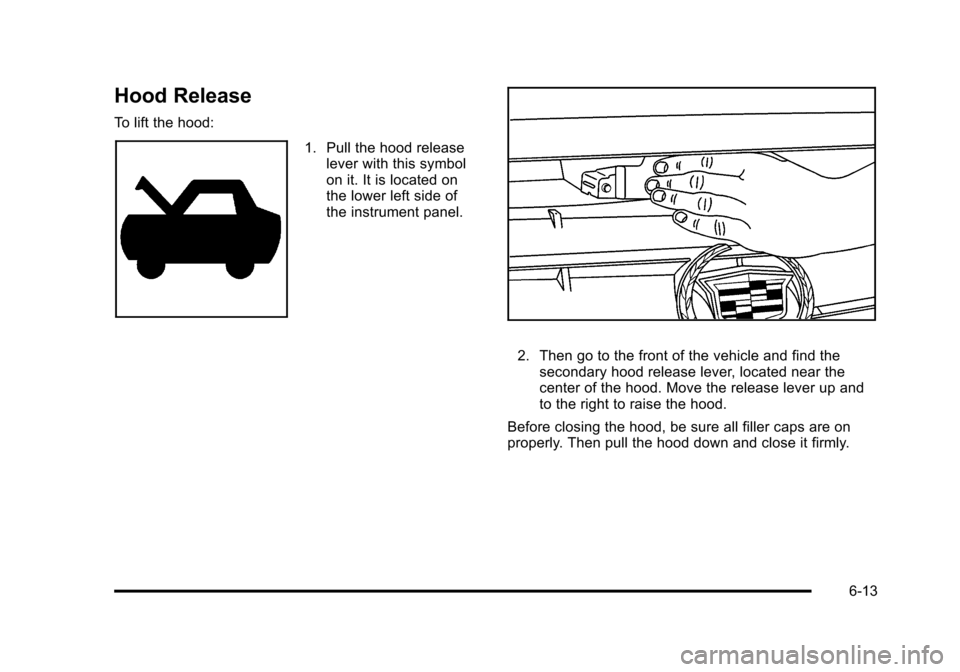
Hood Release
To lift the hood:
1. Pull the hood releaselever with this symbol
on it. It is located on
the lower left side of
the instrument panel.
2. Then go to the front of the vehicle and find thesecondary hood release lever, located near the
center of the hood. Move the release lever up and
to the right to raise the hood.
Before closing the hood, be sure all filler caps are on
properly. Then pull the hood down and close it firmly.
6-13
Page 339 of 470

Black plate (29,1)Cadillac DTS Owner Manual - 2011
4.6L L37 Engine shown, 4.6L LD8 Engine similar
4. With the coolant surge tank cap off, start the engine and let it run until you can feel the upper
radiator hose getting hot. Watch out for the engine
cooling fans.
By this time, the coolant level inside the coolant
surge tank may be lower. If the level is lower, add
more of the proper mixture to the coolant surge
tank until the level reaches the FULL COLD mark
on the side of the coolant surge tank.
5. Replace the cap. Be sure the cap is hand‐tight and fully seated. Notice:
If the pressure cap is not tightly installed,
coolant loss and possible engine damage may
occur. Be sure the cap is properly and tightly
secured.
If coolant is needed, add the proper DEX-COOL
®
coolant mixture at the coolant recovery tank.
Engine Overheating
The vehicle has several indicators to warn of engine
overheating.
There is an engine temperature warning light and/or
gauge on the instrument panel cluster. See Engine
Coolant Temperature Warning Light
on page 4‑53and
Engine Coolant Temperature Gauge on page 4‑53.
The vehicle may also display a ENGINE OVERHEATED
IDLE ENGINE message or an ENGINE OVERHEATED
STOP ENGINE message displayed in the Driver
Information Center (DIC). See DIC Warnings and
Messages
on page 4‑65for more information. You will
also hear a chime.
The decision may be made not to lift the hood when
this warning appears, but instead get service help right
away. See Roadside Service on page 8‑7.
If the decision is made to lift the hood , make sure the
vehicle is parked on a level surface.
6-29
Page 371 of 470

Black plate (61,1)Cadillac DTS Owner Manual - 2011
Federal Communications Commission
(FCC) and Industry Canada
SeeRadio Frequency Statementon page 8‑18for
information regarding Part 15 of the Federal
Communications Commission (FCC) rules and Industry
Canada Standards RSS-210/220/310.
Tire Pressure Monitor Operation
This vehicle may have a Tire Pressure Monitor System
(TPMS). The TPMS is designed to warn the driver when
a low tire pressure condition exists. TPMS sensors are
mounted onto each tire and wheel assembly, excluding
the spare tire and wheel assembly. The TPMS sensors
monitor the air pressure in the vehicle's tires and
transmits the tire pressure readings to a receiver
located in the vehicle.
When a low tire pressure
condition is detected, the
TPMS illuminates the low
tire pressure warning light
located on the instrument
panel cluster. If the warning light comes on, stop as soon as possible
and inflate the tires to the recommended pressure
shown on the tire loading information label. See
Loading the Vehicle on page 5‑18.
At the same time a message to check the pressure in a
specific tire appears on the Driver Information Center
(DIC) display. The low tire pressure warning light and
the DIC warning message come on at each ignition
cycle until the tires are inflated to the correct inflation
pressure. Using the DIC, tire pressure levels can be
viewed by the driver. For additional information and
details about the DIC operation and displays see
DIC
Operation and Displays
on page 4‑60and DIC
Warnings and Messages on page 4‑65.
The low tire pressure warning light may come on in cool
weather when the vehicle is first started, and then turn
off as you start to drive. This could be an early indicator
that the air pressure in the tire(s) are getting low and
need to be inflated to the proper pressure.
6-61
Page 407 of 470
Black plate (97,1)Cadillac DTS Owner Manual - 2011
Instrument Panel, Vinyl, and Other
Plastic Surfaces
A soft cloth dampened with water may be used to
remove dust. If a more thorough cleaning is necessary,
a clean soft cloth dampened with a mild soap solution
can be used to gently remove dust and dirt. Never use
spot lifters or removers on plastic surfaces. Many
commercial cleaners and coatings that are sold to
preserve and protect soft plastic surfaces may
permanently change the appearance and feel of the
interior and are not recommended. Do not use silicone
or wax-based products, or those containing organic
solvents to clean the vehicle's interior because they
can alter the appearance by increasing the gloss in a
non-uniform manner.
Some commercial products may increase gloss on the
instrument panel. The increase in gloss may cause
annoying reflections in the windshield and even make
it difficult to see through the windshield under certain
conditions.
Wood Panels
Use a clean cloth moistened in warm, soapy water (use
mild dish washing soap). Dry the wood immediately with
a clean cloth.
Speaker Covers
Vacuum around a speaker cover gently, so that the
speaker will not be damaged. Clean spots with just
water and mild soap.
Care of Safety Belts
Keep belts clean and dry.
{WARNING:
Do not bleach or dye safety belts. It may severely
weaken them. In a crash, they might not be able
to provide adequate protection. Clean safety belts
only with mild soap and lukewarm water.
Weatherstrips
Silicone grease on weatherstrips will make them last
longer, seal better, and not stick or squeak. Apply
silicone grease with a clean cloth. During very cold,
damp weather frequent application may be required.
SeeRecommended Fluids and Lubricants
on
page 7‑9.
6-97
Page 412 of 470

Black plate (102,1)Cadillac DTS Owner Manual - 2011
Vehicle Identification
Vehicle Identification Number (VIN)
This legal identifier is in the front corner of the
instrument panel, on the driver side. It can be seen
through the windshield from outside. The VIN also
appears on the Vehicle Certification and Service Parts
labels and certificates of title and registration.
Engine Identification
The eighth character in the VIN is the engine code. This
code identifies the vehicle's engine, specifications, and
replacement parts. See“Engine Specifications”under
Capacities and Specifications
on page 6‑112for the
vehicle's engine code.
Service Parts Identification Label
This label, on the spare tire cover, has the following
information:
.Vehicle Identification Number (VIN)
.Model designation
.Paint information
.Production options and special equipment
Do not remove this label from the vehicle.
6-102