stop start CADILLAC ELDORADO 1995 10.G Owner's Manual
[x] Cancel search | Manufacturer: CADILLAC, Model Year: 1995, Model line: ELDORADO, Model: CADILLAC ELDORADO 1995 10.GPages: 395, PDF Size: 20.17 MB
Page 225 of 395
Downloaded from www.Manualslib.com manuals search engine Making Turns
NOTICE:
Making very sharp turns while trailering could cause the trailer
to come in contact with the vehicle. Your vehicle could be
damaged. Avoid making very sharp turns while trailering.
When you’re turning with a trailer, make wider turns than normal. DO this
so your trailer won’t strike soft shoulders, curbs, road signs, trees, or other
objects. Avoid jerky or sudden maneuvers. Signal well in advance.
Turn Signals When Towing a Trailer
When you tow a trailer, your vehicle has to have a different turn signal
flasher and extra wiring. The green arrows on your instrument panel will
flash whenever you signal
a turn or lane change. Properly hooked up, the
trailer lamps
will also flash, telling other drivers you’re about to turn,
change lanes or stop.
When towing a trailer, the green arrows on your instrument panel
will
flash for turns even if the bulbs on the trailer are burned out. Thus, you
may think drivers behind you are seeing your
signal when they are not. It’s
important to
che.ck occasionally to be sure the trailer bulbs are still
working.
Driving On Grades
Reduce speed and shift to a lower gear before you start down a long or
steep downgrade.
If you don’t shift down, you might have to use your
brakes
so much that they would get hot and no longer work well.
4-38
Page 226 of 395
Downloaded from www.Manualslib.com manuals search engine Parking on Hills
c
You really should not park your vehicle, with a trailer attached, on a hill.
If something goes wrong, your rig could start to move. People can be
injured, and both your vehicle and the trailer can be damaged.
But
if you ever have to park your rig on a hill, here’s how to do it:
1. Apply your regular brakes, but do not shift into PARK (P).
2. Have someone place chocks under the trailer wheels.
3. When the wheel chocks are in place, release the regular brakes until
the chocks absorb the load.
4. Reapply the regular brakes. Then shift into PARK (P) firmly and apply
5. Release the regular brakes.
your parking
brake.
When You Are Ready to Leave Afier Parking on a Hill
1. Apply your regular brakes and hold the pedal down while you:
Start your engine;
Shift into a gear; and
Be sure the parking brake has released.
2. Let up on the brake pedal.
3. Drive slowly until the trailer is clear of the chocks.
4. Stop and have someone pick up and store the chocks.
Maintenance When Trailer Towing
Your vehicle will need service more often when you’re pulling a trailer.
See the Maintenance Schedule
for more on this. Things that are especially
important in trailer operation are automatic transaxle fluid (don’t
overfill), engine oil, belt, cooling system, and brake adjustment. Each
of
these is covered in this manual, and the Index will help you find them
quickly.
If you’re trailering, it’s a good idea to review these sections before
you start your trip.
Check periodically to see that all hitch nuts and bolts are tight.
4-39
Page 248 of 395
Downloaded from www.Manualslib.com manuals search engine .. i
k
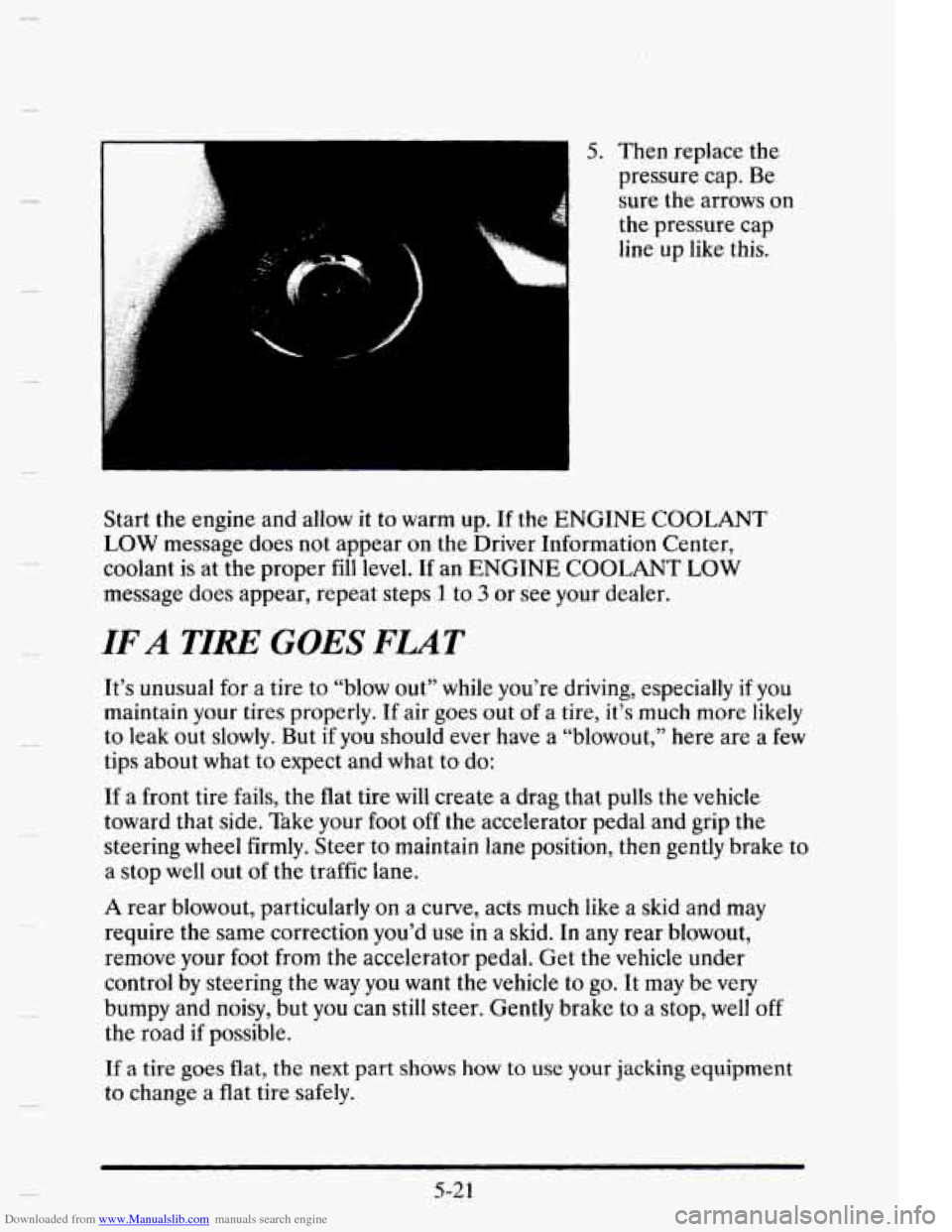
5. Then replace the
pressure cap. Be
sure
the arrows on
the pressure cap
line up
like this.
Start the engine and allow
it to warm up. If the ENGINE COOLANT
LOW message does not appear on the Driver Information Center,
coolant
is at the proper fill level. If an ENGINE COOLANT LOW
message does appear, repeat steps 1 to 3 or see your dealer.
IF A TIRE GOES FLAT
It’s unusual for a tire to “blow out” while you’re driving, especially if you
maintain your tires properly.
If air goes out of a tire, it’s much more likely
to leak out slowly. But
if you should ever have a “blowout,” here are a few
tips about what to expect and what to do:
If a front tire fails, the flat tire will create a drag that pulls the vehicle
toward that side. Take your foot
off the accelerator pedal and grip the
steering
wheel firmly. Steer to maintain lane position, then gently brake to
a stop well out of
the traffic lane.
A rear blowout, particularly on a curve, acts much like a skid and may
require the same correction you’d use
in a skid. In any rear blowout,
remove your foot from the accelerator pedal. Get the vehicle under
control by steering
the way you want the vehicle to go. It may be very
bumpy and noisy, but you can still steer. Gently brake to a stop, well off
the road if possible.
If a tire goes flat, the next part shows how to use your jacking equipment
to change a flat tire safely.
5-2 1
Page 390 of 395
Downloaded from www.Manualslib.com manuals search engine .
.
.
.
.
.
.
.
.
.
.
.
.
Service A/C System A/C Compressor Off ............... 2-89
Service Air Bag System Message ...................... 2-90
Service and Appearance Care ......................... 6-1
Service and Owner Publications ....... See Owner Assistance
Service Engine Soon Light
........................... 2-78
Service Now-Refer to Owners Manual Message ......... 2-89
Service Parts Identification Label ..................... 6-62
Service Ride Control Message ........................ 2-90
Service Vehicle Soon Message ........................ 2-90
Service Work. Doing Your Own ........................ 6-2
Servicing Your Air Bag-Equipped Cadillac ............. 1-28
Sheet Metal Damage ................................ 6-58
Shift Lever. Console ................................ 2-30
Shift Lever. Steering Column ......................... 2-29
Shifting Into Park (P) ............................... 2-28
Shifting Out of Park (P) .............................. 2-32
Shifting. Automatic Transaxle ........................ 2-23
Shoulder Belt Tightness Adjuster ..................... 1-16
Signaling Turns .................................... 2-39
Skidding .......................................... 4-14
Sound Equipment. Adding ........................... 3-19
Spare Tire. Compact ................................ 5-30
Speaker Covers. Cleaning ............................ 6-55
Specifications Chart ................................ 6-71
Speed Sensitive Steering (SSS) ....................... 2-91
Speedometer ...................................... 2-71
Springs. Fiberglass .................................. 6-59
Stains. Cleaning .................................... 6-52
Starting Disabled Message ........................... 2-89
Starting Your Engine. Northstar V8 ................... 2-20
Steam. If Coming From Your Engine .................. 5-13
Steering .......................................... 4-10
Column Shift Lever .............................. 2-29
In Emergencies .................................. 4-11
Power .......................................... 4-10
Speed Sensitive ................................... 2-91
Tips ........................................... 4-10
Wheel. Tilt ..................................... 2-37
Stop Engine Engine Overheated Message .............. 2-90
Stop Engine Low Oil Pressure Message ................ 2-90
Storage Armrest ................................... 2-13
Storage. Of Your Vehicle ............................ 6-33
Storage. Sunglasses ................................. 2-62
Stuck. If You Are ................................... 5-31
13