lock CADILLAC ELDORADO 1998 10.G Repair Manual
[x] Cancel search | Manufacturer: CADILLAC, Model Year: 1998, Model line: ELDORADO, Model: CADILLAC ELDORADO 1998 10.GPages: 380, PDF Size: 21.39 MB
Page 261 of 380
Downloaded from www.Manualslib.com manuals search engine CAUTION: (Continued)
get the overheat warning. Your engine could
catch fire and you
or others could be burned.
Use a 50/50 mixture of clean water and
DEX-COOL@ coolant.
1 NOTICE:
In cold weather, water can freeze and crack the
engine, radiator, heater core and other parts.
So
use the recommended coolant.
I A CAUTION:
You can be burned if you spill coolant on hot
engine parts. Coolant contains ethylene glycol
and it
will burn if the engine parts are hot
enough. Don't spill coolant on a hot engine.
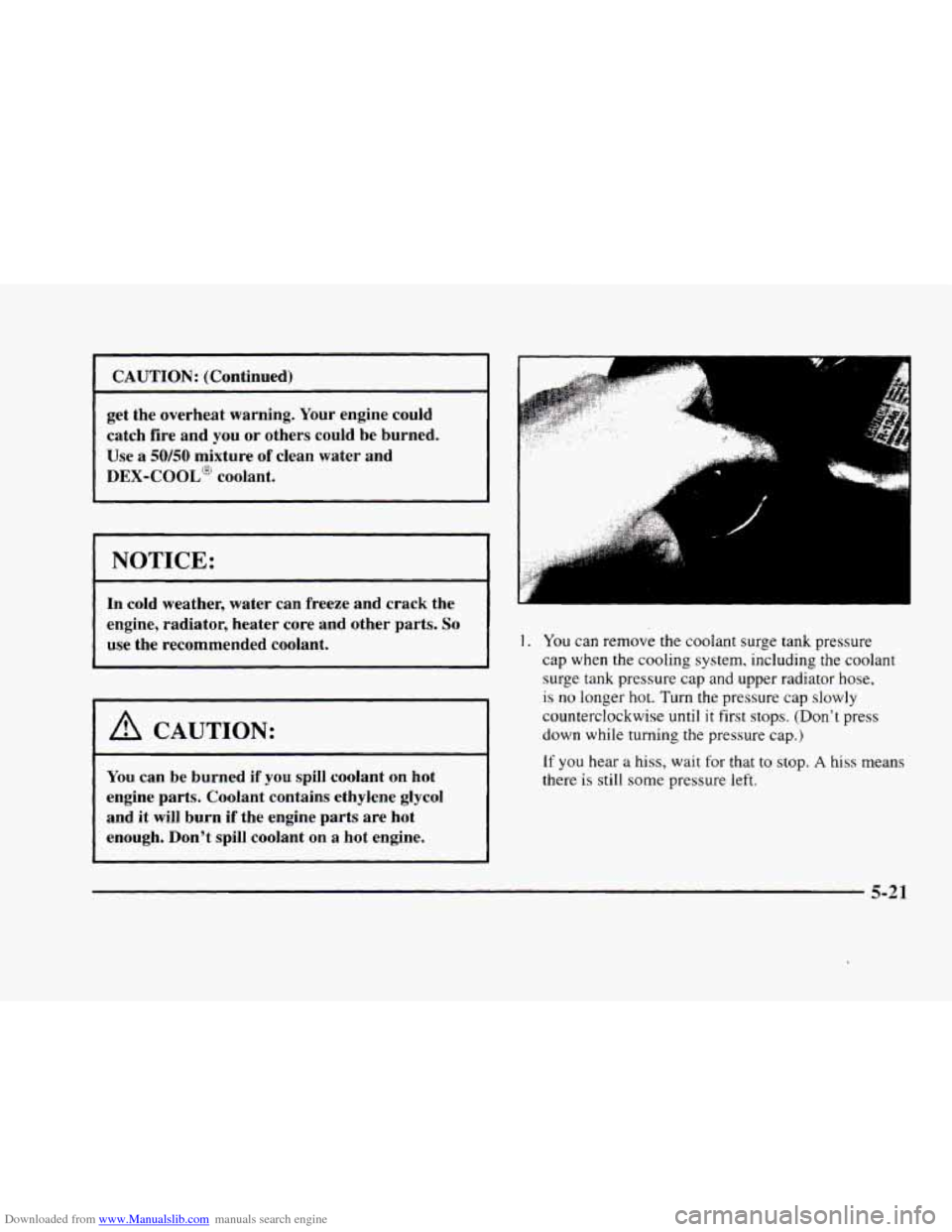
I. You can remove the coolant surge tank pressure
cap when the cooling system, including the coolant
surge tank pressure cap and upper radiator hose,
is no longer hot. Turn the pressure cap slowly
counterclockwise until it first stops. (Don't press
down while turning the pressure cap.)
If you hear a hiss, wait for that to stop. A hiss means
there
is still some pressure left.
5-21
Page 264 of 380
Downloaded from www.Manualslib.com manuals search engine If a Tire Goes Flat
It’s unusual for a tire to “blow out” while you’re driving.
especially
if you maintain your tires properly. If air goes
out
of a tire, it’s much more likely to leak out slowly.
But if you should ever have a “blowout,” here are
a few
tips about what
to expect and what to do:
If a front tire fails, the flat tire will create a drag that
pulls the vehicle toward that side. Take your foot off the
accelerator pedal and grip the steering wheel firmly.
Steer to maintain lane position, and then gently brake
to
a stop well out of the traffic lane.
A rear blowout, particularly on a curve. acts much like a
skid and may require the same correction you’d use in a
skid. In any rear blowout, remove your foot from the
accelerator pedal. Get the vehicle under control by
steering the way
you want the vehicle to go. It may be
very bumpy and noisy, but you can still steer. Gently
brake
to a stop -- well off the road if possible.
If
a tire goes flat, the next part shows how to use your
jacking equipment to change a flat tire safely.
Changing a Flat Tire
If a tire goes flat, avoid further tire and wheel damage
by driving slowly
to a level place. Turn on your hazard
warning flashers.
I A CAUTION:
Changing a tire can cause an injury. The vehicle
can slip
off the jack and roll over you or other
people.
You and they could be badly injured.
Find
a level place to change your tire. To help
prevent the vehicle from moving:
1. Put the shift lever in PARK (P).
2, Set the parking brake firmly.
3. lhrn off the engine.
To be even more certain the vehicle won’t move,
you can put blocks
at the front and rear of the
tire farthest away from the one being changed.
That would be the tire on the other side
of the
vehicle,
at the opposite end.
5-24
Page 286 of 380
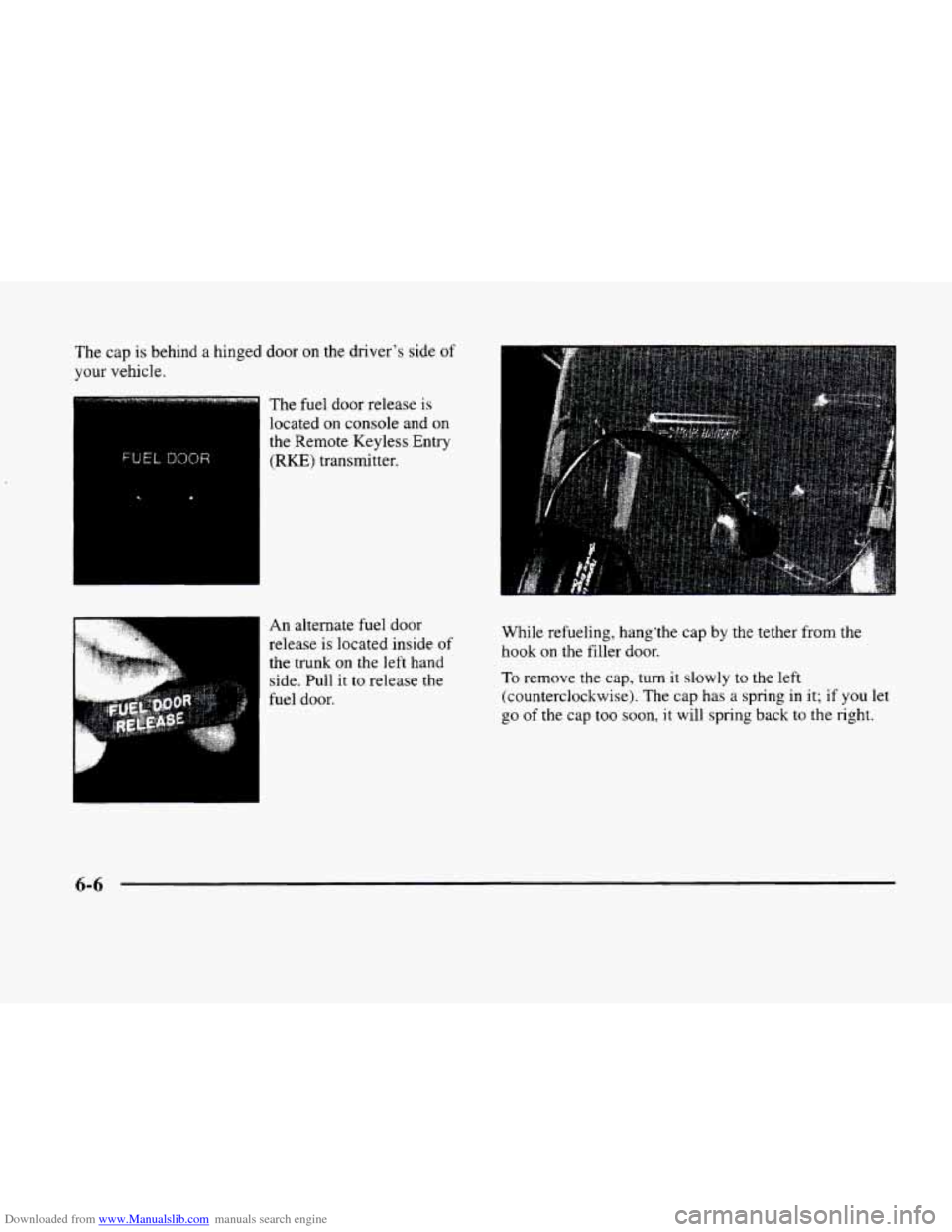
Downloaded from www.Manualslib.com manuals search engine The cap is behind a hinged door on the driver's side of
your vehicle.
The fuel door release
is
located on console and on
the Remote Keyless Entry
(RKE) transmitter.
An alternate fuel door
release is located inside
of
the trunk on the left hand
side. Pull it to release the
fuel door. While refueling, hang'the
cap
by the tether from the
hook
on the filler door.
To remove the cap, turn it slowly to the left
(counterclockwise). The cap has a spring in it;
if you let
go of the
cap too soon, it will spring back to the right.
6-6
Page 287 of 380
Downloaded from www.Manualslib.com manuals search engine r
r
r-
f
I
f
1
I“
I
1 A CAUTION:
If you get gasoline on yourself and then
something ignites it, you could be badly burned.
Gasoline can spray out on you if you open the
fuel filler cap too quickly. This spray can happen
if your
tank is nearly full, and is more likely in
hot weather. Open the fuel filler cap slowly
and
wait for any “hiss” noise to stop. Then unscrew
the cap all the way.
Be careful not to spill gasoline. Clean gasoline from
painted surfaces as soon as possible. See “Cleaning the
Outside of Your Vehicle” in the Index. When
you put
the cap back on, turn it to the right
(clockwise) until you hear a clicking sound. Make
sure you
fully install the cap. The diagnostic system
can determine if the fuel cap has been left
off or
improperly installed. This would allow fuel to
evaporate into the atmosphere. See “Malfunction
Indicator Lamp” in the Index.
NOTICE:
If you need a new cap, be sure to get the right
type. Your dealer can get one for you.
If you get
the wrong type, it may not fit properly. This may
cause your malfunction indicator lamp
to light
and your fuel
tank and emissions system may be
damaged.
See “Malfunction Indicator Lamp” in
the Index.
6-7
Page 304 of 380
Downloaded from www.Manualslib.com manuals search engine Checking Coolant
.
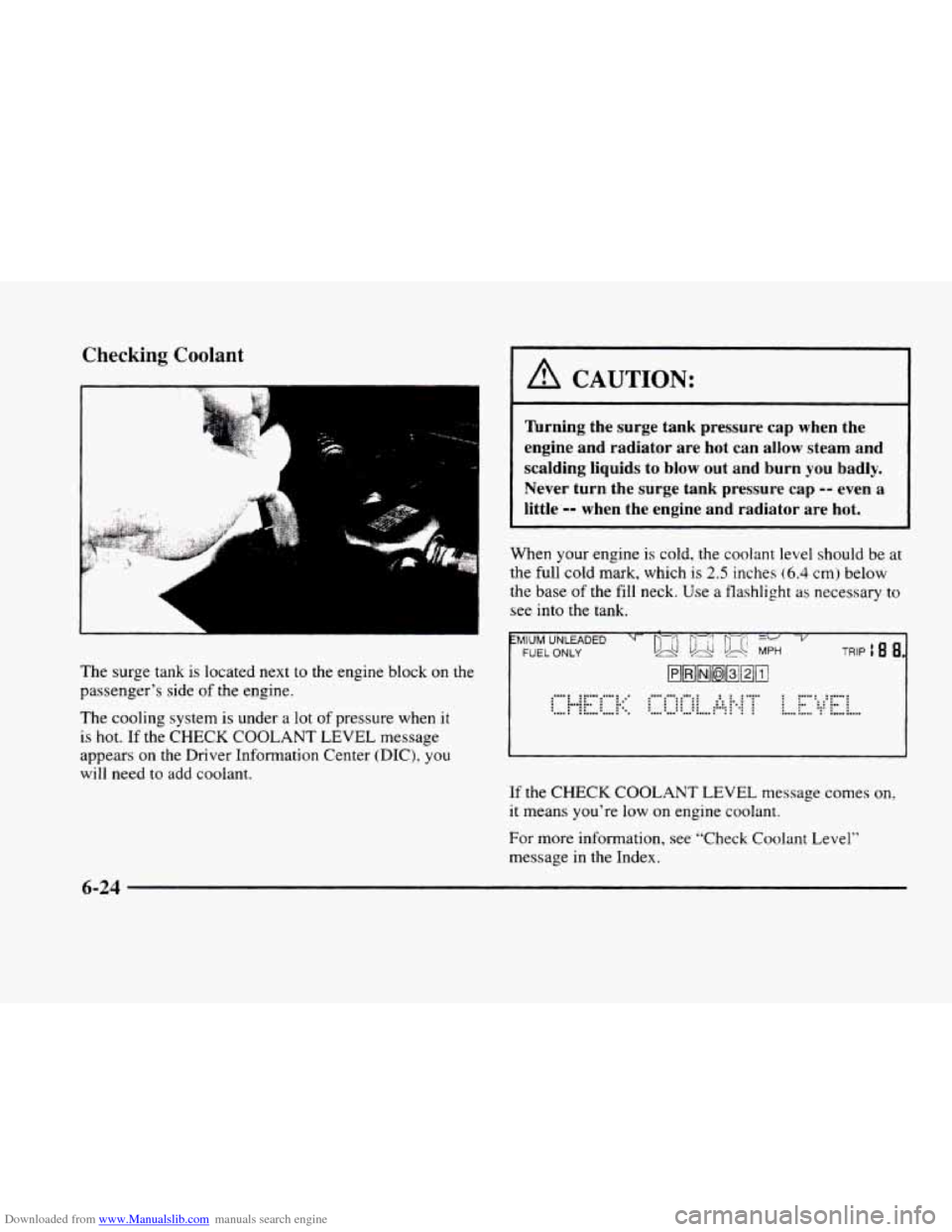
The surge tank is located next to the engine block on the
passenger's side
of the engine.
The cooling system is under a
lot of pressure when it
is hot. If the CHECK COOLANT LEVEL message
appears
on the Driver Information Center (DIC), you
will need to add coolant.
A CAUTION:
Turning the surge tank pressure cap when the
engine and radiator are hot can allow steam and
scalding liquids to blow out and burn
you badly.
Never turn the surge tank pressure cap
-- even a
little
-- when the engine and radiator are hot.
When your engine is cold. the coolant level should be at
the full cold mark, which
is 2.5 inches (6.4 cm) below
the base
of the fill neck. Use a flashlight as necessary to
see into the tank.
.................................................. ................. ...... ....... ............ ...... ............ ............ .......... ...................... ....... .................. ..... ..................................... .....................
If the CHECK COOLANT LEVEL message comes on.
it means you're low on engine coolant.
For more information, see "Check Coolant Level"
message in the Index.
6-24
Page 312 of 380
Downloaded from www.Manualslib.com manuals search engine Bulb Replacement Headlamps
For any bulb changing procedure not listed in this
section, contact your dealer’s service department.
Halogen Bulbs
I A CAUTION:
I I
r
Halogen bulbs have pressurized gas inside and
can burst if you drop or scratch the bulb. You or
others could be injured.
Be sure to read and
follow the instructions on the bulb package.
I I I
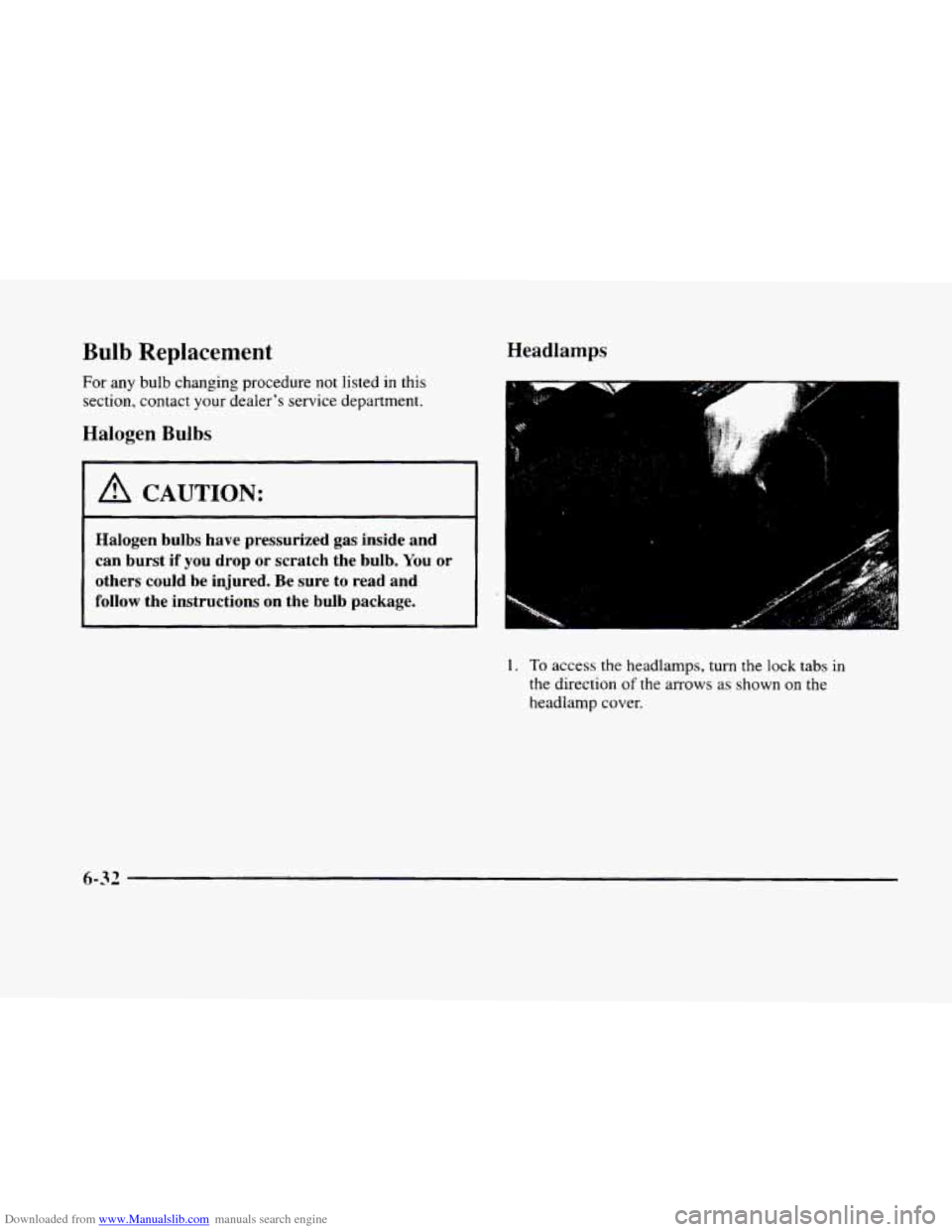
1. To access the headlamps, turn the lock tabs in
the direction
of the arrows as shown on the
headlamp cover.
6-32
Page 313 of 380
Downloaded from www.Manualslib.com manuals search engine I
rl
..
'I.
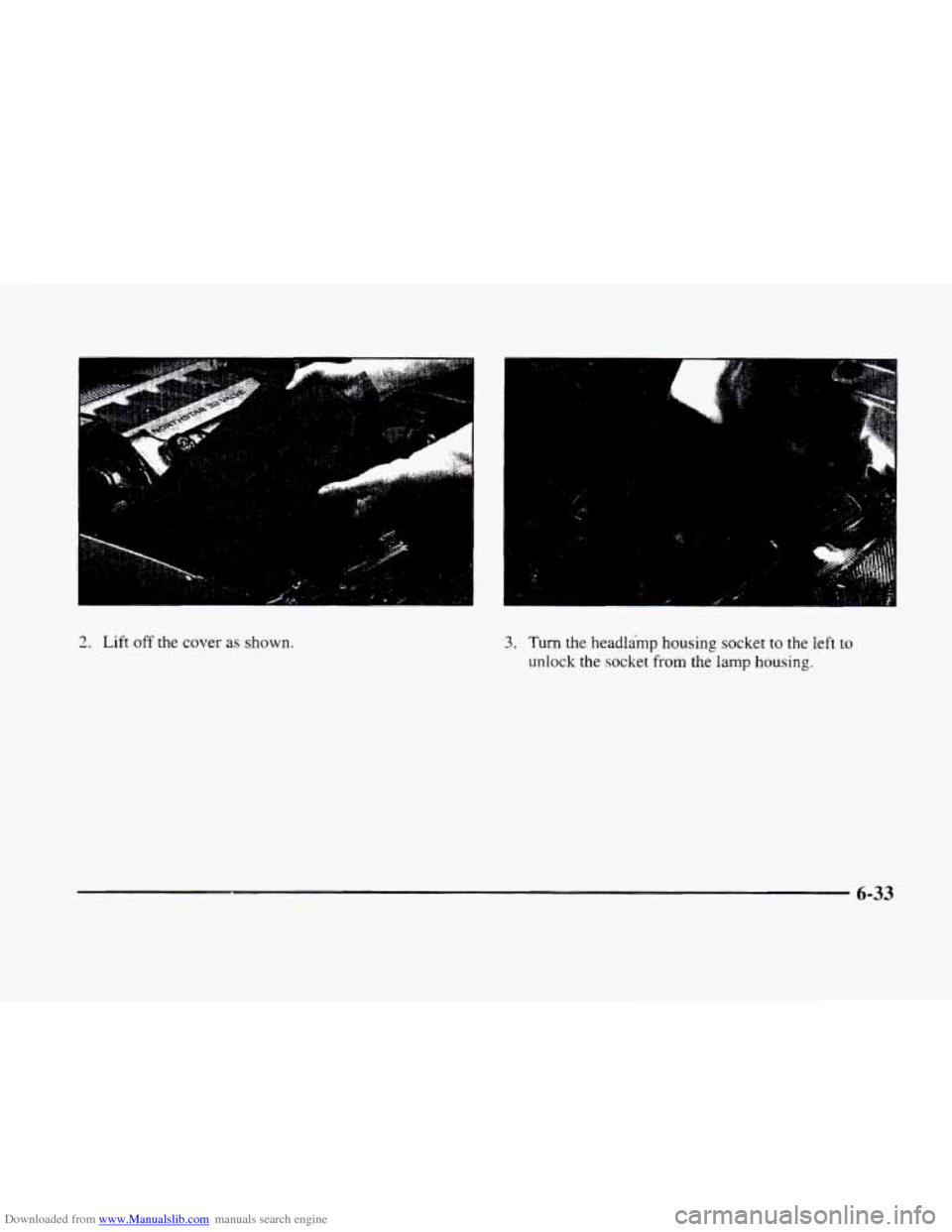
2. Lift off the cover as shown. 3. Turn the headlamp housing socket to the left to
unlock the socket from the lamp housing.
6-33
Page 315 of 380
Downloaded from www.Manualslib.com manuals search engine Front Turn Signal Lamps
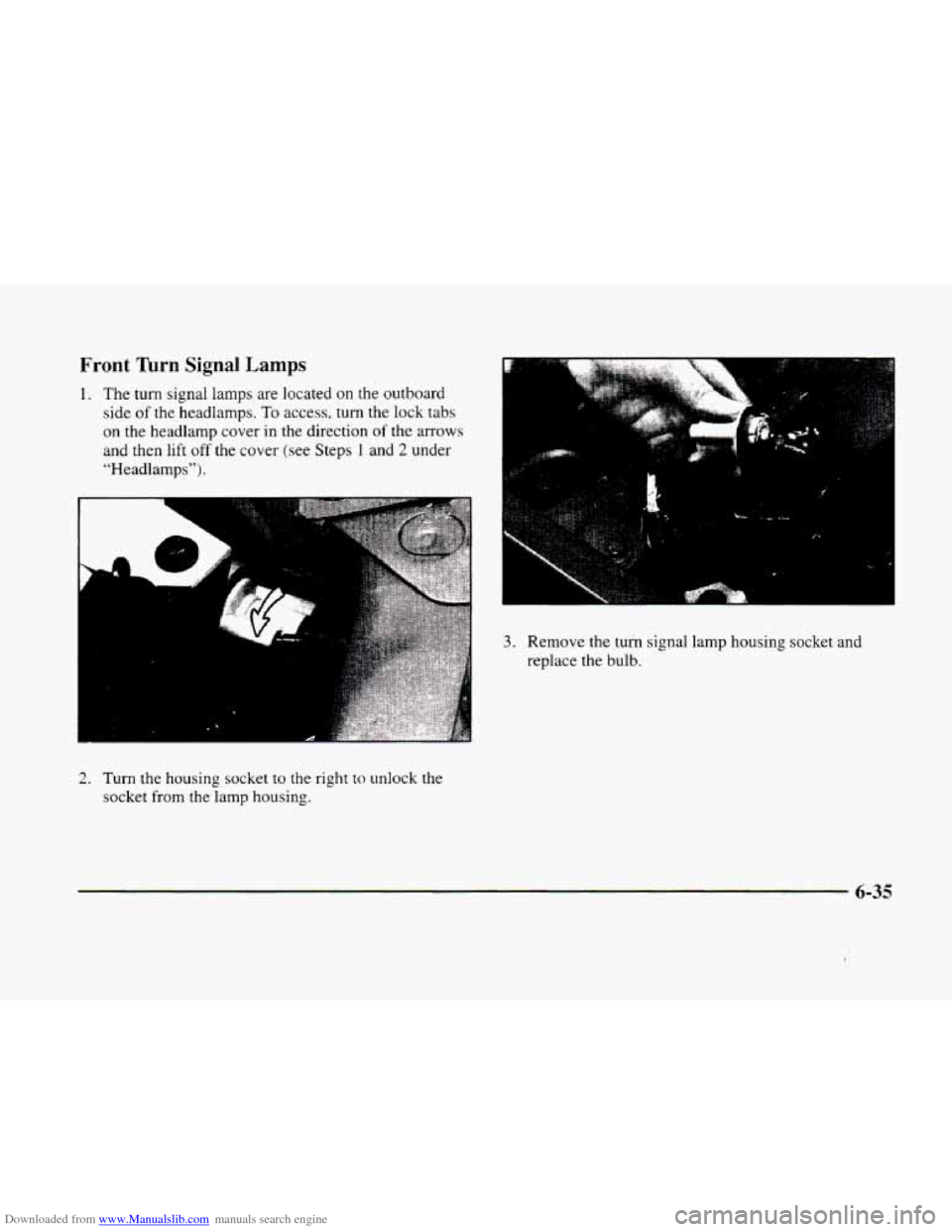
1. The turn signal lamps are located on the outboard
side
of the headlamps. To access, turn the lock tabs
on the headlamp cover in the direction
of the arrows
and then lift off the cover (see Steps 1 and 2 under
"Headlamps").
r
h
2. Turn the housing socket to the right to unlock the
socket
from the lamp housing.
..
.C -
.
3. Remove the tuin signal lamp housing socket and
replace
the bulb.
6-35
Page 336 of 380
Downloaded from www.Manualslib.com manuals search engine Headlamp Wiring
The headlamp wiring has an individual fuse which is
powered by a MaxiFuse@. An electrical overload
will cause the lamps to
go on and off, or in some
cases
to remain off. If this happens, have the headlamp
wiring checked right away.
MaxiFuse is a registered trademark
of Little
Fuse Incorporated.
Windshield Wiper Fuses
The windshield wiper motor is powered by a MaxiFuse.
If the motor overheats due to heavy snow, etc., the
wipers will stop until the
motor cools. If the overload
is caused
by some electrical problem, be sure to have
it fixed.
Power Windows and Other Power Options
Circuit breakers protect the power windows and other
power accessories. When the current load is
too heavy,
the circuit breaker opens and closes, protecting the
circuit until the problem
is fixed or goes away.
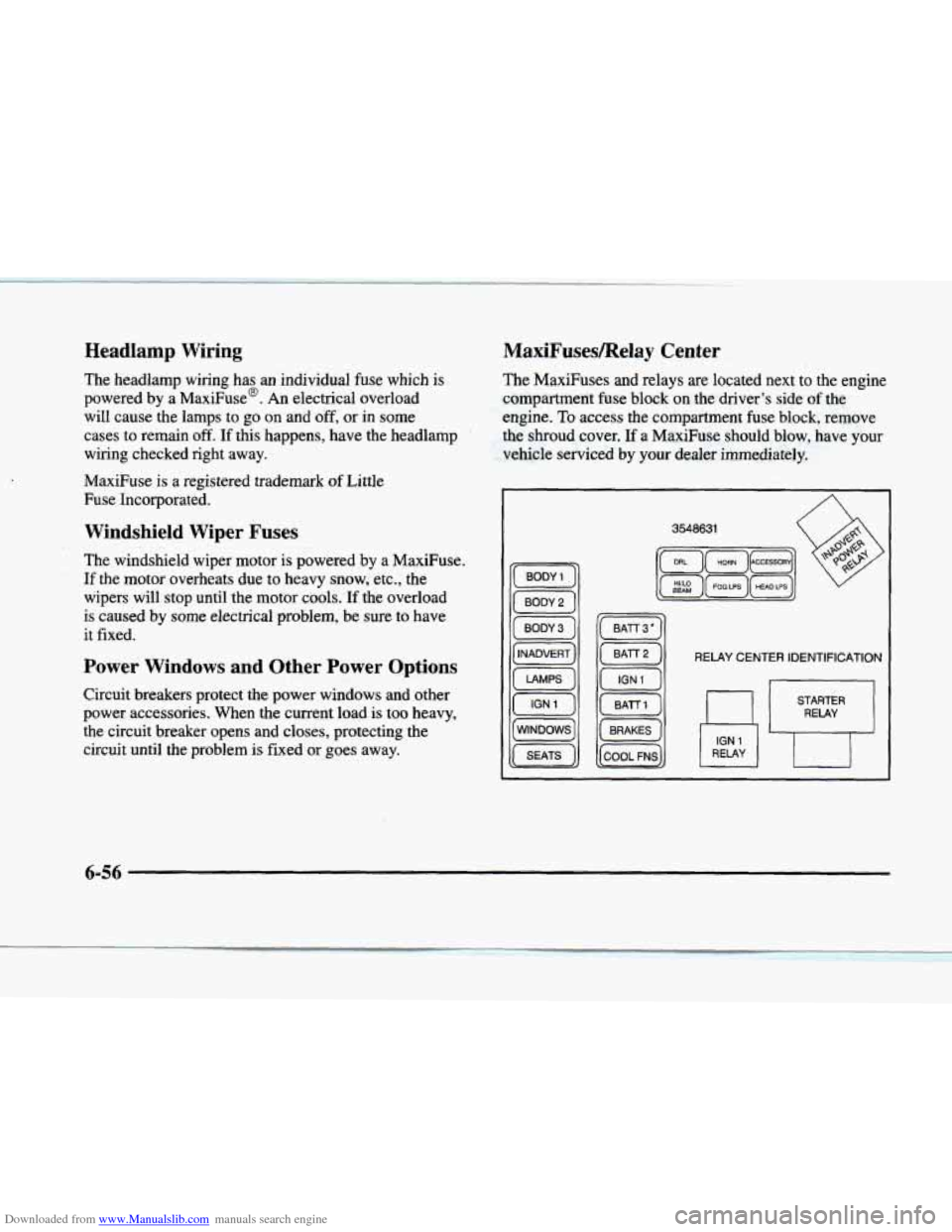
MaxiFusesmelay Center
The MaxiFuses and relays are located next to the engine
compartment fuse block
on the driver's side of the
engine. To access the compartment fuse block, remove
the shroud, cover.
If a MaxiFuse should blow, have your
vehicle serviced by your dealer immediately.
RELAY CENTER IDENTIFICATION
(WINDOWS)
RELAY
91
Page 337 of 380
Downloaded from www.Manualslib.com manuals search engine Fuse
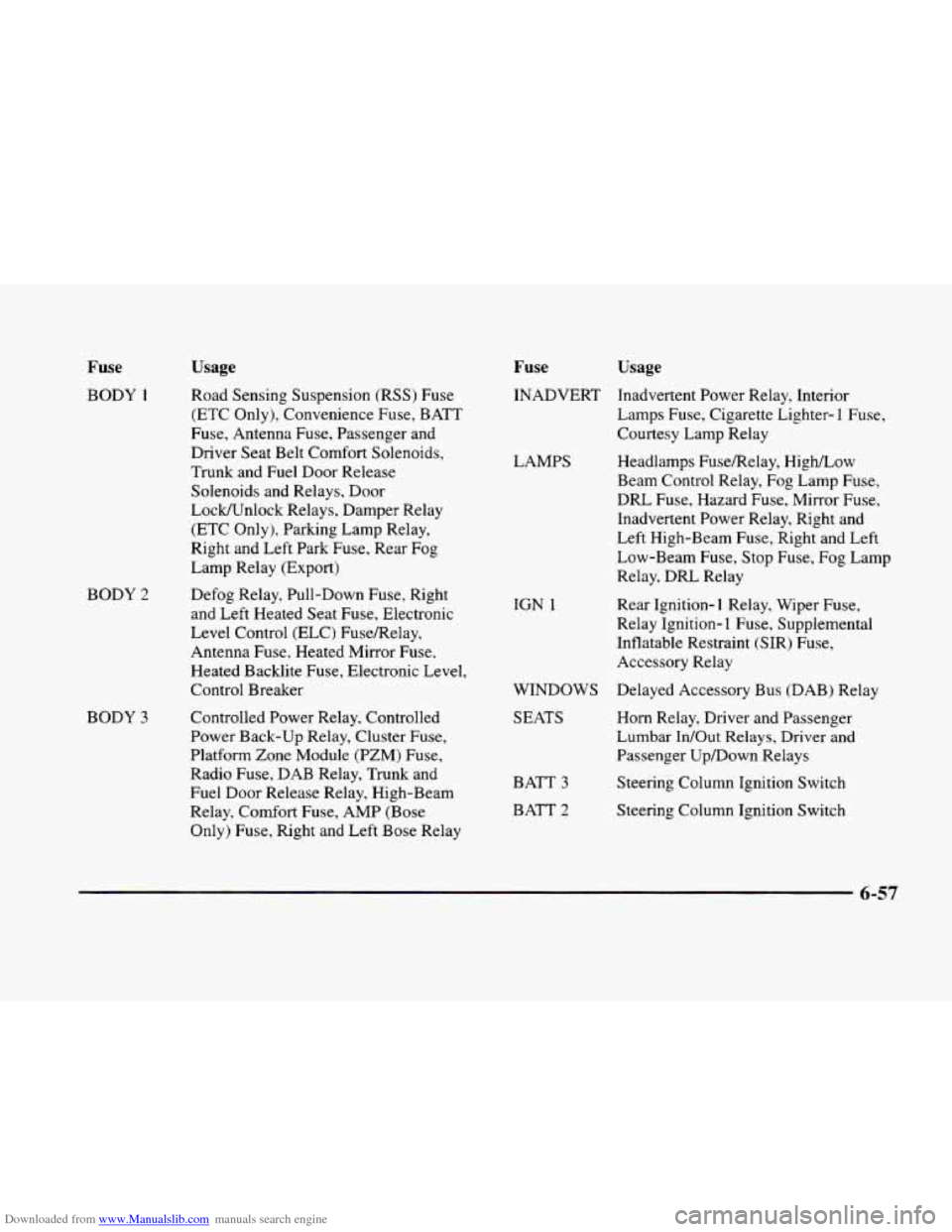
BODY 1
BODY 2
BODY 3
Usage
Road Sensing Suspension (RSS) Fuse
(ETC Only), Convenience Fuse, BATT
Fuse, Antenna Fuse, Passenger and
Driver Seat Belt Comfort Solenoids,
Trunk and Fuel Door Release
Solenoids and Relays, Door
Lock/Unlock Relays, Damper Relay
(ETC Only), Parking Lamp Relay,
Right and Left Park Fuse, Rear Fog
Lamp Relay (Export)
Defog Relay, Pull-Down Fuse, Right
and
Left Heated Seat Fuse, Electronic
Level Control (ELC) Fusemelay,
Antenna Fuse, Heated Mirror Fuse,
Heated Backlite Fuse, Electronic Level,
Control Breaker
Controlled Power Relay, Controlled
Power Back-up Relay, Cluster
Fuse,
Platform Zone Module (PZM) Fuse,
Radio Fuse,
DAB Relay, Trunk and
Fuel Door Release Relay, High-Beam
Relay, Comfort Fuse, AMP (Bose
Only) Fuse, Right and Left Bose Relay
Fuse Usage
INADVERT Inadvertent Power Relay, Interior
Lamps Fuse, Cigarette Lighter-
1 Fuse,
Courtesy Lamp Relay
LAMPS
IGN 1
Headlamps Fusemelay, High/Low
Beam Control Relay, Fog Lamp
Fuse,
DlU Fuse, Hazard Fuse, Mirror Fuse,
Inadvertent Power Relay, Right and
Left High-Beam Fuse, Right and Left
Low-Beam
Fuse, Stop Fuse, Fog Lamp
Relay, DRL Relay
Rear Ignition-
1 Relay, Wiper Fuse,
Relay Ignition-
1 Fuse, Supplemental
Inflatable Restraint (SIR) Fuse, Accessory Relay
WINDOWS Delayed Accessory Bus (DAB) Relay
SEATS
BATT
3
BATT 2
Horn Relay, Driver and Passenger
Lumbar IdOut Relays, Driver and
Passenger Up/Down Relays
Steering Column Ignition Switch
Steering Column Ignition Switch
6-57