lock CADILLAC ESCALADE 2010 3.G Owners Manual
[x] Cancel search | Manufacturer: CADILLAC, Model Year: 2010, Model line: ESCALADE, Model: CADILLAC ESCALADE 2010 3.GPages: 616, PDF Size: 39.41 MB
Page 517 of 616
5. Remove the valve cap from the valve cap stem.Activate the TPMS sensor by increasing ordecreasing the tire's air pressure for five seconds,or until a horn chirp sounds. The horn chirp, whichmay take up to 30 seconds to sound, confirms thatthe sensor identification code has been matched tothis tire and wheel position.
6. Proceed to the passenger side front tire, andrepeat the procedure in Step 5.
7. Proceed to the passenger side rear tire, and repeatthe procedure in Step 5.
8. Proceed to the driver side rear tire, and repeat theprocedure in Step 5. The horn sounds two times toindicate the sensor identification code has beenmatched to the driver side rear tire, and the TPMSsensor matching process is no longer active. TheTIRE LEARNING ACTIVE message on the DICdisplay screen goes off.
9. Turn the ignition switch to LOCK/OFF.
10. Set all four tires to the recommended air pressurelevel as indicated on the Tire and LoadingInformation label.
11. Put the valve caps back on the valve stems.
Tire Inspection and Rotation
We recommend that you regularly inspect your
vehicle's tires, including the spare tire, for signs of
wear or damage. SeeWhen It Is Time for New
Tireson page 7!73for more information.
Tires should be rotated every 5,000 to 8,000 miles
(8 000 to 13 000 km). SeeScheduled Maintenance
on page 8!3.
The purpose of a regular tire rotation is to achieve
a uniform wear for all tires on the vehicle. This will
ensure that your vehicle continues to perform
most like it did when the tires were new.
7-71
Page 521 of 616
{WARNING:
If you use bias-ply tires on the vehicle, the
wheel rim flanges could develop cracks after
many miles of driving. A tire and/or wheel
could fail suddenly, causing a crash. Use
only radial-ply tires with the wheels on the
vehicle.
If you must replace your vehicle's tires with those thatdo not have a TPC Spec number, make sure they arethe same size, load range, speed rating, andconstruction type (radial and bias!belted tires) as yourvehicle's original tires.
Vehicles that have a tire pressure monitoring systemmay give an inaccurate low!pressure warning ifnon!TPC spec rated tires are installed on your vehicle.Non!TPC Spec rated tires may give a low!pressurewarning that is higher or lower than the proper warninglevel you would get with TPC Spec rated tires. SeeTirePressure Monitor System on page 7!67.
Your vehicle's original equipment tires are listed on theTire and Loading Information Label. SeeLoading theVehicleon page 6!32, for more information about theTire and Loading Information Label and its location onyour vehicle.
Different Size Tires and Wheels
If you add wheels or tires that are a different size thanyour original equipment wheels and tires, this couldaffect the way your vehicle performs, including itsbraking, ride and handling characteristics, stability, andresistance to rollover. Additionally, if your vehicle haselectronic systems such as anti!lock brakes, rolloverairbags, traction control, and electronic stability control,the performance of these systems can be affected.
{WARNING:
If you add different sized wheels, your vehicle
may not provide an acceptable level of
performance and safety if tires not recommended
for those wheels are selected. You may increase
the chance that you will crash and suffer serious
injury. Only use GM specific wheel and tire
systems developed for your vehicle, and have
them properly installed by a GM certified
technician.
SeeBuying New Tireson page 7!73andAccessoriesand Modificationso n p a g e 7!4for additionalinformation.
7-75
Page 526 of 616
Changing a Flat Tire
If your vehicle is a Two-mode Hybrid, see theTwo-mode Hybrid manual for more information.
If a tire goes flat, avoid further tire and wheel damageby driving slowly to a level place. Turn on the hazardwarning flashers. SeeHazard Warning Flashersonp a g e 4!3.
{WARNING:
Changing a tire can be dangerous. The vehicle
can slip off the jack and roll over or fall on you or
other people. You and they could be badly injured
or even killed. Find a level place to change your
tire. To help prevent the vehicle from moving:
1. Set the parking brake firmly.
2. Put the shift lever in P (Park).
(Continued)
WARNING: (Continued)
3. Turn off the engine and do not restart while
the vehicle is raised.
4. Do not allow passengers to remain in the
vehicle.
To be even more certain the vehicle will not move,
you should put blocks at the front and rear of the
tire farthest away from the one being changed.
That would be the tire, on the other side, at the
opposite end of the vehicle.
When the vehicle has a flat tire (B), use the followingexample as a guide to assist you in the placement ofwheel blocks (A).
7-80
Page 527 of 616
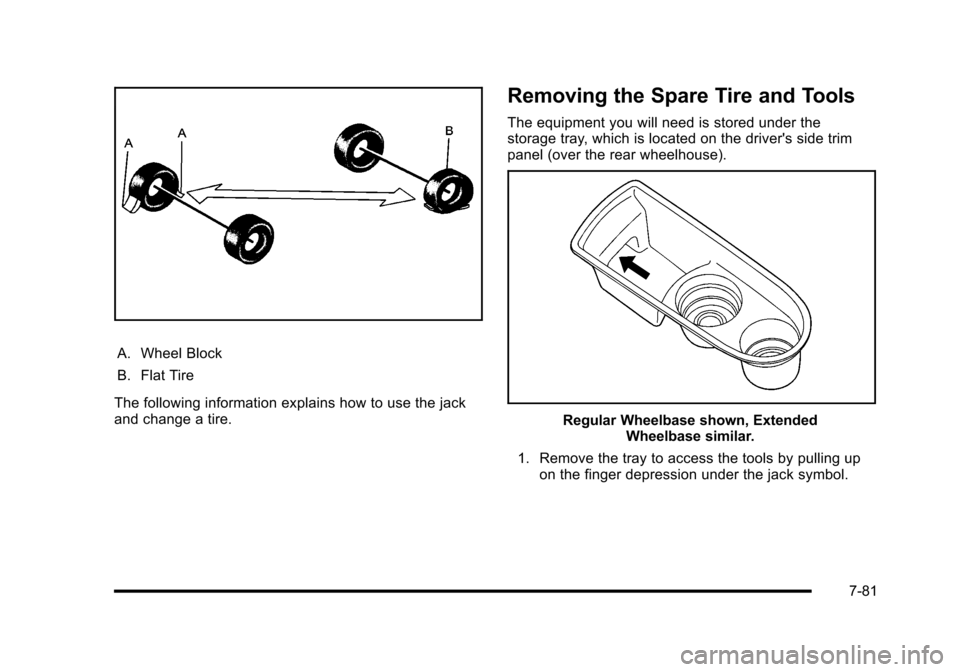
A. Wheel Block
B. Flat Tire
The following information explains how to use the jackand change a tire.
Removing the Spare Tire and Tools
The equipment you will need is stored under thestorage tray, which is located on the driver's side trimpanel (over the rear wheelhouse).
Regular Wheelbase shown, ExtendedWheelbase similar.
1. Remove the tray to access the tools by pulling upon the finger depression under the jack symbol.
7-81
Page 528 of 616
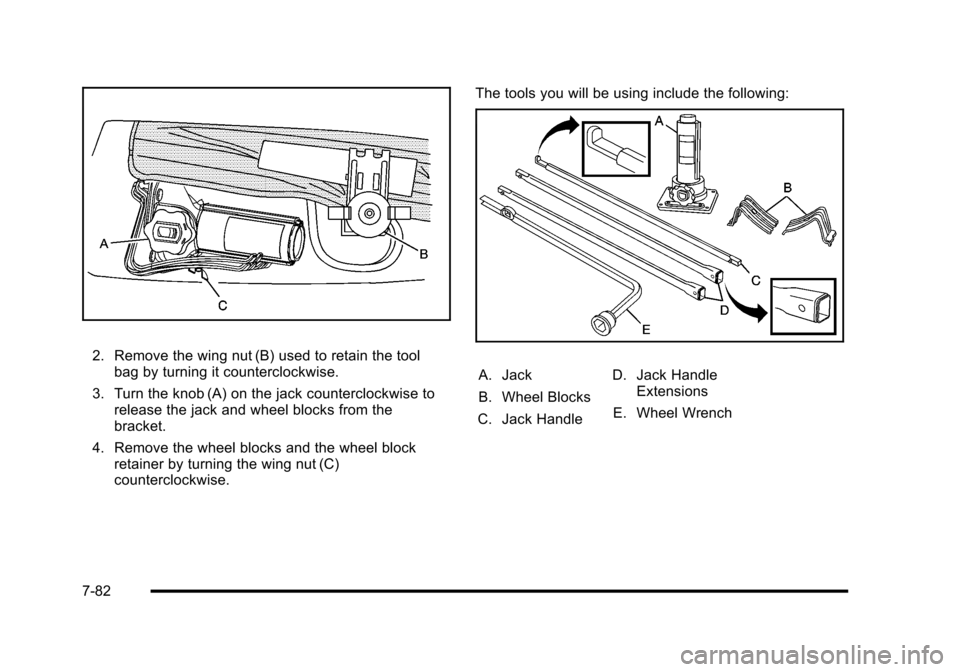
2. Remove the wing nut (B) used to retain the toolbag by turning it counterclockwise.
3. Turn the knob (A) on the jack counterclockwise torelease the jack and wheel blocks from thebracket.
4. Remove the wheel blocks and the wheel blockretainer by turning the wing nut (C)counterclockwise.
The tools you will be using include the following:
A. Jack
B. Wheel Blocks
C. Jack Handle
D. Jack HandleExtensions
E. Wheel Wrench
7-82
Page 529 of 616
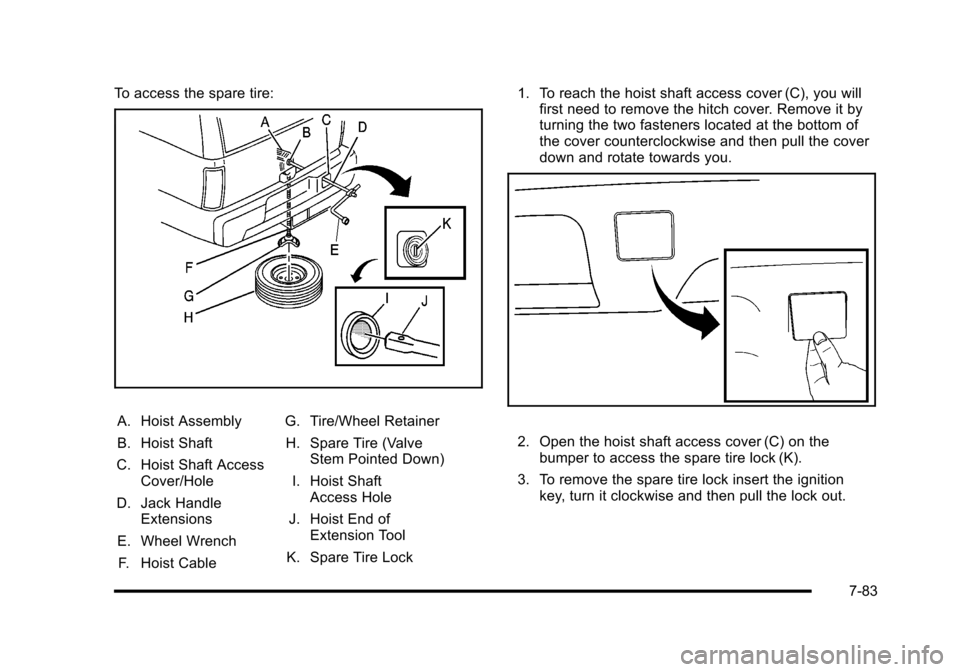
To access the spare tire:
A. Hoist Assembly
B. Hoist Shaft
C. Hoist Shaft AccessCover/Hole
D. Jack HandleExtensions
E. Wheel Wrench
F. Hoist Cable
G. Tire/Wheel Retainer
H. Spare Tire (ValveStem Pointed Down)
I. Hoist ShaftAccess Hole
J. Hoist End ofExtension Tool
K. Spare Tire Lock
1. To reach the hoist shaft access cover (C), you willfirst need to remove the hitch cover. Remove it byturning the two fasteners located at the bottom ofthe cover counterclockwise and then pull the coverdown and rotate towards you.
2. Open the hoist shaft access cover (C) on thebumper to access the spare tire lock (K).
3. To remove the spare tire lock insert the ignitionkey, turn it clockwise and then pull the lock out.
7-83
Page 530 of 616
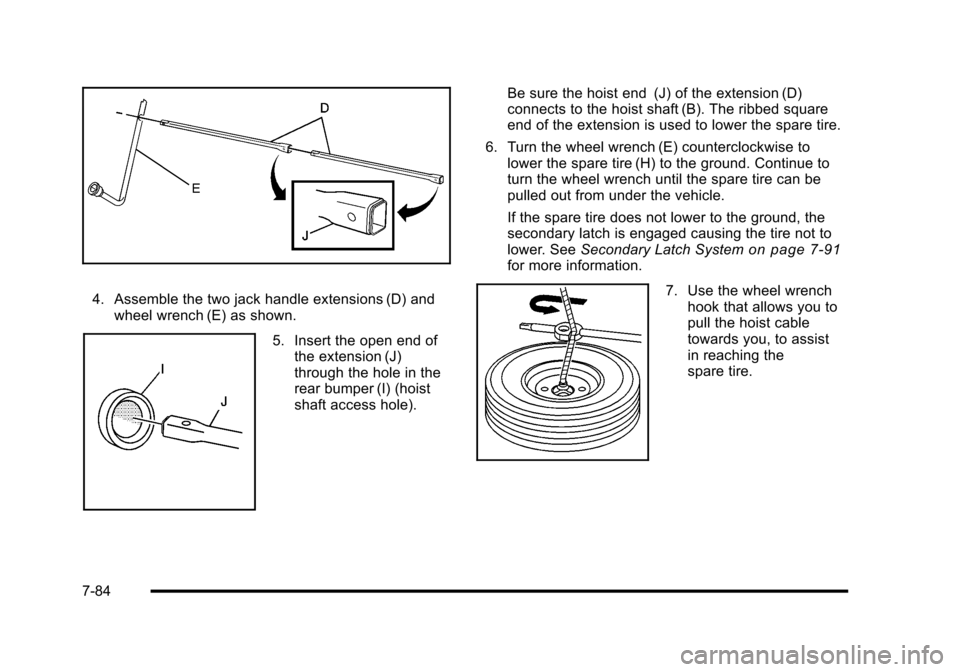
4. Assemble the two jack handle extensions (D) andwheel wrench (E) as shown.
5. Insert the open end ofthe extension (J)through the hole in therear bumper (I) (hoistshaft access hole).
Be sure the hoist end (J) of the extension (D)connects to the hoist shaft (B). The ribbed squareend of the extension is used to lower the spare tire.
6. Turn the wheel wrench (E) counterclockwise tolower the spare tire (H) to the ground. Continue toturn the wheel wrench until the spare tire can bepulled out from under the vehicle.
If the spare tire does not lower to the ground, thesecondary latch is engaged causing the tire not tolower. SeeSecondary Latch Systemon page 7!91for more information.
7. Use the wheel wrenchhook that allows you topull the hoist cabletowards you, to assistin reaching thespare tire.
7-84
Page 532 of 616
Removing the Flat Tire and Installing
the Spare Tire
1. Do a safety check before proceeding. SeeChanging a Flat Tireon page 7!80for moreinformation.
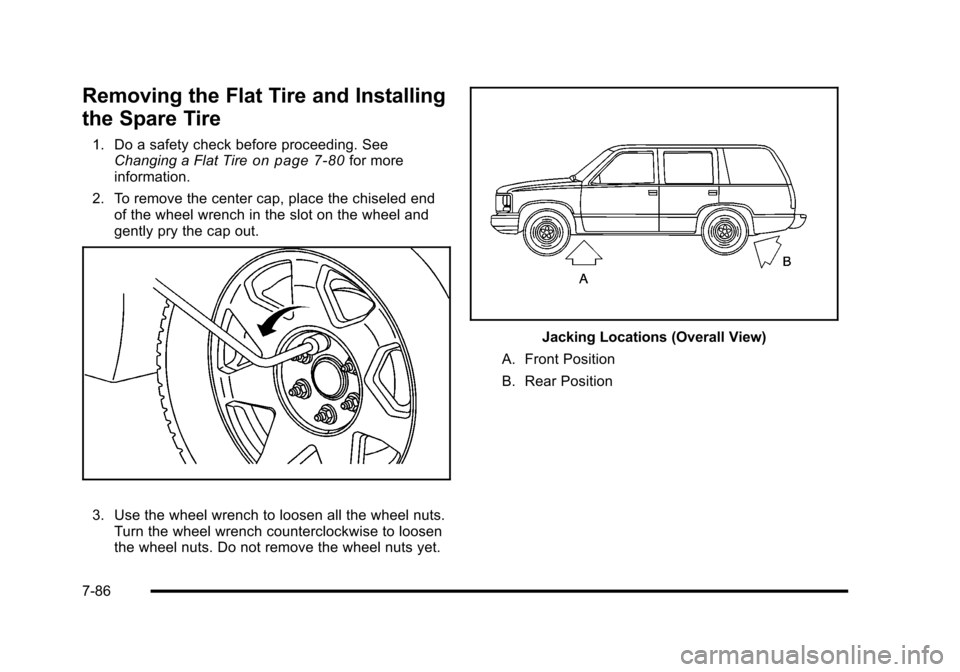
2. To remove the center cap, place the chiseled endof the wheel wrench in the slot on the wheel andgently pry the cap out.
3. Use the wheel wrench to loosen all the wheel nuts.Turn the wheel wrench counterclockwise to loosenthe wheel nuts. Do not remove the wheel nuts yet.
Jacking Locations (Overall View)
A. Front Position
B. Rear Position
7-86
Page 533 of 616

{WARNING:
Getting under a vehicle when it is jacked up is
dangerous. If the vehicle slips off the jack, you
could be badly injured or killed. Never get under a
vehicle when it is supported only by a jack.
{WARNING:
Raising your vehicle with the jack improperly
positioned can damage the vehicle and even
make the vehicle fall. To help avoid personal
injury and vehicle damage, be sure to fit the jack
lift head into the proper location before raising the
vehicle.
4. Position the jack under the vehicle as shown.
Front Position
Front Tire Flat:If the flat tire is on a front tire ofthe vehicle, you will need to use the jack handleand only one jack handle extension. Attach thewheel wrench to the jack handle extension. Attachthe jack handle to the jack (A). Position the jack onthe frame behind the flat tire where the framesections overlap. Turn the wheel wrench clockwiseto raise the vehicle. Raise the vehicle far enoughoff the ground so there is enough room for thespare tire to clear the ground.
7-87
Page 534 of 616
Rear Position
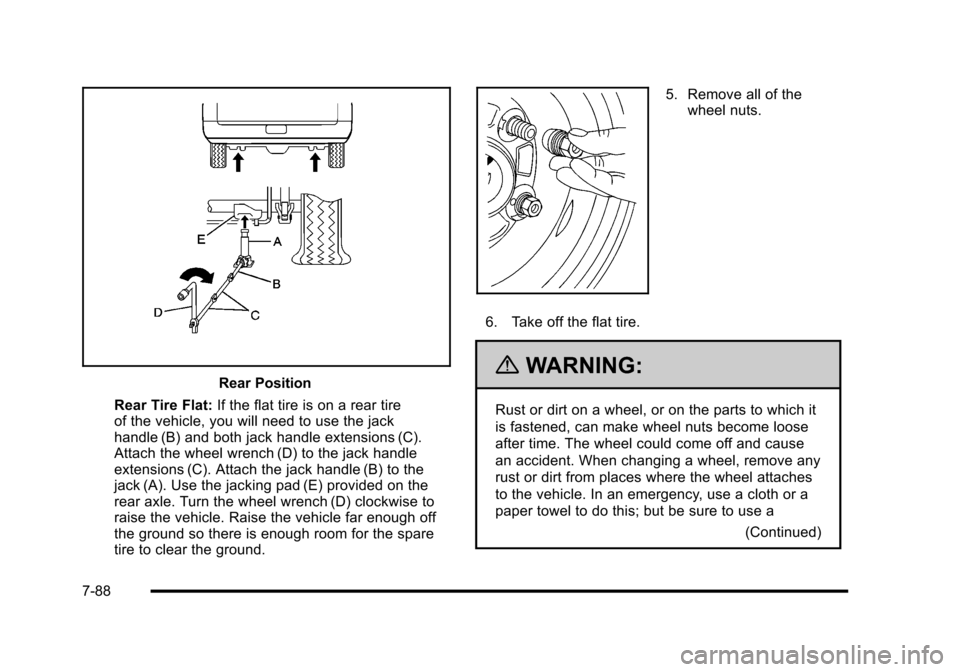
Rear Tire Flat:If the flat tire is on a rear tireof the vehicle, you will need to use the jackhandle (B) and both jack handle extensions (C).Attach the wheel wrench (D) to the jack handleextensions (C). Attach the jack handle (B) to thejack (A). Use the jacking pad (E) provided on therear axle. Turn the wheel wrench (D) clockwise toraise the vehicle. Raise the vehicle far enough offthe ground so there is enough room for the sparetire to clear the ground.
5. Remove all of thewheel nuts.
6. Take off the flat tire.
{WARNING:
Rust or dirt on a wheel, or on the parts to which it
is fastened, can make wheel nuts become loose
after time. The wheel could come off and cause
an accident. When changing a wheel, remove any
rust or dirt from places where the wheel attaches
to the vehicle. In an emergency, use a cloth or a
paper towel to do this; but be sure to use a
(Continued)
7-88