tow CADILLAC ESCALADE 2010 3.G User Guide
[x] Cancel search | Manufacturer: CADILLAC, Model Year: 2010, Model line: ESCALADE, Model: CADILLAC ESCALADE 2010 3.GPages: 616, PDF Size: 39.41 MB
Page 52 of 616
Automatic Seat Release Fold and
Tumble Feature
The transmission must be in (P) for this featureto work.
{WARNING:
Automatically folding and tumbling the seat when
someone is sitting in the seat, could cause injury
to the person sitting there. Always make sure
there is no one sitting in the seat before pressing
the automatic seat release button.
Folding and Tumbling the Second Row
Seat(s) from the Third Row Seats or
Outside
{WARNING:
Using the third row seating position while the
second row is folded, or folded and tumbled, could
cause injury in a sudden stop or crash. Be sure to
return the seat to the passenger seating position.
Push and pull on the seat to make sure it is
locked into place.
To fold and tumble the seat from the third row seats,if your vehicle has them, do the following:
1. Make sure that there is nothing under, in front of,or on the seat.
Notice:Folding a rear seat with the safety beltsstill fastened may cause damage to the seat or thesafety belts. Always unbuckle the safety belts andreturn them to their normal stowed position beforefolding a rear seat.
2-20
Page 54 of 616
Folding the Seatback(s)
Notice:Folding a rear seat with the safety beltsstill fastened may cause damage to the seat or thesafety belts. Always unbuckle the safety belts andreturn them to their normal stowed position beforefolding a rear seat.
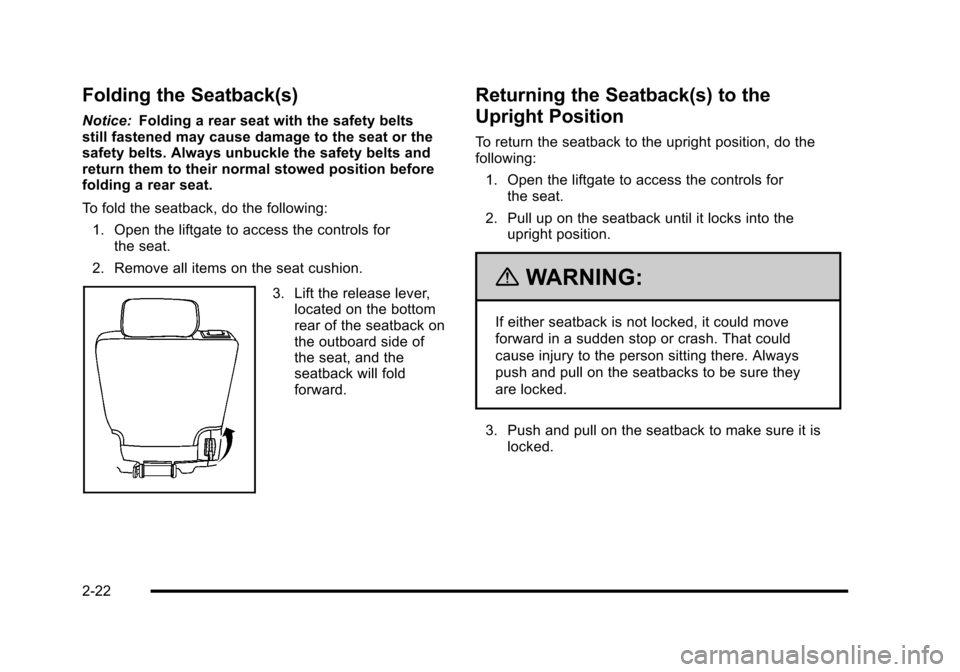
To fold the seatback, do the following:
1. Open the liftgate to access the controls forthe seat.
2. Remove all items on the seat cushion.
3. Lift the release lever,located on the bottomrear of the seatback onthe outboard side ofthe seat, and theseatback will foldforward.
Returning the Seatback(s) to the
Upright Position
To return the seatback to the upright position, do thefollowing:
1. Open the liftgate to access the controls forthe seat.
2. Pull up on the seatback until it locks into theupright position.
{WARNING:
If either seatback is not locked, it could move
forward in a sudden stop or crash. That could
cause injury to the person sitting there. Always
push and pull on the seatbacks to be sure they
are locked.
3. Push and pull on the seatback to make sure it islocked.
2-22
Page 62 of 616
Questions and Answers About
Safety Belts
Q: Will I be trapped in the vehicle after a crash ifI am wearing a safety belt?
A:Youcouldbe—whether you are wearing a safetybelt or not. But your chance of being consciousduring and after an accident, so youcanunbuckleand get out, ismuchgreater if you are belted.And you can unbuckle a safety belt, even if youare upside down.
Q: If my vehicle has airbags, why should I have towear safety belts?
A:Airbags are supplemental systems only; so theyworkwithsafety belts—not instead of them.Whether or not an airbag is provided, all occupantsstill have to buckle up to get the most protection.That is true not only in frontal collisions, butespecially in side and other collisions.
Q: If I am a good driver, and I never drive far fromhome, why should I wear safety belts?
A:You may be an excellent driver, but if you are in acrash—even one that is not your fault—you andyour passenger(s) can be hurt. Being a good driverdoes not protect you from things beyond yourcontrol, such as bad drivers.
Most accidents occur within 25 miles (40 km)of home. And the greatest number of seriousinjuries and deaths occur at speeds of lessthan 40 mph (65 km/h).
Safety belts are for everyone.
How to Wear Safety Belts Properly
This section is only for people of adult size.
Be aware that there are special things to know aboutsafety belts and children. And there are different rulesfor smaller children and infants. If a child will be riding inthe vehicle, seeOlder Childrenon page 2!49orInfantsand Young Childrenon page 2!52. Follow those rulesfor everyone's protection.
It is very important for all occupants to buckle up.Statistics show that unbelted people are hurt more oftenin crashes than those who are wearing safety belts.
Occupants who are not buckled up can be thrown out ofthe vehicle in a crash. And they can strike others in thevehicle who are wearing safety belts.
2-30
Page 74 of 616
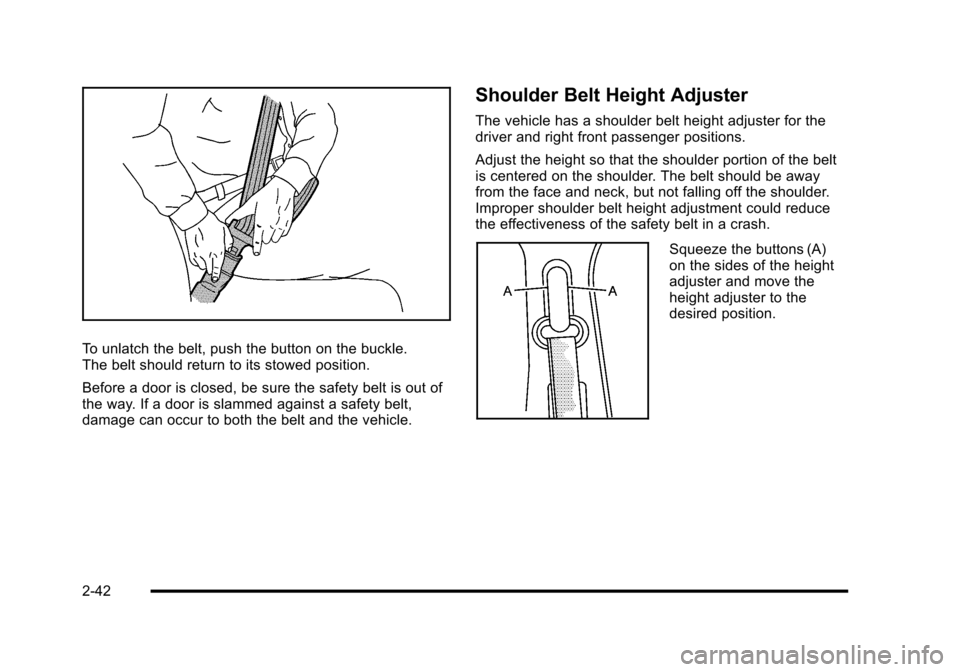
To unlatch the belt, push the button on the buckle.The belt should return to its stowed position.
Before a door is closed, be sure the safety belt is out ofthe way. If a door is slammed against a safety belt,damage can occur to both the belt and the vehicle.
Shoulder Belt Height Adjuster
The vehicle has a shoulder belt height adjuster for thedriver and right front passenger positions.
Adjust the height so that the shoulder portion of the beltis centered on the shoulder. The belt should be awayfrom the face and neck, but not falling off the shoulder.Improper shoulder belt height adjustment could reducethe effectiveness of the safety belt in a crash.
Squeeze the buttons (A)on the sides of the heightadjuster and move theheight adjuster to thedesired position.
2-42
Page 97 of 616
Notice:Do not let the LATCH attachments rubagainst the vehicle’s safety belts. This may damagethese parts. If necessary, move buckled safety beltsto avoid rubbing the LATCH attachments.
Do not fold the empty rear seat with a safety beltbuckled. This could damage the safety belt or theseat. Unbuckle and return the safety belt to itsstowed position, before folding the seat.
1. Attach and tighten the lower attachments to thelower anchors. If the child restraint does not havelower attachments or the desired seating positiondoes not have lower anchors, secure the childrestraint with the top tether and the safety belts.Refer to your child restraint manufacturerinstructions and the instructions in this manual.
1. 1. Find the lower anchors for the desiredseating position.
1. 2. Put the child restraint on the seat.
1. 3. Attach and tighten the lower attachments onthe child restraint to the lower anchors.
2. If the child restraint manufacturer recommends thatthe top tether be attached, attach and tighten thetop tether to the top tether anchor, if the vehiclehas one. Refer to the child restraint instructionsand the following steps:
2. 1. Find the top tether anchor.
2. 2. Route, attach and tighten the top tetheraccording to your child restraint instructionsand the following instructions:
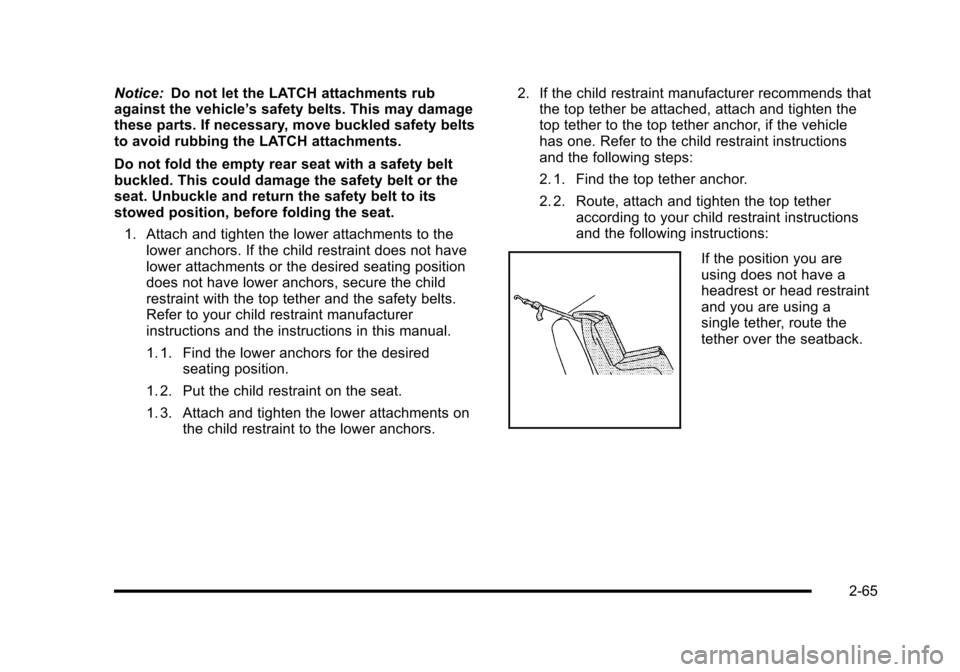
If the position you areusing does not have aheadrest or head restraintand you are using asingle tether, route thetether over the seatback.
2-65
Page 102 of 616
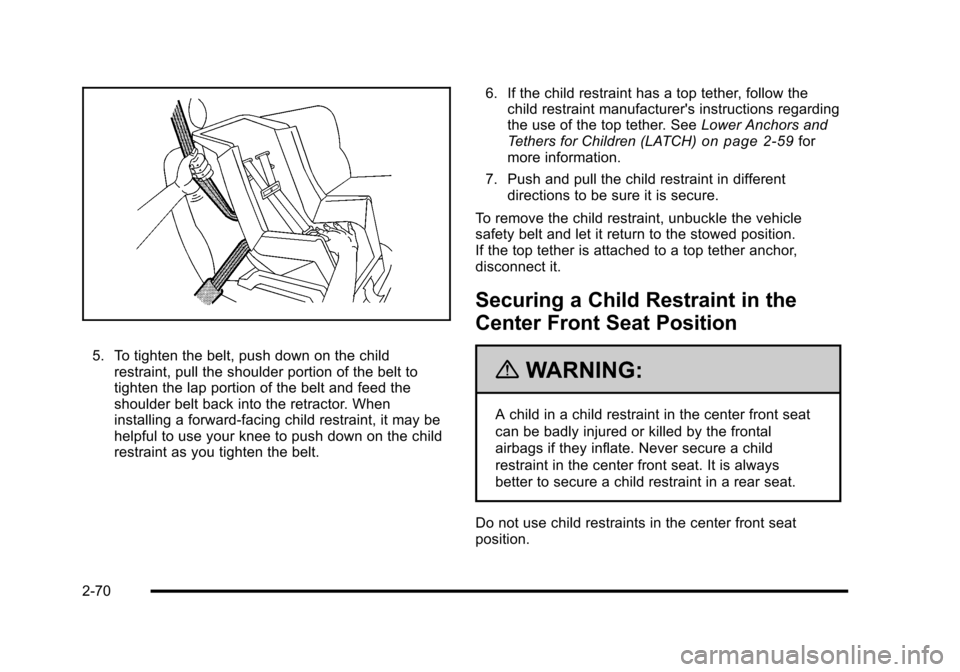
5. To tighten the belt, push down on the childrestraint, pull the shoulder portion of the belt totighten the lap portion of the belt and feed theshoulder belt back into the retractor. Wheninstalling a forward-facing child restraint, it may behelpful to use your knee to push down on the childrestraint as you tighten the belt.
6. If the child restraint has a top tether, follow thechild restraint manufacturer's instructions regardingthe use of the top tether. SeeLower Anchors andTethers for Children (LATCH)on page 2!59formore information.
7. Push and pull the child restraint in differentdirections to be sure it is secure.
To remove the child restraint, unbuckle the vehiclesafety belt and let it return to the stowed position.If the top tether is attached to a top tether anchor,disconnect it.
Securing a Child Restraint in the
Center Front Seat Position
{WARNING:
A child in a child restraint in the center front seat
can be badly injured or killed by the frontal
airbags if they inflate. Never secure a child
restraint in the center front seat. It is always
better to secure a child restraint in a rear seat.
Do not use child restraints in the center front seatposition.
2-70
Page 106 of 616
If the vehicle is equipped with the passenger sensingsystem, and when the passenger sensing system hasturned off the right front passenger frontal airbag, the offindicator in the passenger airbag status indicator shouldlight and stay lit when you start the vehicle. SeePassenger Airbag Status Indicator on page 4!31.
If a child restraint has been installed and the onindicator is lit, see“If the On Indicator is Lit for aChild Restraint”underPassenger Sensing Systemonpage 2!84for more information.
To remove the child restraint, unbuckle the vehiclesafety belt and let it return to the stowed position.
Airbag System
The vehicle has the following airbags:
.A frontal airbag for the driver.
.A frontal airbag for the right front passenger.
.A roof-rail airbag for the driver and passengerdirectly behind the driver.
.A roof-rail airbag for the right front passenger andthe person seated directly behind that passenger.
The vehicle may have the following airbags:
.A seat!mounted side impact airbag for the driver.
.A seat!mounted side impact airbag for the rightfront passenger.
.If the vehicle has a third row seat, it will have athird row roof-rail airbag.
All of the airbags in the vehicle will have the wordAIRBAG embossed in the trim or on an attached labelnear the deployment opening.
For frontal airbags, the word AIRBAG will appear on themiddle part of the steering wheel for the driver and onthe instrument panel for the right front passenger.
With seat!mounted side impact airbags, the wordAIRBAG will appear on the side of the seatback closestto the door.
With roof-rail airbags, the word AIRBAG will appearalong the headliner or trim.
Airbags are designed to supplement the protectionprovided by safety belts. Even though today's airbagsare also designed to help reduce the risk of injury fromthe force of an inflating bag, all airbags must inflate veryquickly to do their job.
2-74
Page 114 of 616
Rollover capable roof-rail airbags are designed to helpcontain the head and chest of occupants in theoutboard seating positions in the first, second, and thirdrows, if equipped with a third row seat. The rollovercapable roof-rail airbags are designed to help reducethe risk of full or partial ejection in rollover events,although no system can prevent all such ejections.
But airbags would not help in many types of collisions,primarily because the occupant's motion is not towardthose airbags. SeeWhen Should an Airbag Inflate?onpage 2!80for more information.
Airbags should never be regarded as anything morethan a supplement to safety belts.
What Will You See After an Airbag
Inflates?
After the frontal airbags and seat-mounted side impactairbags inflate, they quickly deflate, so quickly thatsome people may not even realize an airbag inflated.Roof-rail airbags may still be at least partially inflated forsome time after they deploy. Some components of theairbag module may be hot for several minutes. Forlocation of the airbag modules, seeWhat Makes anAirbag Inflate? on page 2!81.
The parts of the airbag that come into contact with youmay be warm, but not too hot to touch. There may besome smoke and dust coming from the vents in thedeflated airbags. Airbag inflation does not prevent thedriver from seeing out of the windshield or being able tosteer the vehicle, nor does it prevent people fromleaving the vehicle.
{WARNING:
When an airbag inflates, there may be dust in the
air. This dust could cause breathing problems for
people with a history of asthma or other breathing
trouble. To avoid this, everyone in the vehicle
should get out as soon as it is safe to do so.
If you have breathing problems but cannot get out
of the vehicle after an airbag inflates, then get
fresh air by opening a window or a door. If you
experience breathing problems following an airbag
deployment, you should seek medical attention.
The vehicle has a feature that may automatically unlockthe doors, turn on the interior lamps and hazard warningflashers, and shut off the fuel system after the airbagsinflate. You can lock the doors, turn off the interiorlamps and hazard warning flashers by using thecontrols for those features.
2-82
Page 120 of 616
Additional Factors Affecting System
Operation
Safety belts help keep the passenger in position on theseat during vehicle maneuvers and braking, which helpsthe passenger sensing system maintain the passengerairbag status. See“Safety Belts”and“Child Restraints”in the Index for additional information about theimportance of proper restraint use.
If the shoulder portion of the belt is pulled out all theway, the child restraint locking feature will be engaged.This may unintentionally cause the passenger sensingsystem to turn the airbag off for some adult sizeoccupants. If this happens, let the belt go back all theway and start again.
A thick layer of additional material, such as a blanket orcushion, or aftermarket equipment such as seat covers,seat heaters, and seat massagers can affect how wellthe passenger sensing system operates. We
recommend that you not use seat covers or otheraftermarket equipment except when approved byGM for your specific vehicle. SeeAdding Equipment toYour Airbag-Equipped Vehicleon page 2!89for moreinformation about modifications that can affect how thesystem operates.
The on indicator may be lit if an object, such as abriefcase, handbag, grocery bag, laptop or otherelectronic device, is put on an unoccupied seat.If this is not desired remove the object from the seat.
{WARNING:
Stowing of articles under the passenger seat or
between the passenger seat cushion and
seatback may interfere with the proper operation
of the passenger sensing system.
2-88
Page 125 of 616

Section 3 Features and Controls
Keys. . . . . . . . . . . . . . . . . . . . . . . . . . . . . . . . . . . . . . . . . . . . . . . . 3-3Remote Keyless Entry (RKE) System . . . . . . . . . . . 3-4Remote Keyless Entry (RKE) SystemOperation . . . . . . . . . . . . . . . . . . . . . . . . . . . . . . . . . . . . . 3-4Remote Vehicle Start . . . . . . . . . . . . . . . . . . . . . . . . . . . 3-7
Doors and Locks. . . . . . . . . . . . . . . . . . . . . . . . . . . . . . . . . 3-10Door Locks . . . . . . . . . . . . . . . . . . . . . . . . . . . . . . . . . . . . 3-10Power Door Locks . . . . . . . . . . . . . . . . . . . . . . . . . . . . . 3-10Delayed Locking . . . . . . . . . . . . . . . . . . . . . . . . . . . . . . . 3-11Programmable Automatic Door Locks . . . . . . . . . . 3-11Rear Door Security Locks . . . . . . . . . . . . . . . . . . . . . . 3-11Lockout Protection . . . . . . . . . . . . . . . . . . . . . . . . . . . . . 3-12Liftgate/Liftglass . . . . . . . . . . . . . . . . . . . . . . . . . . . . . . . 3-12Power Liftgate . . . . . . . . . . . . . . . . . . . . . . . . . . . . . . . . . 3-14Power Assist Steps . . . . . . . . . . . . . . . . . . . . . . . . . . . . 3-17
Windows. . . . . . . . . . . . . . . . . . . . . . . . . . . . . . . . . . . . . . . . . . 3-18Power Windows . . . . . . . . . . . . . . . . . . . . . . . . . . . . . . . 3-19Sun Visors . . . . . . . . . . . . . . . . . . . . . . . . . . . . . . . . . . . . . 3-21
Theft-Deterrent Systems. . . . . . . . . . . . . . . . . . . . . . . . . 3-22Content Theft-Deterrent . . . . . . . . . . . . . . . . . . . . . . . . 3-22PASS-Key®III+ Electronic Immobilizer . . . . . . . . . 3-24PASS-Key®III+ Electronic ImmobilizerOperation . . . . . . . . . . . . . . . . . . . . . . . . . . . . . . . . . . . . 3-24
Starting and Operating Your Vehicle. . . . . . . . . . . . 3-26New Vehicle Break-In . . . . . . . . . . . . . . . . . . . . . . . . . . 3-26Ignition Positions . . . . . . . . . . . . . . . . . . . . . . . . . . . . . . 3-27Retained Accessory Power (RAP) . . . . . . . . . . . . . 3-28Starting the Engine . . . . . . . . . . . . . . . . . . . . . . . . . . . . 3-29Adjustable Throttle and Brake Pedal . . . . . . . . . . . 3-30Engine Coolant Heater . . . . . . . . . . . . . . . . . . . . . . . . . 3-31Active Fuel Management™. . . . . . . . . . . . . . . . . . . . 3-32Automatic Transmission Operation . . . . . . . . . . . . . 3-32Tow/Haul Mode . . . . . . . . . . . . . . . . . . . . . . . . . . . . . . . . 3-36Parking Brake . . . . . . . . . . . . . . . . . . . . . . . . . . . . . . . . . 3-38Shifting Into Park . . . . . . . . . . . . . . . . . . . . . . . . . . . . . . 3-39Shifting Out of Park . . . . . . . . . . . . . . . . . . . . . . . . . . . . 3-40Parking Over Things That Burn . . . . . . . . . . . . . . . . 3-41Engine Exhaust . . . . . . . . . . . . . . . . . . . . . . . . . . . . . . . . 3-41Running the Vehicle While Parked . . . . . . . . . . . . . 3-42
3-1