tow CADILLAC ESCALADE 2010 3.G Workshop Manual
[x] Cancel search | Manufacturer: CADILLAC, Model Year: 2010, Model line: ESCALADE, Model: CADILLAC ESCALADE 2010 3.GPages: 616, PDF Size: 39.41 MB
Page 423 of 616
The Tire and Loading Information label also
shows the size of the original equipment
tires (C) and the recommended cold tire inflation
pressures (D). For more information on tires and
inflation seeTireson page 7!58andInflation - Tire
Pressureon page 7!65.
There is also important loading information on
the vehicle Certification/Tire label. It tells you the
Gross Vehicle Weight Rating (GVWR) and the
Gross Axle Weight Rating (GAWR) for the front
and rear axles. See“Certification/Tire Label”later
in this section.
Steps for Determining Correct Load Limit
1.Locate the statement“The combined weight
of occupants and cargo should never exceed
XXX kg or XXX lbs”on your vehicle's placard.
2.Determine the combined weight of the
driver and passengers that will be riding in
your vehicle.
3.Subtract the combined weight of the driver
and passengers from XXX kg or XXX lbs.
4.The resulting figure equals the available
amount of cargo and luggage load capacity.
For example, if the“XXX”amount equals
1400 lbs and there will be five 150 lb
passengers in your vehicle, the amount of
available cargo and luggage load capacity
is 650 lbs (1400!750 (5 x 150) = 650 lbs).
5.Determine the combined weight of luggage
and cargo being loaded on the vehicle.
That weight may not safely exceed the
available cargo and luggage load capacity
calculated in Step 4.
6.If your vehicle will be towing a trailer, the load
from your trailer will be transferred to your
vehicle. Consult this manual to determine
how this reduces the available cargo and
luggage load capacity of your vehicle.
SeeTowing a Traileron page 6!42for
important information on towing a trailer,
towing safety rules and trailering tips.
6-33
Page 428 of 616
The system is activated when the ignition key
is turned to RUN and will automatically adjust
vehicle height thereafter. The system may exhaust
(lower vehicle height) for up to 10 minutes after
the ignition key has been turned to LOCK. You
may hear the air compressor operating when the
height is being adjusted.
If a weight-distributing hitch is being used, it is
recommended to allow the shocks to inflate,
thereby leveling the vehicle prior to adjusting the
height. See“Weight distributing Hitches and
Weight Carrying Hitches”underTowing a Trailer
on page 6!42.
Towing
Towing Your Vehicle
To avoid damage, the disabled vehicle should betowed with all four wheels off the ground. Consult yourdealer/retailer or a professional towing service if thedisabled vehicle must be towed. SeeRoadside Serviceo n p a g e 9!8.
To tow the vehicle behind another vehicle forrecreational purposes (such as behind a motorhome),see“Recreational Vehicle Towing”following.
Recreational Vehicle Towing
If the vehicle has a two–mode hybrid engine, see theTwo–mode Hybrid manual for more information.
Recreational vehicle towing means towing the vehiclebehind another vehicle–such as behind a motorhome.The two most common types of recreational vehicletowing are known as“dinghy towing”(towing the vehiclewith all four wheels on the ground) and“dolly towing”(towing the vehicle with two wheels on the ground andtwo wheels up on a device known as a“dolly”).
Here are some important things to consider beforerecreational vehicle towing:
.What is the towing capacity of the towing vehicle?Be sure to read the tow vehicle manufacturer'srecommendations.
.What is the distance that will be travelled? Somevehicles have restrictions on how far and how longthey can tow.
.Is the proper towing equipment going to be used?See your dealer/retailer or trailering professionalfor additional advice and equipmentrecommendations.
.Is the vehicle ready to be towed? Just as preparingthe vehicle for a long trip, make sure the vehicle isprepared to be towed. SeeBefore Leaving on aLong Trip on page 6!26.
6-38
Page 429 of 616
All-Wheel-Drive Vehicles
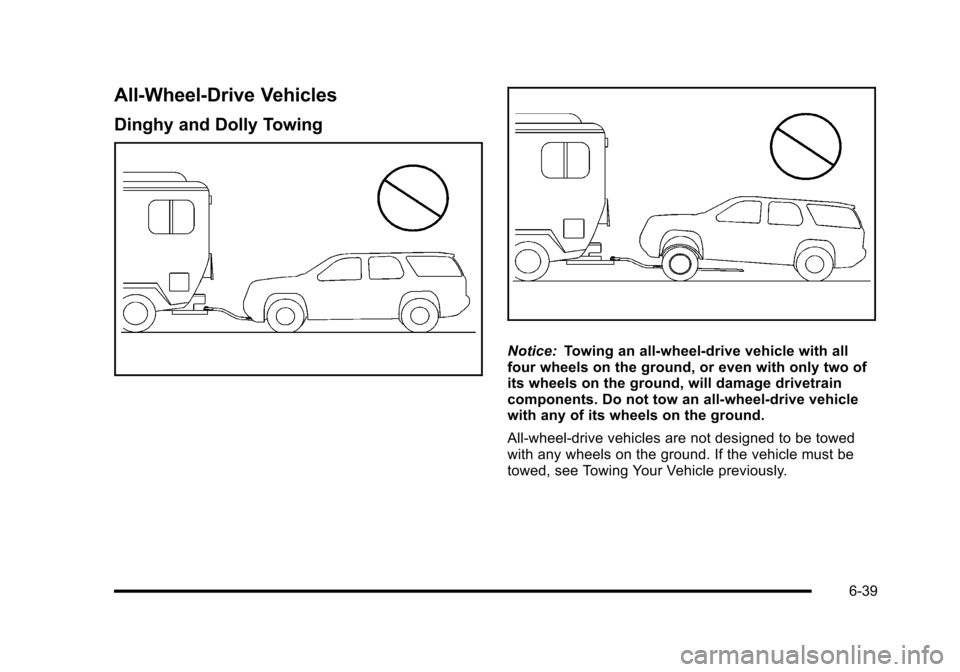
Dinghy and Dolly Towing
Notice:Towing an all-wheel-drive vehicle with allfour wheels on the ground, or even with only two ofits wheels on the ground, will damage drivetraincomponents. Do not tow an all-wheel-drive vehiclewith any of its wheels on the ground.
All-wheel-drive vehicles are not designed to be towedwith any wheels on the ground. If the vehicle must betowed, see Towing Your Vehicle previously.
6-39
Page 430 of 616
Two-Wheel-Drive Vehicles
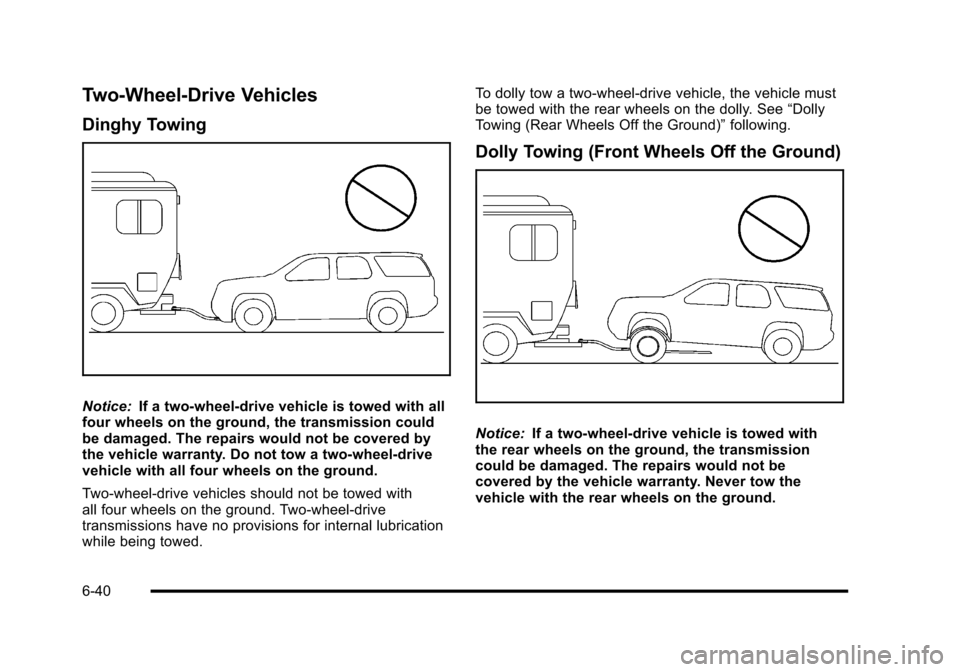
Dinghy Towing
Notice:If a two-wheel-drive vehicle is towed with allfour wheels on the ground, the transmission couldbe damaged. The repairs would not be covered bythe vehicle warranty. Do not tow a two-wheel-drivevehicle with all four wheels on the ground.
Two-wheel-drive vehicles should not be towed withall four wheels on the ground. Two-wheel-drivetransmissions have no provisions for internal lubricationwhile being towed.
To dolly tow a two!wheel!drive vehicle, the vehicle mustbe towed with the rear wheels on the dolly. See“DollyTowing (Rear Wheels Off the Ground)”following.
Dolly Towing (Front Wheels Off the Ground)
Notice:If a two-wheel-drive vehicle is towed withthe rear wheels on the ground, the transmissioncould be damaged. The repairs would not becovered by the vehicle warranty. Never tow thevehicle with the rear wheels on the ground.
6-40
Page 431 of 616
Two-wheel-drive vehicles should not be towed withthe rear wheels on the ground. Two-wheel-drivetransmissions have no provisions for internal lubricationwhile being towed.
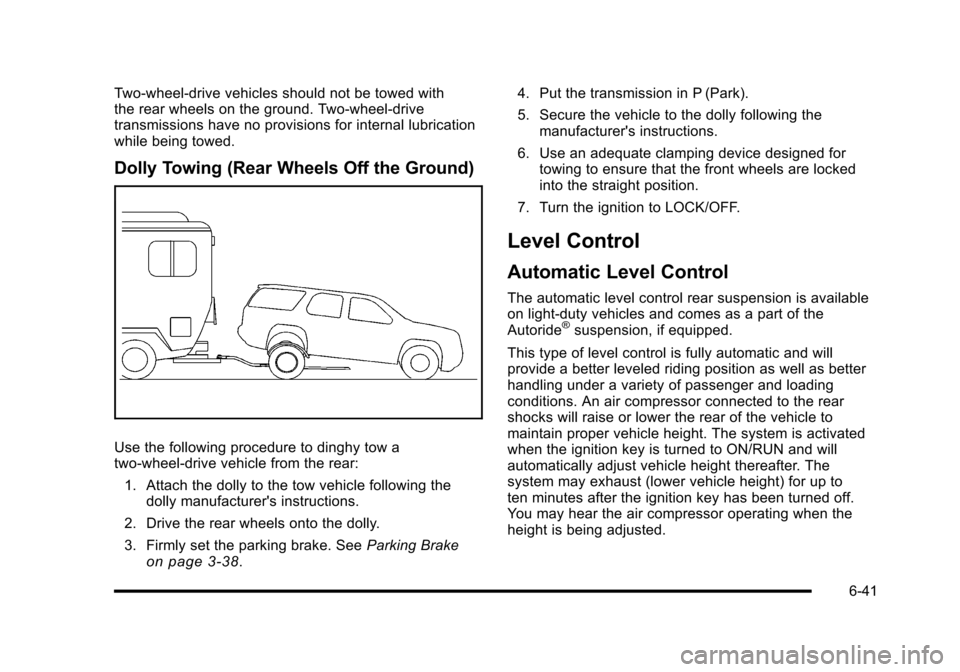
Dolly Towing (Rear Wheels Off the Ground)
Use the following procedure to dinghy tow atwo-wheel-drive vehicle from the rear:
1. Attach the dolly to the tow vehicle following thedolly manufacturer's instructions.
2. Drive the rear wheels onto the dolly.
3. Firmly set the parking brake. SeeParking Brakeon page 3!38.
4. Put the transmission in P (Park).
5. Secure the vehicle to the dolly following themanufacturer's instructions.
6. Use an adequate clamping device designed fortowing to ensure that the front wheels are lockedinto the straight position.
7. Turn the ignition to LOCK/OFF.
Level Control
Automatic Level Control
The automatic level control rear suspension is availableon light!duty vehicles and comes as a part of theAutoride®suspension, if equipped.
This type of level control is fully automatic and willprovide a better leveled riding position as well as betterhandling under a variety of passenger and loadingconditions. An air compressor connected to the rearshocks will raise or lower the rear of the vehicle tomaintain proper vehicle height. The system is activatedwhen the ignition key is turned to ON/RUN and willautomatically adjust vehicle height thereafter. Thesystem may exhaust (lower vehicle height) for up toten minutes after the ignition key has been turned off.You may hear the air compressor operating when theheight is being adjusted.
6-41
Page 432 of 616
If a weight!distributing hitch is being used, it isrecommended to allow the shocks to inflate, therebyleveling the vehicle prior to adjusting the hitch.
Autoride®
With this feature, improved vehicle ride and handling isprovided under a variety of passenger and loadingconditions.
The system is fully automatic and uses a computercontroller to continuously monitor vehicle speed, wheelto body position, lift/dive and steering position of thevehicle. The controller then sends signals to each shockabsorber to independently adjust the damping level toprovide the optimum vehicle ride.
Autoride also interacts with the tow/haul mode that,when activated, will provide additional control of theshock absorbers. This additional control results in betterride and handling characteristics when the vehicle isloaded or towing a trailer. See“Tow/Haul Mode”underTowing a Traileron page 6!42for more information.
Towing a Trailer
If the vehicle has a two–mode hybrid engine, see theTwo–mode Hybrid manual for more information.
Do not tow a trailer during break!in. SeeNew VehicleBreak-Inon page 3!26for more information.
{WARNING:
The driver can lose control when pulling a trailer if
the correct equipment is not used or the vehicle is
not driven properly. For example, if the trailer is
too heavy, the brakes may not work well—or
even at all. The driver and passengers could be
seriously injured. The vehicle may also be
damaged; the resulting repairs would not be
covered by the vehicle warranty. Pull a trailer only
if all the steps in this section have been followed.
Ask your dealer/retailer for advice and information
about towing a trailer with the vehicle.
Notice:Pulling a trailer improperly can damage thevehicle and result in costly repairs not covered bythe vehicle warranty. To pull a trailer correctly,follow the advice in this section and see yourdealer/retailer for important information abouttowing a trailer with the vehicle.
To identify the trailering capacity of the vehicle, read theinformation in“Weight of the Trailer”that appears laterin this section.
6-42
Page 433 of 616
Trailering is different than just driving the vehicle byitself. Trailering means changes in handling,acceleration, braking, durability and fuel economy.Successful, safe trailering takes correct equipment, andit has to be used properly.
The following information has many time-tested,important trailering tips and safety rules. Many ofthese are important for your safety and that of yourpassengers. So please read this section carefully beforepulling a trailer.
Pulling A Trailer
Here are some important points:
.There are many different laws, including speedlimit restrictions, having to do with trailering.Make sure the rig will be legal, not only whereyou live but also where you will be driving.A good source for this information can bestate or provincial police.
.Consider using a sway control. See“Hitches”laterin this section.
.Do not tow a trailer at all during the first 500 miles(800 km) the new vehicle is driven. The engine,axle or other parts could be damaged.
.Then, during the first 500 miles (800 km) that atrailer is towed, do not drive over 50 mph (80 km/h)and do not make starts at full throttle. This helpsthe engine and other parts of the vehicle wear in atthe heavier loads.
.Vehicles can tow in D (Drive). Shift thetransmission to a lower gear if the transmissionshifts too often under heavy loads and/or hillyconditions.
.If the vehicle has the Side Blind Zone Alert (SBZA)system and it doesn't seem to be working properlywhile pulling a trailer, turn the system off. SeeSideBlind Zone Alert (SBZA)on page 3!48for moreinformation.
Important considerations that have to do with weight:
.The weight of the trailer
.The weight of the trailer tongue
.The weight on the vehicle's tires
.And the weight of the trailering combination
6-43
Page 434 of 616
Weight of the Trailer
How heavy can a trailer safely be?
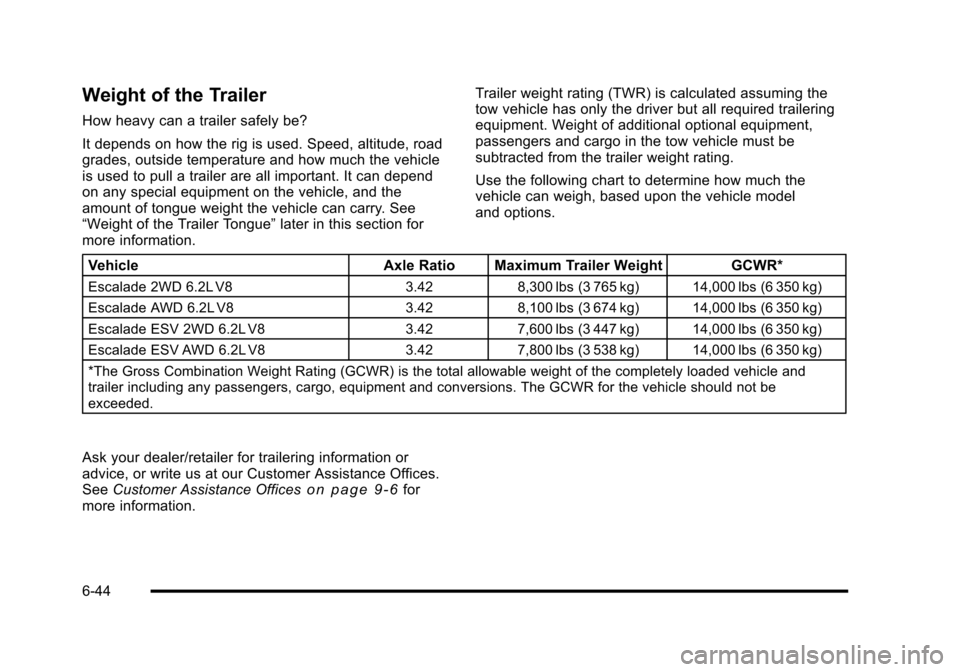
It depends on how the rig is used. Speed, altitude, roadgrades, outside temperature and how much the vehicleis used to pull a trailer are all important. It can dependon any special equipment on the vehicle, and theamount of tongue weight the vehicle can carry. See“Weight of the Trailer Tongue”later in this section formore information.
Trailer weight rating (TWR) is calculated assuming thetow vehicle has only the driver but all required traileringequipment. Weight of additional optional equipment,passengers and cargo in the tow vehicle must besubtracted from the trailer weight rating.
Use the following chart to determine how much thevehicle can weigh, based upon the vehicle modeland options.
VehicleAxle Ratio Maximum Trailer WeightGCWR*
Escalade 2WD 6.2L V83.428,300 lbs (3 765 kg)14,000 lbs (6 350 kg)
Escalade AWD 6.2L V83.428,100 lbs (3 674 kg)14,000 lbs (6 350 kg)
Escalade ESV 2WD 6.2L V83.427,600 lbs (3 447 kg)14,000 lbs (6 350 kg)
Escalade ESV AWD 6.2L V83.427,800 lbs (3 538 kg)14,000 lbs (6 350 kg)
*The Gross Combination Weight Rating (GCWR) is the total allowable weight of the completely loaded vehicle andtrailer including any passengers, cargo, equipment and conversions. The GCWR for the vehicle should not beexceeded.
Ask your dealer/retailer for trailering information oradvice, or write us at our Customer Assistance Offices.SeeCustomer Assistance Officeso n p a g e 9!6formore information.
6-44
Page 435 of 616
Weight of the Trailer Tongue
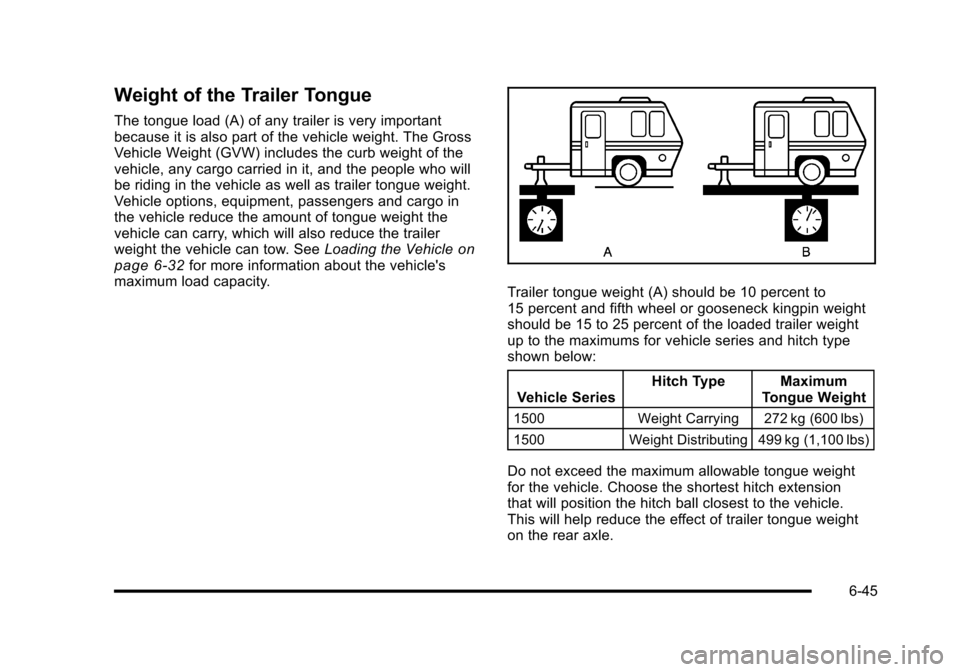
The tongue load (A) of any trailer is very importantbecause it is also part of the vehicle weight. The GrossVehicle Weight (GVW) includes the curb weight of thevehicle, any cargo carried in it, and the people who willbe riding in the vehicle as well as trailer tongue weight.Vehicle options, equipment, passengers and cargo inthe vehicle reduce the amount of tongue weight thevehicle can carry, which will also reduce the trailerweight the vehicle can tow. SeeLoading the Vehicleonpage 6!32for more information about the vehicle'smaximum load capacity.Trailer tongue weight (A) should be 10 percent to15 percent and fifth wheel or gooseneck kingpin weightshould be 15 to 25 percent of the loaded trailer weightup to the maximums for vehicle series and hitch typeshown below:
Vehicle SeriesHitch TypeMaximumTongue Weight
1500Weight Carrying 272 kg (600 lbs)
1500Weight Distributing 499 kg (1,100 lbs)
Do not exceed the maximum allowable tongue weightfor the vehicle. Choose the shortest hitch extensionthat will position the hitch ball closest to the vehicle.This will help reduce the effect of trailer tongue weighton the rear axle.
6-45
Page 436 of 616
Trailering may be limited by the vehicle's ability tocarry tongue weight. Tongue or kingpin weight cannotcause the vehicle to exceed the GVWR (Gross VehicleWeight Rating) or the RGAWR (Rear Gross Axle WeightRating). See“Total Weight on the Vehicle's Tires”laterin this section for more information.
After loading the trailer, weigh the trailer and then thetongue, separately, to see if the weights are proper.If they are not, adjustments might be made by movingsome items around in the trailer.
Total Weight on the Vehicle's Tires
Be sure the vehicle's tires are inflated to the inflationpressures found on the Certification label on the driverdoor or seeLoading the Vehicleon page 6!32for moreinformation. Make sure not to exceed the GVWR limitfor the vehicle, or the RGAWR, with the tow vehicle andtrailer fully loaded for the trip including the weight of thetrailer tongue. If using a weight distributing hitch, makesure not to exceed the RGAWR before applying theweight distribution spring bars.
Weight of the Trailering Combination
It is important that the combination of the towvehicle and trailer does not exceed any of its weightratings—GCWR, GVWR, RGAWR, Trailer WeightRating or Tongue Weight. The only way to be sure it isnot exceeding any of these ratings is to weigh the towvehicle and trailer combination, fully loaded for the trip,getting individual weights for each of these items.
Hitches
The correct hitch equipment helps maintain combinationcontrol. Most small-to-medium trailers can be towedwith a weight carrying hitch which simply features acoupler latched to the hitch ball. Larger trailers mayrequire a weight distributing hitch that uses spring barsto distribute the trailer tongue weight among thetwo vehicle and trailer axles. See“Weight of the TrailerTongue”earlier in this section for rating limits withvarious hitch types.
If a step-bumper hitch will be used, the bumper couldbe damaged in sharp turns. Make sure there is ampleroom when turning to avoid contact between the trailerand the bumper.
Consider using sway controls with any trailer. Ask atrailering professional about sway controls or refer tothe trailer manufacturer's recommendations andinstructions.
6-46