ESP CADILLAC ESCALADE 2010 3.G Workshop Manual
[x] Cancel search | Manufacturer: CADILLAC, Model Year: 2010, Model line: ESCALADE, Model: CADILLAC ESCALADE 2010 3.GPages: 616, PDF Size: 39.41 MB
Page 448 of 616
Section 7 Service and Appearance Care
Windshield Wiper Blade Replacement. . . . . . . . . . . 7-57
Tires. . . . . . . . . . . . . . . . . . . . . . . . . . . . . . . . . . . . . . . . . . . . . . . 7-58Tire Sidewall Labeling . . . . . . . . . . . . . . . . . . . . . . . . . 7-60Tire Terminology and Definitions . . . . . . . . . . . . . . . 7-62Inflation - Tire Pressure . . . . . . . . . . . . . . . . . . . . . . . . 7-65High-Speed Operation . . . . . . . . . . . . . . . . . . . . . . . . . 7-66Tire Pressure Monitor System . . . . . . . . . . . . . . . . . 7-67Tire Pressure Monitor Operation . . . . . . . . . . . . . . . 7-68Tire Inspection and Rotation . . . . . . . . . . . . . . . . . . . 7-71When It Is Time for New Tires . . . . . . . . . . . . . . . . . 7-73Buying New Tires . . . . . . . . . . . . . . . . . . . . . . . . . . . . . . 7-73Different Size Tires and Wheels . . . . . . . . . . . . . . . 7-75Uniform Tire Quality Grading . . . . . . . . . . . . . . . . . . . 7-76Wheel Alignment and Tire Balance . . . . . . . . . . . . 7-77Wheel Replacement . . . . . . . . . . . . . . . . . . . . . . . . . . . 7-77Tire Chains . . . . . . . . . . . . . . . . . . . . . . . . . . . . . . . . . . . . 7-78If a Tire Goes Flat . . . . . . . . . . . . . . . . . . . . . . . . . . . . . 7-79Changing a Flat Tire . . . . . . . . . . . . . . . . . . . . . . . . . . . 7-80Removing the Spare Tire and Tools . . . . . . . . . . . . 7-81Removing the Flat Tire and Installing theSpare Tire . . . . . . . . . . . . . . . . . . . . . . . . . . . . . . . . . . . 7-86Secondary Latch System . . . . . . . . . . . . . . . . . . . . . . 7-91Storing a Flat or Spare Tire and Tools . . . . . . . . . 7-94Spare Tire . . . . . . . . . . . . . . . . . . . . . . . . . . . . . . . . . . . . . 7-98
Appearance Care. . . . . . . . . . . . . . . . . . . . . . . . . . . . . . . . . 7-98Interior Cleaning . . . . . . . . . . . . . . . . . . . . . . . . . . . . . . 7-98Fabric/Carpet . . . . . . . . . . . . . . . . . . . . . . . . . . . . . . . . . . 7-99Leather . . . . . . . . . . . . . . . . . . . . . . . . . . . . . . . . . . . . . . . 7-100Instrument Panel, Vinyl, and Other PlasticSurfaces . . . . . . . . . . . . . . . . . . . . . . . . . . . . . . . . . . . 7-101Wood Panels . . . . . . . . . . . . . . . . . . . . . . . . . . . . . . . . . 7-101Speaker Covers . . . . . . . . . . . . . . . . . . . . . . . . . . . . . . 7-101Care of Safety Belts . . . . . . . . . . . . . . . . . . . . . . . . . . 7-102Weatherstrips . . . . . . . . . . . . . . . . . . . . . . . . . . . . . . . . 7-102Washing Your Vehicle . . . . . . . . . . . . . . . . . . . . . . . . 7-102Cleaning Exterior Lamps/Lenses . . . . . . . . . . . . . 7-103Finish Care . . . . . . . . . . . . . . . . . . . . . . . . . . . . . . . . . . . 7-103Windshield, Backglass, and Wiper Blades . . . . 7-104Aluminum or Chrome-Plated Wheelsand Trim . . . . . . . . . . . . . . . . . . . . . . . . . . . . . . . . . . . 7-104Tires . . . . . . . . . . . . . . . . . . . . . . . . . . . . . . . . . . . . . . . . . . 7-105Sheet Metal Damage . . . . . . . . . . . . . . . . . . . . . . . . . 7-105Finish Damage . . . . . . . . . . . . . . . . . . . . . . . . . . . . . . . 7-106Underbody Maintenance . . . . . . . . . . . . . . . . . . . . . 7-106Chemical Paint Spotting . . . . . . . . . . . . . . . . . . . . . . 7-106
Vehicle Identification. . . . . . . . . . . . . . . . . . . . . . . . . . . . 7-107Vehicle Identification Number (VIN) . . . . . . . . . . . 7-107Service Parts Identification Label . . . . . . . . . . . . . 7-107
7-2
Page 509 of 616

Intended Outboard Sidewall:The side of an
asymmetrical tire, that must always face outward
when mounted on a vehicle.
Kilopascal (kPa):The metric unit for air
pressure.
Light Truck (LT!Metric) Tire:A tire used on light
duty trucks and some multipurpose passenger
vehicles.
Load Index:An assigned number ranging from
1 to 279 that corresponds to the load carrying
capacity of a tire.
Maximum Inflation Pressure:The maximum air
pressure to which a cold tire can be inflated. The
maximum air pressure is molded onto the
sidewall.
Maximum Load Rating:The load rating for a tire
at the maximum permissible inflation pressure for
that tire.
Maximum Loaded Vehicle Weight:The sum of
curb weight, accessory weight, vehicle capacity
weight, and production options weight.
Normal Occupant Weight:The number of
occupants a vehicle is designed to seat multiplied
by 150 lbs (68 kg). SeeLoading the Vehicleon
page 6!32.
Occupant Distribution:Designated seating
positions.
Outward Facing Sidewall:The side of an
asymmetrical tire that has a particular side that
faces outward when mounted on a vehicle. The
side of the tire that contains a whitewall, bears
white lettering, or bears manufacturer, brand,
and/or model name molding that is higher or
deeper than the same moldings on the other
sidewall of the tire.
Passenger (P-Metric) Tire:A tire used on
passenger cars and some light duty trucks and
multipurpose vehicles.
Recommended Inflation Pressure:Vehicle
manufacturer's recommended tire inflation
pressure as shown on the tire placard. See
Inflation - Tire Pressureon page 7!65andLoading
the Vehicleon page 6!32.
Radial Ply Tire:A pneumatic tire in which the ply
cords that extend to the beads are laid at
90 degrees to the centerline of the tread.
Rim:A metal support for a tire and upon which
the tire beads are seated.
Sidewall:The portion of a tire between the tread
and the bead.
7-63
Page 511 of 616
Inflation - Tire Pressure
If your vehicle is a Two-mode Hybrid, see the
Two-mode Hybrid manual for more information.
Tires need the correct amount of air pressure to
operate effectively.
Notice:Do not let anyone tell you that
under!inflation or over!inflation is all right.
It is not. If your tires do not have enough air
(under!inflation), you can get the following:
.Too much flexing
.Too much heat
.Tire overloading
.Premature or irregular wear
.Poor handling
.Reduced fuel economy
If your tires have too much air (over!inflation),
you can get the following:
.Unusual wear
.Poor handling
.Rough ride
.Needless damage from road hazards
A vehicle specific Tire and Loading Information
label is attached to your vehicle. This label shows
your vehicle's original equipment tires and the
correct inflation pressures for your tires when they
are cold. The recommended cold tire inflation
pressure, shown on the label, is the minimum
amount of air pressure needed to support your
vehicle's maximum load carrying capacity.
For additional information regarding how much
weight your vehicle can carry, and an example of
the Tire and Loading Information label, see
Loading the Vehicleon page 6!32. How you load
your vehicle affects vehicle handling and ride
comfort. Never load your vehicle with more weight
than it was designed to carry.
When to Check
Check your tires once a month or more.
Do not forget to check the pressure of the spare
tire. SeeSpare Tireon page 7!98for additional
information.
7-65
Page 513 of 616
Tire Pressure Monitor System
The Tire Pressure Monitor System (TPMS) uses radioand sensor technology to check tire pressure levels.The TPMS sensors monitor the air pressure in yourvehicle's tires and transmit tire pressure readings to areceiver located in the vehicle.
Each tire, including the spare (if provided), should bechecked monthly when cold and inflated to the inflationpressure recommended by the vehicle manufactureron the vehicle placard or tire inflation pressure label.(If your vehicle has tires of a different size than the sizeindicated on the vehicle placard or tire inflation pressurelabel, you should determine the proper tire inflationpressure for those tires.)
As an added safety feature, your vehicle has beenequipped with a tire pressure monitoring system(TPMS) that illuminates a low tire pressure telltale whenone or more of your tires is significantly under!inflated.
Accordingly, when the low tire pressure telltaleilluminates, you should stop and check your tires assoon as possible, and inflate them to the properpressure. Driving on a significantly under!inflated tirecauses the tire to overheat and can lead to tire failure.Under!inflation also reduces fuel efficiency and tiretread life, and may affect the vehicle's handling andstopping ability.
Please note that the TPMS is not a substitute for propertire maintenance, and it is the driver's responsibility tomaintain correct tire pressure, even if under!inflationhas not reached the level to trigger illumination of theTPMS low tire pressure telltale.
Your vehicle has also been equipped with a TPMSmalfunction indicator to indicate when the system isnot operating properly. The TPMS malfunction indicatoris combined with the low tire pressure telltale. Whenthe system detects a malfunction, the telltale will flashfor approximately one minute and then remaincontinuously illuminated. This sequence will continueupon subsequent vehicle start!ups as long as themalfunction exists.
When the malfunction indicator is illuminated, thesystem may not be able to detect or signal low tirepressure as intended. TPMS malfunctions may occurfor a variety of reasons, including the installation ofreplacement or alternate tires or wheels on the vehiclethat prevent the TPMS from functioning properly.Always check the TPMS malfunction telltale afterreplacing one or more tires or wheels on your vehicle toensure that the replacement or alternate tires andwheels allow the TPMS to continue to function properly.
SeeTire Pressure Monitor Operationon page 7!68foradditional information.
7-67
Page 515 of 616
Your vehicle's TPMS can warn you about a low tirepressure condition but it does not replace normal tiremaintenance. SeeTire Inspection and Rotationonpage 7!71andTires on page 7!58.
Notice:Liquid tire sealants could damage the TirePressure Monitor System (TPMS) sensors. Sensordamage caused by using a tire sealant is notcovered by your warranty. Do not use liquid tiresealants.
TPMS Malfunction Light and Message
The TPMS will not function properly if one or more ofthe TPMS sensors are missing or inoperable. When thesystem detects a malfunction, the low tire warning lightflashes for about one minute and then stays on for theremainder of the ignition cycle. A DIC warning messageis also displayed. The low tire warning light and DICwarning message come on at each ignition cycle untilthe problem is corrected. Some of the conditions thatcan cause the malfunction light and DIC message tocome on are:
.One of the road tires has been replaced with thespare tire. The spare tire does not have a TPMSsensor. The TPMS malfunction light and DICmessage should go off once you re!install theroad tire containing the TPMS sensor.
.The TPMS sensor matching process was startedbut not completed or not completed successfullyafter rotating the vehicle's tires. The DIC messageand TPMS malfunction light should go off once theTPMS sensor matching process is performedsuccessfully. See“TPMS Sensor MatchingProcess”later in this section.
.One or more TPMS sensors are missing ordamaged. The DIC message and the TPMSmalfunction light should go off when the TPMSsensors are installed and the sensor matchingprocess is performed successfully. See yourdealer/retailer for service.
.Replacement tires or wheels do not match yourvehicle's original equipment tires or wheels. Tiresand wheels other than those recommended foryour vehicle could prevent the TPMS fromfunctioning properly. SeeBuying New Tiresonpage 7!73.
.Operating electronic devices or being near facilitiesusing radio wave frequencies similar to the TPMScould cause the TPMS sensors to malfunction.
If the TPMS is not functioning it cannot detect or signala low tire condition. See your dealer/retailer for serviceif the TPMS malfunction light and DIC message comeson and stays on.
7-69
Page 522 of 616
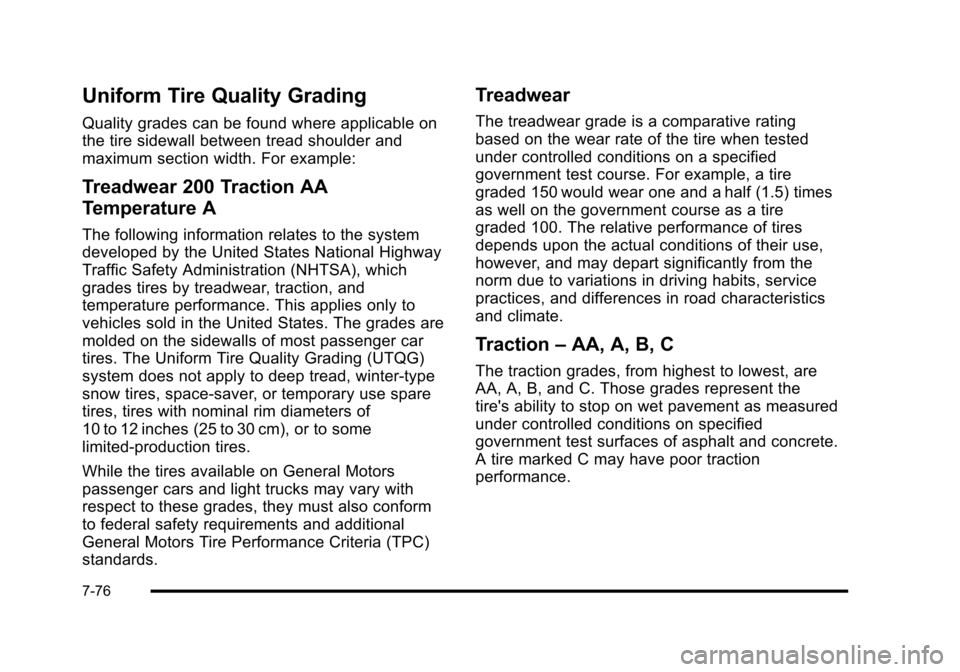
Uniform Tire Quality Grading
Quality grades can be found where applicable on
the tire sidewall between tread shoulder and
maximum section width. For example:
Treadwear 200 Traction AA
Temperature A
The following information relates to the system
developed by the United States National Highway
Traffic Safety Administration (NHTSA), which
grades tires by treadwear, traction, and
temperature performance. This applies only to
vehicles sold in the United States. The grades are
molded on the sidewalls of most passenger car
tires. The Uniform Tire Quality Grading (UTQG)
system does not apply to deep tread, winter-type
snow tires, space-saver, or temporary use spare
tires, tires with nominal rim diameters of
10 to 12 inches (25 to 30 cm), or to some
limited-production tires.
While the tires available on General Motors
passenger cars and light trucks may vary with
respect to these grades, they must also conform
to federal safety requirements and additional
General Motors Tire Performance Criteria (TPC)
standards.
Treadwear
The treadwear grade is a comparative rating
based on the wear rate of the tire when tested
under controlled conditions on a specified
government test course. For example, a tire
graded 150 would wear one and a half (1.5) times
as well on the government course as a tire
graded 100. The relative performance of tires
depends upon the actual conditions of their use,
however, and may depart significantly from the
norm due to variations in driving habits, service
practices, and differences in road characteristics
and climate.
Traction–AA, A, B, C
The traction grades, from highest to lowest, are
AA, A, B, and C. Those grades represent the
tire's ability to stop on wet pavement as measured
under controlled conditions on specified
government test surfaces of asphalt and concrete.
A tire marked C may have poor traction
performance.
7-76
Page 523 of 616
Temperature–A, B, C
The temperature grades are A (the highest),
B, and C, representing the tire's resistance to the
generation of heat and its ability to dissipate heat
when tested under controlled conditions on a
specified indoor laboratory test wheel. Sustained
high temperature can cause the material of the
tire to degenerate and reduce tire life, and
excessive temperature can lead to sudden tire
failure. The grade C corresponds to a level of
performance which all passenger car tires must
meet under the Federal Motor Vehicle Safety
Standard No. 109. Grades B and A represent
higher levels of performance on the laboratory test
wheel than the minimum required by law. It should
be noted that the temperature grade for this tire is
established for a tire that is properly inflated and
not overloaded. Excessive speed, underinflation,
or excessive loading, either separately or in
combination, can cause heat buildup and possible
tire failure.
Wheel Alignment and Tire Balance
The tires and wheels on your vehicle were aligned andbalanced carefully at the factory to give you the longesttire life and best overall performance. Adjustments towheel alignment and tire balancing will not benecessary on a regular basis. However, if you noticeunusual tire wear or your vehicle pulling to one side orthe other, the alignment might need to be checked.If you notice your vehicle vibrating when driving on asmooth road, the tires and wheels might need to berebalanced. See your dealer/retailer for properdiagnosis.
Wheel Replacement
Replace any wheel that is bent, cracked, or badlyrusted or corroded. If wheel nuts keep coming loose,the wheel, wheel bolts, and wheel nuts should bereplaced. If the wheel leaks air, replace it (except somealuminum wheels, which can sometimes be repaired).See your dealer/retailer if any of these conditions exist.
Your dealer/retailer will know the kind of wheelyou need.
Each new wheel should have the same load-carryingcapacity, diameter, width, offset, and be mounted thesame way as the one it replaces.
7-77
Page 525 of 616
WARNING: (Continued)
vehicle and tire size combination and road
conditions. Follow that manufacturer's
instructions. To help avoid damage to the vehicle,
drive slowly, re!adjust or remove the device if it is
contacting the vehicle, and do not spin the
wheels. If you do find traction devices that will fit,
install them on the rear tires.
If a Tire Goes Flat
It is unusual for a tire to blowout while you are driving,especially if you maintain your vehicle's tires properly.If air goes out of a tire, it is much more likely to leak outslowly. But if you should ever have a blowout, here area few tips about what to expect and what to do:
If a front tire fails, the flat tire creates a drag that pullsthe vehicle toward that side. Take your foot off theaccelerator pedal and grip the steering wheel firmly.Steer to maintain lane position, and then gently braketo a stop well out of the traffic lane.
A rear blowout, particularly on a curve, acts much like askid and may require the same correction you woulduse in a skid. In any rear blowout remove your foot fromthe accelerator pedal. Get the vehicle under control bysteering the way you want the vehicle to go. It may bevery bumpy and noisy, but you can still steer. Gentlybrake to a stop, well off the road if possible.
{WARNING:
Lifting a vehicle and getting under it to do
maintenance or repairs is dangerous without the
appropriate safety equipment and training. If a
jack is provided with the vehicle, it is designed
only for changing a flat tire. If it is used for
anything else, you or others could be badly
injured or killed if the vehicle slips off the jack.
If a jack is provided with the vehicle, only use
it for changing a flat tire.
If a tire goes flat, the next part shows how to use thejacking equipment to change a flat tire safely.
7-79
Page 530 of 616
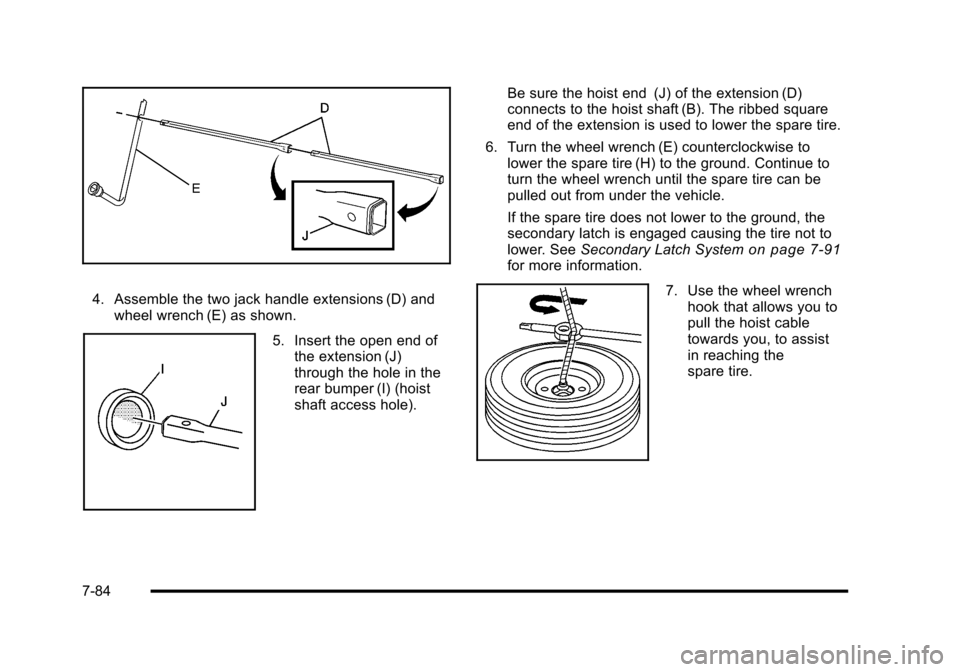
4. Assemble the two jack handle extensions (D) andwheel wrench (E) as shown.
5. Insert the open end ofthe extension (J)through the hole in therear bumper (I) (hoistshaft access hole).
Be sure the hoist end (J) of the extension (D)connects to the hoist shaft (B). The ribbed squareend of the extension is used to lower the spare tire.
6. Turn the wheel wrench (E) counterclockwise tolower the spare tire (H) to the ground. Continue toturn the wheel wrench until the spare tire can bepulled out from under the vehicle.
If the spare tire does not lower to the ground, thesecondary latch is engaged causing the tire not tolower. SeeSecondary Latch Systemon page 7!91for more information.
7. Use the wheel wrenchhook that allows you topull the hoist cabletowards you, to assistin reaching thespare tire.
7-84
Page 533 of 616

{WARNING:
Getting under a vehicle when it is jacked up is
dangerous. If the vehicle slips off the jack, you
could be badly injured or killed. Never get under a
vehicle when it is supported only by a jack.
{WARNING:
Raising your vehicle with the jack improperly
positioned can damage the vehicle and even
make the vehicle fall. To help avoid personal
injury and vehicle damage, be sure to fit the jack
lift head into the proper location before raising the
vehicle.
4. Position the jack under the vehicle as shown.
Front Position
Front Tire Flat:If the flat tire is on a front tire ofthe vehicle, you will need to use the jack handleand only one jack handle extension. Attach thewheel wrench to the jack handle extension. Attachthe jack handle to the jack (A). Position the jack onthe frame behind the flat tire where the framesections overlap. Turn the wheel wrench clockwiseto raise the vehicle. Raise the vehicle far enoughoff the ground so there is enough room for thespare tire to clear the ground.
7-87