lock CADILLAC ESCALADE ESV 2008 Owners Manual
[x] Cancel search | Manufacturer: CADILLAC, Model Year: 2008, Model line: ESCALADE ESV, Model: CADILLAC ESCALADE ESV 2008Pages: 500, PDF Size: 6.65 MB
Page 286 of 500
Skidding In a skid, a driver can lose control of the vehicle.
Defensive drivers avoid most skids by taking reasonable
care suited to existing conditions, and by not overdriving
those conditions. But skids are always possible.
The three types of skids correspond to your vehicle’s
three control systems. In the braking skid, the wheels are
not rolling. In the steering or cornering skid, too much
speed or steering in a curve causes tires to slip and lose
cornering force. And in the acceleration skid, too much
throttle causes the driving wheels to spin.
A cornering skid is best handled by easing your foot off
the accelerator pedal.
Remember: Any traction control system helps avoid only
the acceleration skid. If your traction control system is
off, then an acceleration skid is also best handled
by easing your foot off the accelerator pedal.
If your vehicle starts to slide, ease your foot off the
accelerator pedal and quickly steer the way you want
the vehicle to go. If you start steering quickly enough,
your vehicle may straighten out. Always be ready
for a second skid if it occurs. Of course, traction is reduced when water, snow, ice,
gravel, or other material is on the road. For safety, you
will want to slow down and adjust your driving to these
conditions. It is important to slow down on slippery
surfaces because stopping distance will be longer and
vehicle control more limited.
While driving on a surface with reduced traction, try
your best to avoid sudden steering, acceleration,
or braking, including reducing vehicle speed by shifting
to a lower gear. Any sudden changes could cause
the tires to slide. You may not realize the surface is
slippery until your vehicle is skidding. Learn to
recognize warning clues — such as enough water, ice,
or packed snow on the road to make a mirrored
surface — and slow down when you have any doubt.
Remember: Any Antilock Brake System (ABS) helps
avoid only the braking skid.
Off-Road Driving This off-road guide is for vehicles that have all-wheel
drive. If your vehicle does not have all-wheel drive or if it
has 20-inch tire/wheel assemblies, you should not
drive off-road unless you are on a level, solid surface.
See Tires on page 5-56 .
4-12
Page 289 of 500
Environmental Concerns Off-road driving can provide wholesome and satisfying
recreation. However, it also raises environmental
concerns. We recognize these concerns and urge every
off-roader to follow these basic rules for protecting the
environment:
Always use established trails, roads, and areas
that have been specially set aside for public off-road
recreational driving; obey all posted regulations.
Avoid any driving practice that could damage the
environment — shrubs, owers, trees, grasses — or
disturb wildlife. This includes wheel-spinning,
breaking down trees, or unnecessary driving through
streams or over soft ground.
Always carry a litter bag — make sure all refuse is
removed from any campsite before leaving.
Take extreme care with open res where permitted,
camp stoves, and lanterns.
Never park your vehicle over dry grass or other
combustible materials that could catch re from the
heat of the vehicle’s exhaust system. Traveling to Remote Areas It makes sense to plan your trip, especially when going
to a remote area. Know the terrain and plan your
route. You are much less likely to get bad surprises.
Get accurate maps of trails and terrain. Try to learn of
any blocked or closed roads.
It is also a good idea to travel with at least one other
vehicle. If something happens to one of them, the other
can help quickly.
Getting Familiar with Off-Road Driving It is a good idea to practice in an area that is safe
and close to home before you go into the wilderness.
Off-road driving does require some new and different
driving skills. Here is what we mean.
Tune your senses to different kinds of signals. Your
eyes, for example, need to constantly sweep the terrain
for unexpected obstacles. Your ears need to listen
for unusual tire or engine sounds. With your arms,
hands, feet, and body, you will need to respond to
vibrations and vehicle bounce.
4-15
Page 292 of 500

Approaching a Hill When you approach a hill, you need to decide if it is
one of those hills that is just too steep to climb, descend,
or cross. Steepness can be hard to judge. On a very
small hill, for example, there may be a smooth, constant
incline with only a small change in elevation where
you can easily see all the way to the top. On a large hill,
the incline may get steeper as you near the top, but
you may not see this because the crest of the hill
is hidden by bushes, grass or shrubs.
Here are some other things to consider as you approach
a hill.
Is there a constant incline, or does the hill get
sharply steeper in places?
Is there good traction on the hillside, or will the
surface cause tire slipping?
Is there a straight path up or down the hill so you
will not have to make turning maneuvers?
Are there obstructions on the hill that can block your
path, such as boulders, trees, logs, or ruts?
What is beyond the hill? Is there a cliff, an
embankment, a drop-off, a fence? Get out and
walk the hill if you do not know. It is the smart way
to nd out.
Is the hill simply too rough? Steep hills often have
ruts, gullies, troughs, and exposed rocks because
they are more susceptible to the effects of erosion. Driving Uphill Once you decide you can safely drive up the hill, you
need to take some special steps.
Use a low gear and get a rm grip on the steering
wheel.
Get a smooth start up the hill and try to maintain
your speed. Do not use more power than you
need, because you do not want the wheels to start
spinning or sliding.
{ CAUTION: Turning or driving across steep hills can be
dangerous. You could lose traction, slide
sideways, and possibly roll over. You could be
seriously injured or killed. When driving up
hills, always try to go straight up.
Try to drive straight up the hill if at all possible. If
the path twists and turns, you might want to nd
another route.
Ease up on your speed as you approach the top of
the hill.
4-18
Page 293 of 500
Attach a ag to the vehicle to make you more
visible to approaching traffic on trails or hills.
Sound the horn as you approach the top of the hill
to let opposing traffic know you are there.
Use the headlamps even during the day. They
make your vehicle more visible to oncoming traffic.
{ CAUTION: Driving to the top (crest) of a hill at full speed
can cause an accident. There could be a
drop-off, embankment, cliff, or even another
vehicle. You could be seriously injured or
killed. As you near the top of a hill, slow down
and stay alert. There are some things you should do if the vehicle stalls,
or is about to stall, and you cannot make it up the hill:
Push the brake pedal to stop the vehicle and keep it
from rolling backwards. Also, apply the parking
brake.
If the engine is still running, shift the transmission to
REVERSE (R), release the parking brake, and slowly
back down the hill in REVERSE (R).
If the engine has stopped running, you will need
to restart it. With the brake pedal pressed and the
parking brake still applied, shift the transmission
to PARK (P) and restart the engine. Then shift to
REVERSE (R), release the parking brake, and
slowly back down the hill as straight as possible
in REVERSE (R).
As you are backing down the hill, put your left hand
on the steering wheel at the 12 o’clock position. This
way you will be able to tell if the wheels are straight
and maneuver as you back down. It is best that you
back down the hill with the wheels straight rather
than in the left or right direction. Turning the wheel
too far to the left or right will increase the possibility
of a rollover.
4-19
Page 305 of 500
Accelerate gently. Try not to break the fragile traction.
If you accelerate too fast, the drive wheels will spin
and polish the surface under the tires even more. See
StabiliTrak ®
System on page 4-6 , If Your Vehicle is Stuck
in Sand, Mud, Ice, or Snow on page 4-33 , and Rocking
Your Vehicle to Get It Out on page 4-34 .
The Antilock Brake System (ABS) improves your
vehicle’s stability when you make a hard stop on a
slippery road. Even though you have ABS, begin
stopping sooner than you would on dry pavement.
See Antilock Brake System (ABS) on page 4-4 .
Allow greater following distance on any slippery road.
Watch for slippery spots. The road might be ne until
you hit a spot that is covered with ice. On an
otherwise clear road, ice patches can appear in
shaded areas where the sun cannot reach, such as
around clumps of trees, behind buildings, or under
bridges. Sometimes the surface of a curve or an
overpass can remain icy when the surrounding roads
are clear. If you see a patch of ice ahead of you,
brake before you are on it. Try not to brake while you
are actually on the ice, and avoid sudden steering
maneuvers. If You Are Caught in a Blizzard If you are stopped by heavy snow, you could be in
a serious situation. You should probably stay with your
vehicle unless you know for sure that you are near
help and you can hike through the snow. Here are some
things to do to summon help and keep yourself and
your passengers safe:
Turn on the hazard warning ashers.
Tie a red cloth to your vehicle to alert police that
you have been stopped by the snow.
Put on extra clothing or wrap a blanket around you.
If you do not have blankets or extra clothing, make
body insulators from newspapers, burlap bags,
rags, oor mats — anything you can wrap around
yourself or tuck under your clothing to keep warm.
4-31
Page 306 of 500
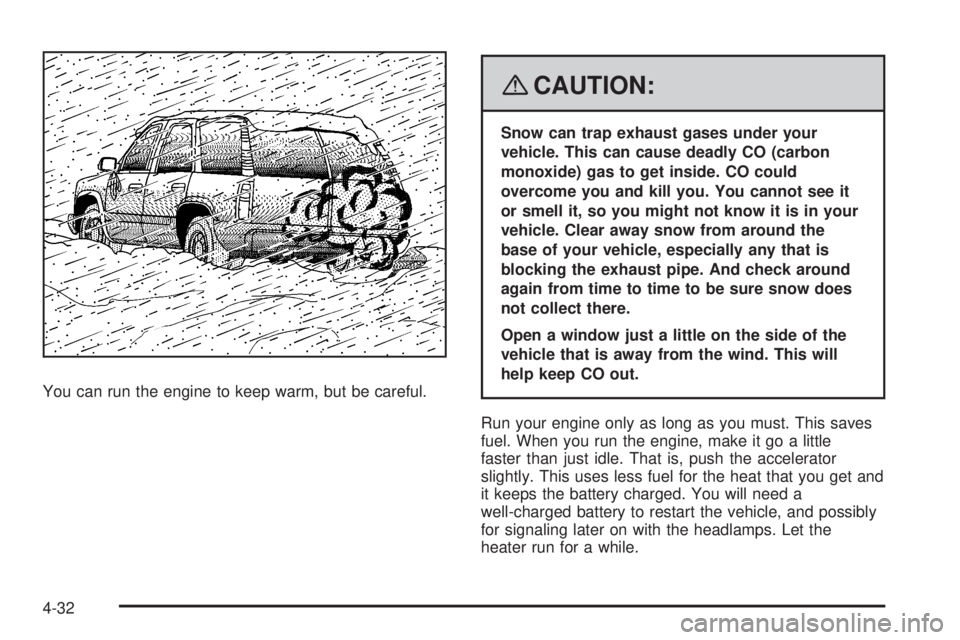
You can run the engine to keep warm, but be careful. { CAUTION: Snow can trap exhaust gases under your
vehicle. This can cause deadly CO (carbon
monoxide) gas to get inside. CO could
overcome you and kill you. You cannot see it
or smell it, so you might not know it is in your
vehicle. Clear away snow from around the
base of your vehicle, especially any that is
blocking the exhaust pipe. And check around
again from time to time to be sure snow does
not collect there.
Open a window just a little on the side of the
vehicle that is away from the wind. This will
help keep CO out.
Run your engine only as long as you must. This saves
fuel. When you run the engine, make it go a little
faster than just idle. That is, push the accelerator
slightly. This uses less fuel for the heat that you get and
it keeps the battery charged. You will need a
well-charged battery to restart the vehicle, and possibly
for signaling later on with the headlamps. Let the
heater run for a while.
4-32
Page 310 of 500
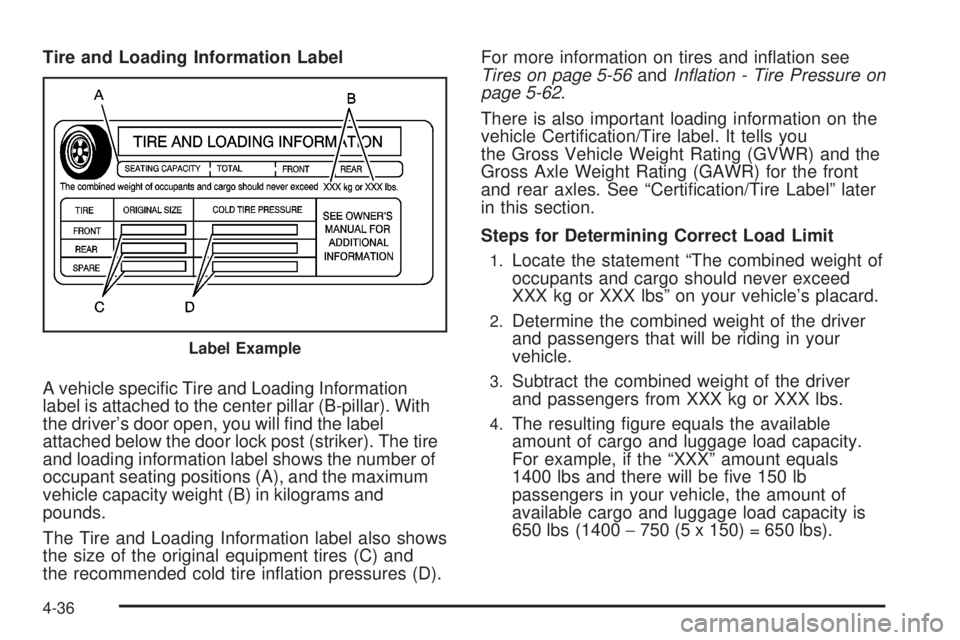
Tire and Loading Information Label
A vehicle specic Tire and Loading Information
label is attached to the center pillar (B-pillar). With
the driver’s door open, you will nd the label
attached below the door lock post (striker). The tire
and loading information label shows the number of
occupant seating positions (A), and the maximum
vehicle capacity weight (B) in kilograms and
pounds.
The Tire and Loading Information label also shows
the size of the original equipment tires (C) and
the recommended cold tire ination pressures (D). For more information on tires and ination see
Tires on page 5-56 and Inflation - Tire Pressure on
page 5-62 .
There is also important loading information on the
vehicle Certication/Tire label. It tells you
the Gross Vehicle Weight Rating (GVWR) and the
Gross Axle Weight Rating (GAWR) for the front
and rear axles. See “Certication/Tire Label” later
in this section.
Steps for Determining Correct Load Limit 1.
Locate the statement “The combined weight of
occupants and cargo should never exceed
XXX kg or XXX lbs” on your vehicle’s placard. 2.
Determine the combined weight of the driver
and passengers that will be riding in your
vehicle. 3.
Subtract the combined weight of the driver
and passengers from XXX kg or XXX lbs.
4.
The resulting gure equals the available
amount of cargo and luggage load capacity.
For example, if the “XXX” amount equals
1400 lbs and there will be ve 150 lb
passengers in your vehicle, the amount of
available cargo and luggage load capacity is
650 lbs (1400 − 750 (5 x 150) = 650 lbs).Label Example
4-36
Page 315 of 500
Automatic Level Control
The automatic level control rear suspension
comes as a part of the Road Sensing Suspension.
See Road Sensing Suspension on page 4-6 .
This type of level control is fully automatic and will
provide a better leveled riding position as well
as better handling under a variety of passenger
and loading conditions. An air compressor
connected to the rear shocks will raise or lower
the rear of the vehicle to maintain proper vehicle
height. The system is activated when the
ignition key is turned to RUN and will automatically
adjust vehicle height thereafter. The system
may exhaust (lower vehicle height) for up to
10 minutes after the ignition key has been turned
to LOCK. You may hear the air compressor
operating when the height is being adjusted. If a weight-distributing hitch is being used, it is
recommended to allow the shocks to inate,
thereby leveling the vehicle prior to adjusting the
height. See “Weight distributing Hitches and
Weight Carrying Hitches” under Towing a Trailer
on page 4-44 .
Towing Towing Your Vehicle Consult your dealer/retailer or a professional towing
service if you need to have your disabled vehicle towed.
See Roadside Service on page 7-6 .
If you want to tow your vehicle behind another vehicle
for recreational purposes (such as behind a motorhome),
see Recreational Vehicle Towing following.
4-41
Page 325 of 500
If you’ll be pulling a trailer that, when loaded, will weigh
more than 5,000 lbs (2 270 kg) be sure to use a
properly mounted weight-distributing hitch and sway
control of the proper size. This equipment is very
important for proper vehicle loading and good handling
when driving. You should always use a sway control
if your trailer will weigh more than these limits. You can
ask a hitch dealer about sway controls.
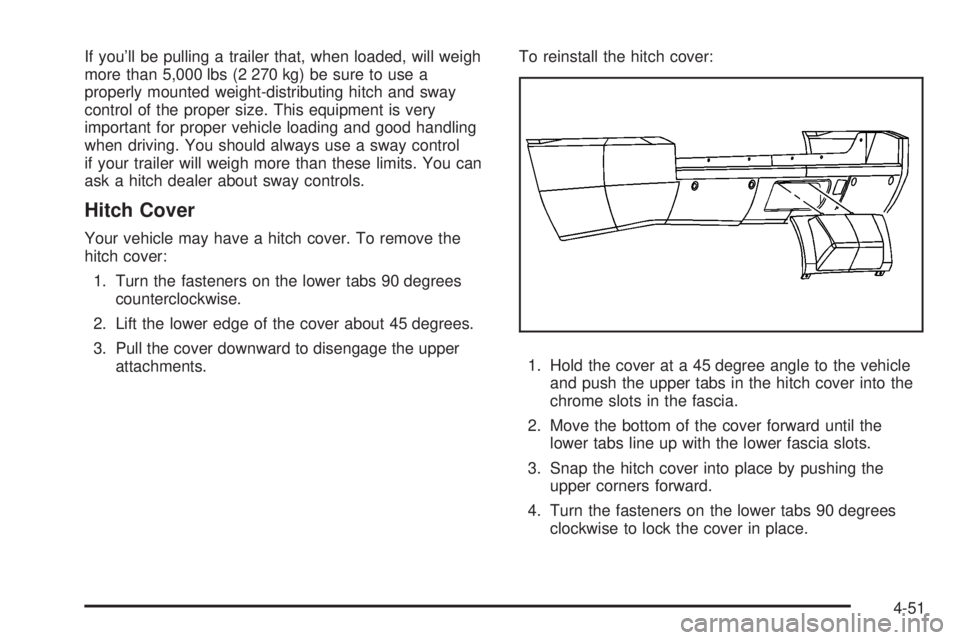
Hitch Cover Your vehicle may have a hitch cover. To remove the
hitch cover:
1. Turn the fasteners on the lower tabs 90 degrees
counterclockwise.
2. Lift the lower edge of the cover about 45 degrees.
3. Pull the cover downward to disengage the upper
attachments. To reinstall the hitch cover:
1. Hold the cover at a 45 degree angle to the vehicle
and push the upper tabs in the hitch cover into the
chrome slots in the fascia.
2. Move the bottom of the cover forward until the
lower tabs line up with the lower fascia slots.
3. Snap the hitch cover into place by pushing the
upper corners forward.
4. Turn the fasteners on the lower tabs 90 degrees
clockwise to lock the cover in place.
4-51
Page 334 of 500
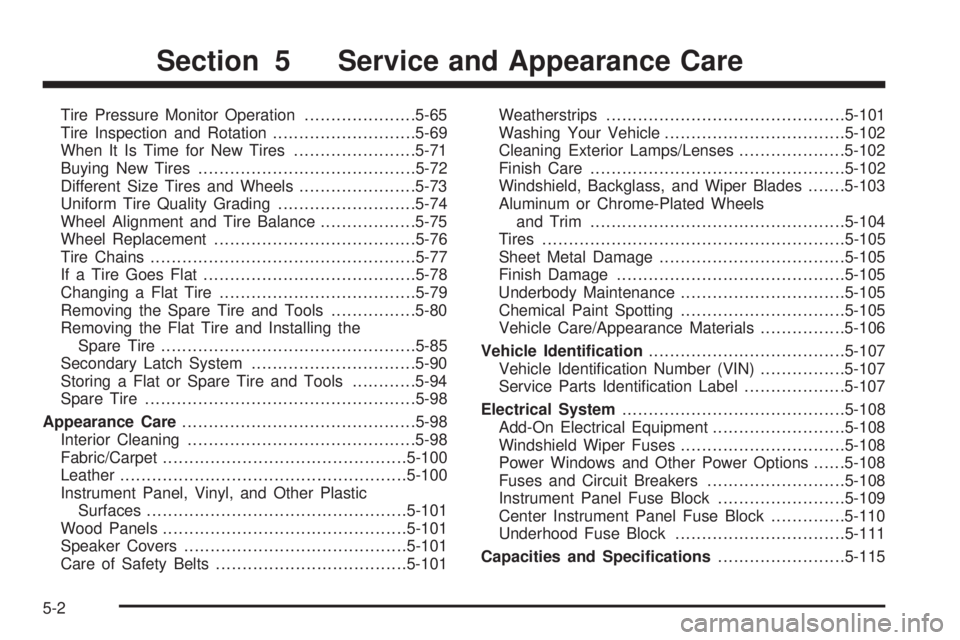
Tire Pressure Monitor Operation .................... .5-65
Tire Inspection and Rotation .......................... .5-69
When It Is Time for New Tires ...................... .5-71
Buying New Tires ........................................ .5-72
Different Size Tires and Wheels ..................... .5-73
Uniform Tire Quality Grading ......................... .5-74
Wheel Alignment and Tire Balance ................. .5-75
Wheel Replacement ..................................... .5-76
Tire Chains ................................................. .5-77
If a Tire Goes Flat ....................................... .5-78
Changing a Flat Tire .................................... .5-79
Removing the Spare Tire and Tools ............... .5-80
Removing the Flat Tire and Installing the
Spare Tire ............................................... .5-85
Secondary Latch System .............................. .5-90
Storing a Flat or Spare Tire and Tools ........... .5-94
Spare Tire .................................................. .5-98
Appearance Care ........................................... .5-98
Interior Cleaning .......................................... .5-98
Fabric/Carpet ............................................. .5-100
Leather ..................................................... .5-100
Instrument Panel, Vinyl, and Other Plastic
Surfaces ................................................ .5-101
Wood Panels ............................................. .5-101
Speaker Covers ......................................... .5-101
Care of Safety Belts ................................... .5-101 Weatherstrips ............................................ .5-101
Washing Your Vehicle ................................. .5-102
Cleaning Exterior Lamps/Lenses ................... .5-102
Finish Care ............................................... .5-102
Windshield, Backglass, and Wiper Blades ...... .5-103
Aluminum or Chrome-Plated Wheels
and Trim ............................................... .5-104
Tires ........................................................ .5-105
Sheet Metal Damage .................................. .5-105
Finish Damage .......................................... .5-105
Underbody
Maintenance .............................. .5-105
Chemical Paint Spotting .............................. .5-105
Vehicle Care/Appearance Materials ............... .5-106
Vehicle Identication .................................... .5-107
Vehicle Identication Number (VIN) ............... .5-107
Service Parts Identication Label .................. .5-107
Electrical System ......................................... .5-108
Add-On Electrical Equipment ........................ .5-108
Windshield Wiper Fuses .............................. .5-108
Power Windows and Other Power Options ..... .5-108
Fuses and Circuit Breakers ......................... .5-108
Instrument Panel Fuse Block ....................... .5-109
Center Instrument Panel Fuse Block ............. .5-110
Underhood Fuse Block ............................... .5-111
Capacities and Specications ....................... .5-115Section 5 Service and Appearance Care
5-2