transmission CADILLAC ESCALADE ESV 2008 User Guide
[x] Cancel search | Manufacturer: CADILLAC, Model Year: 2008, Model line: ESCALADE ESV, Model: CADILLAC ESCALADE ESV 2008Pages: 500, PDF Size: 6.65 MB
Page 131 of 500
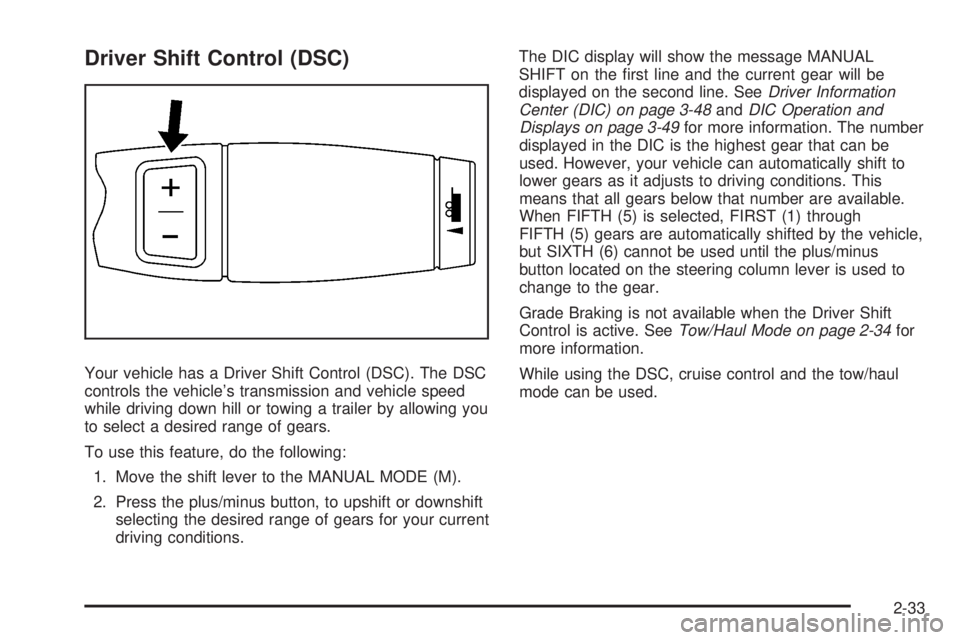
Driver Shift Control (DSC)
Your vehicle has a Driver Shift Control (DSC). The DSC
controls the vehicle’s transmission and vehicle speed
while driving down hill or towing a trailer by allowing you
to select a desired range of gears.
To use this feature, do the following:
1. Move the shift lever to the MANUAL MODE (M).
2. Press the plus/minus button, to upshift or downshift
selecting the desired range of gears for your current
driving conditions. The DIC display will show the message MANUAL
SHIFT on the rst line and the current gear will be
displayed on the second line. See Driver Information
Center (DIC) on page 3-48 and DIC Operation and
Displays on page 3-49 for more information. The number
displayed in the DIC is the highest gear that can be
used. However, your vehicle can automatically shift to
lower gears as it adjusts to driving conditions. This
means that all gears below that number are available.
When FIFTH (5) is selected, FIRST (1) through
FIFTH (5) gears are automatically shifted by the vehicle,
but SIXTH (6) cannot be used until the plus/minus
button located on the steering column lever is used to
change to the gear.
Grade Braking is not available when the Driver Shift
Control is active. See Tow/Haul Mode on page 2-34 for
more information.
While using the DSC, cruise control and the tow/haul
mode can be used.
2-33
Page 132 of 500
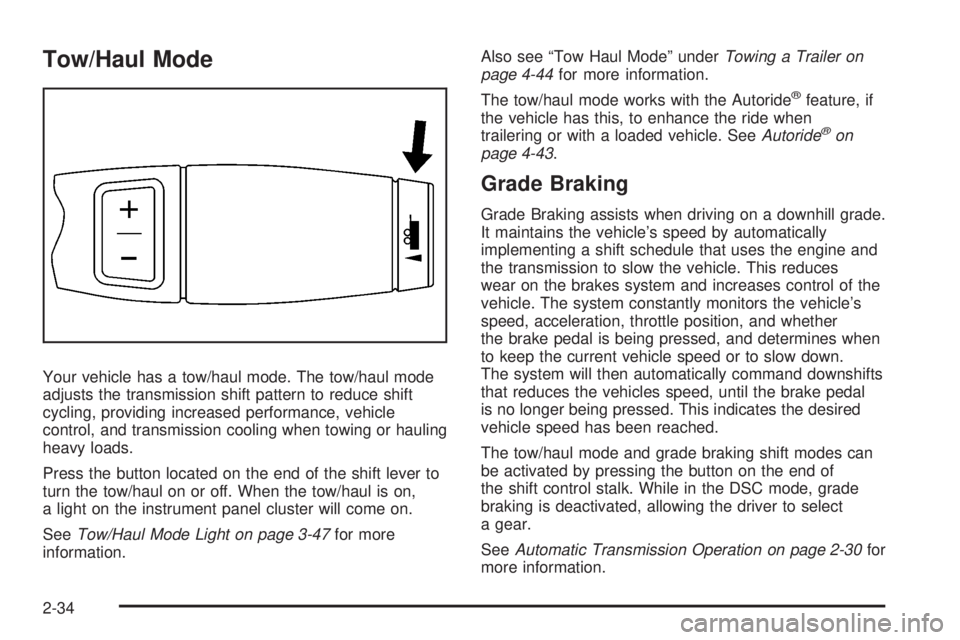
Tow/Haul Mode
Your vehicle has a tow/haul mode. The tow/haul mode
adjusts the transmission shift pattern to reduce shift
cycling, providing increased performance, vehicle
control, and transmission cooling when towing or hauling
heavy loads.
Press the button located on the end of the shift lever to
turn the tow/haul on or off. When the tow/haul is on,
a light on the instrument panel cluster will come on.
See Tow/Haul Mode Light on page 3-47 for more
information. Also see “Tow Haul Mode” under Towing a Trailer on
page 4-44 for more information.
The tow/haul mode works with the Autoride ®
feature, if
the vehicle has this, to enhance the ride when
trailering or with a loaded vehicle. See Autoride ®
on
page 4-43 .
Grade Braking Grade Braking assists when driving on a downhill grade.
It maintains the vehicle’s speed by automatically
implementing a shift schedule that uses the engine and
the transmission to slow the vehicle. This reduces
wear on the brakes system and increases control of the
vehicle. The system constantly monitors the vehicle’s
speed, acceleration, throttle position, and whether
the brake pedal is being pressed, and determines when
to keep the current vehicle speed or to slow down.
The system will then automatically command downshifts
that reduces the vehicles speed, until the brake pedal
is no longer being pressed. This indicates the desired
vehicle speed has been reached.
The tow/haul mode and grade braking shift modes can
be activated by pressing the button on the end of
the shift control stalk. While in the DSC mode, grade
braking is deactivated, allowing the driver to select
a gear.
See Automatic Transmission Operation on page 2-30 for
more information.
2-34
Page 135 of 500
Torque Lock If you are parking on a hill and you do not shift your
transmission into PARK (P) properly, the weight of the
vehicle can put too much force on the parking pawl in the
transmission. It might be difficult to pull the shift lever out
of PARK (P). This is called torque lock. To prevent torque
lock, set the parking brake and then shift into PARK (P)
properly before you leave the driver’s seat. To nd out
how, see Shifting Into PARK (P) on page 2-36 .
When you are ready to drive, move the shift lever out of
PARK (P) before releasing the parking brake.
If torque lock does occur, you might need to have
another vehicle push yours a little uphill to take some of
the pressure from the parking pawl in the transmission.
Then you should be able to pull the shift lever out
of PARK (P). Shifting Out of PARK (P) This vehicle is equipped with an electronic shift lock
release system. The shift lock release is designed to:
Prevent ignition key removal unless the shift
lever is in PARK (P) with the shift lever button fully
released, and
Prevent movement of the shift lever out of
PARK (P), unless the ignition is in ON/RUN or
ACC/ACCESSORY and the regular brake pedal is
applied.
The shift lock release is always functional except in the
case of an uncharged or low voltage (less than 9 volt)
battery.
If your vehicle has an uncharged battery or a battery
with low voltage, try charging or jump starting the
battery. See Jump Starting on page 5-40 for more
information.
2-37
Page 169 of 500
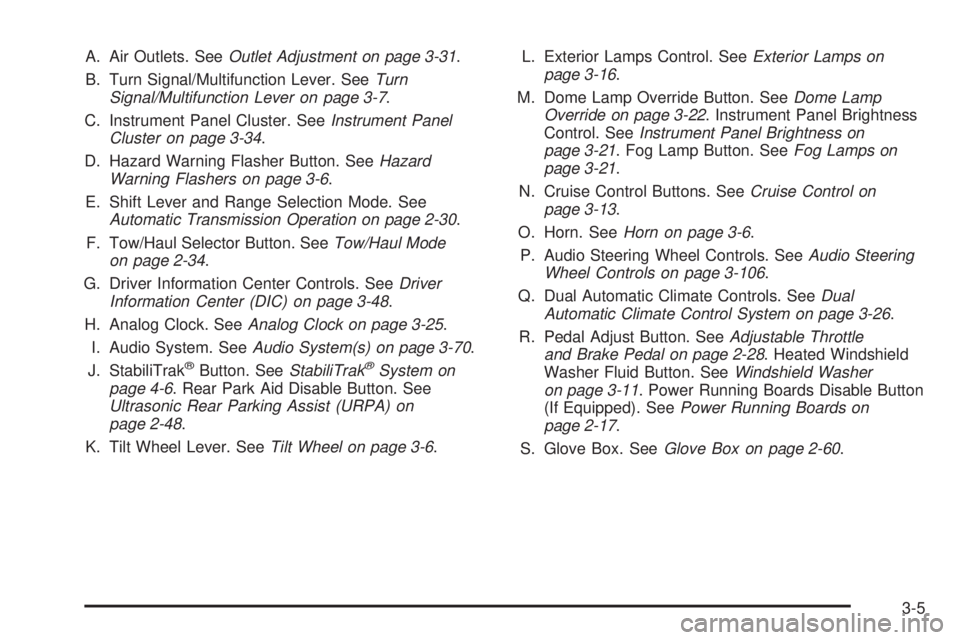
A. Air Outlets. See Outlet Adjustment on page 3-31 .
B. Turn Signal/Multifunction Lever. See Turn
Signal/Multifunction Lever on page 3-7 .
C. Instrument Panel Cluster. See Instrument Panel
Cluster on page 3-34 .
D. Hazard Warning Flasher Button. See Hazard
Warning Flashers on page 3-6 .
E. Shift Lever and Range Selection Mode. See
Automatic Transmission Operation on page 2-30 .
F. Tow/Haul Selector Button. See Tow/Haul Mode
on page 2-34 .
G. Driver Information Center Controls. See Driver
Information Center (DIC) on page 3-48 .
H. Analog Clock. See Analog Clock on page 3-25 .
I. Audio System. See Audio System(s) on page 3-70 .
J. StabiliTrak ®
Button. See StabiliTrak ®
System on
page 4-6 . Rear Park Aid Disable Button. See
Ultrasonic Rear Parking Assist (URPA) on
page 2-48 .
K. Tilt Wheel Lever. See Tilt Wheel on page 3-6 . L. Exterior Lamps Control. See Exterior Lamps on
page 3-16 .
M. Dome Lamp Override Button. See Dome Lamp
Override on page 3-22 . Instrument Panel Brightness
Control. See Instrument Panel Brightness on
page 3-21 . Fog Lamp Button. See Fog Lamps on
page 3-21 .
N. Cruise Control Buttons. See Cruise Control on
page 3-13 .
O. Horn. See Horn on page 3-6 .
P. Audio Steering Wheel Controls. See Audio Steering
Wheel Controls on page 3-106 .
Q. Dual Automatic Climate Controls. See Dual
Automatic Climate Control System on page 3-26 .
R. Pedal Adjust Button. See Adjustable Throttle
and Brake Pedal on page 2-28 . Heated Windshield
Washer Fluid Button. See Windshield Washer
on page 3-11 . Power Running Boards Disable Button
(If Equipped). See Power Running Boards on
page 2-17 .
S. Glove Box. See Glove Box on page 2-60 .
3-5
Page 184 of 500
Daytime Running Lamps (DRL) Daytime Running Lamps (DRL) can make it easier for
others to see the front of your vehicle during the
day. DRL can be helpful in many different driving
conditions, but they can be especially helpful in the short
periods after dawn and before sunset. Fully functional
daytime running lamps are required on all vehicles
rst sold in Canada.
The DRL system will come on when the following
conditions are met:
The ignition is on.
The exterior lamps control is in AUTO.
The transmission is not in PARK (P).
The light sensor determines it is daytime.
When the DRL are on, only the DRL lamps will be on.
The taillamps, sidemarker, and other lamps will not
be on. The instrument panel will not be lit up either.
When it begins to get dark, the automatic headlamp
system will switch from DRL to the headlamps.
To turn off the DRL lamps, turn the exterior lamps
control to the OFF position and then release. For
vehicles rst sold in Canada, the transmission must be
in the PARK (P) position, before the DRL lamps can
be turned off. Automatic Headlamp System When it is dark enough outside, the automatic headlamp
system will turn on the headlamps at the normal
brightness, along with the taillamps, sidemarker, parking
lamps, and the instrument panel lights. The radio
lights will also be dim.
To turn off the automatic headlamp system, turn the
exterior lamps switch to the off position and then release
it. For vehicles rst sold in Canada, the transmission
must be in the PARK (P) position, before the automatic
headlamp system can be turned off.
The vehicle has a light sensor located on the top of the
instrument panel in the defroster grille that regulates
when the automatic headlamps turn on. Be sure it is not
covered, or the headlamps will come on whenever
the ignition is on.
The system may also turn on the headlamps when
driving through a parking garage, heavy overcast
weather, or a tunnel. This is normal.
There is a delay in the transition between the daytime
and nighttime operation of the Daytime Running
Lamps (DRL) and the automatic headlamp systems so
that driving under bridges or bright overhead street
lights does not affect the system. The DRL and
automatic headlamp system will only be affected when
the light sensor detects a change in lighting lasting
longer than the delay.
3-20
Page 207 of 500
Malfunction Indicator Lamp Check Engine Light A computer system called OBD II (On-Board
Diagnostics-Second Generation) monitors operation of
the fuel, ignition, and emission control systems. It makes
sure that emissions are at acceptable levels for the
life of the vehicle, helping to produce a cleaner
environment.
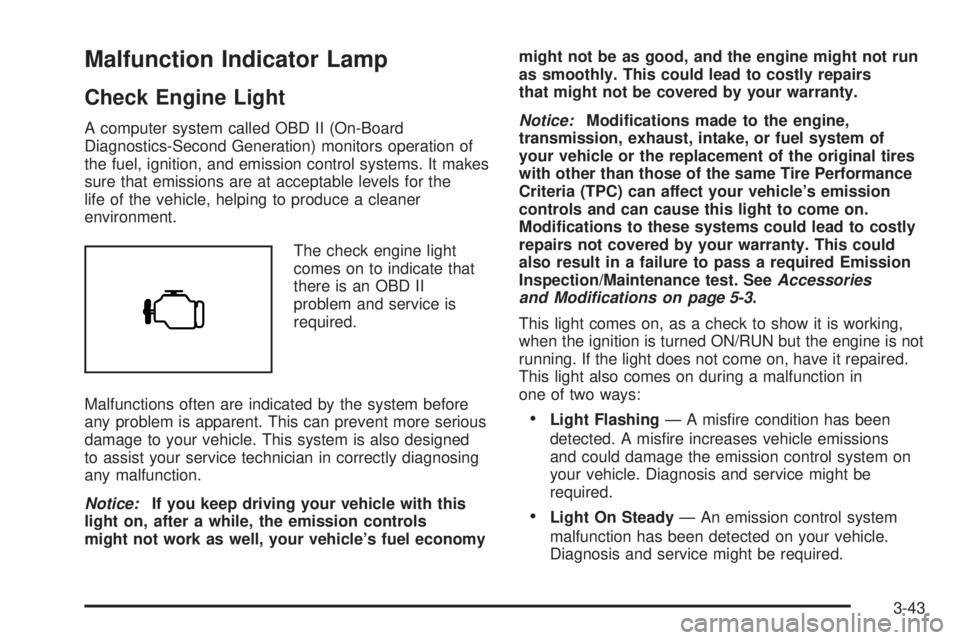
The check engine light
comes on to indicate that
there is an OBD II
problem and service is
required.
Malfunctions often are indicated by the system before
any problem is apparent. This can prevent more serious
damage to your vehicle. This system is also designed
to assist your service technician in correctly diagnosing
any malfunction.
Notice: If you keep driving your vehicle with this
light on, after a while, the emission controls
might not work as well, your vehicle’s fuel economy might not be as good, and the engine might not run
as smoothly. This could lead to costly repairs
that might not be covered by your warranty.
Notice: Modications made to the engine,
transmission, exhaust, intake, or fuel system of
your vehicle or the replacement of the original tires
with other than those of the same Tire Performance
Criteria (TPC) can affect your vehicle’s emission
controls and can cause this light to come on.
Modications to these systems could lead to costly
repairs not covered by your warranty. This could
also result in a failure to pass a required Emission
Inspection/Maintenance test. See Accessories
and Modifications on page 5-3 .
This light comes on, as a check to show it is working,
when the ignition is turned ON/RUN but the engine is not
running. If the light does not come on, have it repaired.
This light also comes on during a malfunction in
one of two ways:
Light Flashing — A misre condition has been
detected. A misre increases vehicle emissions
and could damage the emission control system on
your vehicle. Diagnosis and service might be
required.
Light On Steady — An emission control system
malfunction has been detected on your vehicle.
Diagnosis and service might be required.
3-43
Page 213 of 500
DIC Operation and Displays The DIC has different displays which can be accessed
by pressing the DIC buttons located on the instrument
panel, next to the steering wheel.
The DIC displays trip, fuel, and vehicle system
information, and warning messages if a system problem
is detected. A digital speedometer also appears at
the bottom of the DIC display. The digital speedometer
can be enabled or disabled. See “DISPLAY DIGITAL
SPEED” under DIC Vehicle Customization on page 3-61
for more information.
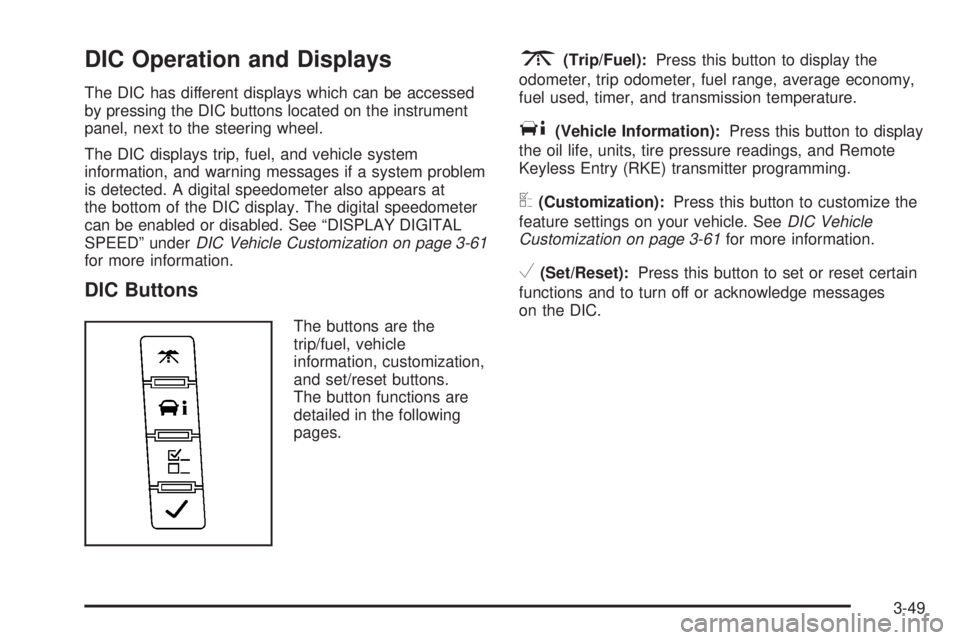
DIC Buttons The buttons are the
trip/fuel, vehicle
information, customization,
and set/reset buttons.
The button functions are
detailed in the following
pages. 3 (Trip/Fuel): Press this button to display the
odometer, trip odometer, fuel range, average economy,
fuel used, timer, and transmission temperature.
T (Vehicle Information): Press this button to display
the oil life, units, tire pressure readings, and Remote
Keyless Entry (RKE) transmitter programming.
U (Customization): Press this button to customize the
feature settings on your vehicle. See DIC Vehicle
Customization on page 3-61 for more information.
V (Set/Reset): Press this button to set or reset certain
functions and to turn off or acknowledge messages
on the DIC.
3-49
Page 215 of 500
Timer Press the trip/fuel button until TIMER displays. This
display can be used as a timer.
To start the timer, press the set/reset button while
TIMER is displayed. The display will show the amount
of time that has passed since the timer was last
reset, not including time the ignition is off. Time will
continue to be counted as long as the ignition is
on, even if another display is being shown on the DIC.
The timer will record up to 99 hours, 59 minutes
and 59 seconds (99:59:59) after which the display will
return to zero.
To stop the timer, press the set/reset button briey while
TIMER is displayed.
To reset the timer to zero, press and hold the set/reset
button while TIMER is displayed.
Transmission Temperature Press the trip/fuel button until TRANS TEMP displays.
This display shows the temperature of the automatic
transmission uid in either degrees Fahrenheit (°F) or
degrees Celsius (°C).
Blank Display
This display shows no information. Vehicle Information Menu Items
T (Vehicle Information): Press this button to scroll
through the following menu items:
Oil Life Press the vehicle information button until OIL LIFE
REMAINING displays. This display shows an estimate
of the oil’s remaining useful life. If you see 99% OIL LIFE
REMAINING on the display, that means 99% of the
current oil life remains. The engine oil life system
will alert you to change the oil on a schedule consistent
with your driving conditions.
When the remaining oil life is low, the CHANGE
ENGINE OIL SOON message will appear on the display.
See “CHANGE ENGINE OIL SOON” under DIC
Warnings and Messages on page 3-53 . You should
change the oil as soon as you can. See Engine Oil on
page 5-14 . In addition to the engine oil life system
monitoring the oil life, additional maintenance is
recommended in the Maintenance Schedule in this
manual. See Scheduled Maintenance on page 6-4 for
more information.
3-51
Page 220 of 500
FUEL LEVEL LOW This message displays and a chime sounds if the fuel
level is low. Refuel as soon as possible. See Fuel Gage
on page 3-48 and Fuel on page 5-5 for more
information.
HOOD OPEN This message displays and a chime sounds if the hood is
not fully closed. Stop and turn off the vehicle, check the
hood for obstructions, and close the hood again. Check to
see if the message still appears on the DIC.
LEFT REAR DOOR OPEN This message displays and a chime sounds if the driver
side rear door is not fully closed and the vehicle is in
a drive gear. Stop and turn off the vehicle, check
the door for obstructions, and close the door again.
Check to see if the message still appears on the DIC.
MANUAL SHIFT X If your vehicle has Driver Shift Control (DSC) and the
shift lever is in the MANUAL MODE (M) position,
this message displays along with the current gear. See
Automatic Transmission Operation on page 2-30 for
more information. OIL PRESSURE LOW STOP ENGINE Notice: If you drive your vehicle while the engine
oil pressure is low, severe engine damage may
occur. If a low oil pressure warning appears on the
Driver Information Center (DIC), stop the vehicle
as soon as possible. Do not drive the vehicle until
the cause of the low oil pressure is corrected.
See Engine Oil on page 5-14 for more information.
This message displays if low oil pressure levels
occur. Stop the vehicle as soon as safely possible and
do not operate it until the cause of the low oil pressure
has been corrected. Check the oil as soon as possible
and have your vehicle serviced by your dealer/retailer.
See Engine Oil on page 5-14 .
PARKING ASSIST OFF After the vehicle has been started, this message
displays to remind the driver that the Ultrasonic Rear
Parking Assist (URPA) system has been turned
off. Press the set/reset button to acknowledge this
message and clear it from the DIC display. To turn the
URPA system back on, see Ultrasonic Rear Parking
Assist (URPA) on page 2-48 .
3-56
Page 224 of 500
TIGHTEN GAS CAP This message may display along with the check engine
light on the instrument panel cluster if the vehicle’s
fuel cap is not tightened properly. See Malfunction
Indicator Lamp on page 3-43 . Reinstall the fuel cap fully.
See Filling the Tank on page 5-7 . The diagnostic
system can determine if the fuel cap has been left off or
improperly installed. A loose or missing fuel cap
allows fuel to evaporate into the atmosphere. A few
driving trips with the cap properly installed should turn
this light and message off.
TIRE LEARNING ACTIVE This message displays when the Tire Pressure Monitor
System (TPMS) is re-learning the tire positions on
your vehicle. The tire positions must be re-learned after
rotating the tires or after replacing a tire or sensor.
See Tire Inspection and Rotation on page 5-69 ,
Tire Pressure Monitor System on page 5-64 , and
Inflation - Tire Pressure on page 5-62 for more
information.
TRACTION CONTROL OFF If your vehicle has StabiliTrak ®
, this message displays
when the Traction Control System (TCS) is turned
off. Adjust your driving accordingly. See StabiliTrak ®
System on page 4-6 for more information. TRANSMISSION HOT IDLE ENGINE Notice: If you drive your vehicle while the
transmission uid is overheating and the
transmission temperature warning is displayed on
the instrument panel cluster and/or DIC, you
can damage the transmission. This could lead to
costly repairs that would not be covered by
your warranty. Do not drive your vehicle with
overheated transmission uid or while the
transmission temperature warning is displayed.
This message displays along with a continuous chime if
the transmission uid in the vehicle gets hot. Driving
with the transmission uid temperature high can cause
damage to the vehicle. Stop the vehicle and let it
idle to allow the transmission to cool. This message
clears and the chime stops when the uid temperature
reaches a safe level.
TURN SIGNAL ON This message displays and a chime sounds if a turn
signal is left on for 3/4 of a mile (1.2 km). Move the turn
signal/multifunction lever to the off position.
3-60