seats CADILLAC ESCALADE ESV 2008 Owner's Manual
[x] Cancel search | Manufacturer: CADILLAC, Model Year: 2008, Model line: ESCALADE ESV, Model: CADILLAC ESCALADE ESV 2008Pages: 500, PDF Size: 6.65 MB
Page 33 of 500
Safety Belts Safety Belts: They Are for Everyone This part of the manual tells you how to use safety
belts properly. It also tells you some things you should
not do with safety belts.
{ CAUTION: Do not let anyone ride where he or she cannot
wear a safety belt properly. If you are in a
crash and you are not wearing a safety belt,
your injuries can be much worse. You can hit
things inside the vehicle harder or be ejected
from it and be seriously injured or killed. In the
same crash, you might not be, if you are
buckled up. Always fasten your safety belt,
and check that your passenger(s) are
restrained properly too. { CAUTION: It is extremely dangerous to ride in a cargo
area, inside or outside of a vehicle. In a
collision, people riding in these areas are more
likely to be seriously injured or killed. Do not
allow people to ride in any area of your vehicle
that is not equipped with seats and safety
belts. Be sure everyone in your vehicle is in a
seat and using a safety belt properly.
Your vehicle has indicators as a reminder to buckle your
safety belts. See Safety Belt Reminders on page 3-35 .
In most states and in all Canadian provinces, the
law requires wearing safety belts. Here is why:
You never know if you will be in a crash. If you do have
a crash, you do not know if it will be a serious one.
A few crashes are mild, and some crashes can be so
serious that even buckled up, a person would not
survive. But most crashes are in between. In many of
them, people who buckle up can survive and sometimes
walk away. Without belts they could have been badly
hurt or killed.
After more than 40 years of safety belts in vehicles, the
facts are clear. In most crashes buckling up does
matter... a lot!
1-29
Page 46 of 500
Lap-Shoulder Belt All seating positions in your vehicle have a lap-shoulder
except for the center front passenger position, if your
vehicle has one, which has a lap belt. See Lap Belt on
page 1-48 for more information.
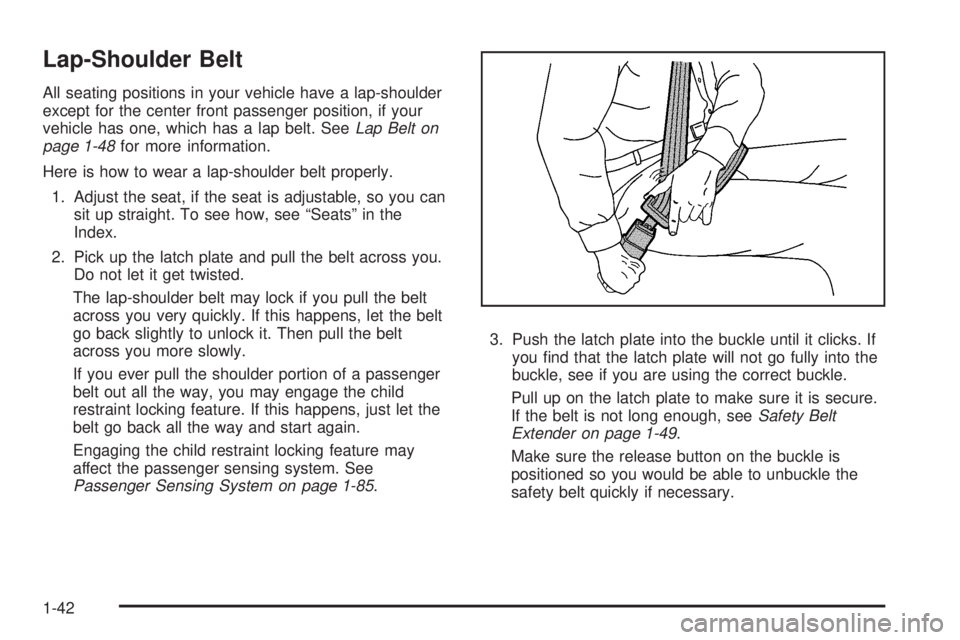
Here is how to wear a lap-shoulder belt properly.
1. Adjust the seat, if the seat is adjustable, so you can
sit up straight. To see how, see “Seats” in the
Index.
2. Pick up the latch plate and pull the belt across you.
Do not let it get twisted.
The lap-shoulder belt may lock if you pull the belt
across you very quickly. If this happens, let the belt
go back slightly to unlock it. Then pull the belt
across you more slowly.
If you ever pull the shoulder portion of a passenger
belt out all the way, you may engage the child
restraint locking feature. If this happens, just let the
belt go back all the way and start again.
Engaging the child restraint locking feature may
affect the passenger sensing system. See
Passenger Sensing System on page 1-85 . 3. Push the latch plate into the buckle until it clicks. If
you nd that the latch plate will not go fully into the
buckle, see if you are using the correct buckle.
Pull up on the latch plate to make sure it is secure.
If the belt is not long enough, see Safety Belt
Extender on page 1-49 .
Make sure the release button on the buckle is
positioned so you would be able to unbuckle the
safety belt quickly if necessary.
1-42
Page 48 of 500
Shoulder Belt Height Adjuster Your vehicle has a shoulder belt height adjuster for the
driver and right front passenger position.
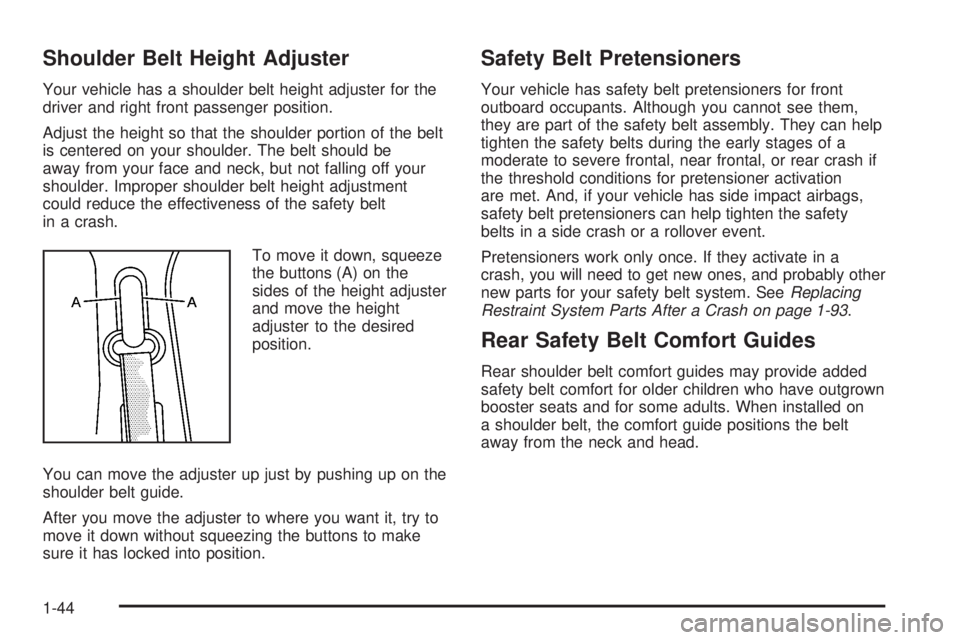
Adjust the height so that the shoulder portion of the belt
is centered on your shoulder. The belt should be
away from your face and neck, but not falling off your
shoulder. Improper shoulder belt height adjustment
could reduce the effectiveness of the safety belt
in a crash.
To move it down, squeeze
the buttons (A) on the
sides of the height adjuster
and move the height
adjuster to the desired
position.
You can move the adjuster up just by pushing up on the
shoulder belt guide.
After you move the adjuster to where you want it, try to
move it down without squeezing the buttons to make
sure it has locked into position. Safety Belt Pretensioners Your vehicle has safety belt pretensioners for front
outboard occupants. Although you cannot see them,
they are part of the safety belt assembly. They can help
tighten the safety belts during the early stages of a
moderate to severe frontal, near frontal, or rear crash if
the threshold conditions for pretensioner activation
are met. And, if your vehicle has side impact airbags,
safety belt pretensioners can help tighten the safety
belts in a side crash or a rollover event.
Pretensioners work only once. If they activate in a
crash, you will need to get new ones, and probably other
new parts for your safety belt system. See Replacing
Restraint System Parts After a Crash on page 1-93 .
Rear Safety Belt Comfort Guides Rear shoulder belt comfort guides may provide added
safety belt comfort for older children who have outgrown
booster seats and for some adults. When installed on
a shoulder belt, the comfort guide positions the belt
away from the neck and head.
1-44
Page 53 of 500
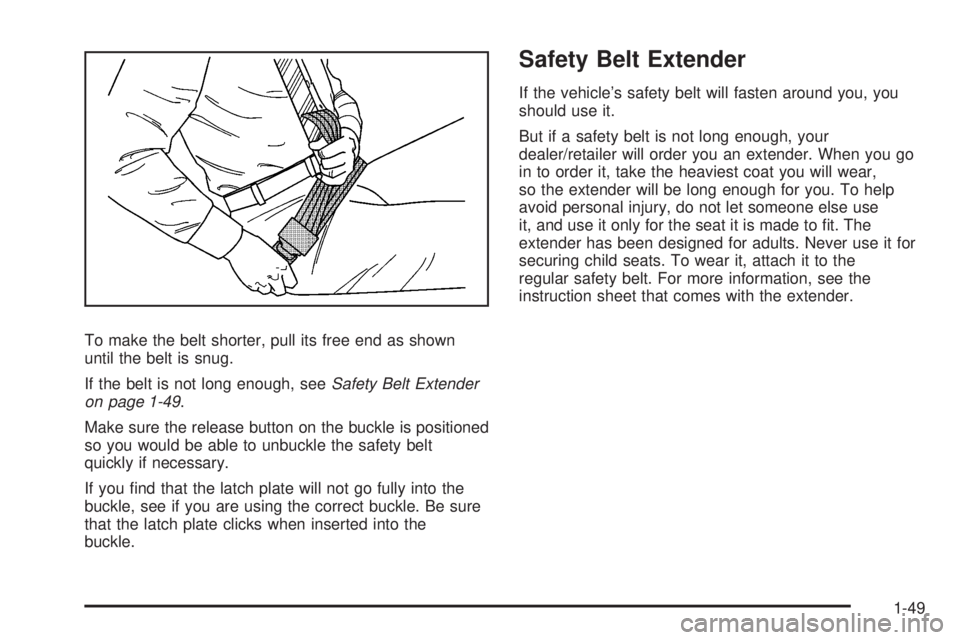
To make the belt shorter, pull its free end as shown
until the belt is snug.
If the belt is not long enough, see Safety Belt Extender
on page 1-49 .
Make sure the release button on the buckle is positioned
so you would be able to unbuckle the safety belt
quickly if necessary.
If you nd that the latch plate will not go fully into the
buckle, see if you are using the correct buckle. Be sure
that the latch plate clicks when inserted into the
buckle. Safety Belt Extender If the vehicle’s safety belt will fasten around you, you
should use it.
But if a safety belt is not long enough, your
dealer/retailer will order you an extender. When you go
in to order it, take the heaviest coat you will wear,
so the extender will be long enough for you. To help
avoid personal injury, do not let someone else use
it, and use it only for the seat it is made to t. The
extender has been designed for adults. Never use it for
securing child seats. To wear it, attach it to the
regular safety belt. For more information, see the
instruction sheet that comes with the extender.
1-49
Page 54 of 500

Child Restraints Older Children
Older children who have outgrown booster seats should
wear the vehicle’s safety belts. The manufacturer’s instructions that come with the
booster seat, state the weight and height limitations for
that booster. Use a booster seat with a lap-shoulder
belt until the child passes the below t test:
Sit all the way back on the seat. Do the knees bend
at the seat edge? If yes, continue. If no, return to
the booster seat.
Buckle the lap-shoulder belt. Does the shoulder belt
rest on the shoulder? If yes, continue. If no, try
using the rear safety belt comfort guide. See “Rear
Safety Belt Comfort Guides” under Lap-Shoulder
Belt on page 1-42 for more information. If the
shoulder belt still does not rest on the shoulder,
then return to the booster seat.
Does the lap belt t low and snug on the hips,
touching the thighs? If yes, continue. If no, return to
the booster seat.
Can proper safety belt t be maintained for length of
trip? If yes, continue. If no, return to the booster seat.
If you have the choice, a child should sit in a position
with a lap-shoulder belt and get the additional restraint a
shoulder belt can provide.
1-50
Page 62 of 500
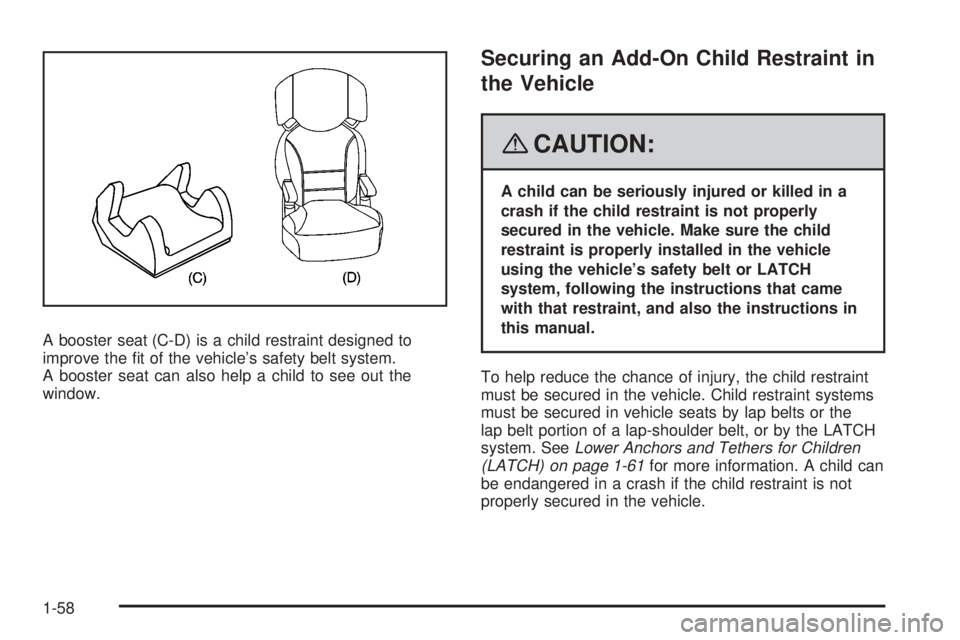
A booster seat (C-D) is a child restraint designed to
improve the t of the vehicle’s safety belt system.
A booster seat can also help a child to see out the
window. Securing an Add-On Child Restraint in
the Vehicle
{ CAUTION: A child can be seriously injured or killed in a
crash if the child restraint is not properly
secured in the vehicle. Make sure the child
restraint is properly installed in the vehicle
using the vehicle’s safety belt or LATCH
system, following the instructions that came
with that restraint, and also the instructions in
this manual.
To help reduce the chance of injury, the child restraint
must be secured in the vehicle. Child restraint systems
must be secured in vehicle seats by lap belts or the
lap belt portion of a lap-shoulder belt, or by the LATCH
system. See Lower Anchors and Tethers for Children
(LATCH) on page 1-61 for more information. A child can
be endangered in a crash if the child restraint is not
properly secured in the vehicle.
1-58
Page 68 of 500
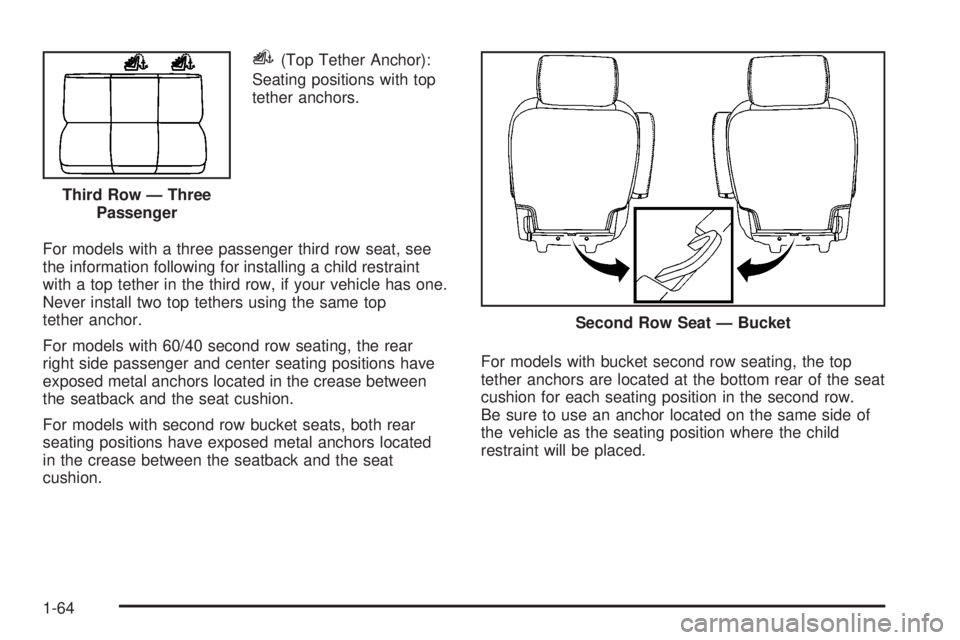
i (Top Tether Anchor):
Seating positions with top
tether anchors.
For models with a three passenger third row seat, see
the information following for installing a child restraint
with a top tether in the third row, if your vehicle has one.
Never install two top tethers using the same top
tether anchor.
For models with 60/40 second row seating, the rear
right side passenger and center seating positions have
exposed metal anchors located in the crease between
the seatback and the seat cushion.
For models with second row bucket seats, both rear
seating positions have exposed metal anchors located
in the crease between the seatback and the seat
cushion. For models with bucket second row seating, the top
tether anchors are located at the bottom rear of the seat
cushion for each seating position in the second row.
Be sure to use an anchor located on the same side of
the vehicle as the seating position where the child
restraint will be placed.Third Row — Three
Passenger
Second Row Seat — Bucket
1-64
Page 94 of 500
Servicing Your Airbag-Equipped
Vehicle Airbags affect how your vehicle should be serviced.
There are parts of the airbag system in several places
around your vehicle. Your dealer/retailer and the service
manual have information about servicing your vehicle
and the airbag system. To purchase a service manual,
see Service Publications Ordering Information on
page 7-14 .
{ CAUTION: For up to 10 seconds after the ignition is
turned off and the battery is disconnected, an
airbag can still inate during improper service.
You can be injured if you are close to an
airbag when it inates. Avoid yellow
connectors. They are probably part of the
airbag system. Be sure to follow proper
service procedures, and make sure the person
performing work for you is qualied to do so. Adding Equipment to Your
Airbag-Equipped Vehicle
Q: Is there anything I might add to or change
about the vehicle that could keep the airbags
from working properly?
A: Yes. If you add things that change your vehicle’s
frame, bumper system, height, front end or side
sheet metal, they may keep the airbag system from
working properly. Changing or moving any parts
of the front seats, safety belts, the airbag sensing
and diagnostic module, steering wheel, instrument
panel, roof-rail airbag modules, ceiling headliner
or pillar garnish trim, overhead console, front
sensors, side impact sensors, rollover sensor
module, or airbag wiring can affect the operation of
the airbag system.
1-90
Page 105 of 500
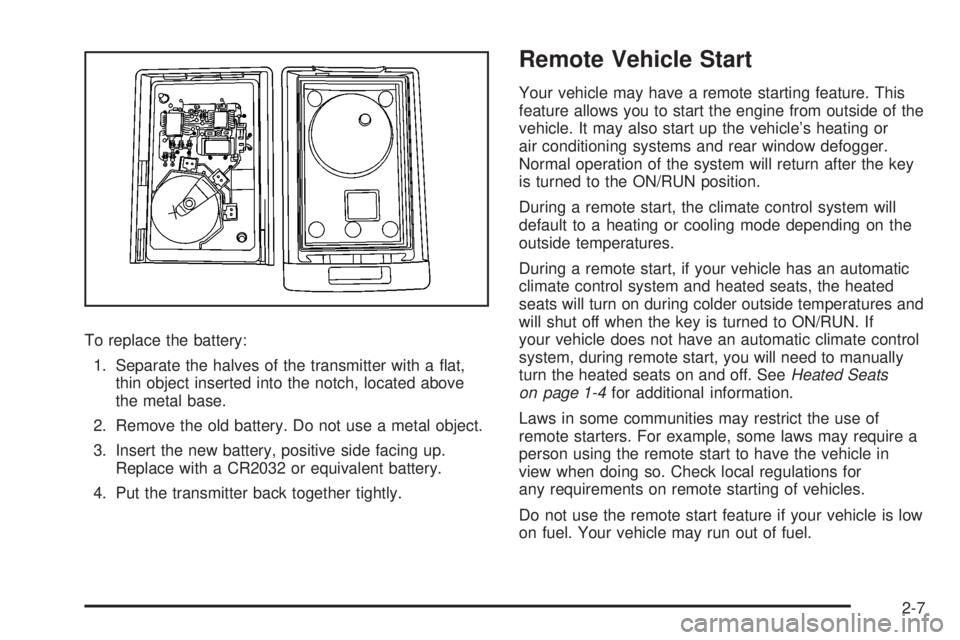
To replace the battery:
1. Separate the halves of the transmitter with a at,
thin object inserted into the notch, located above
the metal base.
2. Remove the old battery. Do not use a metal object.
3. Insert the new battery, positive side facing up.
Replace with a CR2032 or equivalent battery.
4. Put the transmitter back together tightly. Remote Vehicle Start Your vehicle may have a remote starting feature. This
feature allows you to start the engine from outside of the
vehicle. It may also start up the vehicle’s heating or
air conditioning systems and rear window defogger.
Normal operation of the system will return after the key
is turned to the ON/RUN position.
During a remote start, the climate control system will
default to a heating or cooling mode depending on the
outside temperatures.
During a remote start, if your vehicle has an automatic
climate control system and heated seats, the heated
seats will turn on during colder outside temperatures and
will shut off when the key is turned to ON/RUN. If
your vehicle does not have an automatic climate control
system, during remote start, you will need to manually
turn the heated seats on and off. See Heated Seats
on page 1-4 for additional information.
Laws in some communities may restrict the use of
remote starters. For example, some laws may require a
person using the remote start to have the vehicle in
view when doing so. Check local regulations for
any requirements on remote starting of vehicles.
Do not use the remote start feature if your vehicle is low
on fuel. Your vehicle may run out of fuel.
2-7
Page 159 of 500
Center Console Storage Your vehicle has a console compartment between the
bucket seats.
The console has both an upper and lower storage bin
accessed by lifting up on the latches located at the front
of the console lid.
The console may have an accessory power outlet
inside. See Accessory Power Outlet(s) on page 3-24 .
The rear of the console also has a cupholder that swings
down for the rear seat passengers to use.
Assist Handles Your vehicle is equipped with assist handles to be used
when getting out of the vehicle. They are located
above the rear passenger doors. Pull down to use.
Garment Hooks There are garment hooks located on the assist handles. Luggage Carrier If your vehicle has a luggage carrier, you can load
things on top of your vehicle.
The luggage carrier has siderails attached to the roof
and crossrails, if equipped, which can be moved
back and forth to help secure cargo. To adjust, turn the
knob located at each end of the crossrail
counterclockwise until the crossrail can move freely. To
secure the crossrail, turn the knob located at each
end of the crossrail clockwise until tightened. Tie the
load to the siderails or siderail supports.
Notice: Loading cargo on the luggage carrier that
weighs more than 200 lbs (91 kg) or hangs over
the rear or sides of the vehicle may damage your
vehicle. Load cargo so that it rests as far forward as
possible and against the side rails, making sure
to fasten it securely.
Do not exceed the maximum vehicle capacity when
loading your vehicle. For more information on vehicle
capacity and loading, see Loading Your Vehicle on
page 4-35 .
2-61