wheel CADILLAC ESCALADE ESV 2008 Repair Manual
[x] Cancel search | Manufacturer: CADILLAC, Model Year: 2008, Model line: ESCALADE ESV, Model: CADILLAC ESCALADE ESV 2008Pages: 500, PDF Size: 6.65 MB
Page 343 of 500
Hood Release To open the hood do the following:
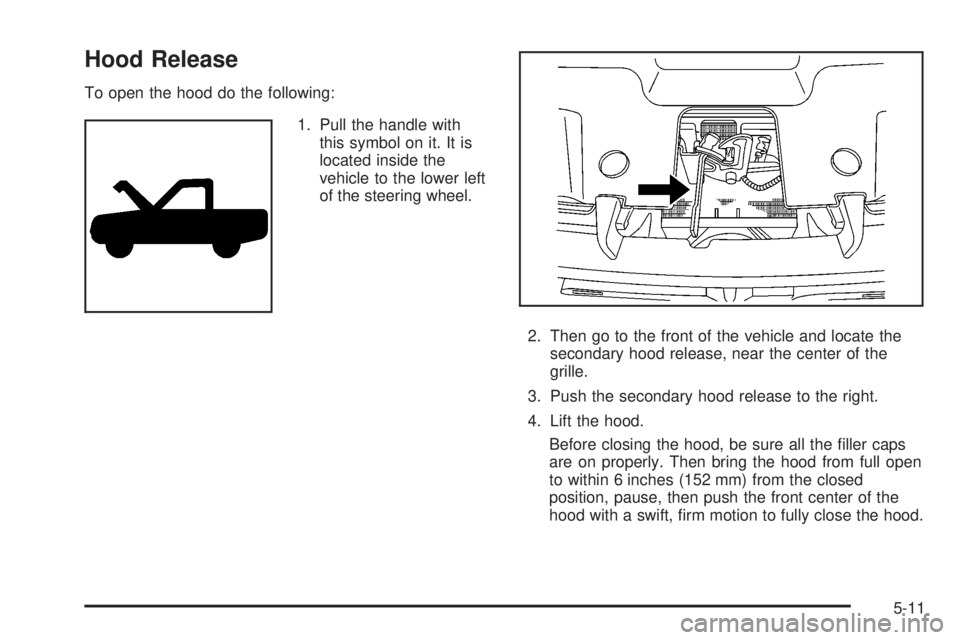
1. Pull the handle with
this symbol on it. It is
located inside the
vehicle to the lower left
of the steering wheel.
2. Then go to the front of the vehicle and locate the
secondary hood release, near the center of the
grille.
3. Push the secondary hood release to the right.
4. Lift the hood.
Before closing the hood, be sure all the ller caps
are on properly. Then bring the hood from full open
to within 6 inches (152 mm) from the closed
position, pause, then push the front center of the
hood with a swift, rm motion to fully close the hood.
5-11
Page 370 of 500
Brake Wear Your vehicle has disc brakes. Disc brake pads have
built-in wear indicators that make a high-pitched warning
sound when the brake pads are worn and new pads
are needed. The sound can come and go or be heard all
the time your vehicle is moving, except when you are
pushing on the brake pedal rmly.
{ CAUTION: The brake wear warning sound means that soon
the brakes will not work well. That could lead to
an accident. When you hear the brake wear
warning sound, have your vehicle serviced.
Notice: Continuing to drive with worn-out brake
pads could result in costly brake repair.
Some driving conditions or climates can cause a brake
squeal when the brakes are rst applied or lightly
applied. This does not mean something is wrong with
the brakes. Properly torqued wheel nuts are necessary to help
prevent brake pulsation. When tires are rotated, inspect
brake pads for wear and evenly tighten wheel nuts in
the proper sequence to torque specications in
Capacities and Specifications on page 5-115 .
Brake linings should always be replaced as complete
axle sets.
Brake Pedal Travel See your dealer/retailer if the brake pedal does not
return to normal height, or if there is a rapid increase in
pedal travel. This could be a sign that brake service
might be required.
Brake Adjustment Every time you make a brake stop, the disc brakes
adjust for wear.
Replacing Brake System Parts The braking system on a vehicle is complex. Its many
parts have to be of top quality and work well together if
the vehicle is to have really good braking. Your vehicle
was designed and tested with top-quality brake parts.
5-38
Page 372 of 500
Jump Starting If your vehicle’s battery (or batteries) has run down, you
may want to use another vehicle and some jumper
cables to start your vehicle. Be sure to use the following
steps to do it safely.
{ CAUTION: Batteries can hurt you. They can be dangerous
because:
They contain acid that can burn you.
They contain gas that can explode or
ignite.
They contain enough electricity to
burn you.
If you do not follow these steps exactly, some
or all of these things can hurt you. Notice: Ignoring these steps could result in costly
damage to your vehicle that would not be covered
by your warranty.
Trying to start your vehicle by pushing or pulling it
will not work, and it could damage your vehicle.
1. Check the other vehicle. It must have a 12-volt
battery with a negative ground system.
Notice: If the other vehicle’s system is not a 12-volt
system with a negative ground, both vehicles can
be damaged. Only use vehicles with 12-volt systems
with negative grounds to jump start your vehicle.
2. Get the vehicles close enough so the jumper cables
can reach, but be sure the vehicles are not touching
each other. If they are, it could cause a ground
connection you do not want. You would not be able
to start your vehicle, and the bad grounding
could damage the electrical systems.
To avoid the possibility of the vehicles rolling, set
the parking brake rmly on both vehicles involved
in the jump start procedure. Put the automatic
transmission in PARK (P) or a manual transmission
in NEUTRAL before setting the parking brake.
If you have a four-wheel-drive vehicle, be sure the
transfer case is in a drive gear, not in NEUTRAL.
5-40
Page 377 of 500
All-Wheel Drive Transfer Case If your vehicle is equipped with All-Wheel Drive, be sure
to perform the lubricant checks described in this section.
There are two additional systems that need lubrication.
When to Check Lubricant Refer to the Maintenance Schedule to determine
how often to check the lubricant. See Scheduled
Maintenance on page 6-4 .
How to Check Lubricant To get an accurate reading, the vehicle should be on a
level surface.
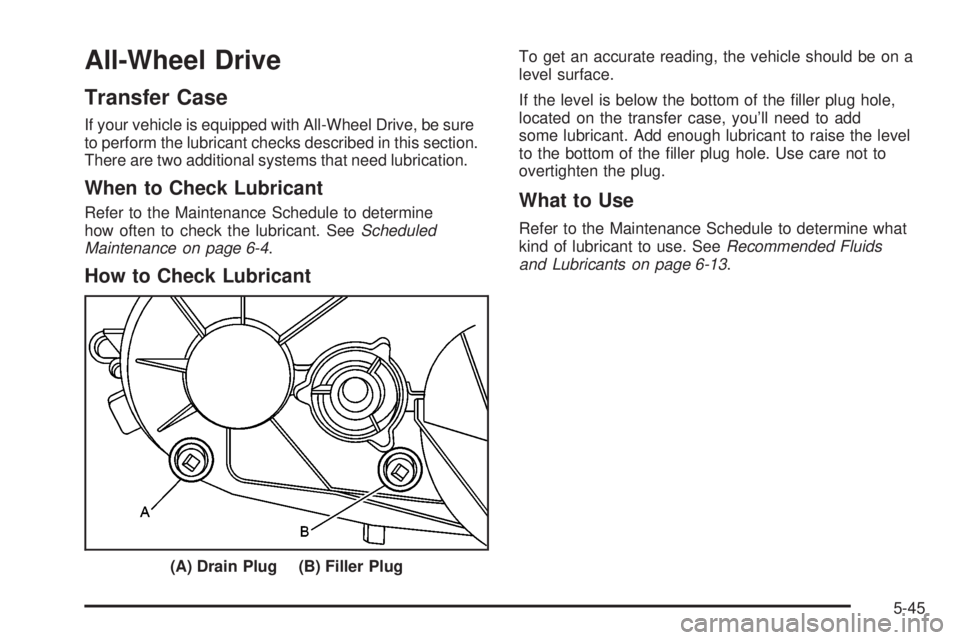
If the level is below the bottom of the ller plug hole,
located on the transfer case, you’ll need to add
some lubricant. Add enough lubricant to raise the level
to the bottom of the ller plug hole. Use care not to
overtighten the plug.
What to Use Refer to the Maintenance Schedule to determine what
kind of lubricant to use. See Recommended Fluids
and Lubricants on page 6-13 .
(A) Drain Plug (B) Filler Plug
5-45
Page 378 of 500
Rear Axle When to Check Lubricant It is not necessary to regularly check rear axle uid
unless you suspect there is a leak or you hear an
unusual noise. A uid loss could indicate a problem.
Have it inspected and repaired.
All axle assemblies are lled by volume of uid during
production. They are not lled to reach a certain
level. When checking the uid level on any axle,
variations in the readings can be caused by factory ll
differences between the minimum and the maximum
uid volume. Also, if a vehicle has just been driven
before checking the uid level, it may appear lower than
normal because uid has traveled out along the axle
tubes and has not drained back to the sump area.
Therefore, a reading taken ve minutes after the vehicle
has been driven will appear to have a lower uid
level than a vehicle that has been stationary for an hour
or two. Remember that the rear axle assembly must
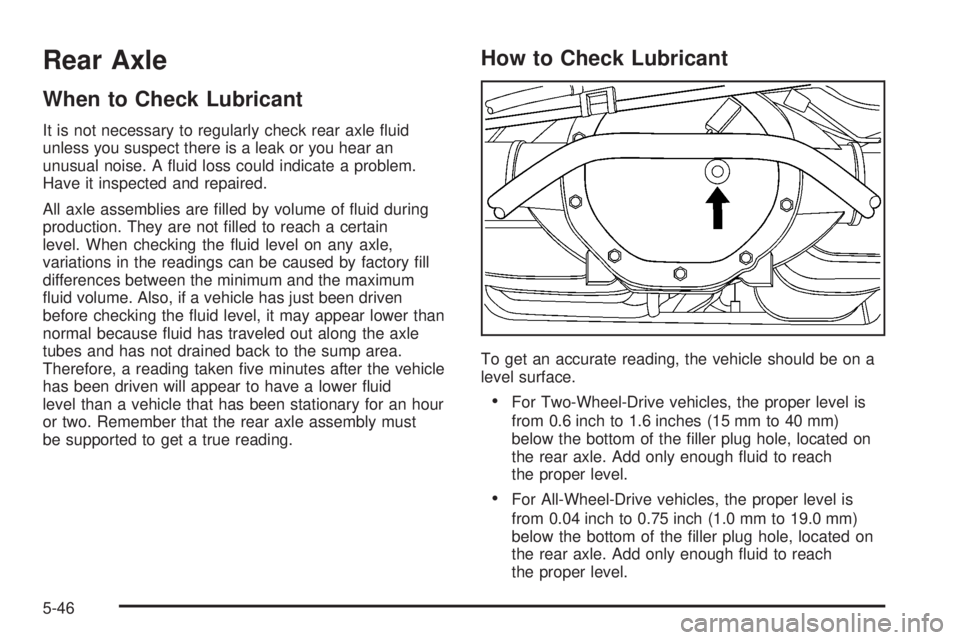
be supported to get a true reading. How to Check Lubricant
To get an accurate reading, the vehicle should be on a
level surface.
For Two-Wheel-Drive vehicles, the proper level is
from 0.6 inch to 1.6 inches (15 mm to 40 mm)
below the bottom of the ller plug hole, located on
the rear axle. Add only enough uid to reach
the proper level.
For All-Wheel-Drive vehicles, the proper level is
from 0.04 inch to 0.75 inch (1.0 mm to 19.0 mm)
below the bottom of the ller plug hole, located on
the rear axle. Add only enough uid to reach
the proper level.
5-46
Page 390 of 500
(G) Maximum Cold Ination Load Limit :
Maximum load that can be carried and the
maximum pressure needed to support that load.
For information on recommended tire pressure
see Inflation - Tire Pressure on page 5-62
and Loading Your Vehicle on page 4-35 .
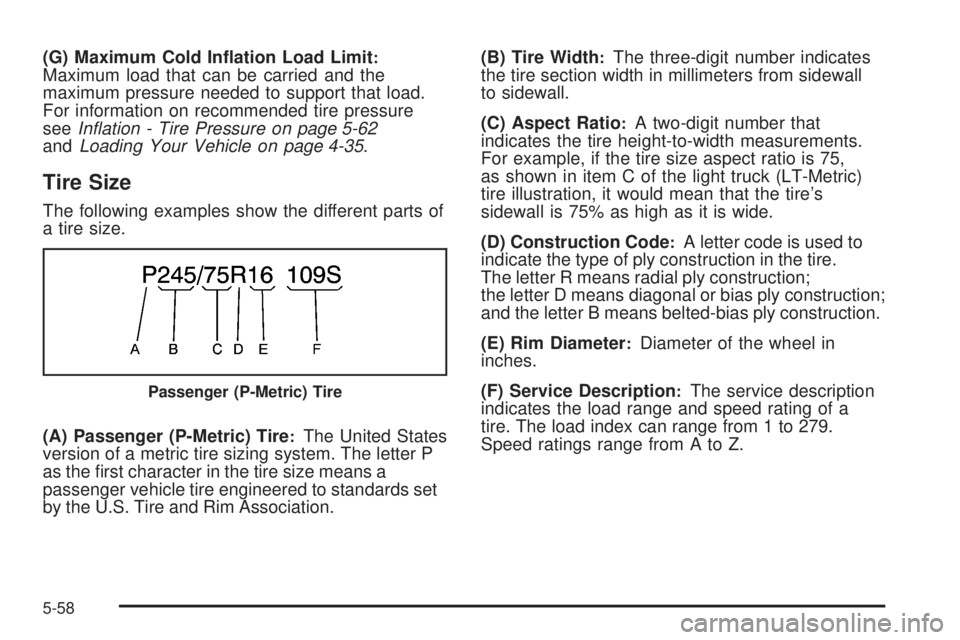
Tire Size The following examples show the different parts of
a tire size.
(A) Passenger (P-Metric) Tire :
The United States
version of a metric tire sizing system. The letter P
as the rst character in the tire size means a
passenger vehicle tire engineered to standards set
by the U.S. Tire and Rim Association. (B) Tire Width :
The three-digit number indicates
the tire section width in millimeters from sidewall
to sidewall.
(C) Aspect Ratio :
A two-digit number that
indicates the tire height-to-width measurements.
For example, if the tire size aspect ratio is 75,
as shown in item C of the light truck (LT-Metric)
tire illustration, it would mean that the tire’s
sidewall is 75% as high as it is wide.
(D) Construction Code :
A letter code is used to
indicate the type of ply construction in the tire.
The letter R means radial ply construction;
the letter D means diagonal or bias ply construction;
and the letter B means belted-bias ply construction.
(E) Rim Diameter :
Diameter of the wheel in
inches.
(F) Service Description :
The service description
indicates the load range and speed rating of a
tire. The load index can range from 1 to 279.
Speed ratings range from A to Z.Passenger (P-Metric) Tire
5-58
Page 396 of 500
Tire Pressure Monitor System The Tire Pressure Monitor System (TPMS) uses radio
and sensor technology to check tire pressure levels.
The TPMS sensors monitor the air pressure in your
vehicle’s tires and transmit tire pressure readings to a
receiver located in the vehicle.
Each tire, including the spare (if provided), should be
checked monthly when cold and inated to the ination
pressure recommended by the vehicle manufacturer
on the vehicle placard or tire ination pressure label.
(If your vehicle has tires of a different size than the
size indicated on the vehicle placard or tire ination
pressure label, you should determine the proper
tire ination pressure for those tires.)
As an added safety feature, your vehicle has been
equipped with a tire pressure monitoring system (TPMS)
that illuminates a low tire pressure telltale when one
or more of your tires is signicantly under-inated.
Accordingly, when the low tire pressure telltale
illuminates, you should stop and check your tires as
soon as possible, and inate them to the proper
pressure. Driving on a signicantly under-inated tire
causes the tire to overheat and can lead to tire failure.
Under-ination also reduces fuel efficiency and tire
tread life, and may affect the vehicle’s handling
and stopping ability. Please note that the TPMS is not a substitute for proper
tire maintenance, and it is the driver’s responsibility to
maintain correct tire pressure, even if under-ination
has not reached the level to trigger illumination of
the TPMS low tire pressure telltale.
Your vehicle has also been equipped with a TPMS
malfunction indicator to indicate when the system is not
operating properly. The TPMS malfunction indicator is
combined with the low tire pressure telltale. When
the system detects a malfunction, the telltale will ash
for approximately one minute and then remain
continuously illuminated. This sequence will continue
upon subsequent vehicle start-ups as long as the
malfunction exists.
When the malfunction indicator is illuminated, the
system may not be able to detect or signal low tire
pressure as intended. TPMS malfunctions may occur for
a variety of reasons, including the installation of
replacement or alternate tires or wheels on the vehicle
that prevent the TPMS from functioning properly.
Always check the TPMS malfunction telltale after
replacing one or more tires or wheels on your vehicle to
ensure that the replacement or alternate tires and
wheels allow the TPMS to continue to function properly.
See Tire Pressure Monitor Operation on page 5-65 ,
for additional information.
5-64
Page 397 of 500
Federal Communications Commission
(FCC) and Industry and Science
Canada The Tire Pressure Monitor System (TPMS) operates on
a radio frequency and complies with Part 15 of the
FCC Rules. Operation is subject to the following
two conditions:
1. This device may not cause harmful interference.
2. This device must accept any interference received,
including interference that may cause undesired
operation.
The Tire Pressure Monitor System (TPMS) operates
on a radio frequency and complies with RSS-210
of Industry and Science Canada. Operation is subject to
the following two conditions:
1. This device may not cause interference.
2. This device must accept any interference received,
including interference that may cause undesired
operation of the device.
Changes or modications to this system by other than
an authorized service facility could void authorization to
use this equipment. Tire Pressure Monitor Operation The Tire Pressure Monitor System (TPMS) is designed
to warn the driver when a low tire pressure condition
exists. TPMS sensors are mounted onto each tire
and wheel assembly, excluding the spare tire and wheel
assembly. The TPMS sensors monitor the air pressure
in the vehicle’s tires and transmits the tire pressure
readings to a receiver located in the vehicle.
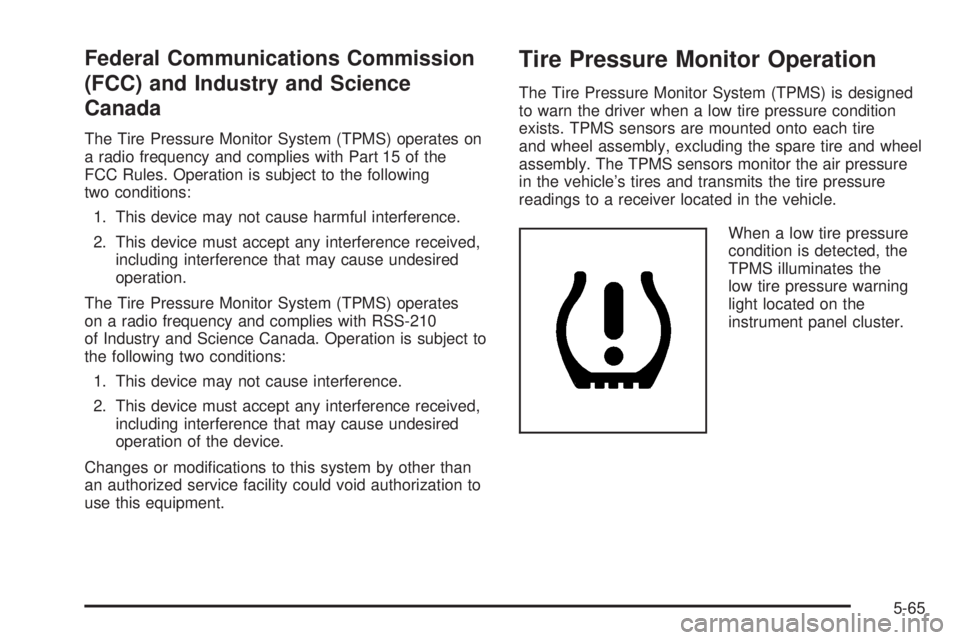
When a low tire pressure
condition is detected, the
TPMS illuminates the
low tire pressure warning
light located on the
instrument panel cluster.
5-65
Page 399 of 500
TPMS Malfunction Light and Message The TPMS will not function properly if one or more of the
TPMS sensors are missing or inoperable. When the
system detects a malfunction, the low tire warning light
ashes for about one minute and then stays on for
the remainder of the ignition cycle. A DIC warning
message is also displayed. The low tire warning light
and DIC warning message come on at each ignition
cycle until the problem is corrected. Some of the
conditions that can cause the malfunction light and
DIC message to come on are:
One of the road tires has been replaced with the
spare tire. The spare tire does not have a TPMS
sensor. The TPMS malfunction light and DIC
message should go off once you re-install the road
tire containing the TPMS sensor.
The TPMS sensor matching process was started
but not completed or not completed successfully
after rotating the vehicle’s tires. The DIC message
and TPMS malfunction light should go off once
the TPMS sensor matching process is performed
successfully. See “TPMS Sensor Matching Process”
later in this section. One or more TPMS sensors are missing or
damaged. The DIC message and the TPMS
malfunction light should go off when the TPMS
sensors are installed and the sensor matching
process is performed successfully. See your
dealer/retailer for service.
Replacement tires or wheels do not match your
vehicle’s original equipment tires or wheels.
Tires and wheels other than those recommended
for your vehicle could prevent the TPMS from
functioning properly. See Buying New Tires on
page 5-72 .
Operating electronic devices or being near facilities
using radio wave frequencies similar to the TPMS
could cause the TPMS sensors to malfunction.
If the TPMS is not functioning it cannot detect or
signal a low tire condition. See your dealer/retailer for
service if the TPMS malfunction light and DIC message
comes on and stays on.
5-67
Page 400 of 500
TPMS Sensor Matching Process Each TPMS sensor has a unique identication code.
Any time you rotate your vehicle’s tires or replace one or
more of the TPMS sensors, the identication codes
will need to be matched to the new tire/wheel position.
The sensors are matched to the tire/wheel positions
in the following order: driver side front tire, passenger
side front tire, passenger side rear tire, and driver
side rear tire using a TPMS diagnostic tool. See your
dealer/retailer for service.
The TPMS sensors can also be matched to each
tire/wheel position by increasing or decreasing the tire’s
air pressure. If increasing the tire’s air pressure, do
not exceed the maximum ination pressure indicated on
the tire’s sidewall.
To decrease air-pressure out of a tire you can use the
pointed end of the valve cap, a pencil-style air pressure
gage, or a key.
You have two minutes to match the rst tire/wheel
position, and ve minutes overall to match all four
tire/wheel positions. If it takes longer than two minutes,
to match the rst tire and wheel, or more than
ve minutes to match all four tire and wheel positions
the matching process stops and you need to start over. The TPMS sensor matching process is outlined below:
1. Set the parking brake.
2. Turn the ignition switch to ON/RUN with the
engine off.
3. Press the Remote Keyless Entry (RKE) transmitter’s
LOCK and UNLOCK buttons at the same time for
approximately ve seconds. The horn sounds twice
to signal the receiver is in relearn mode and TIRE
LEARNING ACTIVE message displays on the
DIC screen.
4. Start with the driver side front tire.
5. Remove the valve cap from the valve cap stem.
Activate the TPMS sensor by increasing or
decreasing the tire’s air pressure for ve seconds,
or until a horn chirp sounds. The horn chirp,
which may take up to 30 seconds to sound,
conrms that the sensor identication code has
been matched to this tire and wheel position.
5-68