steering CADILLAC ESCALADE ESV 2011 User Guide
[x] Cancel search | Manufacturer: CADILLAC, Model Year: 2011, Model line: ESCALADE ESV, Model: CADILLAC ESCALADE ESV 2011Pages: 548, PDF Size: 8.45 MB
Page 25 of 548
Black plate (19,1)Cadillac Escalade/Escalade ESV Owner Manual - 2011
In Brief 1-19
Driver Information
Center (DIC) The DIC display is located at the
bottom of the instrument panel
cluster. It shows the status of
many vehicle systems and enables
access to the personalization menu.
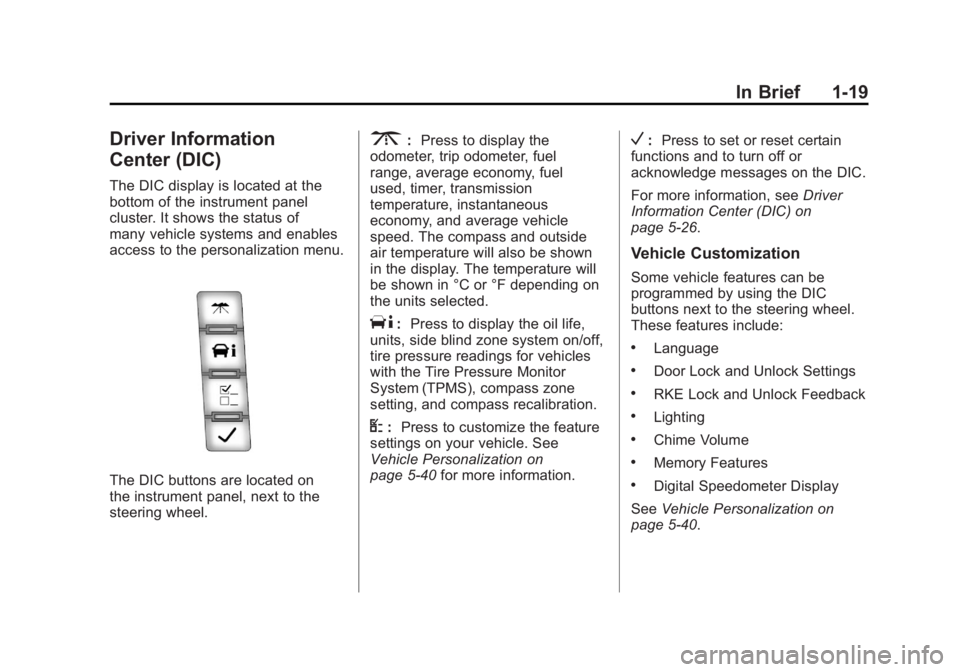
The DIC buttons are located on
the instrument panel, next to the
steering wheel. 3 : Press to display the
odometer, trip odometer, fuel
range, average economy, fuel
used, timer, transmission
temperature, instantaneous
economy, and average vehicle
speed. The compass and outside
air temperature will also be shown
in the display. The temperature will
be shown in °C or °F depending on
the units selected.
T : Press to display the oil life,
units, side blind zone system on/off,
tire pressure readings for vehicles
with the Tire Pressure Monitor
System (TPMS), compass zone
setting, and compass recalibration.
U : Press to customize the feature
settings on your vehicle. See
Vehicle Personalization on
page 5 ‑ 40 for more information. V : Press to set or reset certain
functions and to turn off or
acknowledge messages on the DIC.
For more information, see Driver
Information Center (DIC) on
page 5 ‑ 26 .
Vehicle Customization Some vehicle features can be
programmed by using the DIC
buttons next to the steering wheel.
These features include: .
Language .
Door Lock and Unlock Settings .
RKE Lock and Unlock Feedback .
Lighting .
Chime Volume .
Memory Features .
Digital Speedometer Display
See Vehicle Personalization on
page 5 ‑ 40 .
Page 32 of 548

Black plate (26,1)Cadillac Escalade/Escalade ESV Owner Manual - 2011
1-26 In Brief OnStar Steering Wheel
Controls This vehicle may have a
b g /
c
x Talk/Mute button that can be
used to interact with OnStar
Hands-Free Calling. See Steering
Wheel Controls on page 5 ‑ 3 for
more information.
On some vehicles, the mute button
can be used to dial numbers into
voice mail systems, or to dial phone
extensions. See the OnStar Owner's
Guide for more information. Your Responsibility Increase the volume of the radio if
the OnStar Advisor cannot be
heard.
If the light next to the OnStar
buttons is red, the system may not
be functioning properly. Push
Qand request a vehicle diagnostic
check. If the light appears clear
(no light is appearing), your OnStar
subscription has expired and all
services have been deactivated.
Push
Q to confirm that the OnStar
equipment is active. OnStar ®
If the vehicle is equipped with an
active OnStar system, that system
may also record data in crash or
near crash-like situations. The
OnStar Terms and Conditions
provides information on data
collection and use and is available
in the OnStar Glove Box Kit, at
www.onstar.com (U.S.) or
www.onstar.ca (Canada), or by
pushing
Q and speaking to an
Advisor.
Page 60 of 548

Black plate (4,1)Cadillac Escalade/Escalade ESV Owner Manual - 2011
3-4 Seats and Restraints Memory Features
The controls on the driver door are
used to program and recall memory
settings for the driver seat, outside
mirrors, power steering column, and
the adjustable throttle and brake
pedals. Storing Memory Positions
To save into memory:
1. Adjust the driver seat, including
the seatback recliner and
lumbar, both outside mirrors,
power steering column, and the
throttle and brake pedals.
See Power Mirrors on page 2 ‑ 16
and Adjustable Throttle and
Brake Pedal on page 9 ‑ 31 for
more information.
Not all mirrors and adjustable
throttles and brake pedals will
have the ability to save and
recall their positions. 2. Press and hold “ 1 ” until
two beeps sound.
3. Repeat for a second driver
position using “ 2. ”
To recall, press and release “ 1 ” or
“ 2. ” The vehicle must be in P (Park).
A single beep will sound. The seat,
outside mirrors, power steering
column, and adjustable throttle
and brake pedals will move to the
positions previously stored for the
identified driver.
Page 61 of 548

Black plate (5,1)Cadillac Escalade/Escalade ESV Owner Manual - 2011
Seats and Restraints 3-5Memory Remote Recall
The memory feature can recall the
driver seat, outside mirrors, power
steering column, and pedals to
stored positions when entering the
vehicle.
To activate, unlock the driver
door with the Remote Keyless
Entry (RKE) transmitter. The driver
seat, outside mirrors, power steering
column, and adjustable pedals
will move to the memory positions
associated with the transmitter
used to unlock the vehicle.
This feature can be turned on or off
using the vehicle personalization
menu. See “ Memory Seat Recall ”
under Vehicle Personalization on
page 5 ‑ 40 for more information. To stop recall movement, press one
of the power seat controls, memory
or power mirror buttons, power
steering column control, or the
adjustable pedal switch.
If something has blocked the driver
seat, power steering column, or the
adjustable pedals while recalling a
memory position, the recall may
stop. Remove the obstruction; then
press and hold the appropriate
manual control for the memory item
that is not recalling for two seconds.
Try recalling the memory position
again by pressing the appropriate
memory button. If the memory
position is still not recalling, see
your dealer for service. Easy Exit Positions
This feature can move the driver
seat rearward and the power
steering column up and forward to
allow extra room to exit the vehicle.
B (Easy Exit Positions): Press
to recall the easy exit positions.
The vehicle must be in P (Park).
If the easy exit feature is
programmed on in the vehicle
personalization menu, automatic
driver seat and power steering
column movement occur when
the ignition key is removed.
Page 62 of 548
Black plate (6,1)Cadillac Escalade/Escalade ESV Owner Manual - 2011
3-6 Seats and Restraints A single beep sounds. The driver
seat moves back approximately
8 cm (3 in) and the power steering
column moves up and forward. To
move the seat back farther, press
the easy exit button again until the
seat is all the way back.
If something has blocked the driver
seat while recalling the exit position,
the recall may stop. Remove the
obstruction; then press and hold
the power seat control rearward for
two seconds. Try recalling the exit
position again. If the exit position is
still not recalling, see your dealer for
service.
See “ Easy Exit Recall ” and
“ Easy Exit Setup ” under Vehicle
Personalization on page 5 ‑ 40 for
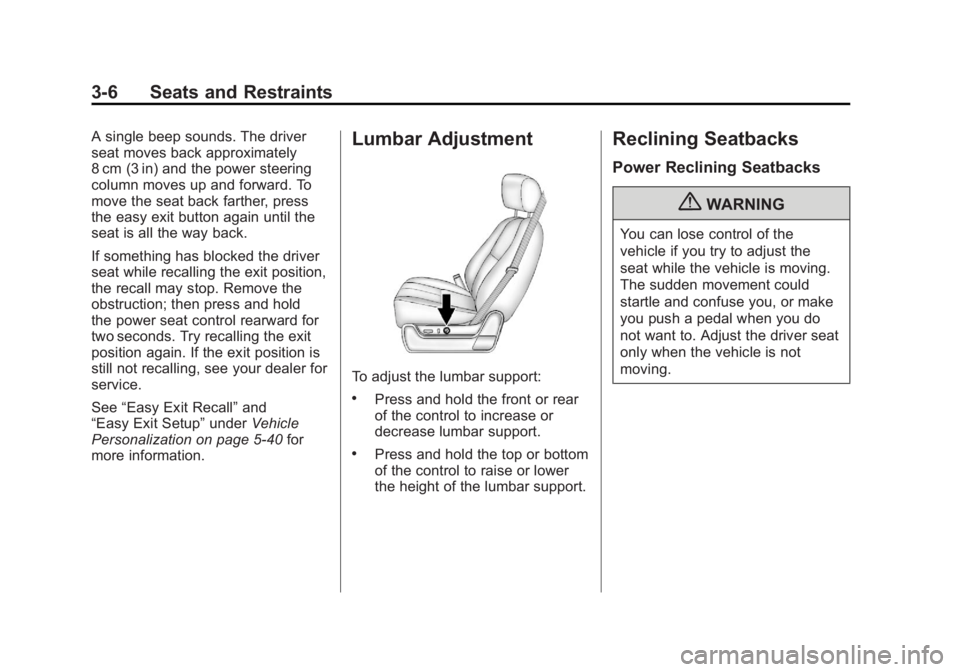
more information. Lumbar Adjustment
To adjust the lumbar support: .
Press and hold the front or rear
of the control to increase or
decrease lumbar support. .
Press and hold the top or bottom
of the control to raise or lower
the height of the lumbar support. Reclining Seatbacks Power Reclining Seatbacks
{ WARNINGYou can lose control of the
vehicle if you try to adjust the
seat while the vehicle is moving.
The sudden movement could
startle and confuse you, or make
you push a pedal when you do
not want to. Adjust the driver seat
only when the vehicle is not
moving.
Page 92 of 548
Black plate (36,1)Cadillac Escalade/Escalade ESV Owner Manual - 2011
3-36 Seats and Restraints The vehicle may have the following
airbags: .
If the vehicle has a third row
seat, it will have a third row
roof-rail airbag.
All of the airbags in the vehicle will
have the word AIRBAG embossed
in the trim or on an attached label
near the deployment opening.
For frontal airbags, the word
AIRBAG will appear on the middle
part of the steering wheel for the
driver and on the instrument panel
for the right front passenger.
With seat ‐ mounted side impact
airbags, the word AIRBAG will
appear on the side of the seatback
closest to the door. With roof-rail airbags, the word
AIRBAG will appear along the
headliner or trim.
Airbags are designed to supplement
the protection provided by safety
belts. Even though today's airbags
are also designed to help reduce
the risk of injury from the force of an
inflating bag, all airbags must inflate
very quickly to do their job.
Here are the most important things
to know about the airbag system:
{ WARNINGYou can be severely injured or
killed in a crash if you are not
wearing your safety belt — even
if you have airbags. Airbags are
designed to work with safety
belts, but do not replace them.
(Continued) WARNING (Continued) Also, airbags are not designed to
deploy in every crash. In some
crashes safety belts are your only
restraint. See When Should an
Airbag Inflate? on page 3 ‑ 40 .
Wearing your safety belt during a
crash helps reduce your chance
of hitting things inside the vehicle
or being ejected from it. Airbags
are “ supplemental restraints ” to
the safety belts. Everyone in your
vehicle should wear a safety belt
properly — whether or not there is
an airbag for that person.
Page 94 of 548
Black plate (38,1)Cadillac Escalade/Escalade ESV Owner Manual - 2011
3-38 Seats and Restraints
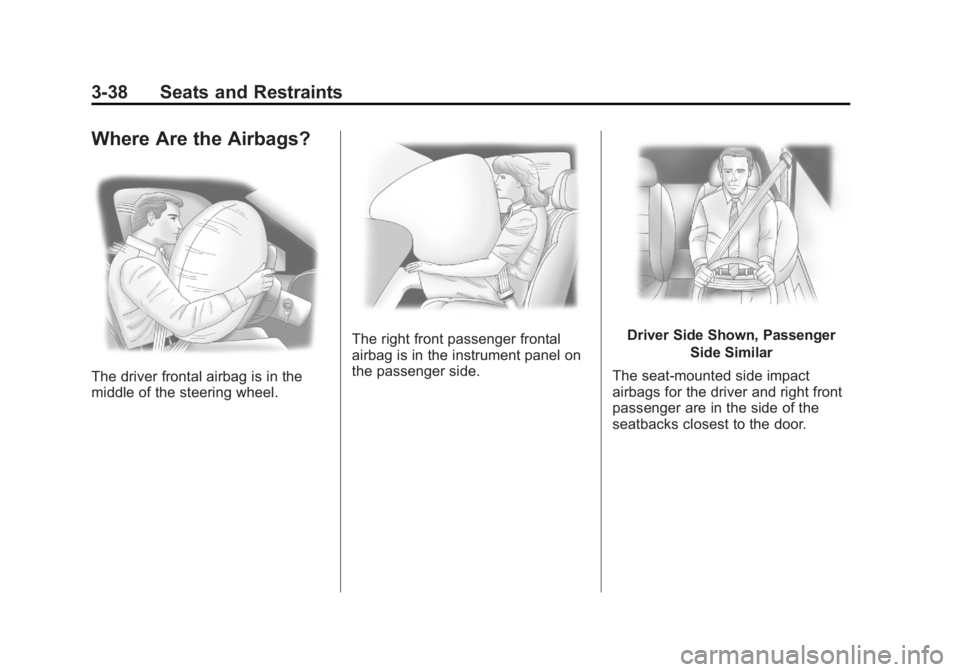
Where Are the Airbags?
The driver frontal airbag is in the
middle of the steering wheel. The right front passenger frontal
airbag is in the instrument panel on
the passenger side. Driver Side Shown, Passenger
Side Similar
The seat ‐ mounted side impact
airbags for the driver and right front
passenger are in the side of the
seatbacks closest to the door.
Page 95 of 548
Black plate (39,1)Cadillac Escalade/Escalade ESV Owner Manual - 2011
Seats and Restraints 3-39
Driver Side Shown, Passenger
Side Similar
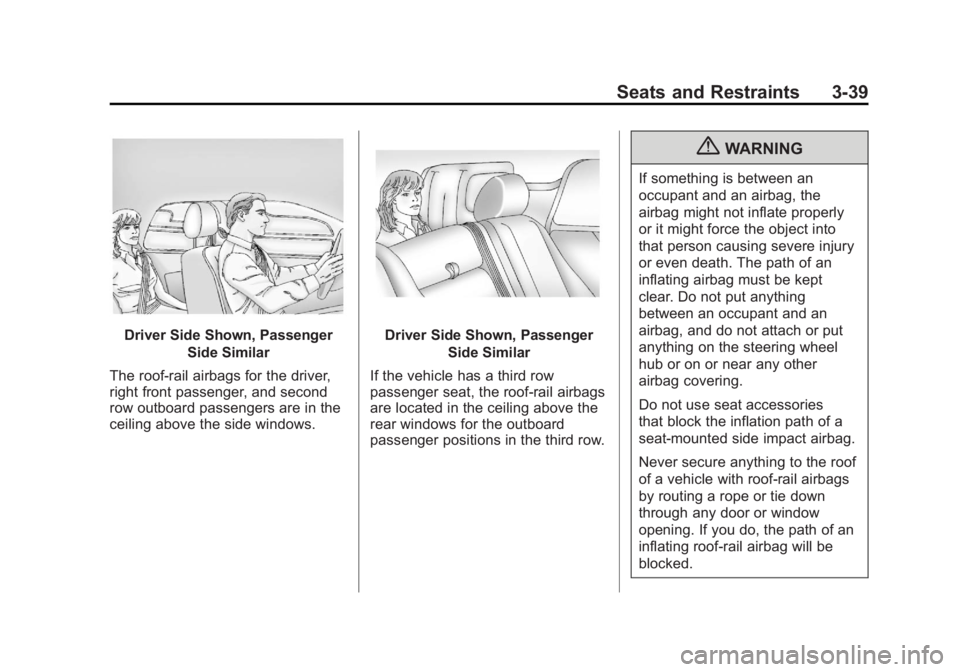
The roof-rail airbags for the driver,
right front passenger, and second
row outboard passengers are in the
ceiling above the side windows. Driver Side Shown, Passenger
Side Similar
If the vehicle has a third row
passenger seat, the roof-rail airbags
are located in the ceiling above the
rear windows for the outboard
passenger positions in the third row. { WARNINGIf something is between an
occupant and an airbag, the
airbag might not inflate properly
or it might force the object into
that person causing severe injury
or even death. The path of an
inflating airbag must be kept
clear. Do not put anything
between an occupant and an
airbag, and do not attach or put
anything on the steering wheel
hub or on or near any other
airbag covering.
Do not use seat accessories
that block the inflation path of a
seat-mounted side impact airbag.
Never secure anything to the roof
of a vehicle with roof-rail airbags
by routing a rope or tie down
through any door or window
opening. If you do, the path of an
inflating roof-rail airbag will be
blocked.
Page 97 of 548

Black plate (41,1)Cadillac Escalade/Escalade ESV Owner Manual - 2011
Seats and Restraints 3-41The seat position sensor provides
information that is used to determine
if the airbags should deploy at a
reduced level or at full deployment.
The vehicle has seat ‐ mounted
side impact and roof-rail airbags.
See Airbag System on page 3 ‑ 35 .
Seat ‐ mounted side impact and
roof-rail airbags are intended to
inflate in moderate to severe side
crashes. In addition, these roof-rail
airbags are intended to inflate
during a rollover or in a severe
frontal impact. Seat ‐ mounted side
impact and roof-rail airbags will
inflate if the crash severity is above
the system's designed threshold
level. The threshold level can vary
with specific vehicle design.
Roof-rail airbags are not
intended to inflate in rear impacts.
A seat ‐ mounted side impact airbag
is intended to deploy on the side of the vehicle that is struck. Both
roof-rail airbags will deploy when
either side of the vehicle is struck or
if the sensing system predicts that
the vehicle is about to roll over,
or in a severe frontal impact.
In any particular crash, no one
can say whether an airbag should
have inflated simply because of
the damage to a vehicle or because
of what the repair costs were.
For frontal airbags, inflation is
determined by what the vehicle hits,
the angle of the impact, and how
quickly the vehicle slows down.
For seat ‐ mounted side impact and
roof-rail airbags, deployment is
determined by the location and
severity of the side impact. In a
rollover event, roof-rail airbag
deployment is determined by the
direction of the roll. What Makes an Airbag
Inflate? In a deployment event, the sensing
system sends an electrical signal
triggering a release of gas from the
inflator. Gas from the inflator fills the
airbag causing the bag to break out
of the cover and deploy. The inflator,
the airbag, and related hardware are
all part of the airbag module.
Frontal airbag modules are located
inside the steering wheel and
instrument panel. For vehicles with
seat ‐ mounted side impact airbags,
there are airbags modules in the
side of the front seatbacks closest
to the door. For vehicles with
roof-rail airbags, there are airbag
modules in the ceiling of the vehicle,
near the side windows that have
occupant seating positions.
Page 98 of 548
Black plate (42,1)Cadillac Escalade/Escalade ESV Owner Manual - 2011
3-42 Seats and Restraints
How Does an Airbag
Restrain? In moderate to severe frontal or
near frontal collisions, even belted
occupants can contact the steering
wheel or the instrument panel. In
moderate to severe side collisions,
even belted occupants can contact
the inside of the vehicle.
Airbags supplement the protection
provided by safety belts. Frontal
airbags distribute the force of
the impact more evenly over the
occupant's upper body, stopping
the occupant more gradually.
Seat ‐ mounted side impact and
roof-rail airbags distribute the
force of the impact more evenly
over the occupant's upper body. Rollover capable roof-rail airbags
are designed to help contain the
head and chest of occupants in
the outboard seating positions
in the first, second, and third rows,
if equipped with a third row seat.
The rollover capable roof-rail
airbags are designed to help
reduce the risk of full or partial
ejection in rollover events, although
no system can prevent all such
ejections.
But airbags would not help in
many types of collisions, primarily
because the occupant's motion is
not toward those airbags. See When
Should an Airbag Inflate? on
page 3 ‑ 40 for more information.
Airbags should never be regarded
as anything more than a supplement
to safety belts. What Will You See After
an Airbag Inflates? After the frontal airbags and
seat-mounted side impact airbags
inflate, they quickly deflate, so
quickly that some people may not
even realize an airbag inflated.
Roof-rail airbags may still be at least
partially inflated for some time after
they deploy. Some components of
the airbag module may be hot for
several minutes. For location of the
airbag modules, see What Makes
an Airbag Inflate? on page 3 ‑ 41 .
The parts of the airbag that come
into contact with you may be warm,
but not too hot to touch. There may
be some smoke and dust coming
from the vents in the deflated
airbags. Airbag inflation does not
prevent the driver from seeing out
of the windshield or being able to
steer the vehicle, nor does it prevent
people from leaving the vehicle.