tire pressure CADILLAC ESCALADE EXT 2010 3.G User Guide
[x] Cancel search | Manufacturer: CADILLAC, Model Year: 2010, Model line: ESCALADE EXT, Model: CADILLAC ESCALADE EXT 2010 3.GPages: 580, PDF Size: 6.23 MB
Page 233 of 580
SERVICE STABILITRAK
If your vehicle has StabiliTrak®and this message
displays, it means there may be a problem with the
StabiliTrak system. If you see this message, try to reset
the system. Stop; turn off the engine for at least
15 seconds; then start the engine again. If this message
still comes on, it means there is a problem. You should
see your dealer/retailer for service. The vehicle is safe
to drive, however, you do not have the benefit of
StabiliTrak, so reduce your speed and drive accordingly.
SERVICE SUSPENSION SYSTEM
This message displays when the Road Sensing
Suspension (RSS) system is not operating properly.
Have your vehicle serviced by your dealer/retailer.
SERVICE THEFT DETERRENT SYSTEM
This message displays when there is a problem with the
theft-deterrent system. The vehicle may or may not
restart so you may want to take the vehicle to your
dealer/retailer before turning off the engine. See
PASS-Key
®III+ Electronic Immobilizer Operationon
page 3‑28for more information.
SERVICE TIRE MONITOR SYSTEM
On vehicles with the Tire Pressure Monitor System
(TPMS), this message displays if a part on the TPMS is
not working properly. The tire pressure light also flashes
and then remains on during the same ignition cycle.
See Tire Pressure Light
on page 4‑33. Several
conditions may cause this message to appear. See Tire
Pressure Monitor Operation
on page 7‑67for more
information. If the warning comes on and stays on,
there may be a problem with the TPMS. See your
dealer/retailer.
SERVICE TRACTION CONTROL
If your vehicle has StabiliTrak, this message displays
when there is a problem with the Traction Control
System (TCS). When this message displays, the
system will not limit wheel spin. Adjust your driving
accordingly. See your dealer/retailer for service. See
StabiliTrak
®Systemon page 6‑6for more
information.
STABILITRAK OFF
If your vehicle has StabiliTrak, this message
displays when you turn off StabiliTrak, or when the
stability control has been automatically disabled.
To limit wheel spin and realize the full benefits of the
stability enhancement system, you should normally
leave StabiliTrak on.
4-53
Page 234 of 580
However, you should turn StabiliTrak off if your vehicle
gets stuck in sand, mud, ice, or snow and you want to
rock your vehicle to attempt to free it, or if you are
driving in extreme off-road conditions and require more
wheel spin. SeeIf Your Vehicle is Stuck in Sand, Mud,
Ice, or Snow
on page 6‑30. To turn the StabiliTrak
system on or off, see StabiliTrak®Systemon
page 6‑6.
There are several conditions that can cause this
message to appear.
.One condition is overheating, which could occur if
StabiliTrak activates continuously for an extended
period of time.
.The message also displays if the brake system
warning light is on. See Brake System Warning
Light on page 4‑31.
.The message could display if the stability system
takes longer than usual to complete its diagnostic
checks due to driving conditions.
.The message displays if an engine or vehicle
related problem has been detected and the vehicle
needs service. See your dealer/retailer.
The message turns off as soon as the conditions that
caused the message to be displayed are no longer
present.
TIGHTEN GAS CAP
This message may display along with the check engine
light on the instrument panel cluster if the vehicle's fuel
cap is not tightened properly. See Malfunction Indicator
Lamp
on page 4‑34. Reinstall the fuel cap fully. See
Filling the Tankon page 7‑10. The diagnostic system
can determine if the fuel cap has been left off or
improperly installed. A loose or missing fuel cap allows
fuel to evaporate into the atmosphere. A few driving
trips with the cap properly installed should turn this light
and message off.
TIRE LEARNING ACTIVE
On vehicles with the Tire Pressure Monitor System
(TPMS), this message displays when the TPMS is
re-learning the tire positions on your vehicle. The tire
positions must be re-learned after rotating the tires or
after replacing a tire or sensor. See Tire Inspection and
Rotation
on page 7‑70, Tire Pressure Monitor Systemon page 7‑66, and Inflation - Tire Pressureon
page 7‑64for more information.
TIRE LOW ADD AIR TO TIRE
On vehicles with the Tire Pressure Monitor System
(TPMS), this message displays when the pressure in
one or more of the vehicle's tires is low. This message
also displays LEFT FRONT, RIGHT FRONT, LEFT
REAR, or RIGHT REAR to indicate the location of the
low tire.
4-54
Page 235 of 580
The low tire pressure warning light will also come on.
SeeTire Pressure Lighton page 4‑33. You can receive
more than one tire pressure message at a time. To read
the other messages that may have been sent at the
same time, press the set/reset button. If a tire pressure
message appears on the DIC, stop as soon as you can.
Have the tire pressures checked and set to those
shown on the Tire Loading Information label. See Tires
on page 7‑57,Loading the Vehicleon page 6‑32, and
Inflation - Tire Pressureon page 7‑64. The DIC also
shows the tire pressure values. See DIC Operation and
Displays
on page 4‑40.
TRACTION CONTROL OFF
If your vehicle has StabiliTrak, this message displays
when the Traction Control System (TCS) is turned off.
Adjust your driving accordingly. See StabiliTrak
®
Systemon page 6‑6for more information.
TRANSMISSION HOT IDLE ENGINE
Notice:If you drive your vehicle while the
transmission fluid is overheating and the
transmission temperature warning is displayed on
the instrument panel cluster and/or DIC, you can
damage the transmission. This could lead to costly
repairs that would not be covered by your warranty.
Do not drive your vehicle with overheated
transmission fluid or while the transmission
temperature warning is displayed. This message displays along with four chimes if the
transmission fluid in the vehicle gets hot. Driving with
the transmission fluid temperature high can cause
damage to the vehicle. Stop the vehicle and let it idle to
allow the transmission to cool. This message clears and
the chime stops when the fluid temperature reaches a
safe level.
TURN SIGNAL ON
This message displays and a chime sounds if a turn
signal is left on for 3/4 of a mile (1.2 km). Move the turn
signal/multifunction lever to the off position.
WASHER FLUID LOW ADD FLUID
This message displays when the windshield washer
fluid is low. Fill the windshield washer fluid reservoir as
soon as possible. See
Engine Compartment Overview
on page 7‑14for the location of the windshield washer
fluid reservoir. Also, see Windshield Washer Fluidon
page 7‑37for more information.
4-55
Page 327 of 580

Notice:Do not apply after-market glass tinting to
the vehicle's windows. Glass tinting interferes with
the system's ability to receive GPS signals and
causes the system to malfunction. The window
might have to be replaced to correct the problem.
This would not be covered by the warranty.
For more information if the GPS is not functioning
properly, see If the System Needs Service
on
page 5‑58and Problems with Route Guidanceon
page 5‑58.
Vehicle Positioning
At times, the position of the vehicle on the map may be
inaccurate due to one or more of the following reasons:
.Road system has changed.
.Vehicle is driving on slippery road surfaces such as
in sand, gravel, and/or snow.
.Vehicle is traveling on winding roads.
.Vehicle is on a long straight road.
.Vehicle is approaching a tall building or a large
vehicle.
.Surface streets run parallel to a freeway.
.Vehicle has just been transferred by a vehicle
carrier or a ferry.
.Current position calibration is set incorrectly.
.Vehicle is traveling at high speed.
.Vehicle changes directions more than once,
or when the vehicle is turning on a turn table
in a parking lot.
.Vehicle is entering and/or exiting a parking lot
or a garage.
.GPS signal is not received.
.Roof carrier is installed on the vehicle.
.Vehicle is being driven with tire chains.
.Tires are replaced.
.Tire pressure for the tires is incorrect.
.Tires are worn.
.First time the map DVD is inserted.
.Battery is disconnected for several days.
.Vehicle is driving in heavy traffic where driving is at
low speeds, and the vehicle is stopped and started
repeatedly.
See your dealer/retailer if other problems occur.
5-57
Page 386 of 580
Other Rainy Weather Tips
Besides slowing down, other wet weather driving
tips include:
.Allow extra following distance.
.Pass with caution.
.Keep windshield wiping equipment in good shape.
.Keep the windshield washer fluid reservoir filled.
.Have good tires with proper tread depth.
SeeTires on page 7‑57.
.Turn off cruise control.
Before Leaving on a Long Trip
To prepare your vehicle for a long trip, consider having
it serviced by your dealer/retailer before departing.
Things to check on your own include:
.Windshield Washer Fluid: Reservoir full? Windows
clean —inside and outside?
.Wiper Blades: In good shape?
.Fuel, Engine Oil, Other Fluids: All levels checked?
.Lamps:Do they all work and are lenses clean?
.Tires:Are treads good? Are tires inflated to
recommended pressure?
.Weather and Maps: Safe to travel? Have
up-to-date maps?
Highway Hypnosis
Always be alert and pay attention to your surroundings
while driving. If you become tired or sleepy, find a safe
place to park your vehicle and rest.
Other driving tips include:
.Keep the vehicle well ventilated.
.Keep interior temperature cool.
.Keep your eyes moving —scan the road ahead
and to the sides.
.Check the rearview mirror and vehicle
instruments often.
6-26
Page 393 of 580
The Tire and Loading Information label also
shows the size of the original equipment
tires (C) and the recommended cold tire inflation
pressures (D). For more information on tires and
inflation seeTires
on page 7‑57andInflation - Tire
Pressure
on page 7‑64.
There is also important loading information on the
vehicle Certification/Tire label. It tells you the
Gross Vehicle Weight Rating (GVWR) and the
Gross Axle Weight Rating (GAWR) for the front
and rear axles. See “Certification/Tire Label” later
in this section.
Steps for Determining Correct Load Limit
1.Locate the statement “The combined weight
of occupants and cargo should never exceed
XXX kg or XXX lbs” on your vehicle's placard.
2.Determine the combined weight of the
driver and passengers that will be riding in
your vehicle.
3.Subtract the combined weight of the driver
and passengers from XXX kg or XXX lbs.
4.The resulting figure equals the available
amount of cargo and luggage load capacity.
For example, if the“XXX”amount equals
1400 lbs and there will be five 150 lb
passengers in your vehicle, the amount of
available cargo and luggage load capacity
is 650 lbs (1400 −750 (5 x 150) = 650 lbs).
5.Determine the combined weight of luggage
and cargo being loaded on the vehicle.
That weight may not safely exceed the
available cargo and luggage load capacity
calculated in Step 4.
6.If your vehicle will be towing a trailer, the load
from your trailer will be transferred to your
vehicle. Consult this manual to determine
how this reduces the available cargo and
luggage load capacity of your vehicle.
SeeTowing a Trailer
on page 6‑42for
important information on towing a trailer,
towing safety rules and trailering tips.
6-33
Page 396 of 580
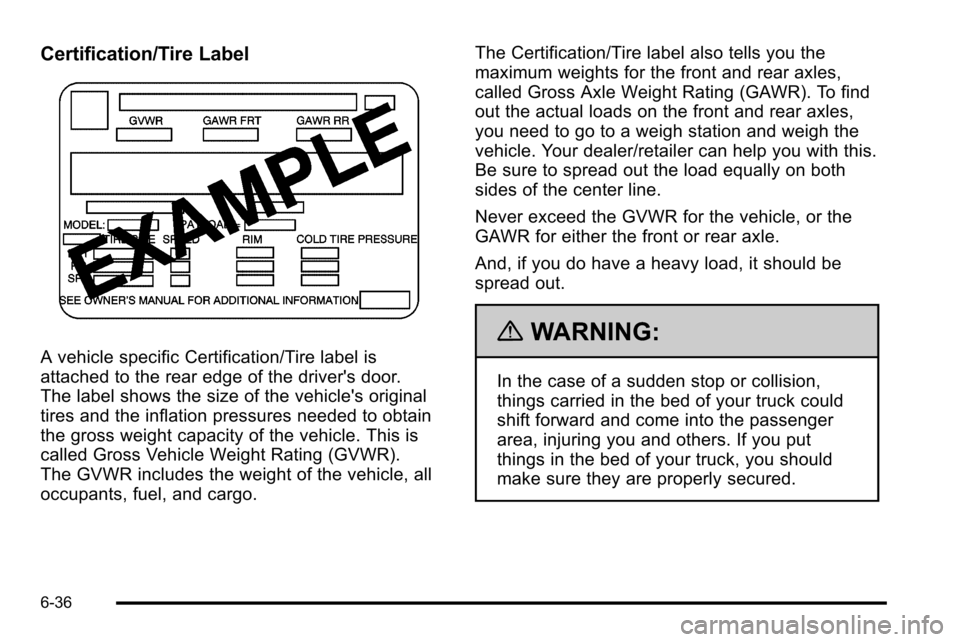
Certification/Tire Label
A vehicle specific Certification/Tire label is
attached to the rear edge of the driver's door.
The label shows the size of the vehicle's original
tires and the inflation pressures needed to obtain
the gross weight capacity of the vehicle. This is
called Gross Vehicle Weight Rating (GVWR).
The GVWR includes the weight of the vehicle, all
occupants, fuel, and cargo.The Certification/Tire label also tells you the
maximum weights for the front and rear axles,
called Gross Axle Weight Rating (GAWR). To find
out the actual loads on the front and rear axles,
you need to go to a weigh station and weigh the
vehicle. Your dealer/retailer can help you with this.
Be sure to spread out the load equally on both
sides of the center line.
Never exceed the GVWR for the vehicle, or the
GAWR for either the front or rear axle.
And, if you do have a heavy load, it should be
spread out.
{WARNING:
In the case of a sudden stop or collision,
things carried in the bed of your truck could
shift forward and come into the passenger
area, injuring you and others. If you put
things in the bed of your truck, you should
make sure they are properly secured.
6-36
Page 406 of 580
Total Weight on the Vehicle's Tires
Be sure the vehicle's tires are inflated to the inflation
pressures found on the Certification label on the driver
door or seeLoading the Vehicle
on page 6‑32for more
information. Make sure not to exceed the GVWR limit
for the vehicle, or the RGAWR, with the tow vehicle and
trailer fully loaded for the trip including the weight of the
trailer tongue. If using a weight distributing hitch, make
sure not to exceed the RGAWR before applying the
weight distribution spring bars.
Weight of the Trailering Combination
It is important that the combination of the tow
vehicle and trailer does not exceed any of its weight
ratings —GCWR, GVWR, RGAWR, Trailer Weight
Rating or Tongue Weight. The only way to be sure it is
not exceeding any of these ratings is to weigh the tow
vehicle and trailer combination, fully loaded for the trip,
getting individual weights for each of these items.
Hitches
The correct hitch equipment helps maintain combination
control. Most small-to-medium trailers can be towed
with a weight carrying hitch which simply features a
coupler latched to the hitch ball. Larger trailers may
require a weight distributing hitch that uses spring bars
to distribute the trailer tongue weight among the two
vehicle and trailer axles. See “Weight of the Trailer
Tongue” earlier in this section for rating limits with
various hitch types.
If a step-bumper hitch will be used, the bumper could
be damaged in sharp turns. Make sure there is ample
room when turning to avoid contact between the trailer
and the bumper.
Consider using sway controls with any trailer. Ask a
trailering professional about sway controls or refer to
the trailer manufacturer's recommendations and
instructions.
6-46
Page 416 of 580
Section 7 Service and Appearance Care
Windshield Wiper Blade Replacement. . . . . . . . . . .7-56
Tires . . . . . . . . . . . . . . . . . . . . . . . . . . . . . . . . . . . . . . . . . . . . . . . 7-57
Tire Sidewall Labeling . . . . . . . . . . . . . . . . . . . . . . . . . 7-58
Tire Terminology and Definitions . . . . . . . . . . . . . . . 7-61
Inflation - Tire Pressure . . . . . . . . . . . . . . . . . . . . . . . . 7-64
High-Speed Operation . . . . . . . . . . . . . . . . . . . . . . . . . 7-65
Tire Pressure Monitor System . . . . . . . . . . . . . . . . . 7-66
Tire Pressure Monitor Operation . . . . . . . . . . . . . . . 7-67
Tire Inspection and Rotation . . . . . . . . . . . . . . . . . . . 7-70
When It Is Time for New Tires . . . . . . . . . . . . . . . . . 7-71
Buying New Tires . . . . . . . . . . . . . . . . . . . . . . . . . . . . . . 7-72
Different Size Tires and Wheels . . . . . . . . . . . . . . . 7-74
Uniform Tire Quality Grading . . . . . . . . . . . . . . . . . . . 7-74
Wheel Alignment and Tire Balance . . . . . . . . . . . . 7-76
Wheel Replacement . . . . . . . . . . . . . . . . . . . . . . . . . . . 7-76
Tire Chains . . . . . . . . . . . . . . . . . . . . . . . . . . . . . . . . . . . . 7-77
If a Tire Goes Flat . . . . . . . . . . . . . . . . . . . . . . . . . . . . . 7-78
Changing a Flat Tire . . . . . . . . . . . . . . . . . . . . . . . . . . . 7-79
Removing the Spare Tire and Tools . . . . . . . . . . . . 7-80
Removing the Flat Tire and Installing the Spare Tire . . . . . . . . . . . . . . . . . . . . . . . . . . . . . . . . . . . 7-84
Secondary Latch System . . . . . . . . . . . . . . . . . . . . . . 7-89
Storing a Flat or Spare Tire and Tools . . . . . . . . . 7-92
Spare Tire . . . . . . . . . . . . . . . . . . . . . . . . . . . . . . . . . . . . . 7-96 Appearance Care
. . . . . . . . . . . . . . . . . . . . . . . . . . . . . . . . . 7-96
Interior Cleaning . . . . . . . . . . . . . . . . . . . . . . . . . . . . . . 7-96
Fabric/Carpet . . . . . . . . . . . . . . . . . . . . . . . . . . . . . . . . . . 7-98
Leather . . . . . . . . . . . . . . . . . . . . . . . . . . . . . . . . . . . . . . . . 7-98
Instrument Panel, Vinyl, and Other Plastic Surfaces . . . . . . . . . . . . . . . . . . . . . . . . . . . . . . . . . . . . . 7-99
Wood Panels . . . . . . . . . . . . . . . . . . . . . . . . . . . . . . . . . . 7-99
Speaker Covers . . . . . . . . . . . . . . . . . . . . . . . . . . . . . . . 7-99
Care of Safety Belts . . . . . . . . . . . . . . . . . . . . . . . . . . . 7-99
Weatherstrips . . . . . . . . . . . . . . . . . . . . . . . . . . . . . . . . 7-100
Washing Your Vehicle . . . . . . . . . . . . . . . . . . . . . . . . 7-100
Cleaning Exterior Lamps/Lenses . . . . . . . . . . . . . 7-100
Finish Care . . . . . . . . . . . . . . . . . . . . . . . . . . . . . . . . . . . 7-101
Windshield and Wiper Blades . . . . . . . . . . . . . . . . 7-101
Aluminum or Chrome-Plated Wheels and Trim . . . . . . . . . . . . . . . . . . . . . . . . . . . . . . . . . . . 7-102
Tires . . . . . . . . . . . . . . . . . . . . . . . . . . . . . . . . . . . . . . . . . . 7-103
Sheet Metal Damage . . . . . . . . . . . . . . . . . . . . . . . . . 7-103
Finish Damage . . . . . . . . . . . . . . . . . . . . . . . . . . . . . . . 7-103
Underbody Maintenance . . . . . . . . . . . . . . . . . . . . . 7-103
Chemical Paint Spotting . . . . . . . . . . . . . . . . . . . . . . 7-103
Vehicle Identification . . . . . . . . . . . . . . . . . . . . . . . . . . . . 7-104
Vehicle Identification Number (VIN) . . . . . . . . . . . 7-104
Service Parts Identification Label . . . . . . . . . . . . . 7-104
7-2
Page 471 of 580
Tires
Your new vehicle comes with high-quality tires
made by a leading tire manufacturer. If you ever
have questions about your tire warranty and
where to obtain service, see your vehicle
Warranty booklet for details. For additional
information refer to the tire manufacturer.
{WARNING:
.Poorly maintained and improperly used
tires are dangerous.
.Overloading your tires can cause
overheating as a result of too much
flexing. You could have an air-out and a
serious accident. SeeLoading the Vehicle
on page 6‑32.
(Continued)
WARNING: (Continued)
.Underinflated tires pose the same danger
as overloaded tires. The resulting
accident could cause serious injury.
Check all tires frequently to maintain the
recommended pressure. Tire pressure
should be checked when your tires are
cold. SeeInflation - Tire Pressure
on
page 7‑64
.
.Overinflated tires are more likely to be
cut, punctured, or broken by a sudden
impact —such as when you hit a
pothole. Keep tires at the recommended
pressure.
.Worn, old tires can cause accidents.
If your tread is badly worn, or if your tires
have been damaged, replace them.
See High-Speed Operation
on page 7‑65for
inflation pressure adjustment for high speed
driving.
7-57