lock CADILLAC ESCALADE HYBRID 2012 User Guide
[x] Cancel search | Manufacturer: CADILLAC, Model Year: 2012, Model line: ESCALADE HYBRID, Model: CADILLAC ESCALADE HYBRID 2012Pages: 90, PDF Size: 1.62 MB
Page 43 of 90
Black plate (1,1)Cadillac Escalade Hybrid - 2012
Vehicle Care 10-1
Vehicle Care Vehicle Checks Doing Your Own
Service Work . . . . . . . . . . . . . . . 10-2
Engine Compartment
Overview . . . . . . . . . . . . . . . . . . . 10-4
Automatic Transmission
Fluid . . . . . . . . . . . . . . . . . . . . . . . 10-5
Drive Motor/Generator Control
Module (DMCM) Coolant
Surge Tank
Pressure Cap . . . . . . . . . . . . . . 10-8
Drive Motor/Generator Control
Module (DMCM) Cooling
System . . . . . . . . . . . . . . . . . . . . . 10-8
Battery . . . . . . . . . . . . . . . . . . . . . . 10-11
Four-Wheel Drive . . . . . . . . . . . 10-12 Electrical System High Voltage Devices and
Wiring . . . . . . . . . . . . . . . . . . . . . 10-13
Fuses and Circuit
Breakers . . . . . . . . . . . . . . . . . . 10-13
Engine Compartment Fuse
Block . . . . . . . . . . . . . . . . . . . . . 10-14
Wheels and Tires Tire Pressure . . . . . . . . . . . . . . . 10-16
Tire Pressure Monitor
Operation . . . . . . . . . . . . . . . . . 10-17
Tire Rotation . . . . . . . . . . . . . . . 10-20
If a Tire Goes Flat . . . . . . . . . . 10-20
Tire Sealant and
Compressor Kit . . . . . . . . . . . 10-22
Storing the Tire Sealant and
Compressor Kit . . . . . . . . . . . 10-29 Jump Starting Jump Starting . . . . . . . . . . . . . . 10-29
Towing Recreational Vehicle
Towing . . . . . . . . . . . . . . . . . . . . 10-33
Appearance Care Exterior Care . . . . . . . . . . . . . . . 10-37
Page 47 of 90
Black plate (5,1)Cadillac Escalade Hybrid - 2012
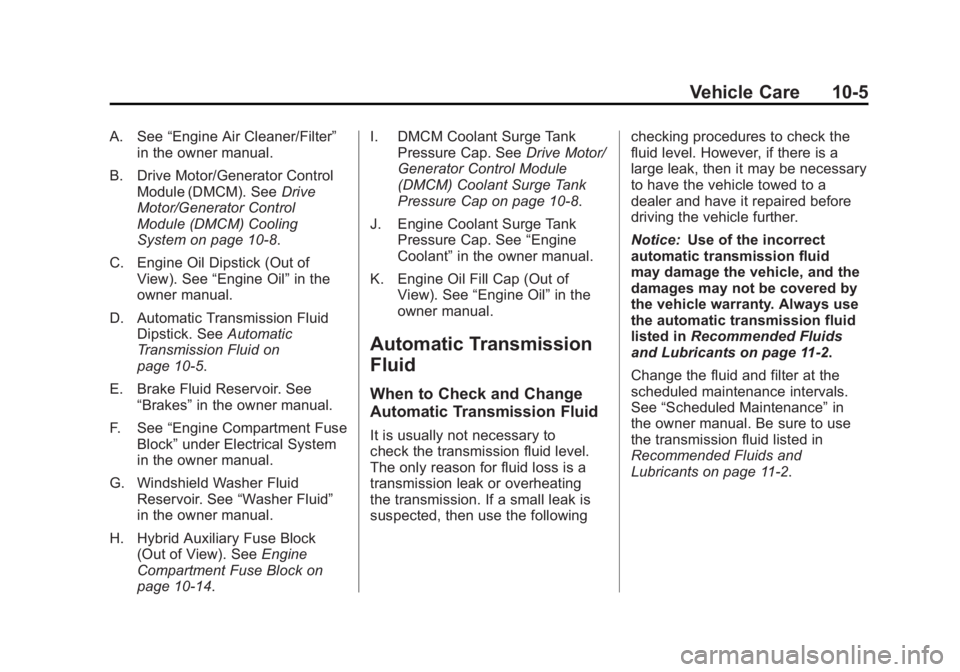
Vehicle Care 10-5A. See “ Engine Air Cleaner/Filter ”
in the owner manual.
B. Drive Motor/Generator Control
Module (DMCM). See Drive
Motor/Generator Control
Module (DMCM) Cooling
System on page 10 ‑ 8 .
C. Engine Oil Dipstick (Out of
View). See “ Engine Oil ” in the
owner manual.
D. Automatic Transmission Fluid
Dipstick. See Automatic
Transmission Fluid on
page 10 ‑ 5 .
E. Brake Fluid Reservoir. See
“ Brakes ” in the owner manual.
F. See “ Engine Compartment Fuse
Block ” under Electrical System
in the owner manual.
G. Windshield Washer Fluid
Reservoir. See “ Washer Fluid ”
in the owner manual.
H. Hybrid Auxiliary Fuse Block
(Out of View). See Engine
Compartment Fuse Block on
page 10 ‑ 14 . I. DMCM Coolant Surge Tank
Pressure Cap. See Drive Motor/
Generator Control Module
(DMCM) Coolant Surge Tank
Pressure Cap on page 10 ‑ 8 .
J. Engine Coolant Surge Tank
Pressure Cap. See “ Engine
Coolant ” in the owner manual.
K. Engine Oil Fill Cap (Out of
View). See “ Engine Oil ” in the
owner manual.
Automatic Transmission
Fluid When to Check and Change
Automatic Transmission Fluid It is usually not necessary to
check the transmission fluid level.
The only reason for fluid loss is a
transmission leak or overheating
the transmission. If a small leak is
suspected, then use the following checking procedures to check the
fluid level. However, if there is a
large leak, then it may be necessary
to have the vehicle towed to a
dealer and have it repaired before
driving the vehicle further.
Notice: Use of the incorrect
automatic transmission fluid
may damage the vehicle, and the
damages may not be covered by
the vehicle warranty. Always use
the automatic transmission fluid
listed in Recommended Fluids
and Lubricants on page 11 ‑ 2 .
Change the fluid and filter at the
scheduled maintenance intervals.
See “ Scheduled Maintenance ” in
the owner manual. Be sure to use
the transmission fluid listed in
Recommended Fluids and
Lubricants on page 11 ‑ 2 .
Page 53 of 90
Black plate (11,1)Cadillac Escalade Hybrid - 2012
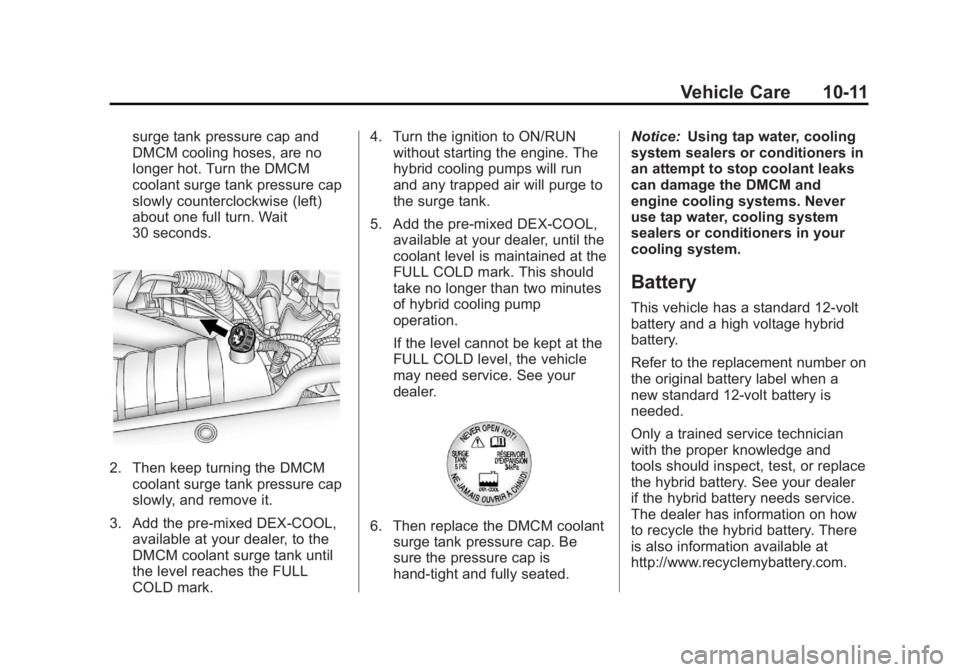
Vehicle Care 10-11surge tank pressure cap and
DMCM cooling hoses, are no
longer hot. Turn the DMCM
coolant surge tank pressure cap
slowly counterclockwise (left)
about one full turn. Wait
30 seconds.
2. Then keep turning the DMCM
coolant surge tank pressure cap
slowly, and remove it.
3. Add the pre ‐ mixed DEX ‐ COOL,
available at your dealer, to the
DMCM coolant surge tank until
the level reaches the FULL
COLD mark. 4. Turn the ignition to ON/RUN
without starting the engine. The
hybrid cooling pumps will run
and any trapped air will purge to
the surge tank.
5. Add the pre ‐ mixed DEX ‐ COOL,
available at your dealer, until the
coolant level is maintained at the
FULL COLD mark. This should
take no longer than two minutes
of hybrid cooling pump
operation.
If the level cannot be kept at the
FULL COLD level, the vehicle
may need service. See your
dealer.
6. Then replace the DMCM coolant
surge tank pressure cap. Be
sure the pressure cap is
hand-tight and fully seated. Notice: Using tap water, cooling
system sealers or conditioners in
an attempt to stop coolant leaks
can damage the DMCM and
engine cooling systems. Never
use tap water, cooling system
sealers or conditioners in your
cooling system.
Battery This vehicle has a standard 12 ‐ volt
battery and a high voltage hybrid
battery.
Refer to the replacement number on
the original battery label when a
new standard 12 ‐ volt battery is
needed.
Only a trained service technician
with the proper knowledge and
tools should inspect, test, or replace
the hybrid battery. See your dealer
if the hybrid battery needs service.
The dealer has information on how
to recycle the hybrid battery. There
is also information available at
http://www.recyclemybattery.com.
Page 56 of 90

Black plate (14,1)Cadillac Escalade Hybrid - 2012
10-14 Vehicle Care The vehicle also has a special fuse
in the battery box for the 300-volt
batteries. If this fuse has failed and
needs to be replaced, the vehicle
will be disabled and you will need
to have the vehicle repaired by
your dealer. Do not attempt to
self-service this fuse.
Engine Compartment
Fuse Block Hybrid Auxiliary Engine
Compartment Fuse Block The hybrid auxiliary engine
compartment fuse block is located
in the engine compartment near the
front of the vehicle. Lift the cover for
access to the fuse/relay block. See
Engine Compartment Overview on
page 10 ‑ 4 for more information on
its location. For more information on
the main underhood fuse block, see
“ Engine Compartment Fuse Block ”
in the owner manual. Fuses Usage
1 ACPO (SUV Only)
2 BECM FAN
3 ACCM
4 CAB HTR PMP Fuses Usage
5 EMPTY
6 COOL PUMP
7 EPS
Page 61 of 90

Black plate (19,1)Cadillac Escalade Hybrid - 2012
Vehicle Care 10-19TPMS Sensor Matching
Process Each TPMS sensor has a unique
identification code. The identification
code needs to be matched to a new
tire/wheel position after rotating the
vehicle ’ s tires or replacing one or
more of the TPMS sensors. Also,
the TPMS sensor matching process
should be performed after replacing
a spare tire with a road tire
containing the TPMS sensor. The
malfunction light and the DIC
message should go off at the next
ignition cycle. The sensors are
matched to the tire/wheel positions,
using a TPMS relearn tool, in the
following order: driver side front tire,
passenger side front tire, passenger
side rear tire, and driver side rear.
See your dealer for service or to
purchase a relearn tool.
There are two minutes to match
the first tire/wheel position, and
five minutes overall to match all
four tire/wheel positions. If it takes
longer, the matching process stops
and must be restarted. The TPMS sensor matching
process is:
1. Set the parking brake.
2. Turn the ignition to ON/RUN with
the engine off.
3. Press
Q and
K on the
Remote Keyless Entry (RKE)
transmitter at the same time for
approximately five seconds. The
horn sounds twice to signal the
receiver is in relearn mode and
TIRE LEARNING ACTIVE
message displays on the DIC
screen.
4. Start with the driver side
front tire.
5. Place the relearn tool against
the tire sidewall, near the valve
stem. Then press the button to
activate the TPMS sensor.
A horn chirp confirms that the
sensor identification code has
been matched to this tire and
wheel position. 6. Proceed to the passenger
side front tire, and repeat the
procedure in Step 5.
7. Proceed to the passenger side
rear tire, and repeat the
procedure in Step 5.
8. Proceed to the driver side rear
tire, and repeat the procedure
in Step 5. The horn sounds
two times to indicate the sensor
identification code has been
matched to the driver side rear
tire, and the TPMS sensor
matching process is no longer
active. The TIRE LEARNING
ACTIVE message on the DIC
display screen goes off.
9. Turn the ignition to LOCK/OFF.
10. Set all four tires to the
recommended air pressure
level as indicated on the Tire
and Loading Information label.
Page 66 of 90
Black plate (24,1)Cadillac Escalade Hybrid - 2012
10-24 Vehicle Care Do not remove any objects that
have penetrated the tire.
1. Remove the tire sealant and
compressor kit from its storage
location. See Storing the Tire
Sealant and Compressor Kit on
page 10 ‑ 29 .
Make sure the on/off button (D)
is in the off (O) position.
2. Unwrap the sealant/air hose (G)
and the power plug (C).
3. Place the kit on the ground.
Make sure the tire valve stem is
positioned close to the ground
so the hose will reach it.
4. Remove the valve stem cap
from the flat tire by turning it
counterclockwise.
5. Attach the sealant/air hose (G)
onto the tire valve stem. Turn it
clockwise until it is tight.
6. Plug the power plug (C) into the
accessory power outlet in the
vehicle. Unplug all items from other accessory power outlets.
See “ Power Outlets ” in the
owner manual.
If the vehicle has an accessory
power outlet, do not use the
cigarette lighter.
If the vehicle only has a cigarette
lighter, use the cigarette lighter.
Do not pinch the power plug
cord in the door or window.
7. Start the vehicle. The vehicle
must be running while using the
air compressor.
8. Press the on/off (D) button
to turn the tire sealant and
compressor kit on.
The compressor will inject
sealant and air into the tire.
The pressure gauge (E) will
initially show a high pressure
while the compressor pushes the
sealant into the tire. Once the
sealant is completely dispersed
into the tire, the pressure will quickly drop and start to rise
again as the tire inflates with
air only.
9. Inflate the tire to the
recommended inflation
pressure using the pressure
gauge (E). The recommended
inflation pressure can be
found on the Tire and Loading
Information label. See Tire
Pressure on page 10 ‑ 16 .
The pressure gauge (E) may
read higher than the actual tire
pressure while the compressor
is on. Turn the compressor
off to get an accurate pressure
reading. The compressor may
be turned on/off until the correct
pressure is reached.
Notice: If the recommended
pressure cannot be reached after
approximately 25 minutes, the
vehicle should not be driven
farther. The tire is too severely
damaged and the tire sealant and
compressor kit cannot inflate the
tire. Remove the power plug from
Page 67 of 90
Black plate (25,1)Cadillac Escalade Hybrid - 2012
Vehicle Care 10-25the accessory power outlet and
unscrew the inflating hose from
the tire valve. See “ Roadside
Assistance Program ” or
“ Roadside Service ” in the owner
manual.
10. Press the on/off button (D) to
turn the tire sealant and
compressor kit off.
The tire is not sealed and
will continue to leak air until
the vehicle is driven and
the sealant is distributed in
the tire, therefore, Steps 11
through 17 must be done
immediately after Step 10.
Be careful while handling the
tire sealant and compressor kit
as it could be warm after
usage.
11. Unplug the power plug (C) from
the accessory power outlet in
the vehicle.
12. Turn the sealant/air hose (G)
counterclockwise to remove it
from the tire valve stem. 13. Replace the tire valve
stem cap.
14. Replace the sealant/air
hose (G), and the power
plug (C) back in their original
location.
15. If the flat tire was able to
inflate to the recommended
inflation pressure, remove the
maximum speed label from the
tire sealant canister (B) and
place it in a highly visible
location.
Do not exceed the speed on
this label until the damaged tire
is repaired or replaced.
16. Return the equipment to its
original storage location in the
vehicle. 17. Immediately drive the vehicle
8 km (5 mi) to distribute the
sealant in the tire.
18. Stop at a safe location and
check the tire pressure. Refer
to Steps 1 through 11 under
“ Using the Tire Sealant and
Compressor Kit without
Sealant to Inflate a Tire (Not
Punctured). ”
If the tire pressure has fallen
more than 68 kPa (10 psi)
below the recommended
inflation pressure, stop driving
the vehicle. The tire is too
severely damaged and the tire
sealant cannot seal the tire.
See “ Roadside Assistance
Program ” in the owner manual.
If the tire pressure has not
dropped more than 68 kPa
(10 psi) from the recommended
inflation pressure, inflate the
tire to the recommended
inflation pressure.
Page 68 of 90
Black plate (26,1)Cadillac Escalade Hybrid - 2012
10-26 Vehicle Care 19. Wipe off any sealant from the
wheel, tire or vehicle.
20. Dispose of the used tire
sealant canister (B) and
sealant/air hose (G) assembly
at a local dealer or in
accordance with local state
codes and practices.
21. Replace it with a new canister
available from your dealer.
22. After temporarily sealing a tire
using the tire sealant and
compressor kit, take the
vehicle to an authorized dealer
within a 161 km (100 mi) of
driving to have the tire repaired
or replaced. Using the Tire Sealant and
Compressor Kit without
Sealant to Inflate a Tire
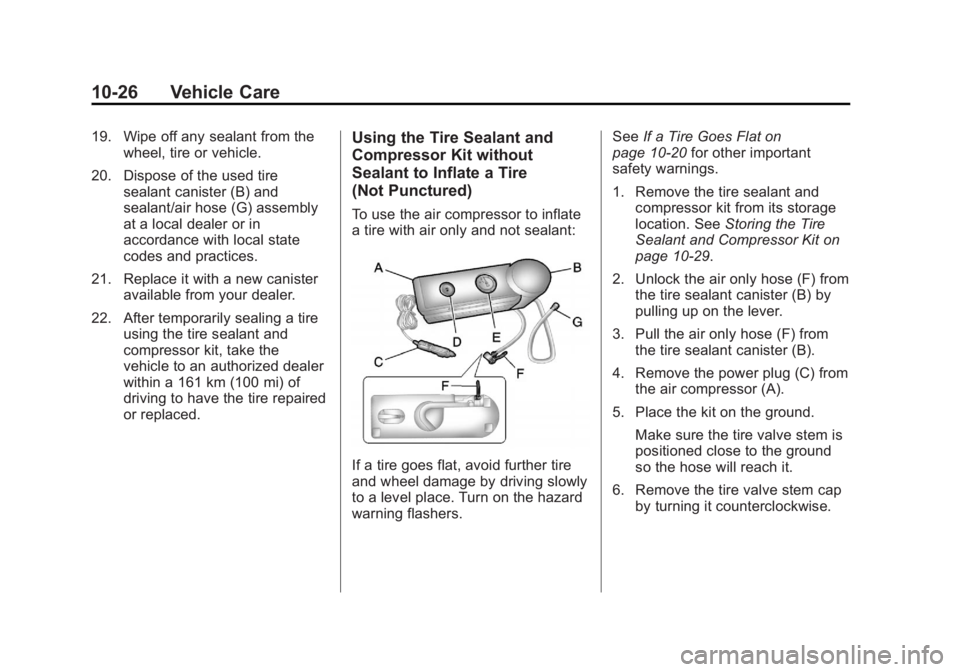
(Not Punctured) To use the air compressor to inflate
a tire with air only and not sealant:
If a tire goes flat, avoid further tire
and wheel damage by driving slowly
to a level place. Turn on the hazard
warning flashers. See If a Tire Goes Flat on
page 10 ‑ 20 for other important
safety warnings.
1. Remove the tire sealant and
compressor kit from its storage
location. See Storing the Tire
Sealant and Compressor Kit on
page 10 ‑ 29 .
2. Unlock the air only hose (F) from
the tire sealant canister (B) by
pulling up on the lever.
3. Pull the air only hose (F) from
the tire sealant canister (B).
4. Remove the power plug (C) from
the air compressor (A).
5. Place the kit on the ground.
Make sure the tire valve stem is
positioned close to the ground
so the hose will reach it.
6. Remove the tire valve stem cap
by turning it counterclockwise.
Page 69 of 90
Black plate (27,1)Cadillac Escalade Hybrid - 2012
Vehicle Care 10-277. Attach the air only hose (F) onto
the tire valve stem and press the
lever down to secure it.
8. Plug the power plug (C) into the
accessory power outlet in the
vehicle. Unplug all items from
other accessory power outlets.
See “ Power Outlets ” in the
owner manual.
If the vehicle has an accessory
power outlet, do not use the
cigarette lighter.
If the vehicle only has a cigarette
lighter, use the cigarette lighter.
Do not pinch the power plug
cord in the door or window.
9. Start the vehicle. The vehicle
must be running while using the
air compressor. 10. Press the on/off (D) button to
turn the compressor on.
The compressor will inflate the
tire with air only.
11. Inflate the tire to the
recommended inflation
pressure using the pressure
gauge (E). The recommended
inflation pressure can be found
on the Tire and Loading
Information label. See Tire
Pressure on page 10 ‑ 16 .
The pressure gauge (E) may
read higher than the actual tire
pressure while the compressor
is on. Turn the compressor off
to get an accurate reading.
The compressor may be turned
on/off until the correct pressure
is reached. 12. Press the on/off button (D) to
turn the tire sealant and
compressor kit off.
Be careful while handling the
tire sealant and compressor
kit as it could be warm after
usage.
13. Unplug the power plug (C) from
the accessory power outlet in
the vehicle.
14. Disconnect the air only
hose (F) from the tire
valve stem, by turning it
counterclockwise, and replace
the tire valve stem cap.
15. Replace the air only hose (F)
and the power plug (C) back in
its original location.
16. Place the equipment in the
original storage location in the
vehicle.
Page 70 of 90
Black plate (28,1)Cadillac Escalade Hybrid - 2012
10-28 Vehicle Care Removal and Installation of the
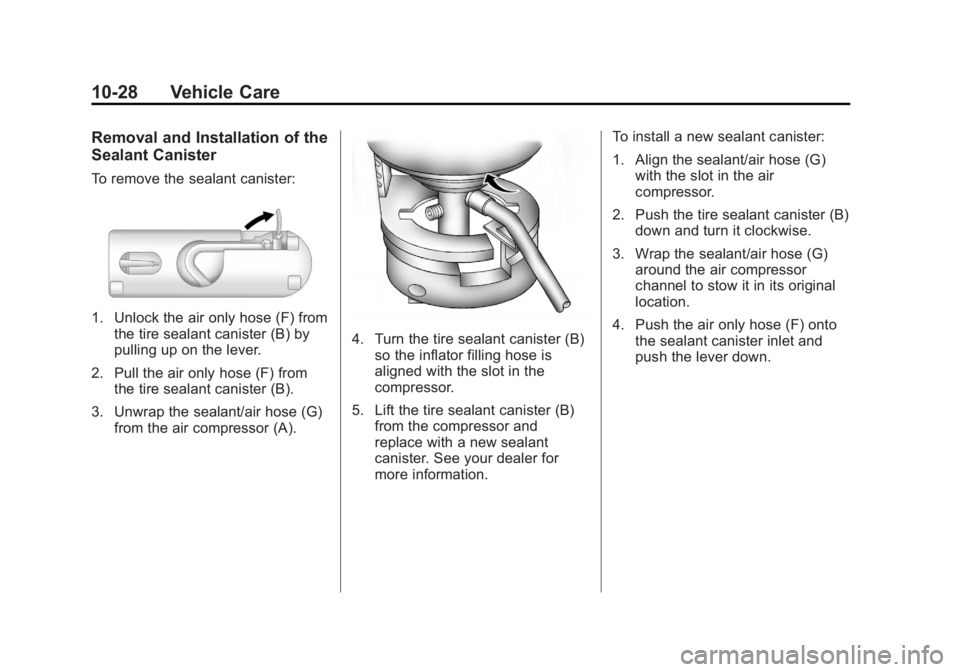
Sealant Canister To remove the sealant canister:
1. Unlock the air only hose (F) from
the tire sealant canister (B) by
pulling up on the lever.
2. Pull the air only hose (F) from
the tire sealant canister (B).
3. Unwrap the sealant/air hose (G)
from the air compressor (A). 4. Turn the tire sealant canister (B)
so the inflator filling hose is
aligned with the slot in the
compressor.
5. Lift the tire sealant canister (B)
from the compressor and
replace with a new sealant
canister. See your dealer for
more information. To install a new sealant canister:
1. Align the sealant/air hose (G)
with the slot in the air
compressor.
2. Push the tire sealant canister (B)
down and turn it clockwise.
3. Wrap the sealant/air hose (G)
around the air compressor
channel to stow it in its original
location.
4. Push the air only hose (F) onto
the sealant canister inlet and
push the lever down.