check engine CADILLAC FLEETWOOD 1994 User Guide
[x] Cancel search | Manufacturer: CADILLAC, Model Year: 1994, Model line: FLEETWOOD, Model: CADILLAC FLEETWOOD 1994Pages: 398, PDF Size: 19.19 MB
Page 206 of 398
r 0 Weather Forecasts: What’s the weather outlook along your route?
Should you delay your trip a short time to avoid a major storm
system?
0 Maps: Do you have up-to-date maps !
HIGHVKAY HIPNOSIS
Is there actually such a condition as “highway hypnosis”? Or is it just
plain falling asleep at the wheel? Call it highway hypnosis, lack of
awareness, or whatever.
There is something about an easy stretch of road with the same scenery,
along with the hum of the tires on the road, the drone of the engine, and
the rush of the wind against the vehicle that can make you sleepy. Don’t
let it happen to you!
If it does, your vehicle can leave the road in less than
a second, and you could crash and be injured.
What can you do about highway hypnosis? First, be aware that it can
happen.
Then here are some tips:
Make sure your vehicle is well ventilated, with a comfortably cool
Keep your eyes moving. Scan the road ahead and to the sides. Check
interior.
your rearview mirrors and your instruments frequently.
If you get sleepy, pull off the road into a rest, service, or parking area
and take a nap, get some exercise, or both. For safety, treat drowsiness
on the highway as an emergency.
193
Page 207 of 398
HILL AND MOUNTMN ROADS
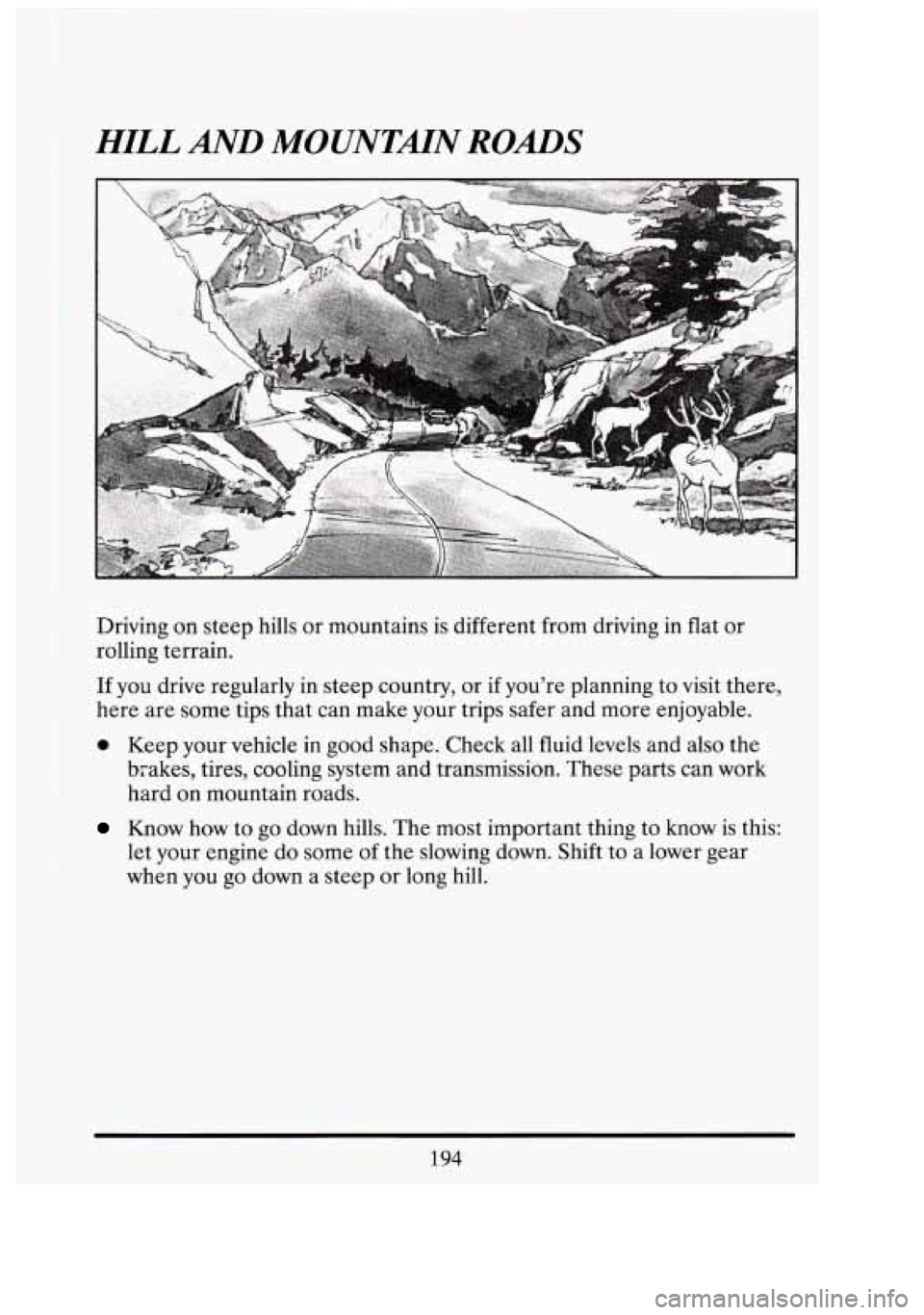
Driving on steep hills or mountains is different from driving in flat or
rolling terrain.
If you drive regularly in steep country, or if you’re planning to visit there,
here are some tips that can make your trips safer and more enjoyable.
0 Keep your vehicle in good shape. Check all fluid levels and also the
brakes, tires, cooling system and transmission. These parts can work
hard on mountain roads.
Know how to go down hills. The most important thing to know is this:
let your engine do some
of the slowing down. Shift to a lower gear
when you go down a steep or long hill.
194
13
I
Page 224 of 398
Engine Cooling When Trailering
Your cooling system may temporarily overheat during severe operating
conditions such as;
Climbing grades steeper than 4% at ambient temperatures above
90’Fahrenheit (32O Celsius)
with a loaded vehicle and trailer.
0 Stopping after high-speed driving.
0 Idling for long periods in stop and go traffic.
If the “TEMP” warning light comes on, pull
to the side of the road as
soon as it is safe to do
so. When the vehicle is at a complete stop, shift the
transmission selector to P (Park) and allow the engine to idle. If your
Electronic Climate Control system is on, shut it
off. Do not turn off the
engine or increase engine speed above a normal idle. Within
two or three
minutes the system should cool sufficiently to allow A/C operation to
resume. At that time resume driving at a reduced speed. Return to
normal driving after
10 minutes if the “TEMP” warning light is not
displayed.
Maintenance when Trailer Towing
Your vehicle will need service more often when you’re pulling a trailer.
See the Maintenance Schedule for details. Things that are especially
important in trailer operation are automatic transmission fluid (don’t
overfill), engine oil, axle lubricant, engine drive belt, cooling system, and
brake adjustment. Each of these is covered in this manual. The Index will
help you find them quickly. If you’re trailering, it’s a good idea to review
these sections before you start your trip.
Check periodically to
see that all hitch attaching nuts and bolts are tight.
21
1
Page 229 of 398
I
4. Open the hoods and locate the batteries.
Find the positive
(+) and negative (-) terminals on each battery.
5. Check that the jumper cables don't have loose or missing insulation. If
they do, you could get a shock. The vehicles could be damaged, too.
Before you connect the cables, here are some basic things you should
know. Positive
(+) will go to positive (+) and negative (-) will go to
negative
(-) or a metal engine part. Don't connect (+) to (-) or you'll
get a short that would damage the battery and maybe other parts, too.
216
I n
Page 239 of 398
I
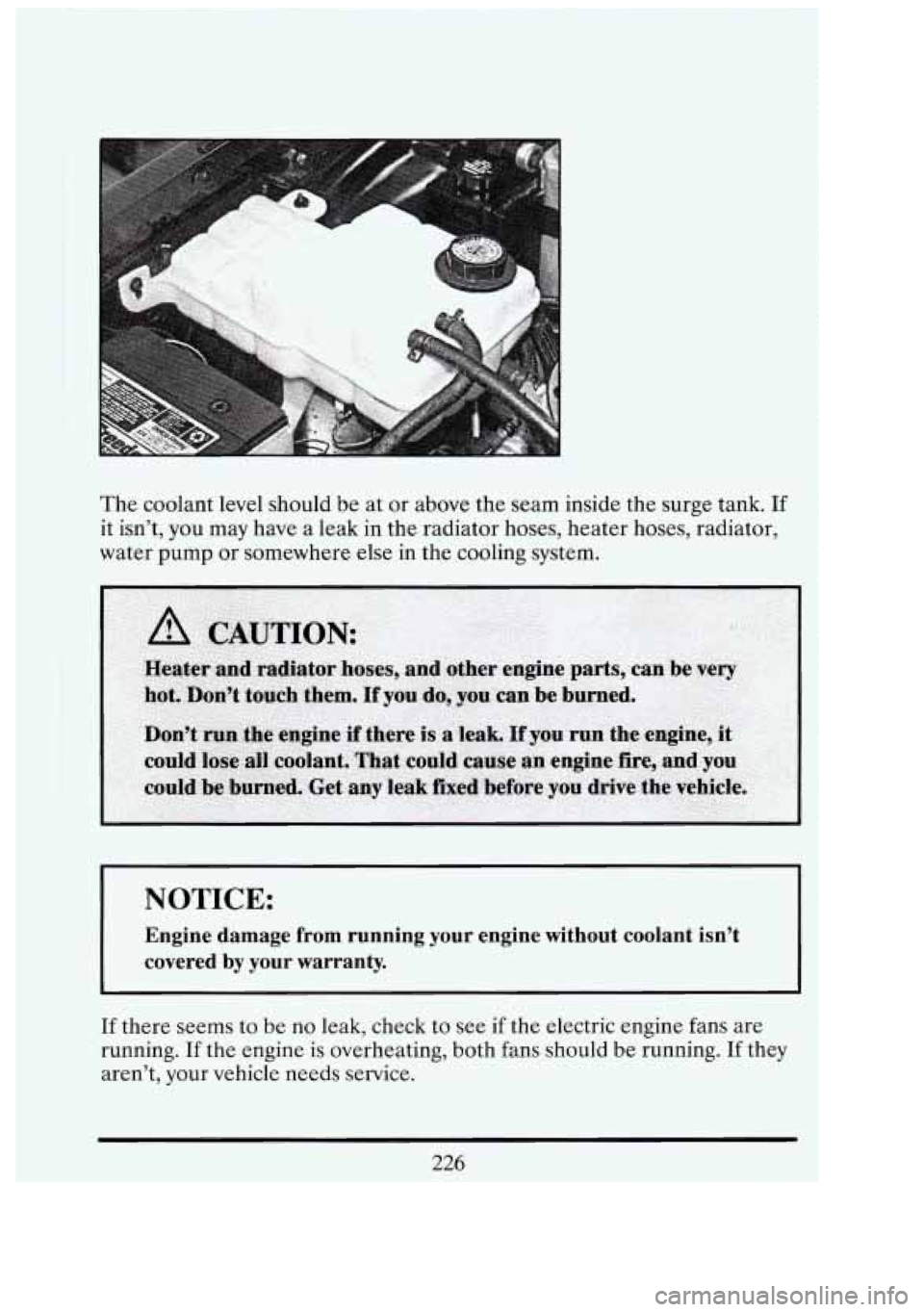
The coolant level should be at or above the seam inside the surge tank. If
it isn’t, you may have a leak in the radiator hoses, heater hoses, radiator,
water pump or somewhere else in the cooling system.
NOTICE:
Engine damage from running your engine without coolant isn’t \
covered
by your warranty.
If there seems to be no leak, check to see if the electric engine fans are
running.
If the engine is overheating, both fans should be running. If they
aren’t, your vehicle needs service.
226
Pl i
Page 261 of 398
I
I
You should ask your service station operators if their gasolines contain
deposit control additives and oxygenates, and if they have been
reformulated to reduce vehicle emissions.
FUELS IN FOREIGN COUNTHES
If you plan on driving in another country outside the U.S. or Canada,
unleaded fuel may be hard to find. Do not use leaded gasoline. If you use
even one tankful, your emission controls won’t work well or at all. With
continuous use, spark plugs can get fouled, the exhaust system can
corrode, and your engine oil can deteriorate quickly. Your vehicle’s
oxygen sensor will be damaged. All
of that means costly repairs that
wouldn’t be covered by your warranty.
To check on fuel availability, ask an auto club, or contact a major oil
company that does business
in the country where you’ll be driving.
You can also write us at the following address for advice. Just tell us
where you’re going and give your Vehicle Identification Number (VIN).
General Motors Overseas Distribution Corporation,
North American Export Sales (NAES)
1908 Colonel Sam Drive
Oshawa, Ontario
LlH 8P7
FUEL ECONOMY
Your fuel economy (miles per gallon or liters per 100 kilometers) can vary
depending on how your Cadillac
is driven. Several vehicles like yours
have been driven through a standard test and their actual fuel economy
was recorded. These readings were adjusted and printed on the fuel
economy window sticker which was attached to your new Cadillac when
it
was delivered and in the Gas Mileage Guide which is available from your
dealership.
The fuel economy estimates are based on results of tests required by the
U. S. Environmental Protection Agency (EPA). These tests are used to
certify that vehicles meet the Federal emissions and fuel economy
standards. Cadillac tests prototypes of new vehicles and submits the
results to the EPA. The EPA then confirms the accuracy of the figures
provided by Cadillac. The vehicles are driven
by a professional driver
under controlled laboratory conditions, on an instrument similar to a
ni
I
I
o(
L
nl
248
Page 267 of 398
Before closing the hood, be sure all the filler caps are on properly. Then
just pull the hood down and close it firmly.
ENGINE OIL
If the LOW OIL LEVEL light on the instrument panel comes on, it
means you need to check your engine oil level right away.
For more.
information, see Low Oil Level light in the Index.
You should check your-
engine oil level regularly; this is .an, added reminder.
It's
a good idea to check your engine oil every time you get fuel. In order
to get an accurate reading, the oil must be warm and the vehicle must be
om level ground.
t
E
-4
254
Page 268 of 398
To Check Engine Oil
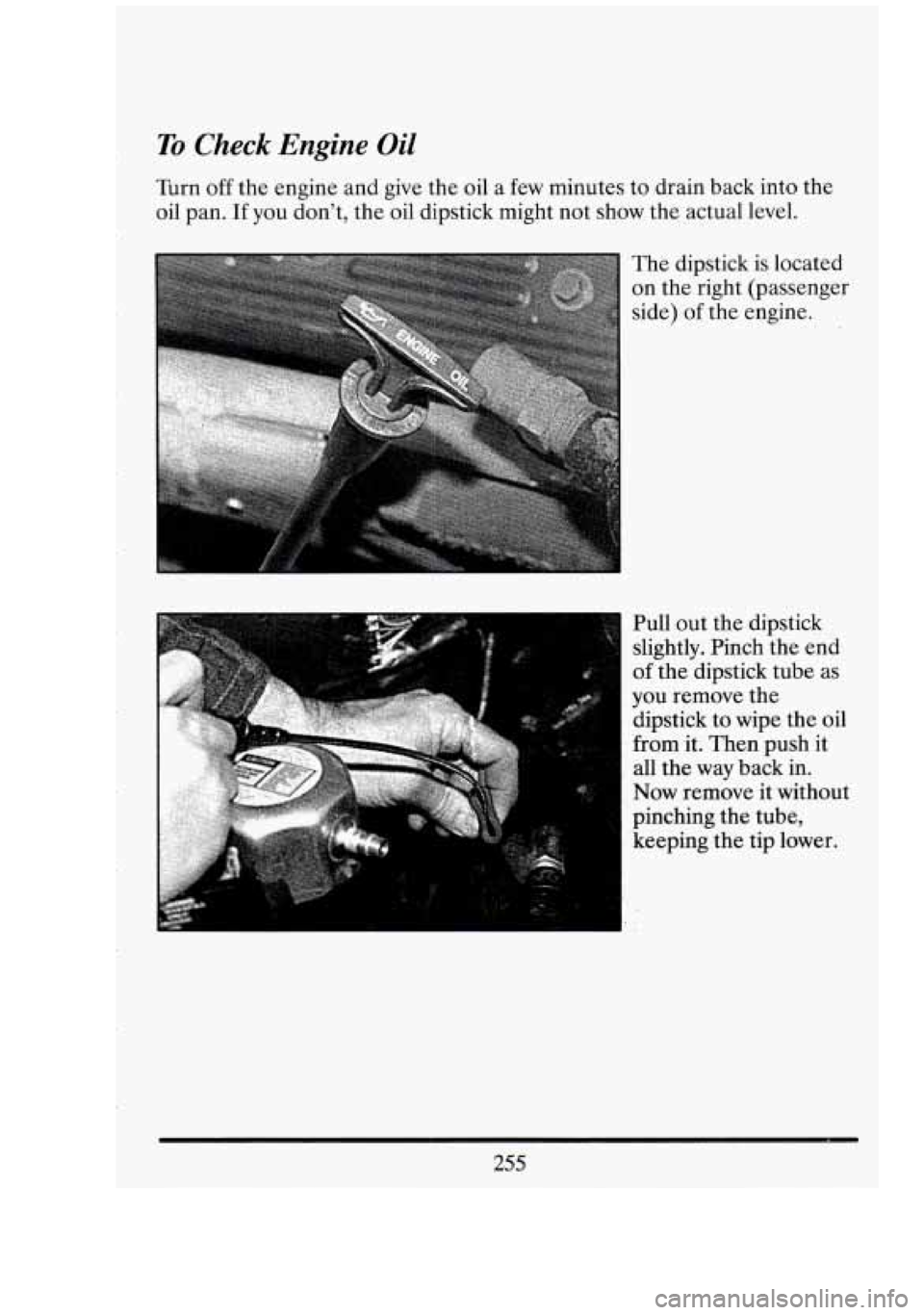
Turn off the engine and give the oil a few minutes to drain back into the
oil pan. If you don't, the oil dipstick might not show the actual level.
I Pull out the dipstick
slightly. Pinch the end
of the dipstick tube as
you remove the
dipstick to wipe the oil
from it. Then push it
all the way back in.
Now remove it without
pinching the tube,
keeping the tip lower.
Page 275 of 398
-NOTICE:
If the air cleaner is off, a backfire can cause a damaging engine
fire:And, dirt can easily get into your engine, which will damage
it. Always have the air cleaner in place when you’re driving. I
I AUTOAUTIC .TRANsIMISSION FLUID
‘When to Check and Change
A good time to check your automatic transmission fluid level is when the
engine oil is changed. Refer to the Maintenance Schedule to determine
when to change your fluid. See “Scheduled Maintenance Services” in
the Index.
How to Check
Because this operation can be a little difficult, you may choose to have
this done at .a Cadillac dealership Service Department.
If you do it yourself, be sure to follow all the instructions here, or you
cou.ld get a false reading on the dipstick.
I I Too NOTICE: much or too little fluidcan damage your. transmission. Too
much can mean that some of the fluid could come out and fall
on hot engine parts or exhaust system, starting
a fire. Be sure to
get an accurate reading
if you check your transmission fluid. i
I
Wait at least 30 minutes before checking the transmission fluid level if
you
have been driving:
When outside temperatures are above 90°F (32OC).
At high speed for. quite a while.
tll
il
3‘ I
CI)
262
Page 276 of 398
r
r
ec
In heavy traffic -- especially in hot weather.
0 While pulling a trailer.
To get the right reading, the fluid should be at normal.operating
temperature, which is
180 " F .to -200 " F (82' C to 93 " C).
To check transmission fluid hot: Get the.vehicle warmed up by driving
about
15 miles (24 km) when outside temperatures are above 50°F
(10" C). If it's colder than 50°F (10" C), drive the vehicle in "D" (3rd
Gear) until the engine temperature gage moves and then remains steady
for ten minutes. Then follow the hot check procedures.
To check transmission fluid cold: A cold check is made after the vehicle
has been sitting for eight hours or more with the engine
off and is used
only as a reference. Let the engine run at idle for five minutes
if outside
temperatures are
50 " F (10 " C) or more. If it's colder than 50 " F (10 " C),
you may have to idle the engine longer. Should the fluid level be low
during a cold checkj you must perform a hot check before adding fluid.
This will give you a more accurate reading
of the fluid level.
To check thefluid hot or cold
0 Park your vehicle on a level place.
0 With the parking brake applied, place the shift lever in "P" (Park).
0 With your foot on the brake pedal, move the shift lever through each
gear range, pausing for about three seconds in each range. Then,
position the shift lever in "P" (Park).
0 Let the engine run at idle for three minutes or more.
263