lock CADILLAC FLEETWOOD 1994 Owner's Manual
[x] Cancel search | Manufacturer: CADILLAC, Model Year: 1994, Model line: FLEETWOOD, Model: CADILLAC FLEETWOOD 1994Pages: 398, PDF Size: 19.19 MB
Page 96 of 398
The alarm won’t stop if you try to unlock a door any other way.
How to Test The Alarm
r 0 From inside the vehicle roll down your window, then get out of your
vehicle keeping the door open.
0 From outside the vehicle with the door open, lock the vehicle using
the power door lock or the Keyless Entry System and close the door.
0 Once the interior lights are off, reach in and unlock the door using the
manual lock. Open the door, the horn will sound and your headlights
will flash.
If the alarm does not sound when it should, check to see
if the horn
works. The horn fuse may be blown. To replace the fuse, see “Fuses and
Circuit Breakers” in the Index.
To reduce the possibility of theft, always arm the theft deterrent system
when leaving your vehicle.
PASS-KEY@II
Your vehicle is equipped with the PASS-Key@II (Personalized
Automotive Security System) theft deterrent system. PASS-Key@II
is a
passive theft deterrent system. This means you don’t have to do anything
different to arm or disarm the system. It works when you insert or remove
the
key from the ignition. PASS-Key@II uses a resistor pellet in the
ignition key that matches a decoder in your vehicle.
When the PASS-Key@II system senses that someone is using the wrong
key, it shuts down the vehicle’s starter and fuel systems. For about three
minutes, the starter won’t work and fuel won’t
go to the engine. If
someone tries to start your vehicle again or uses another key during this
time, the vehicle will not start. This discourages someone from randomly
trying different keys with different resistor pellets in an attempt to make a
match.
The ignition
key must be clean and dry before it’s inserted in the ignition
or the engine may not start. If the engine does not start and and the
“PASS
KEY FAULT” light comes on, the key may be dirty or wet. Turn
the ignition off.
83
Page 97 of 398
Clean and dry the key. If the starter still won’t work, and the key appears
to be clean and dry, wait about three minutes and try the other ignition
key. At this time, you may also want to check the (see “Fuses and Circuit
Breakers” in the Index). If the starter won’t work with the other key, your
vehicle needs service. If your vehicle does start, the first ignition key may
be faulty. See your Cadillac dealer or a locksmith who can service the
PASS-Key@II.
If you accidentally use a
key that has a damaged or missing resistor pellet,
the starter won’t work But you don’t have to wait three minutes before
trying one of the other ignition keys.
See your Cadillac dealer or a locksmith who can service the PASS-Key@II
to have
a new key made.
If you’re ever driving and the “PASS KEY FAULT” light comes on and
stays on, you will be able to restart your engine if you turn it off. Your
PASS-Key@II system, however, is not working properly and must be
serviced by your Cadillac dealer. Your vehicle is not protected by the
PASS-Key@II system.
If you lose or damage a PASS-Key@II ignition ke
, see your Cadillac
dealer or a locksmith who can service PASS-Key I1 to have a new key
made. J
o/
‘U I
84
Page 98 of 398
NOTICE:
Your modern Cadillac doesn’t need .an elaborate “break-in.” But
it will perform better in the long run if you follow these
guidelines:
Keep your speed at 55 mph (88 km/h) or less for the first
1000 miles (160 km).
Don’t drive at any one speed -- fast.or slow -- for the first
1000 miles (160 km). Don’t make full-throttle starts.
Avoid making hard stops for the first 200 miles (322 km) or
so. During this time your new brake linings aren’t yet broken
in. Hard stops with new linings can mean premature wear
and earlier replacement. Follow this “breaking-in’’ guideline
every time
you get new brake linings.
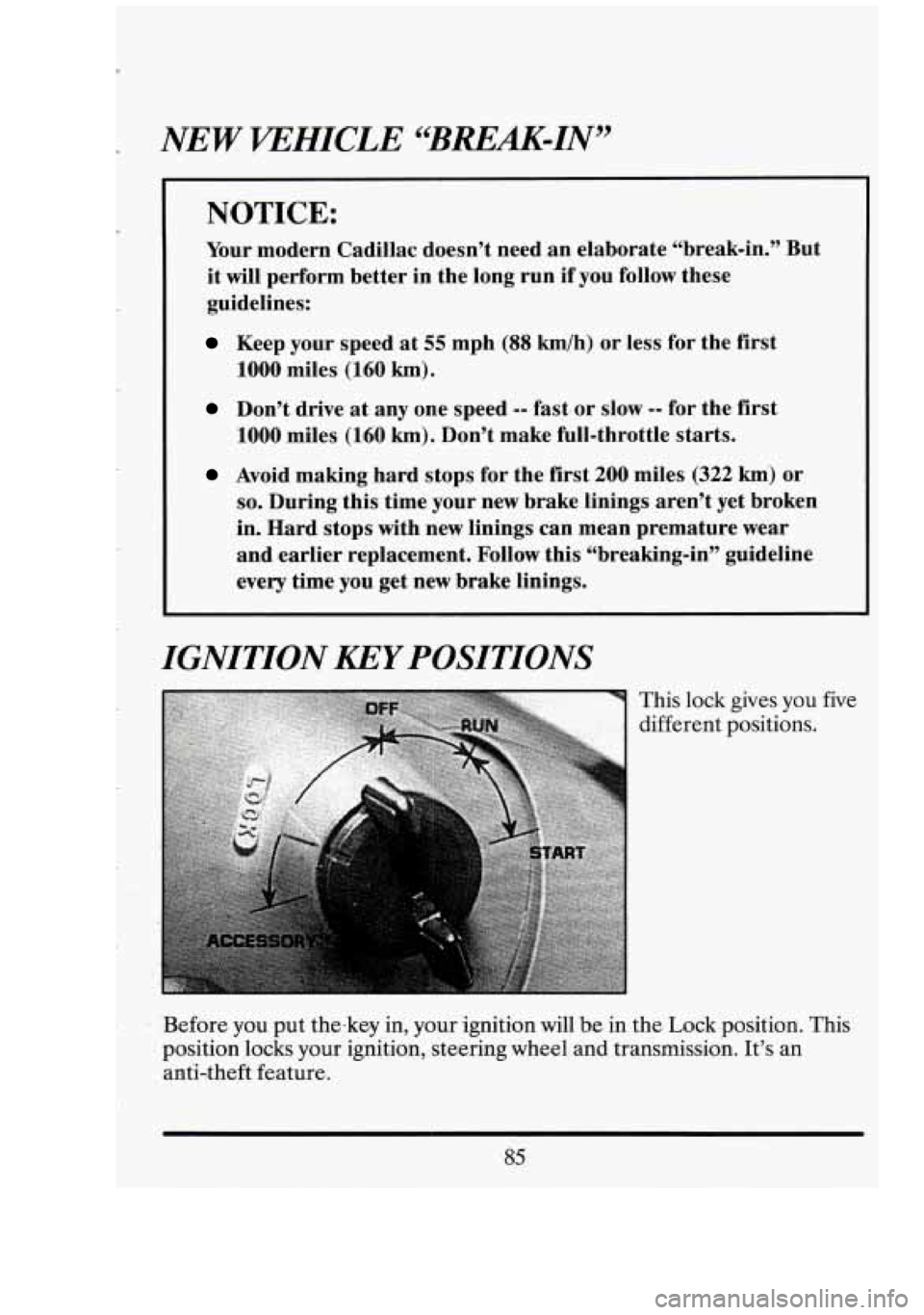
IGNITIQN KEY POSITIONS
This lock
different : gives you
positions. five
‘Before you put the-key in, your ignition will
be in the Lock position. This
position locks your ignition, steering wheel and transmission. It’s an
anti-:theft ,feature.
Page 99 of 398
I
The other positions let you perform these functions:
ACC: Accessory lets you use things like the radio and the windshield
wipers when the engine is
off. To get into “ACC”, push in the key and turn
it toward
you. Yoursteeringwheel will remain locked, just as it was
before you inserted the key.
OFF: This position lets you turn off the engine but still turn the steering
wheel. It doesn’t lock the steering wheel like “Lock.” Use “Off”
if you
must have your car in motion while the engine is
off (for example, if your
car is being pushed).
RUN This is the position for driving.
START This starts your engine.
NOTICE:
If your key seems stuck in “Lock” and you can’t turn it, be sure
it
is all the way in. If it is, then turn the steering wheel left and
right while. you turn the key hard. But turn the key only with
your hand. Using
a tool to force it could break the key or the
ignition switch.
If none of this works, then your vehicle needs
service.
STARTING YOUR ENGINE
Move your shift lever to “P” (Park) or “N” (Neutral). Your,,engine won’t
start in
any other position -- that’s a safety feature. To restart when you’re
already moving, use “N” (Neutral) only.
NOTICE:
Don’t try to shift to “P” (Park).. if your Cadillae is moving. If you
do, you could .damage the transmission. Shift to “P” (Park) only
when your vehicle
is stopped. ”. .
1
W I
D
I
I
-
Page 102 of 398
ENGINE COOLANT HEATER
(ENGINE BLOCK HEATER) (OPTION)
(CANADA ONLY)
In very cold weather, 0°F (-18O C) or colder, the engine coolant heater
can help. You’ll get easier starting and better fuel economy during engine
warm-up. Usually, the coolant heater should be plugged in a minimum of
four hours prior to starting your vehicle.
To use the coolant heater:
1. Turn off the engine.
2. Open the hood and unwrap the electrical cord.
3. Plug it into a normal, grounded 110-volt outlet.
NOTICE:
After you’ve used the coolant heater, be sure to store the cord as
it
was before to keep it away from moving engine parts. If you
don’t, it could be damaged.
How long should you keep the coolant heater plugged in? The answer
depends on the weather, the kind
of oil you have, and some other things.
Instead
of trying to list everything here, we ask that you contact a Cadillac
dealer in the area where you’ll be parking your vehicle. The dealer can
give you the best advice
for that particular area.
89
Page 103 of 398
AUTOMTIC TRANSIMIISSION
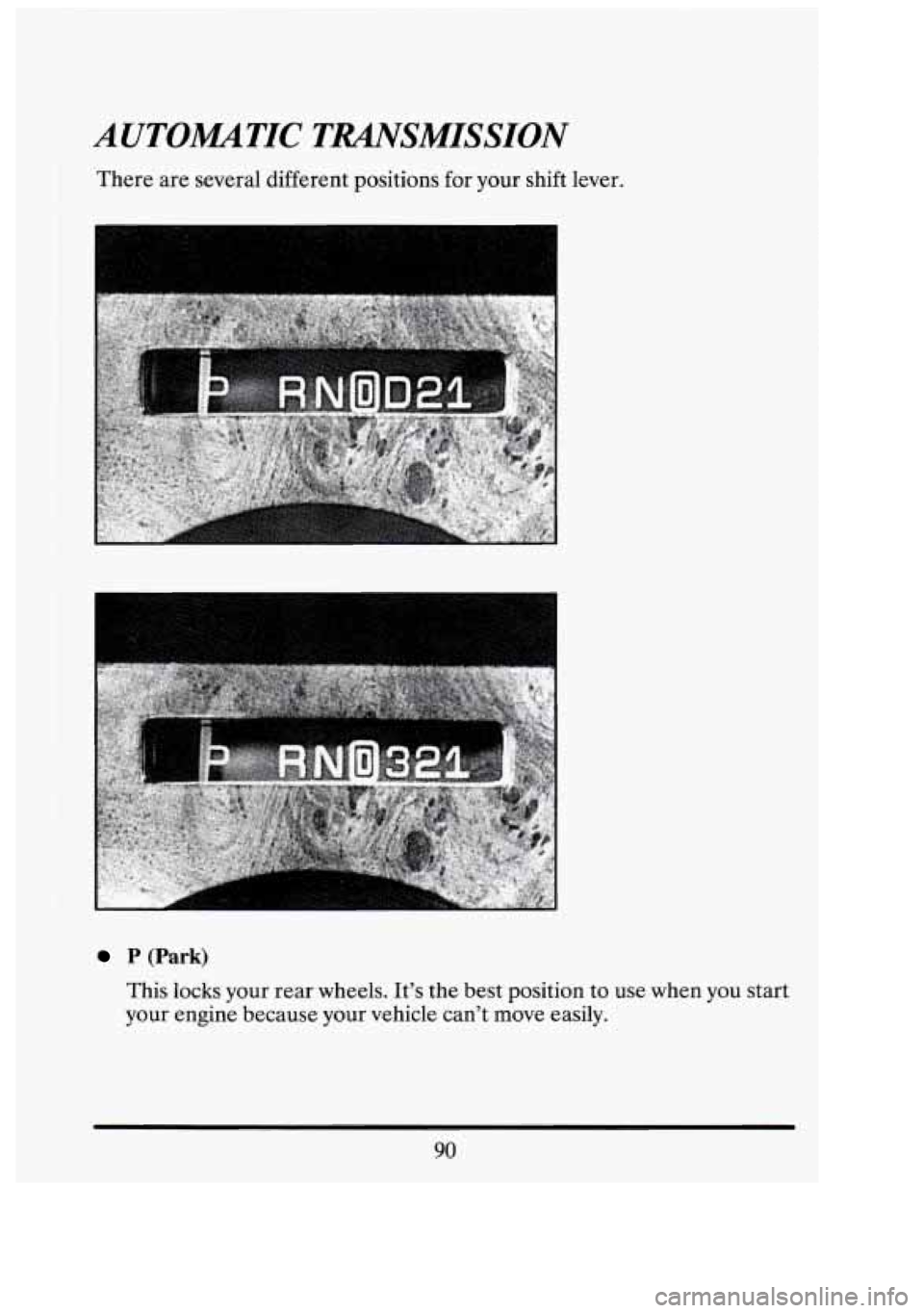
There are several different positions for your shift lever.
P (Park)
This locks your rear wheels. It’s the best position to use when you start
your engine because your vehicle can’t move easily.
90
1;
-1
-7 i
r_
Page 104 of 398
Ensure the shift lever is fully in “P” (Park) range before starting the engine.
Your Cadillac has a brake-transmission shift interlock. You have to fully
apply your regular brakes before you can shift from “P” (Park) when the
ignition key is in the “Run” position.
If you cannot shift out of “P” (Park),
ease pressure on the shift lever
-- push the shift lever all the way into “P77
(Park) as you maintain brake application. Then move the shift lever into the
gear you wish. See “Shifting Out of ‘P’ (Park)” in this part.
R (Reverse)
Use this gear to back up.
NOTICE:
Shifting to “R” (Reverse) while your vehicle is moving forward
could damage your transmission. Shift to “R” only after your
vehicle
is stopped.
To rock your vehicle back and forth to get out of snow, ice or sand
without damaging your transmission, see
“If You’re Stuck: In Sand, Mud,
Ice
or Snow” in the Index.
91
Page 110 of 398
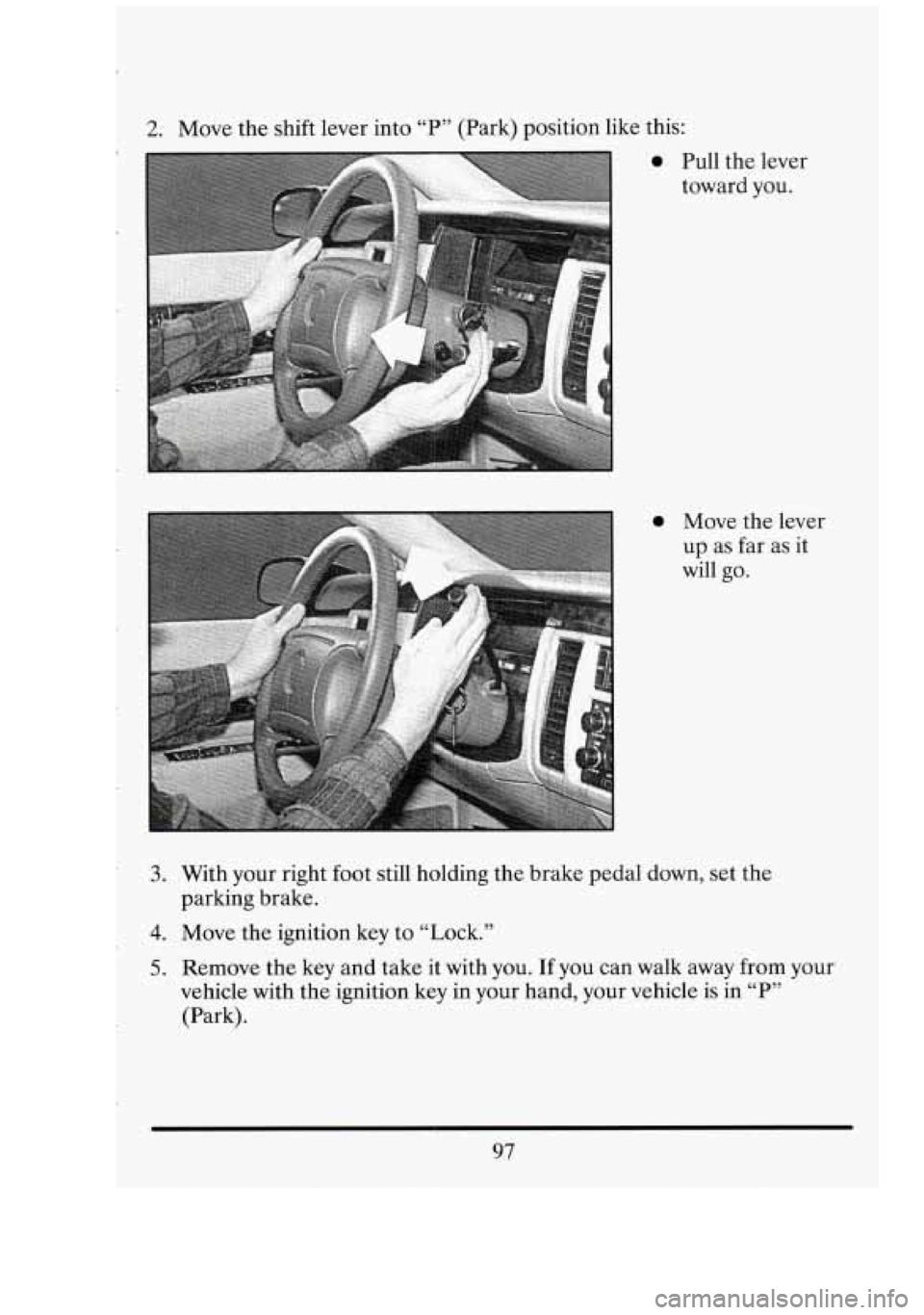
2. Move the shift lever into “P” (Park) position like this:
0 Pull the lever
toward you.
3. With your right foot still holding the brake pedal down, set the
4. Move the ignition key to “Lock.”
parking brake.
5. Remove
the key and take it with you. If you can walk away from your
vehicle with the ignition key in your hand, your vehicle is in
“P”
(Park).
97
Page 111 of 398
having Your Vehicle With the Engine Running
Torque Lock (Automatic Transmission)
If you are parking on a hill and you don’t shift your transmission into “P”
(Park) properly, the weight of the vehicle may put too much force
on the
parking pawl in the transmission.
You may find it difficult to pull the shift
lever out
of “P” (Park). This is called “torque lock.” To prevent torque
lock, always be sure to shift into “P” (Park) properly before you leave the
driver’s seat.
To find out how, see “Shifting Into ‘P’ (Park)” in the Index.
If “torque lock” does occur, you may need to have another vehicle push
yours a little uphill to take some of the pressure from the transmission,
so
you can pull the shift lever out of “P” (Park).
SHIFTING OUT OF “P” (PARK)
Your Cadillac has a brake-transmission shift interlock. You have to fully
apply your regular brake before you can shift from
“P” (Park) when the
ignition is in the “Run” position. See “Automatic Transmission”
in the
Index.
If you cannot shift out of “P” (Park), ease pressure on the shift lever --
push the shift lever all the way into “P” (Park) as you maintain brake
application. Then move the shift lever into the gear you want.
If you ever
hold the brake pedal down but still can’t shift out of “P” (Park), try this:
1. Turn the key to “Off.” Open and close the driver’s door to turn off the
Retained Accessory Power feature.
3
r
b 4
Ir
Eli
I
98
Page 115 of 398
TILT WHEEL
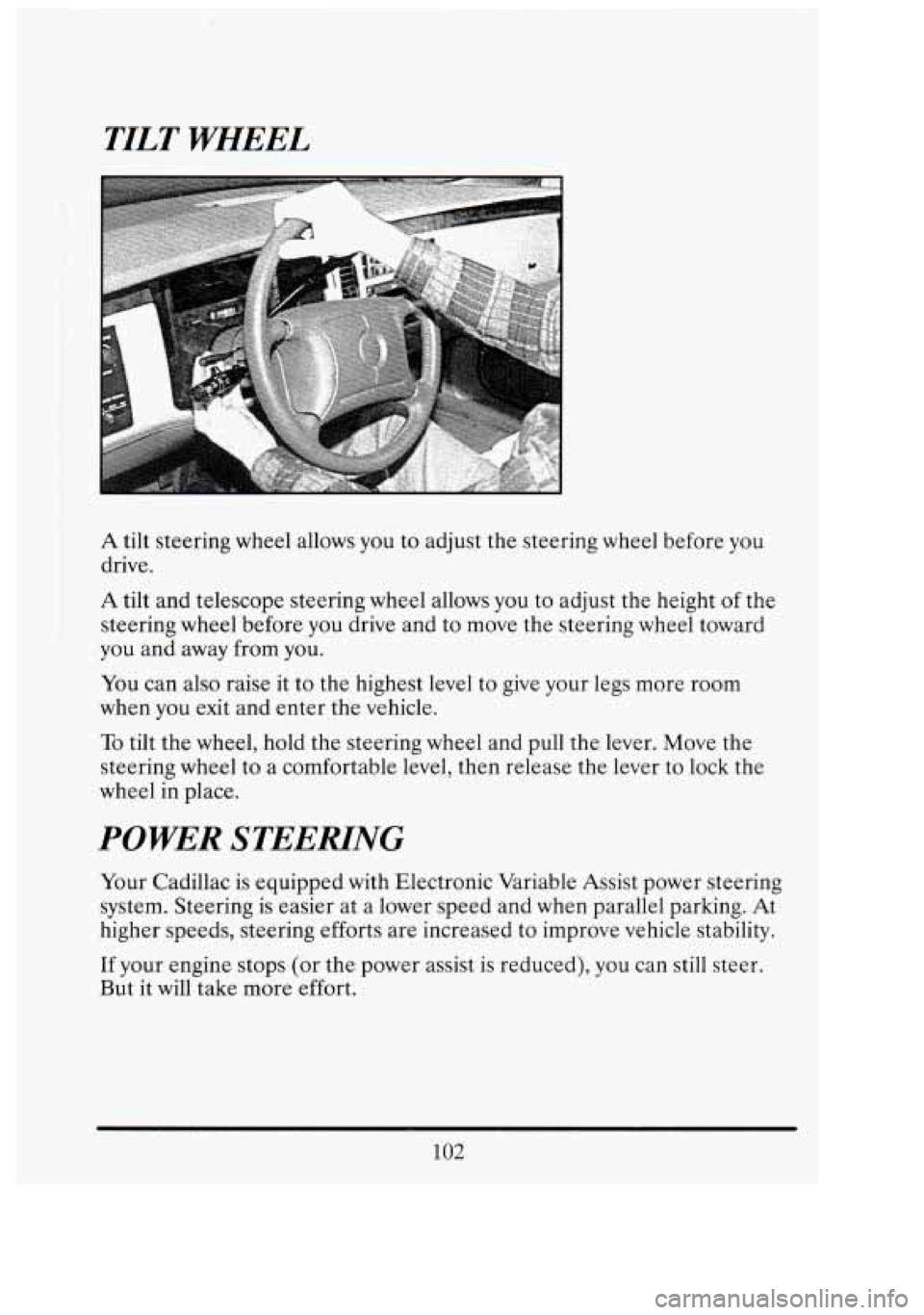
A tilt steering wheel allows you to adjust the steering wheel before you
drive.
A tilt and telescope steering wheel allows you to adjust the height of the
steering wheel before you drive and to move the steering wheel toward
you and away
from you.
You can also raise it to the highest level to give your legs more room
when you exit and enter the vehicle.
To tilt the wheel, hold the steering wheel and pull the lever. Move the
steering wheel to a comfortable level, then release the lever
to lock the
wheel
in place.
POWER STEERLNG
Your Cadillac is equipped with Electronic Variable Assist power steering
system. Steering is easier at a lower speed and when parallel parking. At
higher speeds, steering efforts are increased to improve vehicle stability.
If your engine stops (or the power assist is reduced),
you can still steer.
But it will take more effort.
102
GI
nr