light CADILLAC FLEETWOOD 1994 Manual PDF
[x] Cancel search | Manufacturer: CADILLAC, Model Year: 1994, Model line: FLEETWOOD, Model: CADILLAC FLEETWOOD 1994Pages: 398, PDF Size: 19.19 MB
Page 228 of 398
I r NOTICE:
Ignoring these steps could result in costly damage to your
vehicle that wouldn’t be covered by your warranty.
ming to start. your Cadillac by pushing or pulling it won’t
work, and
it could damage your vehicle.
TO JUMP START YOUR CXDILLAC:
1. Check the other vehicle. It must have a 12-volt battery with a negative
ground system.
NOTICE:
If the other system isn’t a 12-volt system with a negative ground,
both vehicles can be damaged.
2. Get the vehicies close enough
so the jumper cables can reach, but be
sure the vehicles aren’t touching each other. If they are, it could cause
a ground connection you don’t want. You wouldn’t be able to start
your Cadillac, and the bad grounding could damage the electrical
systems.
You could be injured
if the vehicles roll. Set the parking brake firmly
on each vehicle. Put
an automatic transmission in “P” (Park) or a
manual transmission in
“N” (Neutral).
needed, and radios. This will avoid sparks and help save both
batteries. And it could save your radio!
3. Turn off the ignition on both vehicles. Turn off all lights that aren’t
NOTICE:
If you leave your radio on, it could be badly damaged. The
repairs wouldn’t be covered
by your warranty.
215
Page 236 of 398
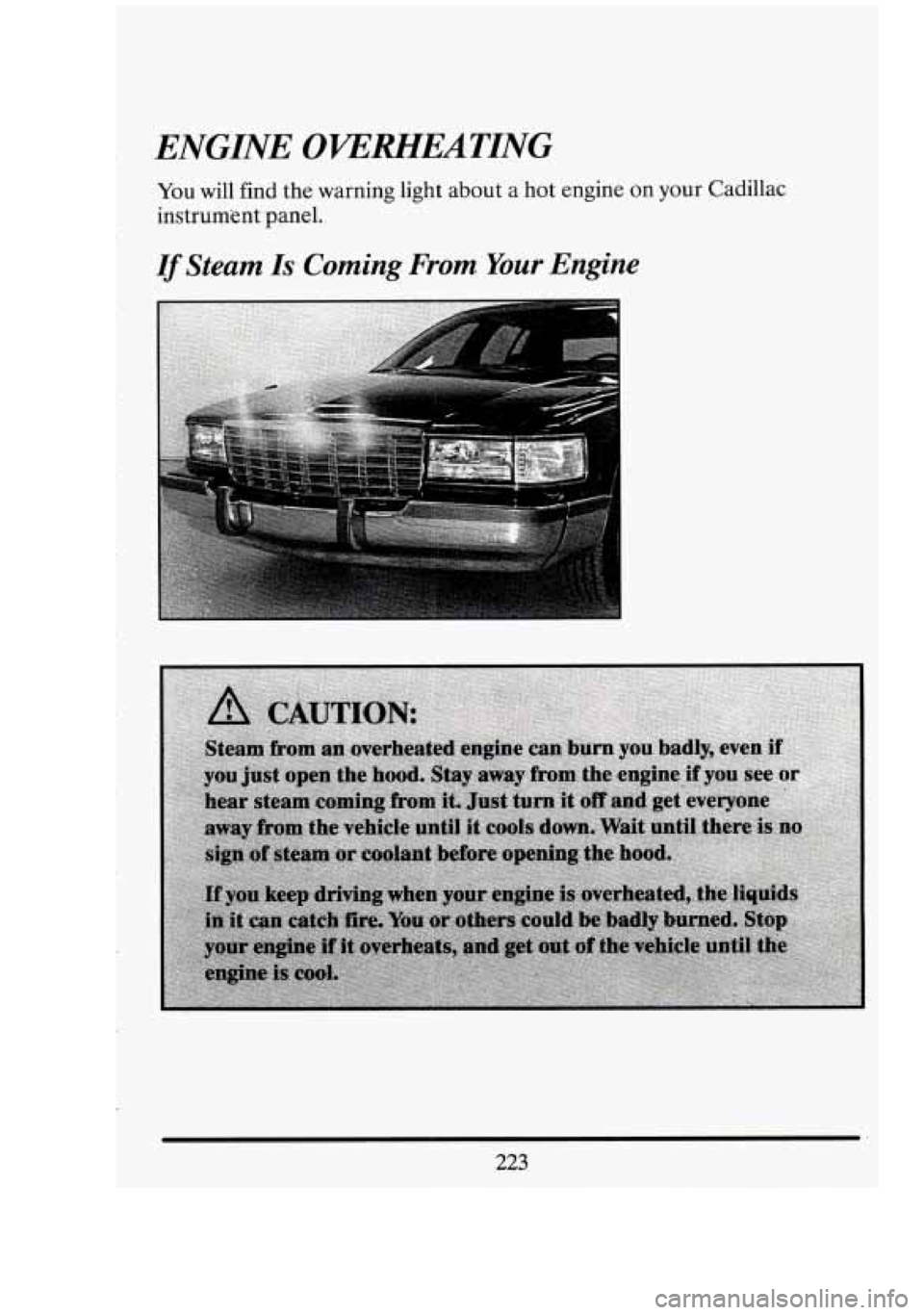
r_ ENGINE O'VERHEATING
You will find the warning light about a hot engine on your Cadillac
instrument panel.
If Steam Is Coming From Your Engine
-
223
Page 255 of 398
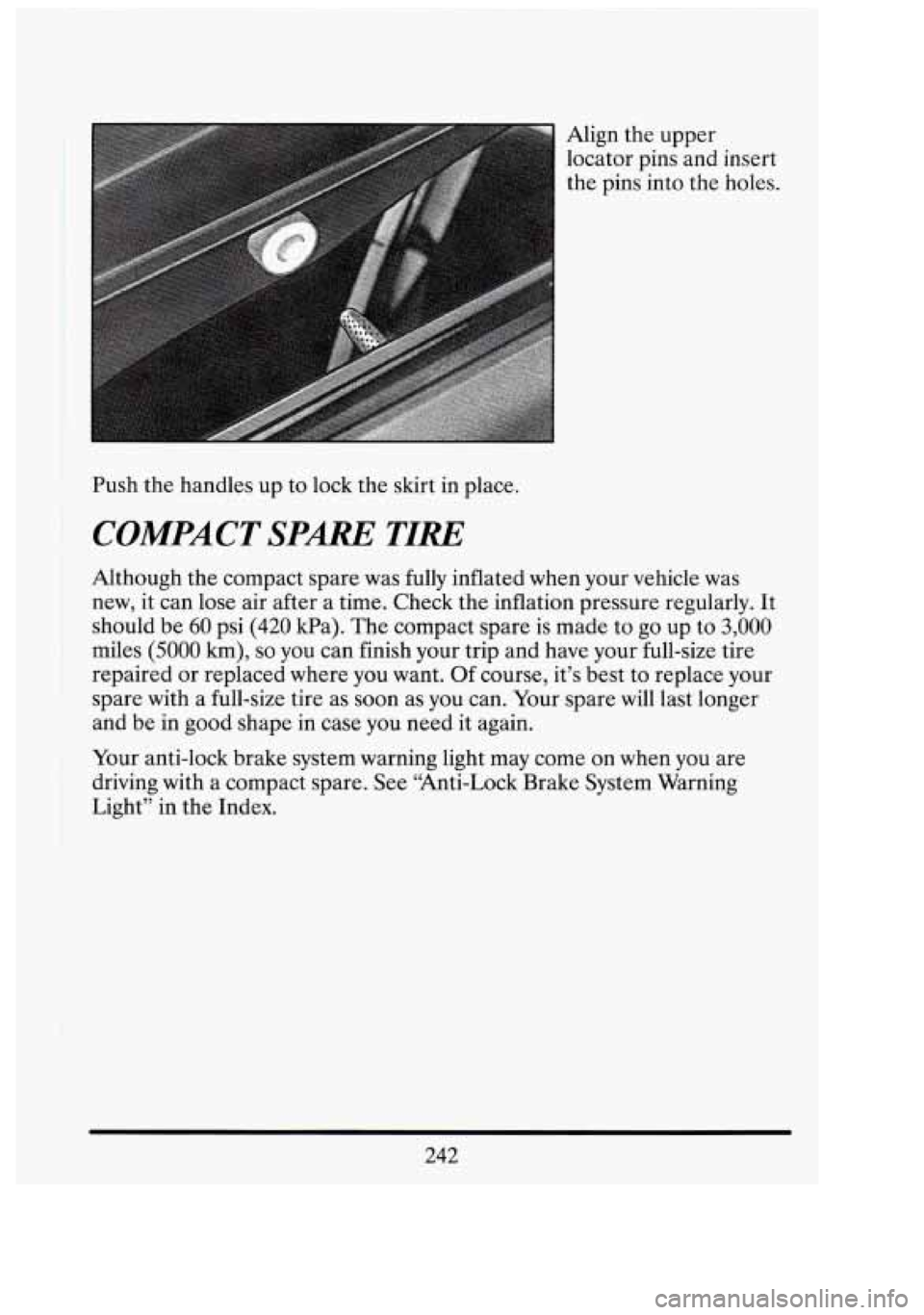
Align the upper
locator pins and insert
the pins into the holes. I
i-1 1;l
Push the handles up to lock the skirt in place.
I COMPACT SPARE TIRE
Although the compact spare was fully inflated when your vehicle was
new, it can lose air after a time. Check the inflation pressure regularly. It
should be
60 psi (420 Pa). The compact spare is made to go up to 3,000
miles (5000 km), so you can finish your trip and have your full-size tire
repaired or replaced where you want.
Of course, it’s best to replace your
spare with a full-size tire as soon
as you can. Your spare will last longer
and be in good shape in case you need it again.
Your anti-lock brake system warning light may come on when you are
driving with
a compact spare. See “Anti-Lock Brake System Warning
Light” in the Index.
242 I
CII
i
Page 257 of 398
I-
IF YOU’RE STUCK: IN SAND, MUD, ICE
OR SNOW
What you don’t want to do when your vehicle is stuck is to spin your
wheels. The method known as “rocking” can help you get out when
you’re stuck, but you must use caution.
I I NOTICE:
Spinning your wheels can destroy parts of your vehicle as well
as the tires. If you spin the wheels too fast while shifting your
transmission back and forth, you can destroy your
transmission.
Rocking your vehicle to get it out:
First, turn your steering wheel left and right. That will clear the area
around your front wheels. You should turn your traction control system
off. (See “Traction Control System”
in the Index.) Then shift back and ’ forth between “R’ (Reverse) and a forward gear, spinning the wheels as
little as possible. Release the accelerator pedal while you shift, and press
lightly on the accelerator pedal when the transmission is in gear.
If that
doesn’t get you out after a few tries, you may need to be towed out.
If you
do need to be towed out, see “Towing Your Vehicle” in the Index.
244
D/
Page 262 of 398
r
r
treadmill. These procedures ensure that each vehicle is tested under
identical conditions.
There are
two different fuel economy estimates for each vehicle, one Ior
city driving and one for highway driving.
To develop these two estimates,
separate tests are used to represent typical everyday city and rural
driving.
The test used to determine the city fuel economy estimate simulates a
7.5 mile (12 km), stop and go trip with an average speed of 20 mph
(32
km/h). The trip takes 23 minutes and has 18 stops. About one fifth
of the time is spent idling, as in waiting at traffic lights or in rush hour
traffic. Two kinds of engine starts are used: a cold start, which is similar to
starting a car in the morning after it has been parked all night and a hot
start, which is similar to restarting a vehicle after it has been warmed up,
driven and stopped for a short time.
The test used to determine the highway fuel economy estimate
represents a mixture of “non-city” driving. Segments corresponding to
different kinds
of rural roads and interstate highways are included. The
test simulates a 10 mile (17 km) trip with an average speed of 48 mph
(77 km/h). The test is run from a hot start and has little idling time and
no stops.
To assure that the fuel economy numbers are most useful for consumers,
the
EPA adjusts these laboratory test results to account for the difference
between controlled laboratory conditions and actual driving on the road.
The laboratory fuel economy results are adjusted downward
to arrive at
the estimates on the fuel economy window sticker and the Gas Mileage
Y Guide. The city estimate is lowered by 10 percent and the highwq
estimate
is lowered by 22 percent from the laboratory test results.
Experience has proven that these adjustments make the mileage
estimates correspond more closely to the actual fuel economy rea
by the average driver. lized
249
Page 267 of 398
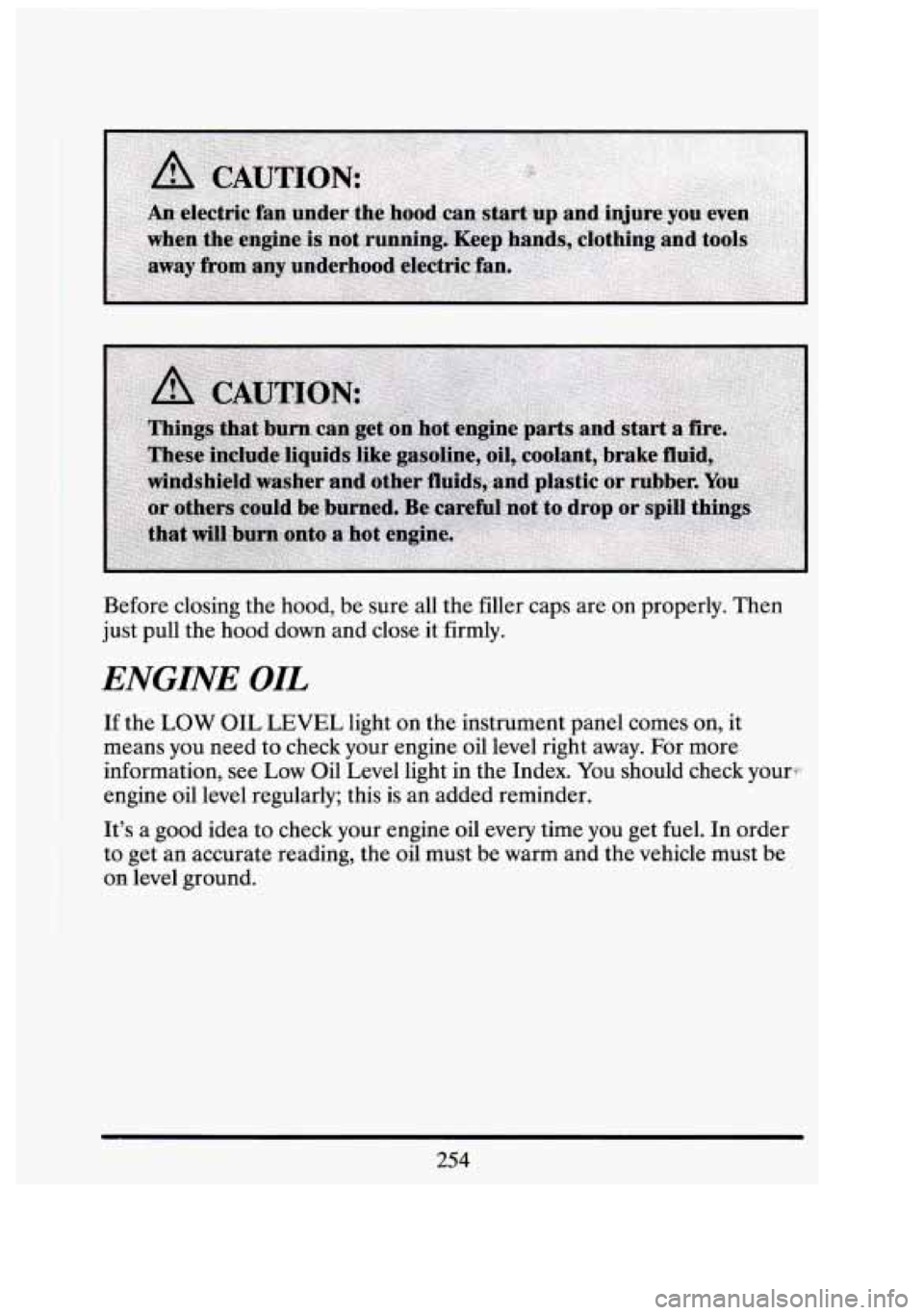
Before closing the hood, be sure all the filler caps are on properly. Then
just pull the hood down and close it firmly.
ENGINE OIL
If the LOW OIL LEVEL light on the instrument panel comes on, it
means you need to check your engine oil level right away.
For more.
information, see Low Oil Level light in the Index.
You should check your-
engine oil level regularly; this is .an, added reminder.
It's
a good idea to check your engine oil every time you get fuel. In order
to get an accurate reading, the oil must be warm and the vehicle must be
om level ground.
t
E
-4
254
Page 268 of 398
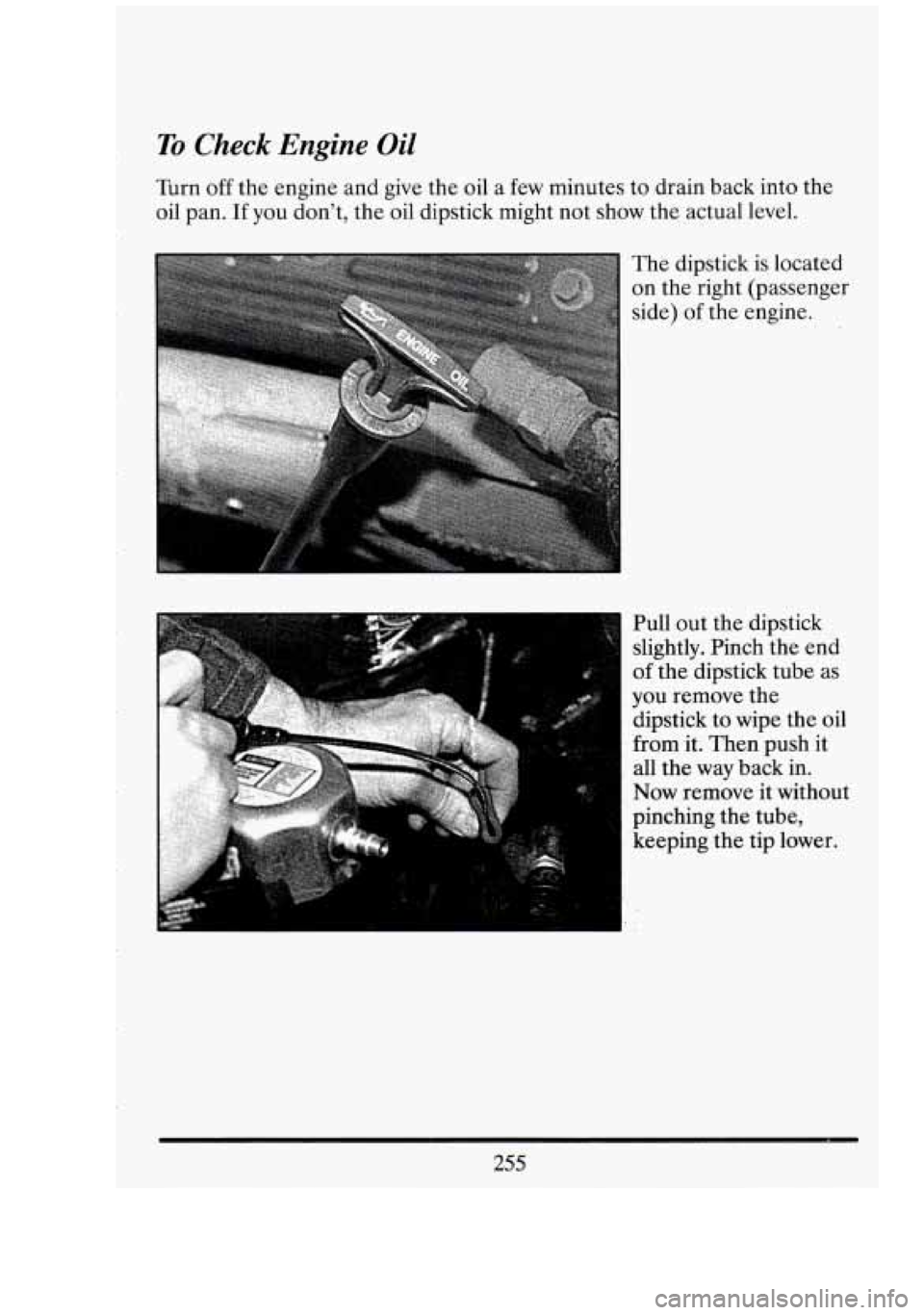
To Check Engine Oil
Turn off the engine and give the oil a few minutes to drain back into the
oil pan. If you don't, the oil dipstick might not show the actual level.
I Pull out the dipstick
slightly. Pinch the end
of the dipstick tube as
you remove the
dipstick to wipe the oil
from it. Then push it
all the way back in.
Now remove it without
pinching the tube,
keeping the tip lower.
Page 273 of 398
Engine Oil Additives
Don’t add anything to your oil. Your Cadillac dealer is ready to advise if
you think something should be added.
When to Change Engine Oil
Your Cadillac has an “Oil Life Indicator.” This feature will let you know
when to change your oil
-- usually between 3,000 miles (5 000 km) and
7,500 miles (12 500 km) since your last oil change. Under severe
conditions, the indicator may come on before
3,000 miles (5 000 km).
Never drive your vehicle more than 7,500 miles (12 500 km) or 12 months
without an oil change.
The system won’t detect dust
in the oil. So, if you drive in a dusty area, be
sure to change your oil every 3,000 miles
(5 000 km) or sooner if the
“Change Oil Soon” light comes on. Remember to reset the Oil Life
Indicator when the oil has been changed. For more information, see
“Oil Life Indicator” in the Index.
How to Reset the Oil Life Indicator
After the oil has been changed, you’ll need to reset your system. To
do that, turn the ignition switch to the “ON” position with the engine
stopped. Fully depress and release the accelerator pedal
3 times within
5 seconds.
If the “CHANGE OIC’ light comes on and stays on for 5 seconds, it did
not reset. You’ll need to reset the system again.
Engine Coolant Heater (Engine Block Heater)
An engine coolant heater can’be a big help if you have to park outside in
very cold weather,
0 F (-18 C) or colder. If your vehicle has this option,
see “Engine Coolant Heater” in the Index.
What to Do with Used Oil
Did you know that used engine oil contains certain elements that may be
unhealthy for your skin and could even cause cancer? Don’t let used oil
stay
on your skin for very long. Clean your skin and nails with soap and
water, or a good hand cleaner. Wash or properly throw away clothing or
-1
c:
I 3‘
260
Page 279 of 398
What to Use
Standard Differential
Use Axle Lubricant (GM Part No. 1052271) or SAE 8OW-90 GL-5 gear
lubricant.
ENGINE COOLANT
The following explains your cooling system and how to add coolant when
it is low. If you have a problem with engine overheating, see “Engine
Overheating” in the Index.
The proper coolant for your Cadillac
will:
Give freezing protection down to -34 F (-37 C).
Give boiling protection up to 262 F (128 C).
Protect against rust and corrosion.
Help keep the proper engine temperature.
I Let the warning lights work as they should.
1 What to Use
Use a mixture of one-half clean water (preferably distilled) and one-half
antifreeze that meets “GM Specification 1825-M,” which won’t damage
aluminum parts.
You can also use a recycled coolant conforming to GM
Specification 1825-M with a complete coolant flush and refill. Use GM
Engine Coolant Supplement (sealer) with any complete coolant change.
If you use this mixture, you don’t need to add anything else.
c
I
I
31
Page 281 of 398
Adding Coolant
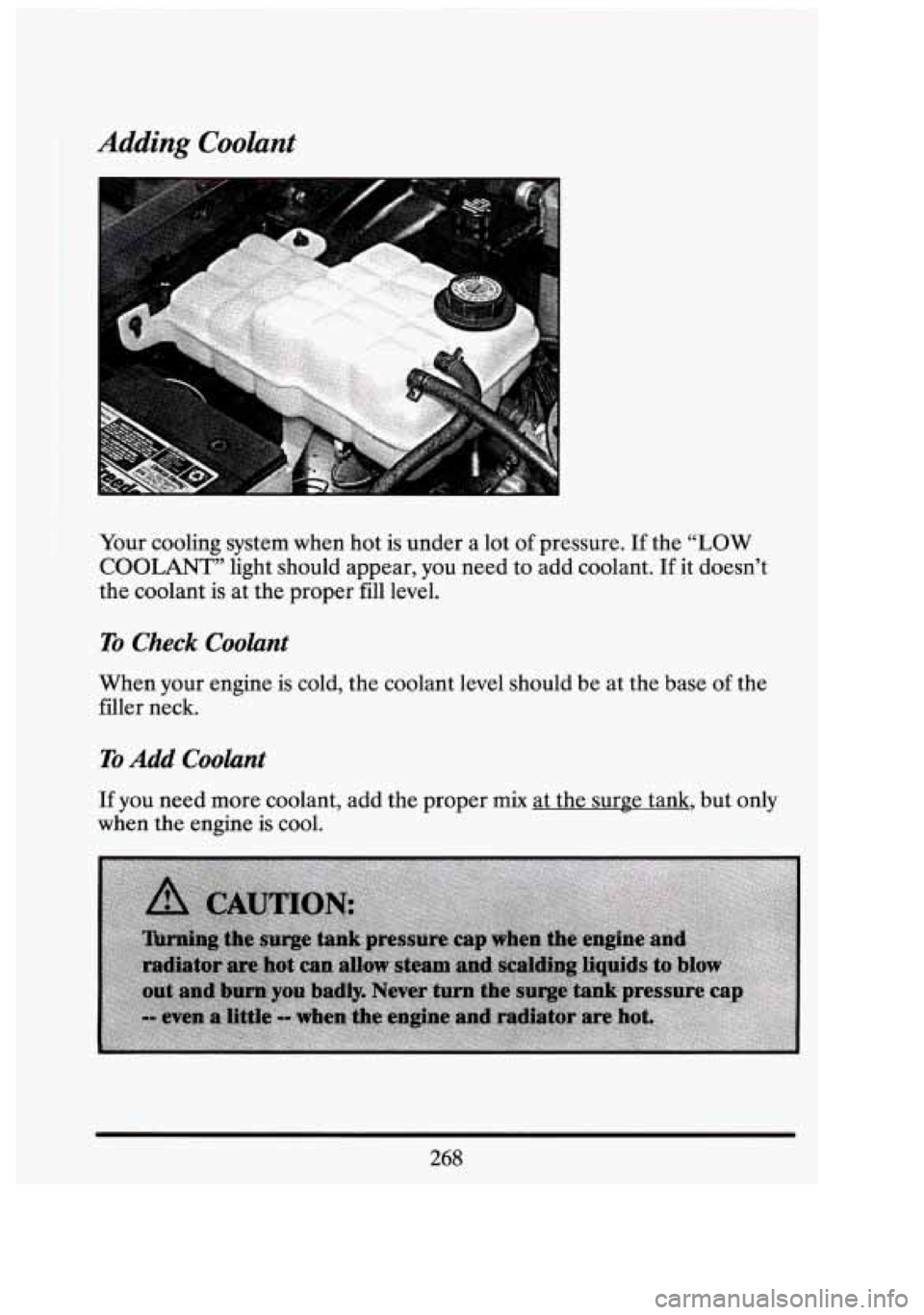
Your cooling system when hot is under a lot of pressure. If the “LOW
COOLANT” light should appear, you need to add coolant. If it doesn’t
the coolant
is at the proper fill level.
To Check Coolant
When your engine is cold, the coolant level should be at the base of the
filler neck.
To Add Coolant
If you need more coolant, add the proper mix at the surge tank, but only
when the engine is cool.
- I
dl
268